
A larger agency can look like the safer choice on paper. But scale alone does not show who is accountable when a Panama Canal requirement, vessel update, or coordination issue needs attention. Justifying boutique ship agent to management means demonstrating operational fit and visible oversight, not arguing that larger agencies are inadequate.
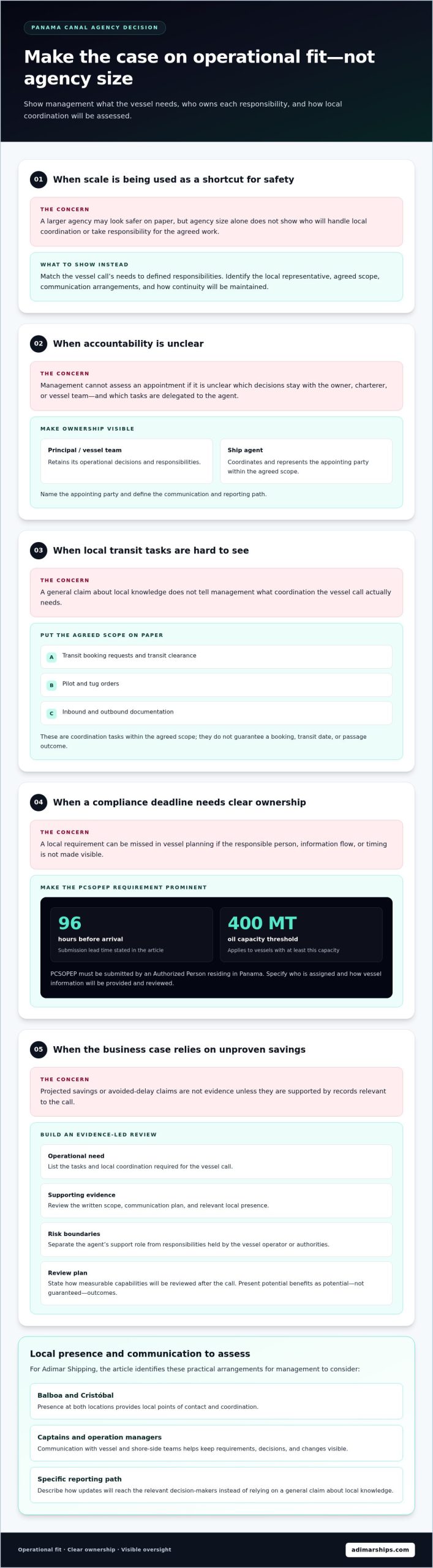
Decision-makers are right to ask how local coordination supports the operation and how the agent’s work can be assessed. At the Panama Canal, PCSOPEP must be submitted at least 96 hours before arrival for vessels with at least 400 MT oil capacity. Clear communication and timely local representation help keep this requirement visible in vessel planning.
This article shows how to build an evidence-led rationale for appointing a boutique agent. Assess accountability, communication, compliance support, and service scope, then connect those capabilities to the vessel’s needs. For management, define the required responsibilities, review how updates and costs will be communicated, and consider whether the agent’s presence at Balboa and Cristóbal supports the oversight the operation needs.
Key Takeaways
- Make justifying boutique ship agent to management an evidence-led decision by linking local coordination and clear accountability to the vessel’s operational needs.
- Define the agency scope, from transit documentation and coordination to nominated representation, so management can see who is responsible for each task.
- Compare boutique agency, larger agency, and in-house representation using practical criteria such as local presence, communication, service scope, and continuity.
- Build a business case around the operational need, written scope, supporting evidence, decision criteria, and a review plan, without relying on unsupported savings estimates.
- Assess how Adimar’s presence at Balboa and Cristóbal, communication with captains and operation managers, and integration with the DA desk support oversight.
Why justify a boutique ship agent to management?
Agency size is easy to compare, but operational fit is more useful. For a Panama Canal vessel call, management needs to know who will coordinate locally, communicate with the vessel and shore teams, and take responsibility for the agreed scope. A boutique agency can be a sound choice when its defined capabilities match the call’s needs. The case is not that a larger agency is less reliable; it is that size alone does not explain how the work will be handled.
That distinction matters on the Panama Canal, where vessel operations involve local requirements and multiple stakeholders. A ship agent acts as a local representative and coordination point. For more context on those responsibilities, see the Panama Canal ship agent’s role.
Keep the business case evidence-led. Separate documented capabilities, such as the written scope, communication arrangements, and local presence, from projected savings or avoided-delay claims. Present an outcome as a potential benefit, not a guaranteed result, unless it is supported by records relevant to the call. Management can then assess the appointment against the responsibilities the agent has agreed to deliver.
What management needs to see in an agency proposal
Start with the vessel’s requirements and identify who retains each operational decision. Map each need to an agency responsibility. For example, when PCSOPEP must be submitted by an Authorized Person residing in Panama, specify who is assigned to that task and how the owner or operator will provide and review vessel information. Include the proposed service scope and communication arrangements so management can assess them directly.
Address the assumption that bigger always means safer
Scale can matter when considering resources and continuity, but it does not replace clear responsibilities or local execution. Compare practical details: who the local representative is, how the agent communicates with the captain and operation managers, what the agreed scope covers, and how continuity is maintained. A reputation claim is less useful than an explanation of how this vessel call will be managed.
A fair management test is to match the call’s needs to the agent’s responsibilities. A brief proposal can organize the review around:
- Operational need: List the tasks and local coordination required for the vessel call.
- Ownership: Identify which decisions remain with the owner, charterer, or vessel team, and which tasks are delegated.
- Evidence: Review the written scope, communication plan, and relevant local presence.
- Risk boundaries: Distinguish the agent’s support role from responsibilities that remain with the vessel operator or authorities.
This makes justifying boutique ship agent to management a practical comparison, not a debate about company size. For measurable capabilities, state how they will be reviewed after the call. Do not present an expected saving or avoided delay as a proven result. Management can approve the appointment based on operational fit, accountable local representation, and clear evidence, with a realistic view of what the agent can control.
What a boutique Panama Canal ship agent handles locally
Boutique value is focused local coordination, not an assumption that a smaller agency works differently because of its size. For a Panama Canal vessel call, the agent coordinates agreed tasks locally and keeps the vessel and shore-side team informed. Those tasks can include transit booking requests, pilot and tug orders, transit clearance, and inbound and outbound documentation.
For management, the key question is whether these responsibilities fit the call and are clearly assigned. A Panama Canal transit guide can help operators understand the stages involved and identify the local coordination their vessel may require.
How local coordination supports a vessel’s canal transit
Transit coordination brings several moving parts into one working sequence. Within the agreed scope, the agent can handle booking requests, arrange pilot and tug orders, and manage the required inbound and outbound documentation. These actions support the operation; they do not guarantee a booking, transit date, or passage outcome. Clear updates are also essential: the vessel, client, and local agent need a shared understanding of outstanding requirements, decisions, and changes.
Adimar Shipping has a presence at both Balboa and Cristóbal and maintains communication with captains and operation managers. In an approval proposal, describe these as local points of contact and coordination, then state how updates will reach the relevant decision-makers. This gives management specific arrangements to assess instead of a general claim about local knowledge.
How nominated agency protects the principal’s interests
Nominated agency clarifies which party the agent represents. An owner’s nominated agent represents the owner’s stated interests during the call; a charterer’s nominated agent represents the charterer’s. The role is representation and coordination within the agreed scope, not a transfer of the principal’s decisions or responsibilities. A proposal should name the appointing party and explain the communication and reporting path. This owner’s nominated agency guide offers more context on the owner-focused arrangement.
To make the local scope concrete, present it as a short responsibility map:
- Transit coordination: State whether booking requests and related communication are included in the agreed scope.
- Port-call arrangements: Identify responsibility for clearance, pilot and tug orders, and required documentation.
- Principal representation: Name whether the appointment is for the owner or charterer, and define the interests represented.
- Updates: Specify how information moves between the agent, captain, and operation managers.
This is a practical basis for justifying boutique ship agent to management: connect each local task to a named responsibility, then review how the arrangement supports the vessel’s operation. If you are assessing Panama Canal agency scope, explore Adimar’s local ship agency support as part of the evaluation.
Boutique agent vs. large agency or in-house representation
No agency model is automatically the safest choice for a Panama Canal call. A larger agency may have a broader organizational structure, a boutique agent may focus on local coordination, and an in-house team may retain direct control. These descriptions are not proof of performance. Compare documented responsibilities, local arrangements, communication, and continuity for the specific vessel rather than relying on assumptions about size or reputation.
Use the matrix below as a procurement framework. Treat unanswered points as items to resolve during the review, not as evidence for or against a particular model.
Which evaluation criteria matter for a Panama Canal call?
Begin with the vessel’s transit and coordination requirements. Check whether the proposed service covers relevant documentation, local arrangements, and communication with vessel stakeholders. Then put reporting expectations in writing: who receives updates, which issues are escalated, and who retains each decision. This compares operational fit rather than making claims about market-wide performance.
When does a local agency offer a practical alternative?
A local representative can be a practical option when an owner does not maintain an office in the port region and needs defined local coordination. Nominated agency can also align representation with the appointing party, whether owner or charterer. Base the decision on the required scope, local presence, and documented accountability, not on assumptions that a boutique agency has better technology or a larger organization is inherently safer.
For management, justifying boutique ship agent to management means showing how the chosen model meets the call’s requirements and where responsibility sits. Compare proposals against the same criteria, record open questions, and select the arrangement that offers the clearest operational fit and oversight.
Build a management-ready business case without inventing savings
A strong proposal gives management a decision they can evaluate, not a promise of savings that cannot be demonstrated. Organize the case around five elements: the operational need, proposed service scope, supporting evidence, decision criteria, and a review plan. Use the agent’s written quote and defined scope to show what is being requested. Avoid market price benchmarks or claims that the appointment will prevent delays unless relevant records support them.
For justifying boutique ship agent to management, the practical value lies in clear responsibilities and reviewable performance. Before the call, document who handles each agreed task, which channels carry updates, and who receives escalations. Afterward, compare the planned responsibilities with the vessel’s operational records. This creates a fair record of completed work and follow-up needs.
Use operational evidence instead of unsupported ROI claims
Set review measures around observable work, not assumed financial outcomes. Retain the timestamps of operational updates, track documentation status, and record whether each agreed responsibility was completed. Note delays or exceptions without automatically attributing them to the agent. If a claim about avoided waiting time or savings cannot be verified against reliable records, leave it out of the business case.
Include compliance and contingency responsibilities
Compliance needs a clear owner and timeline. PCSOPEP is mandatory for vessels with at least 400 MT oil capacity and must be submitted at least 96 hours before arrival by an Authorized Person residing in Panama. Failure to submit on time results in the highest fee, with a minimum sanction of US $2,500, and possible denial of transit. Adimar provides PCSOPEP Authorized Person service. The sanction cannot be waived, and no agent can guarantee transit. The PCSOPEP Authorized Person guide provides further context for defining this responsibility.
Include contingency handling without implying that every issue can be prevented. State how the parties will identify an outstanding document, communicate a developing issue, and escalate a decision to the responsible owner, charterer, or vessel representative. This makes the agent’s role and the principal’s retained responsibilities visible before the call begins.
A concise approval memo can follow this sequence:
- Need: Describe the vessel-call requirement the appointment addresses.
- Scope: Attach the written quote and identify included responsibilities.
- Evidence: Record communication arrangements, documentation status, and task completion.
- Decision criteria: Set the operational standards management will use to assess the appointment.
- Review: Compare planned and completed work after the call, note exceptions, and decide whether the approach fits future calls.
To develop a Panama-specific proposal around a defined agency scope, review ship agency representation with Adimar Shipping.
Present Adimar Shipping as the local partner for the decision
A provider-specific proposal helps management move from general claims about agency size to evidence it can assess. Adimar Shipping is based in Panama, with a presence at Balboa and Cristóbal. Its services include full agency service 24/7, owner’s and charterer’s nominated agency, husbandry, and service as a PCSOPEP Authorized Person. Present the services relevant to the vessel call rather than treating every service as necessary for every appointment.
Adimar maintains communication with captains and operation managers, and its agency work is integrated with the DA desk. These are concrete features management can consider when reviewing coordination and information flow. Adimar provides transparent, cost-efficient quotes on request, giving decision-makers a written basis for reviewing the proposed scope against the vessel’s requirements without relying on unsupported market comparisons.
What the appointment process should establish
Before operations begin, identify the principal Adimar will represent: the owner or charterer. Define the requested agency and husbandry scope, including which responsibilities are delegated and which decisions remain with the principal or vessel team. Set communication expectations, identify relevant contacts, and agree what vessel information is needed for the transit request. Clear boundaries help everyone work from the same plan.
Make the next step easy for management
A focused request makes the review more efficient. Prepare the vessel details, intended transit timing, appointing principal, and services required. Then review Adimar’s proposed responsibilities and quote against that information. This gives management a practical record of what is being requested and what the appointment is intended to cover, while establishing the operational details before work starts.
For an approval discussion, present Adimar’s local presence and defined scope as evidence, not as a promise of a particular transit outcome. The team’s presence at both canal terminals, communication with captains and operation managers, and integration with the DA desk offer specific points for assessing local oversight and coordination. A tailored proposal can clarify whether the appointment is for owner’s nominated agency, charterer’s nominated agency, husbandry, full agency service, or PCSOPEP Authorized Person support.
Give management a straightforward decision to make: share the vessel’s requirements, review the proposed scope and quote, and assess whether the arrangement fits the call. This keeps justifying boutique ship agent to management grounded in operational needs, transparent information, and accountable local representation.
Discuss your Panama Canal agency requirements with Adimar and request a tailored service proposal for your vessel.
Turn this decision into a stronger operating standard
Use the appointment decision to establish a consistent way to assess local representation for future Panama Canal calls. Record what management approved, what the vessel team needed, and which review criteria mattered. After the call, capture lessons while details are fresh, including scope changes and communication gaps. This record can help refine future proposals and make agency decisions easier to compare across vessels without relying on assumptions about company size or unverified savings.
That is the lasting value of justifying boutique ship agent to management: a decision grounded in a specific operation’s needs, with clear expectations to inform the next one. Keep the process practical. Share the vessel’s requirements, identify the principal, and define the support needed so the discussion can focus on fit and accountability.
Start a Panama Canal agency discussion with Adimar with a clear, vessel-specific brief. A well-defined appointment gives your team a practical foundation for planning.
Frequently Asked Questions
How do I justify a boutique ship agent to management?
Build a concise approval case around the vessel’s canal requirements, proposed scope, local execution, communication, and compliance support. For justifying boutique ship agent to management, use the same criteria for each alternative. Attach the written scope and quote, name the decision-maker for each delegated task, and agree how updates will be recorded. After the call, review completed responsibilities and documented exceptions. Do not present unverified savings or prevented delays as fact.
What should management compare when selecting a Panama Canal ship agent?
Compare proposed service scope, local presence, availability, communication with vessel stakeholders, responsibility for documentation and coordination, and reporting approach. Apply the same criteria to agencies and any in-house option to keep the comparison fair. For a Panama Canal call, include transit-related tasks and compliance responsibilities that apply to the vessel. Agency size alone does not demonstrate capability; assess the specific duties and working arrangements proposed for the call.
Can a boutique ship agent represent either the owner or the charterer?
Yes. Adimar provides both owner’s nominated agency and charterer’s nominated agency services. The appointment should identify the principal being represented and define the work included, such as coordinating vessel requirements and relaying relevant operational information. Nominated representation focuses the local agency relationship on the appointing party’s stated interests. It does not automatically make the agent representative of both owner and charterer, so name the represented party clearly.
How early should Panama Canal pre-arrival information be submitted?
Adimar recommends submitting the ETA and pre-arrival information not less than 144 hours in advance. Separately, PCSOPEP must be submitted at least 96 hours before arrival for vessels with at least 400 MT oil capacity. The 144-hour lead time is a recommendation for pre-arrival information; the PCSOPEP deadline is mandatory. Failure to submit PCSOPEP on time results in the highest fee, with a minimum sanction of US $2,500, and possible denial of transit. Track it as a distinct compliance deadline.
Does a PCSOPEP Authorized Person need to reside in Panama?
Yes. PCSOPEP must be submitted by an Authorized Person residing in Panama, and Adimar can act in that role. Include the resident Authorized Person requirement in the vessel’s transit compliance plan. PCSOPEP submission is mandatory for vessels with at least 400 MT oil capacity, and the sanction for late submission cannot be waived. See the PCSOPEP Authorized Person guide for more detail.
What does 24/7 ship agency service mean for a vessel operator?
Adimar provides full agency service 24/7. Treat this as the stated availability of the agency service, not as a specific response-time commitment or a guarantee of an operational result. In the agreed scope, identify vessel and shore-side contacts, communication channels, and the updates management expects. Adimar maintains communication with captains and operation managers, giving the parties a clear basis for coordinating information during the call.