
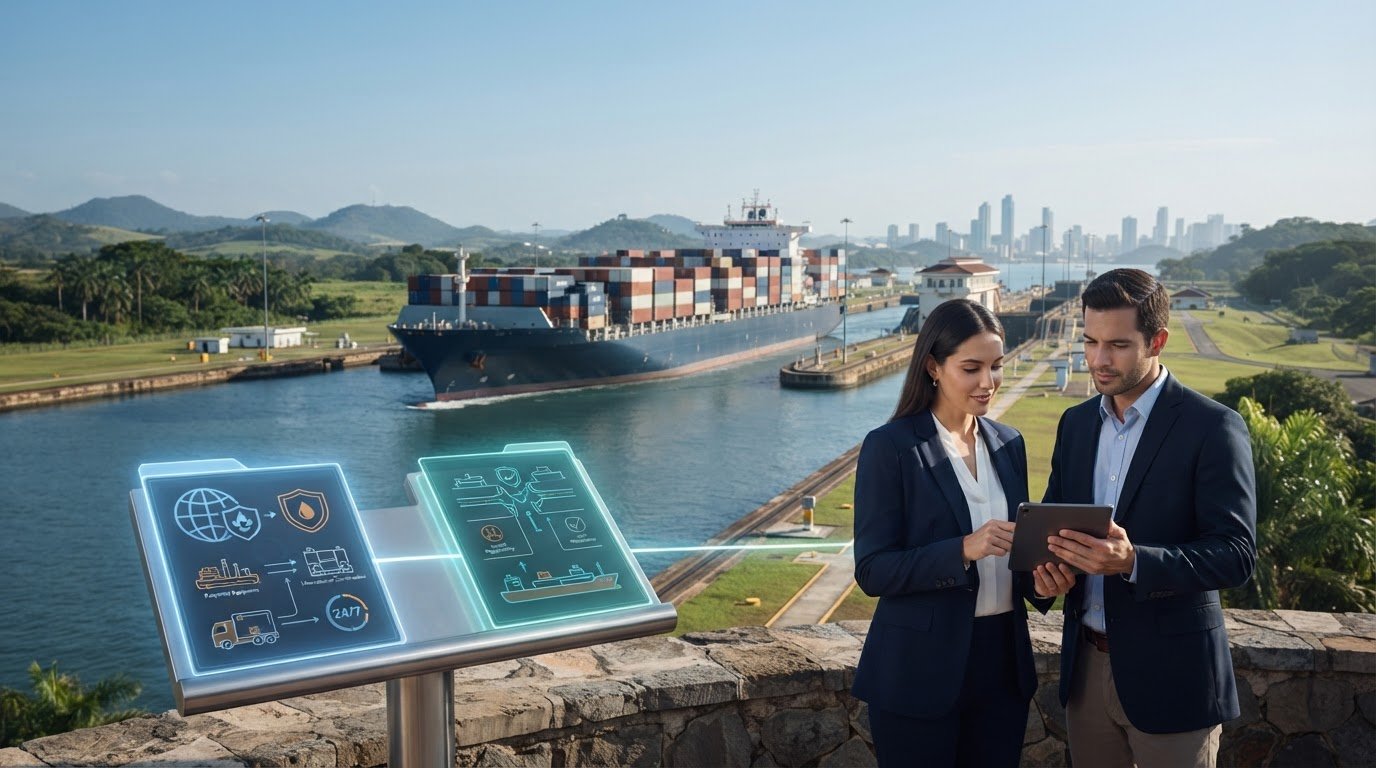
What if a vessel’s approved SOPEP still isn’t enough for Panama Canal transit? That’s the key difference between SOPEP and PCSOPEP: SOPEP supports the vessel’s broader oil-pollution response planning, while PCSOPEP adds Canal-specific requirements. For vessels with capacity to carry at least 400 metric tons of oil as fuel and/or cargo, PCSOPEP is mandatory.
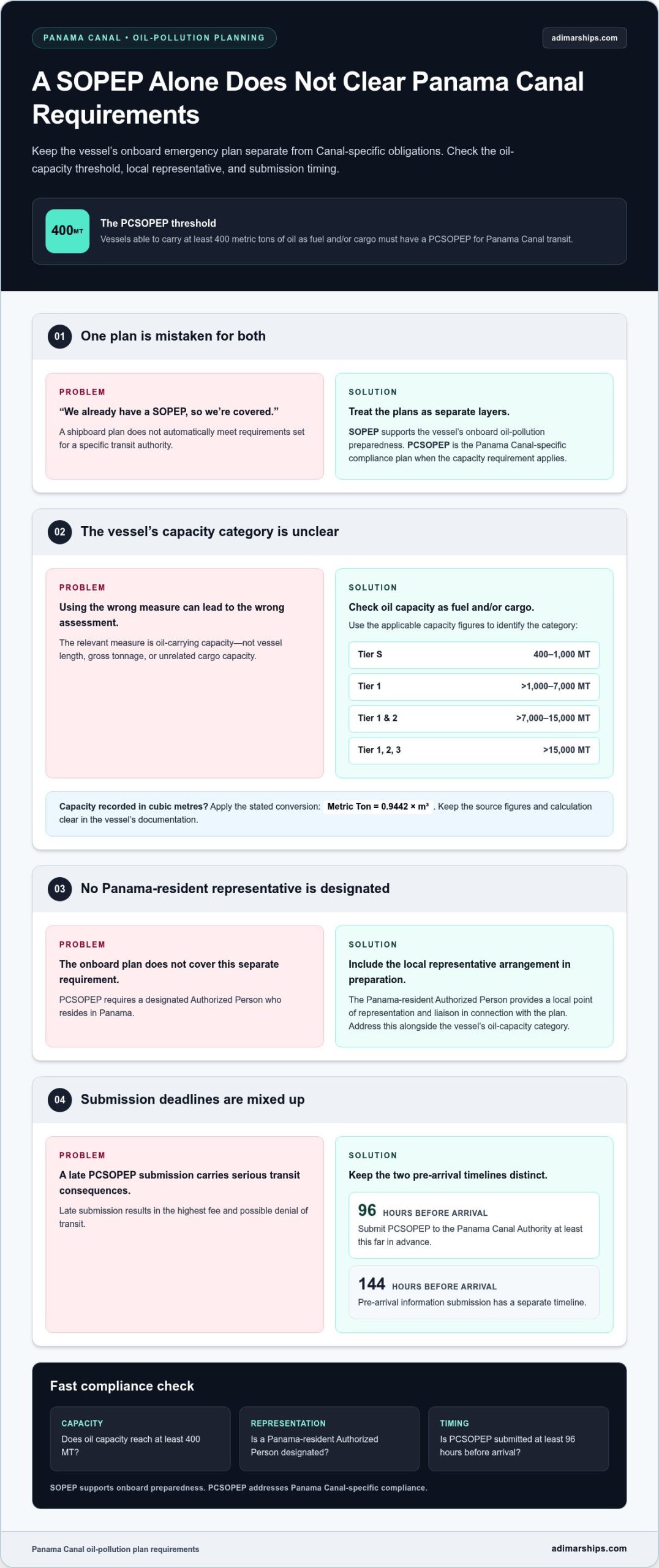
It’s understandable to assume one oil-pollution plan covers every requirement. But vessels that meet the threshold must also submit PCSOPEP to the Panama Canal Authority at least 96 hours before arrival and designate an Authorized Person who resides in Panama. Late submission results in the highest fee and possible denial of transit.
This guide explains what each plan is for, how to identify whether PCSOPEP applies to your vessel, and what to prepare for Canal compliance. You’ll also learn how oil-capacity categories affect the process and why the Panama-resident Authorized Person plays a practical role. Clear preparation and local coordination help keep documentation organized ahead of transit.
Key Takeaways
- Understand the difference between SOPEP and PCSOPEP, and why an existing SOPEP doesn’t replace Panama Canal-specific obligations.
- Use the 400 MT oil-capacity threshold to identify whether PCSOPEP requirements apply to your vessel.
- Plan for PCSOPEP submission at least 96 hours before arrival, and keep this deadline distinct from the 144-hour pre-arrival information submission.
- Prepare for the Panama-resident Authorized Person requirement and understand this representative’s role in Canal compliance.
- See how local PCSOPEP preparation and agency coordination in Panama can help keep documentation organized.
What SOPEP Covers: The Vessel’s Oil-Pollution Emergency Plan
A vessel’s oil-pollution preparedness starts onboard. Its Shipboard Oil Pollution Emergency Plan, or SOPEP, is part of the ship’s emergency-planning documents and supports the crew’s response if an oil-pollution incident occurs. It contributes to the vessel’s broader preparedness, but it does not automatically meet every port or transit authority’s additional requirements.
SOPEP is the vessel’s shipboard plan for preparing for and responding to oil pollution, while PCSOPEP is a separate Panama Canal compliance requirement. That distinction is central to understanding the difference between SOPEP and PCSOPEP. An existing SOPEP remains relevant to onboard readiness, but it does not satisfy a PCSOPEP obligation that applies to the vessel.
What Does SOPEP Mean in a Vessel’s Compliance Documents?
SOPEP stands for Shipboard Oil Pollution Emergency Plan. The plan is part of the vessel’s emergency-preparedness documentation and provides a formal framework for addressing an oil-pollution emergency. For a plain-language overview of the term, see Ship Oil Pollution Emergency Plan (SOPEP).
For operators, the practical point is straightforward: SOPEP concerns the vessel’s shipboard preparedness. Treat it as one part of the ship’s overall compliance and response arrangements, alongside other applicable documentation. Having a SOPEP does not mean every authority’s jurisdiction-specific requirements are fulfilled.
Why a Global Plan Does Not End the Panama Canal Review
A shipboard plan and a transit-specific obligation serve different purposes. The first concerns the vessel’s onboard preparedness; the second addresses requirements tied to a particular waterway. A vessel can therefore have a SOPEP on file and still need to meet a separate Panama Canal requirement.
If a vessel’s oil capacity reaches the applicable threshold, an existing SOPEP does not remove the PCSOPEP requirement. The distinction isn’t about replacing the ship’s plan. It’s about recognizing that Panama Canal transit adds a local compliance layer, including requirements for the Canal’s operating context.
Before transit, keep these questions separate:
- Does the vessel have its shipboard oil-pollution emergency plan in its preparedness documents?
- Does the vessel’s oil capacity trigger a Panama Canal-specific plan requirement?
- Are the vessel’s transit documents being prepared for the correct Canal requirements and timelines?
Clear answers help owners, charterers, and ship operators avoid treating one document as a substitute for another. For a wider view of operational planning and transit considerations, consult Adimar’s Panama Canal transit guide. Next, consider what PCSOPEP adds and how to determine whether it applies.
What PCSOPEP Adds for a Panama Canal Transit
PCSOPEP means Panama Canal Shipboard Oil Pollution Emergency Plan. It adds a Canal-specific compliance layer to a vessel’s oil-pollution planning, addressing requirements for transit through Panama. A vessel may already carry a SOPEP, but that document doesn’t replace PCSOPEP when the Canal requirement applies.
Any vessel with capacity to carry at least 400 metric tons (MT) of oil as fuel and/or cargo must have a PCSOPEP for Panama Canal transit. This is the key threshold when assessing the difference between SOPEP and PCSOPEP. The Panama Canal Authority publishes shipping requirements through its Panama Canal Authority (ACP) Notices to Shipping.
Which Vessels Fall Within the PCSOPEP Requirement?
Assess the vessel’s oil-carrying capacity, not its length, gross tonnage, or unrelated cargo capacity. The PCSOPEP capacity categories are:
- Tier S: 400 MT-1,000 MT
- Tier 1: >1,000 MT-7,000 MT
- Tier 1 & 2: >7,000 MT-15,000 MT
- Tier 1, 2, 3: >15,000 MT
Use the vessel’s applicable oil-capacity figures to establish its category. If the data is recorded in cubic metres, apply this conversion: Metric Ton = 0.9442 × m³. Keep the source figures and conversion clear in the vessel’s documentation so the capacity assessment is easy to follow. Review the category boundaries against current ACP guidance during preparation.
How the Panama-Based Authorized Person Fits In
PCSOPEP also requires a designated Authorized Person who resides in Panama. This provides a Panama-based point of representation and liaison in connection with the plan. It is separate from the shipboard plan itself, so address both the vessel’s oil-capacity category and the Authorized Person arrangement during preparation.
For owners and charterers coordinating a transit from overseas, a Panama-resident representative provides a local point of contact for this compliance step. Adimar Shipping, Inc. prepares PCSOPEP and provides Authorized Person services in Panama, and can act as the Panama-resident Authorized Person. Its PCSOPEP Authorized Person guide explains the representative’s role in the process. Learn about Adimar Shipping, Inc.’s PCSOPEP support in Panama.
SOPEP vs. PCSOPEP: Which Requirements Apply to Your Vessel?
The difference between SOPEP and PCSOPEP comes down to scope and application. SOPEP is the vessel’s shipboard oil-pollution emergency plan. PCSOPEP is specific to Panama Canal transit and adds a local compliance requirement for vessels that meet the oil-capacity threshold. The plans relate to oil-pollution preparedness, but they are not interchangeable.
| Comparison point | SOPEP | PCSOPEP |
|---|---|---|
| Purpose | Supports the vessel’s onboard oil-pollution emergency preparedness. | Addresses Panama Canal-specific oil-pollution plan requirements for transit. |
| Geographic context | Shipboard plan, not limited to a Panama Canal transit. | Applies in the context of Panama Canal transit. |
| Applicability | Applies according to the vessel’s relevant obligations. | Mandatory for a vessel with oil capacity of at least 400 MT. |
| Local representation | Does not, by itself, meet the PCSOPEP requirement for a Panama-resident Authorized Person. | Requires a designated Authorized Person who resides in Panama. |
The Practical Difference in Scope and Application
Think of the documents as serving distinct purposes within the vessel’s preparedness and transit compliance. SOPEP concerns the shipboard plan; PCSOPEP addresses an additional Panama Canal obligation. Their subject matter is connected, but having one document does not establish that the other requirement has been met. An existing SOPEP does not remove applicable PCSOPEP obligations.
The Canal threshold is based on oil-carrying capacity, not vessel length, gross tonnage, or unrelated cargo measures. That makes capacity assessment a practical first step rather than an assumption based on vessel type alone.
A Quick Decision Path for Ship Operators
Start with the vessel’s Panama Canal transit plans and its capacity to carry oil as fuel and/or cargo. Then follow these steps to identify the next compliance action:
- Establish oil capacity. Use the vessel’s relevant capacity figures, not its dimensions or general cargo capacity.
- Compare it with the threshold. At 400 MT or more, prepare for the PCSOPEP requirement and its associated local representation requirement.
- Review current guidance. Consult current Panama Canal Authority notices for vessel-specific interpretation and applicable requirements.
A vessel below the stated threshold should still be assessed against other applicable transit requirements. Keep the capacity assessment and the authority’s current guidance together in your pre-arrival compliance review.
Before Panama Canal arrival, establish whether the vessel’s oil-carrying capacity reaches 400 MT, triggering mandatory PCSOPEP compliance in addition to its SOPEP.
PCSOPEP Preparation: Deadlines, Submission, and Compliance Checks
Good preparation means keeping two timelines distinct. PCSOPEP must be submitted at least 96 hours before the vessel arrives. Separately, ETA and pre-arrival information should be submitted not less than 144 hours in advance. The earlier information deadline provides a planning milestone, but it doesn’t replace or extend the mandatory PCSOPEP deadline.
Work Backward from the Arrival Deadline
Build the compliance schedule around the vessel’s expected arrival, leaving time to coordinate and review the submission. A clear sequence helps owners, charterers, and operators see what needs attention before the final deadline approaches.
- Establish the vessel’s arrival timeline. Coordinate the expected arrival with the transit plan so the team can work backward from the applicable deadlines.
- Submit ETA and pre-arrival information. Send this information not less than 144 hours before arrival. Treat it as a separate pre-arrival milestone.
- Prepare and submit the PCSOPEP. Ensure the plan is submitted at least 96 hours before arrival. The 144-hour information submission is not a substitute for PCSOPEP submission.
- Review completion before arrival. Keep records of the plan submission and pre-arrival information with the vessel’s transit documentation.
Late PCSOPEP submission results in the highest fee and possible denial of transit. The minimum sanction for non-compliance is US $2,500. This is a mandatory sanction and cannot be waived, so early preparation is essential to managing deadline risk.
Check the Plan, Representation, and Boarding Requirements
Before submission, confirm the vessel’s oil-capacity classification and ensure the Authorized Person resides in Panama. These are distinct checks: the capacity category relates to the applicable PCSOPEP requirements, while Panama residency applies to the designated representative. Also verify that the vessel’s boarding facilities comply with SOLAS Regulation 17, Chapter V requirements, which apply to all vessels.
- Tier S: 400 MT-1,000 MT
- Tier 1: >1,000 MT-7,000 MT
- Tier 1 & 2: >7,000 MT-15,000 MT
- Tier 1, 2, 3: >15,000 MT
Keep the vessel’s capacity data, plan, Authorized Person details, and pre-arrival milestones aligned throughout preparation. This helps teams handle the difference between SOPEP and PCSOPEP as separate documentation requirements, rather than assuming one plan covers both.
Adimar provides PCSOPEP preparation and Panama-resident representation. Read Adimar Shipping, Inc.’s PCSOPEP compliance guidance.
How Adimar Supports PCSOPEP Compliance in Panama
PCSOPEP preparation involves more than placing a document in a transit file. Operators must coordinate the plan and its local representation with the vessel’s wider Panama Canal arrangements. Adimar Shipping, Inc. supports this process in Panama through PCSOPEP preparation and its Authorized Person service, helping owners and charterers keep compliance steps clear and coordinated.
Adimar Shipping, Inc.’s support helps with preparation and representation, while the vessel operator remains responsible for meeting applicable requirements. An agent cannot waive the mandatory sanction for late submission. Local coordination helps organize the work around the vessel’s transit and keep responsibilities clear.
Local Representation for Panama Canal Compliance
The Authorized Person must reside in Panama. Adimar Shipping, Inc. can act in that role, providing a Panama-based point of representation for the PCSOPEP process. The team at Adimar Shipping, Inc. coordinates locally and communicates with vessel representatives, helping keep the plan and transit arrangements aligned. The company’s presence at both Balboa and Cristóbal terminals supports its local agency work.
Keep responsibilities clear: the vessel’s operator remains responsible for compliance, including timely and accurate submission. Adimar Shipping, Inc.’s service supports plan preparation and local representation. Assigning these tasks clearly helps teams prepare before the transit timeline becomes tight.
Prepare the Transit with a Panama Canal Ship Agent
PCSOPEP steps sit alongside other pre-arrival and transit coordination. Adimar Shipping, Inc.’s ship agency service supports that broader process with full agency service 24/7 and constant communication with operation managers and captains. A consistent local contact helps owners, charterers, and vessel teams track documentation needs, share updates, and coordinate plan preparation with other transit arrangements.
This coordination is useful when several parties contribute information or when the vessel’s schedule requires close attention to submission milestones. Adimar Shipping, Inc. works with clients through personalized coordination and timely communication, connecting compliance tasks to the practical details of a Panama Canal transit. The Panama Canal ship agency guide from Adimar Shipping, Inc. provides further context on the agent’s role in transit coordination.
For operators reviewing the difference between SOPEP and PCSOPEP, the practical next step is to bring the applicable plan, local representation, and transit coordination into one clear workflow. This helps teams identify who is handling each preparation task and keep communication organized.
Discuss Panama Canal agency support with Adimar Shipping, Inc. to coordinate your vessel’s transit and PCSOPEP preparation with a Panama-based team.
Set Up a Clear Compliance Handoff for Your Next Transit
Use the difference between SOPEP and PCSOPEP as a prompt to make compliance ownership explicit before the vessel’s transit preparations intensify. Assign responsibility for gathering vessel data, coordinating the required plan, and tracking submission milestones. A clear handoff helps ship, shore, and agency teams work from the same information instead of assuming one document covers every obligation.
Review the process after each transit. Note where information was delayed, where responsibilities overlapped, and which coordination steps should begin earlier next time. These workflow improvements can make future preparation more orderly while keeping administrative support distinct from the operator’s responsibility to comply.
Adimar Shipping supports Panama Canal PCSOPEP preparation and can act as the Panama-resident Authorized Person. Discuss Panama Canal PCSOPEP and agency support with Adimar to plan your next steps with a local team.
Frequently Asked Questions
Is PCSOPEP mandatory for a vessel carrying exactly 400 MT of oil?
Yes. Exactly 400 MT meets the stated threshold because the requirement applies to vessels with oil capacity of at least 400 MT. Use the vessel’s applicable oil-capacity information when assessing its category, rather than rounding a figure or relying on a general vessel description. Then prepare for the applicable PCSOPEP requirements. An existing SOPEP doesn’t replace PCSOPEP where the Canal requirement applies. Use current Panama Canal Authority guidance for vessel-specific preparation.
How do I convert cubic metres to metric tons for the stated oil-capacity calculation?
Use this formula: Metric Ton = 0.9442 × m³. For example, if the relevant capacity figure is 1,000 m³, multiply 1,000 by 0.9442 to get 944.2 metric tons. Keep the original cubic-metre figure, the calculation, and the resulting metric-ton figure together in your working records. That makes the basis for your capacity classification easier to review against applicable Panama Canal Authority instructions.
Does PCSOPEP replace a vessel’s SOPEP?
No. The plans aren’t interchangeable, and neither should be treated as replacing the other. SOPEP is part of the vessel’s shipboard oil-pollution preparedness; PCSOPEP addresses Panama Canal-specific compliance when the vessel meets the applicable threshold. In practical terms, the difference between SOPEP and PCSOPEP is also a document-checking distinction: operators should identify each applicable requirement separately and account for both in transit preparation.
Do all vessels need to comply with SOLAS Regulation 17, Chapter V boarding facility requirements?
Yes. All vessels must comply with SOLAS Regulation 17, Chapter V boarding facility requirements. Treat this as a separate compliance check from preparing and submitting PCSOPEP. In a pre-transit review, confirm the boarding-facility documentation alongside the vessel’s other transit records rather than assuming oil-pollution planning covers boarding arrangements.
Can a booked Panama Canal transit date be changed if PCSOPEP paperwork is delayed?
No. A booked transit date cannot be changed, so a documentation delay shouldn’t be treated as a reason to move it. Build the compliance schedule around the booked date and coordinate the required submissions in advance. ETA and pre-arrival information should be submitted not less than 144 hours ahead; PCSOPEP has a separate deadline of at least 96 hours before arrival. One timeline doesn’t extend the other.
Does the Authorized Person have to be on board the vessel?
The requirement is that the Authorized Person resides in Panama. Keep this residency requirement distinct from the vessel’s onboard arrangements when preparing documentation. Adimar can act as the Panama-resident Authorized Person for PCSOPEP compliance, providing operators with a local representative as part of Panama Canal preparation.
What happens if a vessel submits PCSOPEP after the deadline?
Late submission results in the highest fee and possible denial of transit. The minimum sanction for non-compliance is US $2,500, and this mandatory sanction cannot be waived by an agency. To reduce the risk of missing the deadline, make PCSOPEP submission a tracked item in the vessel’s pre-arrival plan, with an assigned owner and enough lead time to coordinate the required information before arrival.