
The best Panama Canal agent for small operators isn’t necessarily the one with the longest checklist. It’s the local representative who keeps communication clear, coordinates the details, and represents your vessel’s interests when shore-side resources are limited. Finding the best panama canal agent for small operators means looking beyond a name on the paperwork to the support you’ll receive before and during transit.
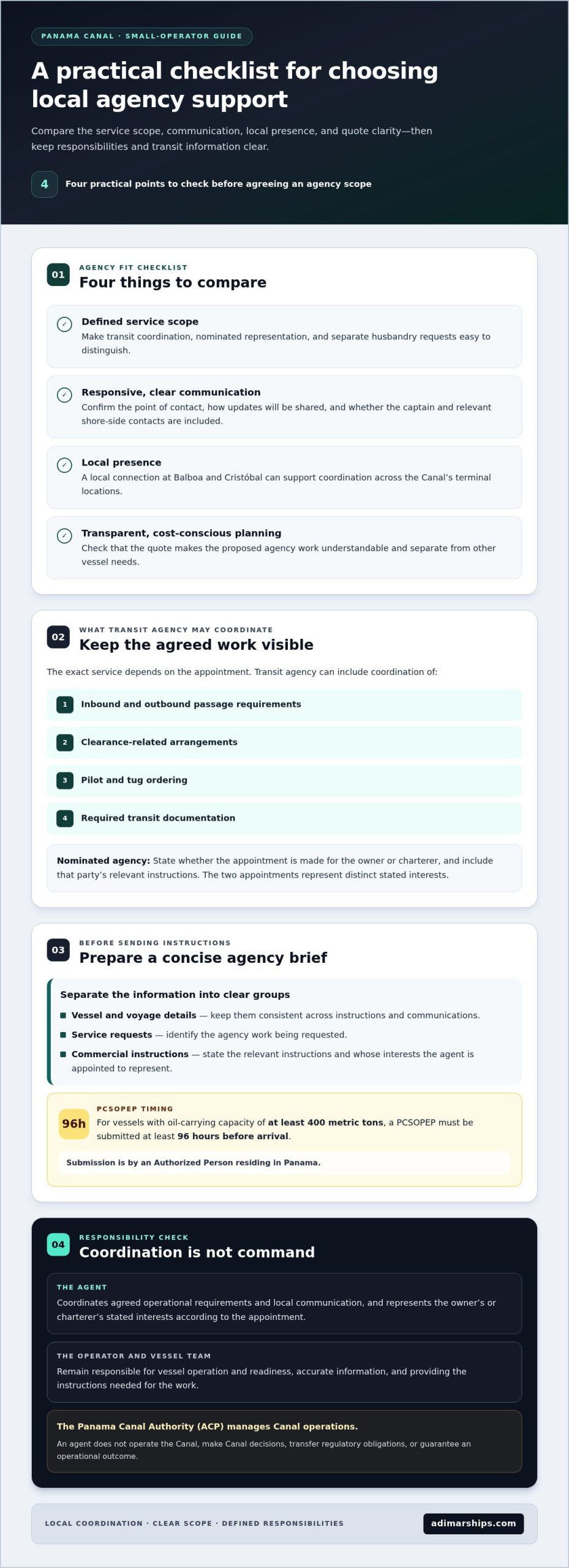
It’s reasonable to want clear answers about what an agent handles, what information is needed, and how coordination will stay on track. Documentation deadlines matter, too: vessels with an oil-carrying capacity of at least 400 metric tons must have a PCSOPEP submitted at least 96 hours before arrival by an Authorized Person residing in Panama.
This guide offers a practical framework for assessing local agency support, preparing key transit information, and reducing avoidable confusion around coordination and compliance. Adimar Shipping, Inc. provides ship agency services in Panama, with a presence at Balboa and Cristóbal and daily communication with operation managers and captains. You’ll also learn how its local support can help small operators manage transit details with greater clarity and cost-conscious planning.
Key Takeaways
- Assess the best panama canal agent for small operators by comparing service scope, communication, local presence, and quote clarity.
- Understand how ship agency and nominated agency support transit coordination while representing the owner’s or charterer’s stated interests.
- Prepare a concise agency brief that separates vessel and voyage details from service requests and commercial instructions.
- Use a clear sequence to agree the agency scope and organize transit updates, reducing the coordination load on a lean shore team.
- See how Adimar’s local coordination and personalized, cost-conscious approach can support small operators through Canal transit planning.
Why Small Operators Need a Panama Canal Agent That Fits Their Operation
A lean shore team may be coordinating a Canal transit while also managing crew, schedules, commercial instructions, and other vessel needs. When updates pass through several contacts or the agency scope is unclear, it becomes harder to see what has been arranged and what still needs attention. The right local support can reduce that coordination burden while leaving operational decisions with the operator.
A ship agent is the vessel’s local representative. The agent coordinates operational requirements and communication in port, helping connect the vessel and its shore-side team with relevant local parties. The agent does not operate the Canal. That authority belongs to the Panama Canal Authority (ACP), which manages Canal operations. An agency appointment does not give an agent authority to make Canal decisions or remove the operator’s responsibilities.
What a small operator needs from a local ship agent
For a small operator, responsiveness is practical, not cosmetic. A clear point of contact helps the captain, operations manager, and shore team understand where to send information and where updates will come from. Timely communication gives the operator a better basis for decisions when plans or vessel information need attention. When assessing an agency, look for a stated communication approach and confirm that the relevant vessel and shore-side contacts are included.
Local presence matters, too. An agency team with a presence at Balboa and Cristóbal provides a direct local connection across the Canal’s terminal locations. Adimar Shipping, Inc. maintains daily communication with operation managers and captains, helping keep transit coordination visible to the people managing the vessel and the shore-side operation.
Cost-conscious planning starts with visibility. A useful quote should make the proposed service scope understandable, so the operator can distinguish requested agency work from other vessel needs and plan accordingly. Before agreeing to a scope, check that transit coordination, nominated representation, and any separate husbandry requests are easy to identify. The best panama canal agent for small operators is not simply a local name; it is a representative whose communication and scope fit the operation.
What an agent does, and what remains the operator’s responsibility
An agent coordinates and represents, rather than taking command of the vessel or the Canal. Depending on the appointment, the agent can serve the owner’s or charterer’s stated interests and coordinate agreed agency services. The operator still directs the vessel’s overall operation and remains responsible for vessel readiness and for providing accurate, required information.
That distinction is important. Appointing an agent does not transfer regulatory obligations, make a vessel ready for transit, or guarantee a particular operational outcome. The agent can help organize communication and local coordination, but the vessel’s team must supply the information and instructions needed for the work. Clear responsibility lines make it easier to identify gaps early and keep decisions with the people authorized to make them.
When comparing support, focus on four practical points: a defined service scope, responsive communication, a local presence, and transparent, cost-conscious planning. Adimar’s Panama-based agency model combines daily communication with terminal presence at Balboa and Cristóbal, giving small operators a local representative while leaving Canal authority and vessel responsibilities where they belong.
What a Panama Canal Agent Can Coordinate for a Small Operator
A Canal transit brings together vessel information, operational arrangements, and communication with local parties. A ship agent helps coordinate these moving parts on the vessel’s behalf. The precise scope depends on the appointment, so small operators benefit from separating transit agency from representation arrangements and other requested support.
Transit agency and nominated representation
Transit agency can include coordinating inbound and outbound passage requirements, clearance-related arrangements, pilot and tug ordering, and required transit documentation. The agent helps organize the process and relay information between the vessel, its shore team, and relevant local parties. The agent does not replace the operator’s responsibility to provide accurate vessel and voyage information or meet applicable requirements.
Vessel and cargo details are also part of transit preparation and connect with the Panama Canal Service Portal. A small operator can make coordination more efficient by keeping those details consistent across instructions and communications, and by distinguishing information about the vessel from requests for agency services. Before sending instructions, compare the vessel and cargo details across the material being shared so discrepancies can be addressed early.
Nominated agency defines whose interests the agent represents. An owner’s nominated agency acts on the owner’s stated instructions; a charterer’s nominated agency represents the charterer’s stated interests. These are distinct appointments, not interchangeable labels. State clearly which party is making the nomination and include the relevant instructions, so communications remain aligned. For broader country context around Panama and the Canal, see the U.S. Department of State’s information on Panama.
Husbandry, protective agency, and port-call support
Husbandry is separate from transit coordination. It addresses vessel and crew support requested around a port call, such as coordinating crew changes, Panamanian marine visas, flights, inland transportation, or provisions. Other husbandry and technical fleet support can include forwarding spare parts, freshwater, deck stores, bunkers, launch services, medical attention, ship repairs, and inspection or cleaning services. Keeping these requests distinct from transit requirements helps the operator track what is needed for the Canal passage and what relates to the vessel’s wider port-call needs.
Protective agency is a different arrangement again. When another agent has been appointed, a protective agent provides oversight on behalf of the client and represents that client’s interests. It is not the same as taking over the appointed agent’s role. For a small operator, this distinction clarifies who is coordinating the call and who is monitoring matters for the owner or charterer.
Adimar Shipping, Inc. offers full agency service 24/7 and coordinates transit, nominated agency, and husbandry support. Its integration with the DA desk connects agency coordination with disbursement-account processes, helping keep operational and financial administration aligned. The aim is a clear view of the requested scope, not a blurred list of services.
Before appointing an agent, organize instructions by category: transit coordination, nominated representation, and any husbandry or protective agency needs. This makes the scope easier to communicate and follow. Small operators looking for a local point of coordination can review Adimar’s Panama Canal agency support.
How to Compare Panama Canal Agents: A Small-Operator Scorecard
A useful comparison focuses on how an agency will work with your vessel, not just the breadth of its service list. Assess each criterion as demonstrated, partly clear, or unclear, using the written scope and specific operating practices as evidence. This keeps the decision grounded in what your lean team needs to coordinate the transit.
| Criterion | Why it matters to a small operator | Adimar’s stated approach |
|---|---|---|
| Service-scope clarity | A defined scope helps separate transit agency from nominated representation, husbandry, or protective agency requests. | Demonstrated: Adimar offers full agency service, owner’s and charterer’s nominated agency, husbandry, and protective agency. |
| Communication | Timely updates let a small shore team follow open items and make informed operational decisions. | Demonstrated: Adimar emphasizes daily communication with operation managers and captains. |
| Local terminal presence | A local representative can keep vessel-related questions and updates connected to Panama operations. | Demonstrated: Adimar has a presence at both Balboa and Cristóbal. |
| Quote transparency | Clear scope and quote information help the operator plan without confusing requested services with other expenses. | Stated approach: Adimar emphasizes transparent, cost-conscious quotes. Pricing is specific to the requested scope. |
Assess communication, local presence, and operational follow-through
Look for a defined communication rhythm and a clear route for updates to reach the captain and shore-side operations manager. Daily communication is a stated part of Adimar’s approach. Its presence at Balboa and Cristóbal also provides local representation at both Canal terminals. Together, these practices give a small team a practical basis for tracking coordination without relying on scattered messages.
When scoring an agency, consider whether its communication approach connects local presence with day-to-day coordination. An office location alone does not explain how updates will reach the vessel team. A strong fit makes it easier to identify who is handling an operational question, what information is still needed, and where the next update will come from.
Match the agency scope to the vessel’s actual needs
Start with the vessel’s planned requirements. A transit-only appointment differs from a broader request that includes crew or other husbandry support. Then identify whether the owner’s or charterer’s interests require nominated agency representation. These distinctions help keep the requested work and responsibilities clear from the outset.
Evaluate quote transparency by checking whether the scope is understandable and reflects the services requested. Adimar describes its quotes as transparent and cost-conscious, supporting planning without implying a fixed price or guaranteed savings. For the best panama canal agent for small operators, give greater weight to clear communication, local presence, and a well-defined scope than to a headline price alone.
Use the scorecard as a decision aid, not a substitute for clear appointment instructions. If a criterion remains unclear, record the point in the agency brief so the agreed scope, representation arrangement, and communication expectations are easy for the vessel and shore team to follow.
Prepare a Clear Agency Brief Before Your Panama Canal Transit
A concise agency brief gives the local team a practical starting point and helps prevent vessel details, service requests, and commercial instructions from getting mixed together. For a small operator, a useful sequence is straightforward: identify the vessel’s needs, share the voyage information, agree on the agency scope, then keep updates moving between the agent, captain, and shore team.
Share vessel, voyage, and service requirements clearly
Begin with the vessel’s identity and voyage context, then state what support you’re requesting. Separate Canal transit coordination from other work so each item has a clear purpose and owner. For example, list transit booking coordination separately from a crew change, provisions, or technical support request. If the owner or charterer has nominated the agent, identify whose interests the agent is to represent and include the relevant instructions.
Adimar coordinates transit booking requests and vessel and cargo details through the Canal Service Portal. Complete, consistent information helps connect the agency’s work with the vessel’s actual requirements. It also gives the agent a clearer basis for coordinating with the captain and operation managers, while making it easier for your shore team to track outstanding information and requested services.
- Vessel and voyage: Provide the vessel identity and relevant voyage context.
- Transit coordination: State the booking request and related agency support needed.
- Additional services: List crew, provisions, or technical support requests separately.
- Commercial instructions: Identify the appointing party, representation arrangement, and agreed scope.
Keep pre-arrival and compliance responsibilities visible
Keep required vessel information and compliance preparation visible in the brief, but distinguish them from the agency services being requested. PCSOPEP preparation is a specialized compliance matter. Adimar provides the Panama-resident Authorized Person service for submission. The vessel owner or operator remains responsible for readiness and for providing accurate information in time to meet applicable requirements. An agent’s coordination does not transfer those obligations.
Boarding readiness belongs on the preparation checklist as well. All vessels must meet the boarding-facility requirements of SOLAS Regulation 17, Chapter V. Treat this as a vessel-readiness responsibility, not simply an item to delegate in an agency appointment. Clear ownership of each task helps the captain and shore team address preparation without confusing compliance with transit coordination.
After the scope is agreed, maintain a simple update routine: record open items, identify who is responsible for each response, and share relevant changes with the agent and vessel team. This helps keep decisions connected as the transit approaches. For broader preparation context, consult the Panama Canal transit complete guide. A well-structured brief gives the best panama canal agent for small operators a clear basis for coordinating local support around the vessel’s needs.
Adimar’s Panama Canal agency services bring local coordination together with personalized, cost-conscious support.
Why Adimar Shipping Is a Practical Panama Canal Agent for Small Operators
A small operator needs local coordination that fits the vessel and keeps the shore team informed. Adimar Shipping, Inc. serves vessels transiting the Panama Canal from its Panama-based team, combining full agency service 24/7 with daily operational communication and a presence at both Balboa and Cristóbal. These features address practical scorecard priorities: a defined agency scope, accessible updates, and local representation.
A local partner with coordinated agency support
Adimar’s team communicates with operation managers and captains, helping keep vessel and shore-side information connected as transit arrangements progress. For a lean operation, regular contact can make it easier to follow the status of coordination without assigning every local detail to an already busy shore team. Its presence at Balboa and Cristóbal adds an on-the-ground connection in Panama.
The service model can be organized around the vessel’s actual requirements. Owners’ or charterers’ nominated agency clarifies whose interests Adimar represents, while husbandry addresses separate vessel or crew support requests. For applicable vessels, Adimar can act as a Panama-resident Authorized Person for PCSOPEP. These services can be considered as distinct parts of the agency scope, rather than treated as one undifferentiated request.
Adimar emphasizes personalized, timely service with integrity and cost-conscious coordination. Those principles matter to a small operator because clear communication and a transparent scope support planning, while leaving operational decisions with the vessel’s authorized team. Adimar acts as a local agent, not as the Canal operator.
Request support with a clear scope and next step
A request for an agency quote is more useful when it explains the voyage and separates the vessel’s needs. Include the vessel and transit context, whether the appointment is for the owner or charterer, and any husbandry or PCSOPEP support required. This gives Adimar a clear starting point to prepare a transparent, cost-conscious quote for the requested scope. Quotes are provided on request, and the scope should reflect the services needed for the vessel.
For a closer look at the service itself, review Panama Canal ship agency services. The owner’s nominated agency guidance explains the representation arrangement for an owner appointing an agent to act on its interests.
The best panama canal agent for small operators is one whose local coordination, communication, and agreed scope suit the vessel’s needs. To begin, outline the voyage, representation arrangement, and any additional support required in a request for a tailored agency quote from Adimar.
Turn Your Transit Plan Into a Clear Agency Brief
Your next step is to turn the vessel’s transit needs into concise instructions: what coordination is required, whose interests the agent represents, and which additional requests belong in the agreed scope. A focused brief gives both your shore team and local representative a practical reference point as preparations move forward.
The best panama canal agent for small operators is one that fits the vessel’s requirements and makes the working relationship clear from the outset. With that fit established, your team can delegate local coordination while retaining responsibility for vessel decisions and readiness.
Share the voyage requirements and requested scope with Adimar to receive a tailored agency quote. Request a tailored Panama Canal agency quote from Adimar and take the next step with a clearer plan for your transit.
A well-prepared brief can make coordination easier to manage. Move forward with confidence and keep your vessel’s needs at the center of the plan.
Frequently Asked Questions
Is a Panama Canal agent required for every small operator?
No. A private agency appointment isn’t a universal legal requirement for every small operator; applicable Canal rules and the vessel’s transit arrangements determine what’s needed. An agent can coordinate local communications and operational tasks, but the operator remains responsible for meeting obligations and preparing the vessel. Adimar provides full agency service for Panama Canal transits. The best panama canal agent for small operators can help organize local work without being mistaken for the Canal authority.
Can a vessel owner or charterer nominate its own Panama Canal agent?
Yes. Adimar offers both owner’s nominated agency and charterer’s nominated agency. The appointment identifies which party the representative serves, so instructions should state whether the owner or charterer is making the nomination. For example, if the owner appoints the agent while the charterer sends voyage instructions, make the representation arrangement explicit and distinguish it from other service requests. Clear direction helps prevent confusion about whose interests the agent represents.
How early should ETA and pre-arrival information be submitted for a Panama Canal transit?
Submit ETA and pre-arrival information not less than 144 hours in advance, as recommended for transit preparation. PCSOPEP has a separate deadline: it must be submitted at least 96 hours before arrival by an Authorized Person residing in Panama. Keep both milestones on the vessel’s planning calendar, with separate task owners if needed. Sending one package should not be treated as satisfying the other submission requirement.
Is PCSOPEP mandatory for every vessel transiting the Panama Canal?
No. PCSOPEP is mandatory for vessels with oil-carrying capacity of at least 400 MT. The applicable capacity classification is Tier S, 400 MT-1,000 MT; Tier 1, over 1,000 MT-7,000 MT; Tier 1 & 2, over 7,000 MT-15,000 MT; and Tier 1, 2, 3, over 15,000 MT. An Authorized Person residing in Panama must submit the plan. Adimar can act as that Authorized Person.
What happens if a vessel submits PCSOPEP late?
Failure to submit PCSOPEP on time results in the highest fee and possible denial of transit. The minimum sanction is US $2,500, and it is mandatory; an agency cannot waive it. The plan must be submitted at least 96 hours before arrival by an Authorized Person residing in Panama. Operators should assign responsibility early and include submission status in pre-arrival tracking, rather than leaving the task until other transit documents are being finalized.
Can a booked Panama Canal transit date be changed?
No. A booked transit date cannot be changed, so treat it as fixed when arranging the vessel’s schedule and related operations. Regular vessels must arrive by 14:00 hrs on the booked date; “Supers” vessels must arrive by 02:00 hrs on that date. Include the vessel’s category and applicable arrival time in instructions shared with the captain and shore team, so everyone plans against the same deadline.