
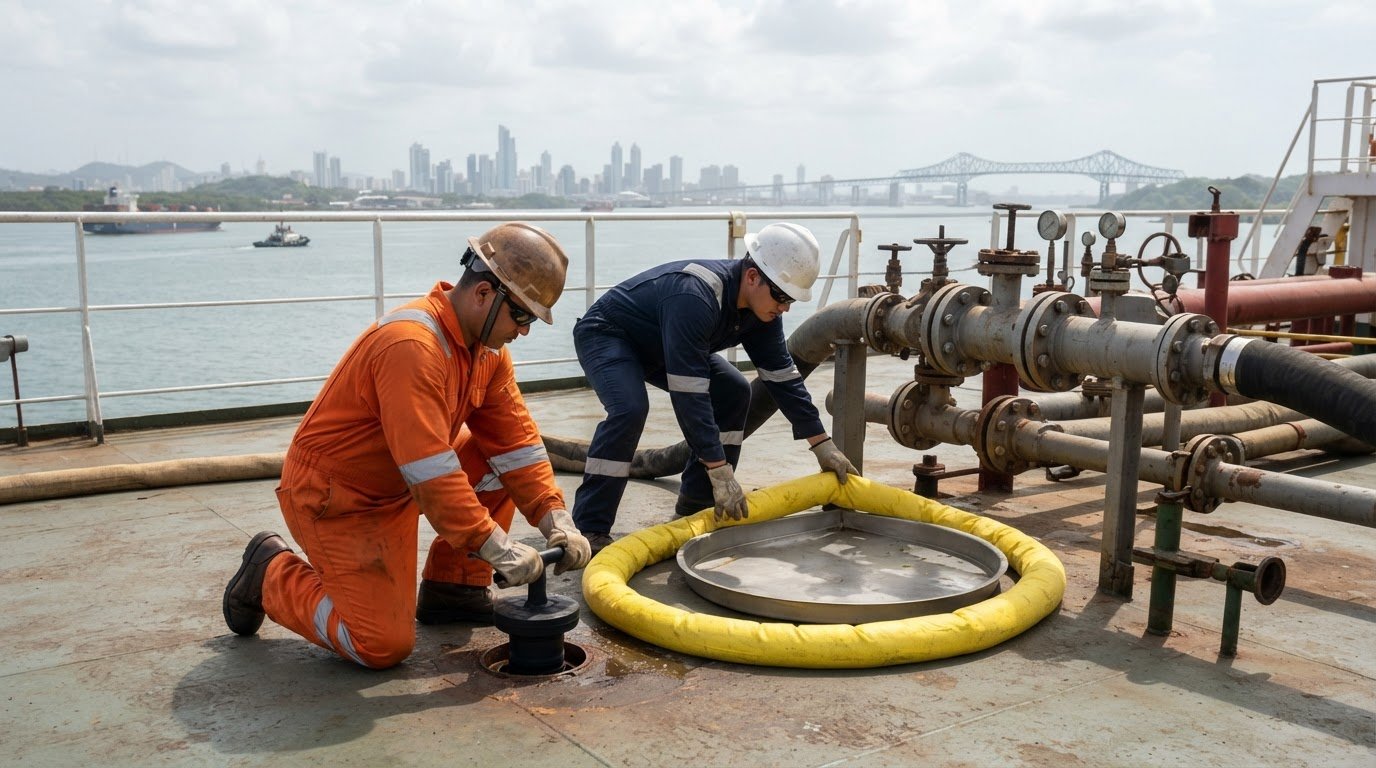
A missed deadline can have consequences for a vessel’s PCSOPEP status. In Panama, vessels with fuel and/or oil cargo-carrying capacity of 400 MT or more must submit an ACP shipboard oil pollution emergency plan at least 96 hours before arrival.
That makes timing and plan quality operational priorities, not just paperwork. The Panama Canal Authority reviews submitted PCSOPEPs and emails the ship company or agent to confirm approval when the plan is in order. This article explains what the ACP shipboard oil pollution emergency plan must cover, how the Panama Canal requirement relates to MARPOL Annex I, when submission is due, and what to expect during the Authority’s review. It also explains how a vessel’s oil-carrying capacity determines its applicable PCSOPEP tier and the consequences of a late or non-compliant submission.
Key Takeaways
- Build the plan around vessel-specific details, covering pollution prevention, spill notification and response, crew training, exercise records, and Authorized Person contact information.
- Understand how MARPOL Annex I distinguishes plan requirements for tankers and other vessels, and how the shipboard plan addresses oil discharge response procedures.
- Prepare for Authority review by understanding the required submission information and what confirmation follows when the plan is in order.
- See how Panama Canal ship agency support can help coordinate vessel-related arrangements alongside the PCSOPEP process.
¿What shall include a PCSOPEP?
For Panama Canal transit, a PCSOPEP must cover oil pollution prevention, spill notification, response procedures, crew training, exercise records, and the Authorized Person’s contact details. A vessel’s oil-carrying capacity determines whether the requirement applies and which tier applies.
ACP Plan Purpose
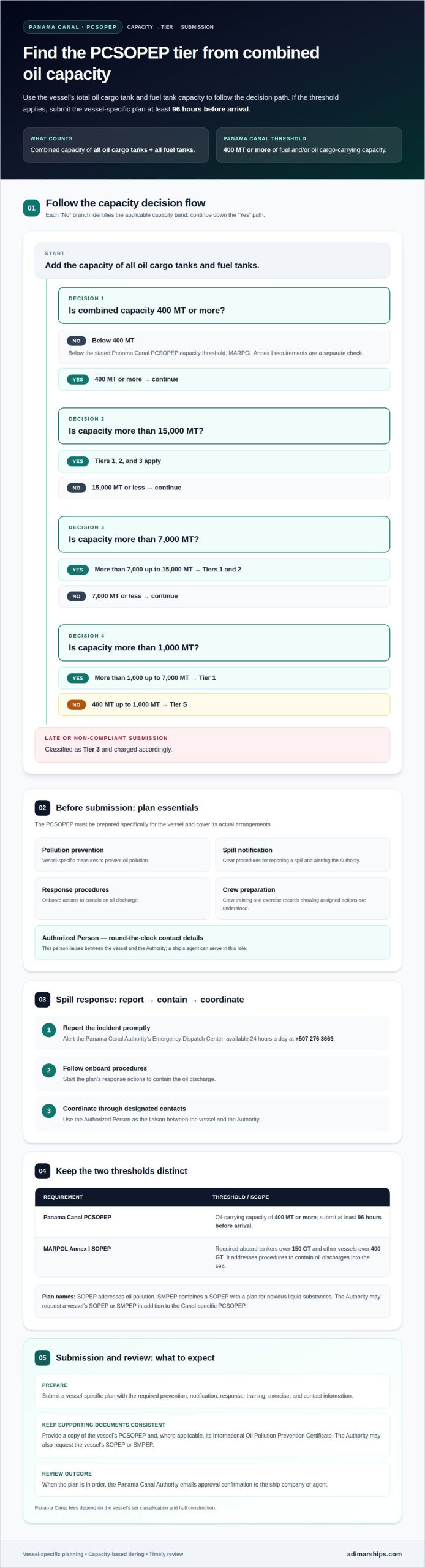
A Panama Canal Shipboard Oil Pollution Emergency Plan, or PCSOPEP, sets out how a vessel will prevent and respond to oil pollution in Canal waters. It matters because the Authority requires vessels with fuel and/or oil cargo-carrying capacity of 400 MT or more to submit a vessel-specific plan at least 96 hours before arrival. Capacity is the combined capacity of all oil cargo tanks and fuel tanks.
Spill Notifications and Response Steps
After a spill, the vessel should follow its plan’s notification procedures, alert the Panama Canal Authority’s Emergency Dispatch Center promptly, and start response actions to contain the discharge. The center is reachable 24 hours a day at +507 276 3669. The plan must also provide round-the-clock contact details for the Authorized Person, who liaises between the vessel and the Authority. A ship’s agent can serve in this role.
The practical response sequence is to report an incident, follow onboard procedures to contain the oil, and coordinate the response through designated contacts. Crew training and exercise records help show that personnel understand their assigned actions.
For Panama Canal PCSOPEP eligibility, the 400 MT threshold includes fuel tanks as well as oil cargo tanks. The applicable tiers depend on oil-carrying capacity: Tier S covers 400 MT up to 1,000 MT; Tier 1 covers more than 1,000 MT up to 7,000 MT; Tiers 1 and 2 cover more than 7,000 MT up to 15,000 MT; and Tiers 1, 2, and 3 apply above 15,000 MT. A late or non-compliant submission is classified as Tier 3 and charged accordingly.
MARPOL Annex I requires a SOPEP aboard tankers over 150 GT and other vessels over 400 GT. An SOPEP addresses oil pollution, while an SMPEP combines a SOPEP with a plan for noxious liquid substances. Panama Canal fees depend on the vessel’s tier classification and hull construction, so capacity and vessel details affect the applicable charge.
MARPOL Annex I requirements
MARPOL Annex I sets shipboard oil pollution emergency plan requirements by vessel type and gross tonnage. Tankers over 150 GT must carry a plan; other vessels over 400 GT must also carry one. The plan must describe procedures to contain oil discharges into the sea, under regulation 37. These thresholds distinguish the general MARPOL obligation from Panama Canal-specific PCSOPEP requirements.
For vessels entering Panama Canal waters, the Panama Canal Authority requires a Panama Canal Shipboard Oil Pollution Emergency Plan. The PCSOPEP requirement became effective on January 1, 2005. The Authority may also request a vessel’s SOPEP under MARPOL Annex I or its Shipboard Marine Pollution Emergency Plan under MARPOL Annex II. These plans address related pollution risks, but their scope differs.
The International Maritime Organization says a plan for noxious liquid substances may be combined with a SOPEP; the combined plan is called an SMPEP. This distinction matters when a vessel carries both oil and noxious liquid substances, because its documentation must address the relevant pollution hazards. For a Panama Canal transit, the vessel-specific plan and procedures should clearly cover oil-discharge response in Canal waters.
How often must an SOPEP be reviewed, updated, and exercised? Panama Canal requirements call for crew training and exercise records, but the information covered here does not establish a recurring interval. Keep the response procedures and contact details aligned with the vessel’s current arrangements, and retain exercise records to document crew preparation.
For operational planning, separate the MARPOL threshold from the Canal’s PCSOPEP submission rules. A tanker above 150 GT has the MARPOL plan requirement; a non-tanker crosses that threshold above 400 GT. The Panama Canal Authority’s review can involve the vessel’s SOPEP or SMPEP, while its PCSOPEP requirement applies to vessels meeting the separate oil-carrying-capacity threshold. Clear, vessel-specific procedures help crews understand which plan governs each pollution response.
Submission of the PCSOPEP to the Authority for review
Article 141A requires vessels in Panama Canal waters to submit a PCSOPEP to the Authority for review. The plan must include the minimum required information, and it must be prepared specifically for the vessel.
How do you prepare and obtain approval for a shipboard oil pollution emergency plan? Develop a vessel-specific plan covering the required pollution prevention and response information, then submit it for Authority review. When the plan is in order, the Panama Canal Authority emails the ship company or agent to confirm approval.
Before submission, ensure the plan reflects the vessel’s actual arrangements. Include procedures for oil pollution prevention, spill notification and response, crew training, and exercises. Provide the Authorized Person’s round-the-clock contact details so the Authority has a clear liaison for pollution matters. Companies experienced in pollution prevention should develop PCSOPEPs.
Keep supporting documents consistent with the plan. For Panama Canal verification, vessels provide a copy of the PCSOPEP prepared for that vessel and, where applicable, a copy of the International Oil Pollution Prevention Certificate. The Authority may also request the vessel’s SOPEP under MARPOL Annex I or SMPEP under MARPOL Annex II. These documents distinguish the Canal-specific plan from international shipboard pollution documentation.
The review outcome depends on whether the submitted plan contains the required information and is appropriate for the vessel. If the Authority finds the plan in order, it emails approval confirmation to the ship company or agent. The Notice of Acknowledgement is completed when the vessel arrives and an Authority boarding officer boards it. The notice expires four years after delivery by an ACP boarding officer.
Keep the approved plan and relevant records accessible onboard. Crew training and exercise records support readiness, while accurate contact details help maintain a reliable response chain. Treat submission, review, and onboard documentation as connected parts of the vessel’s preparation for Panama Canal transit.
What is an ACP shipboard oil pollution emergency plan?
A Panama Canal Shipboard Oil Pollution Emergency Plan, or PCSOPEP, is a vessel-specific plan for oil pollution risks in Panama Canal waters. The Panama Canal Authority requires vessels entering Canal waters to carry one. For vessels with fuel and/or oil cargo-carrying capacity of 400 MT or more, submission is required before arrival.
The PCSOPEP addresses the Canal’s local response framework, while a SOPEP serves as the shipboard oil pollution plan under MARPOL Annex I. The Authority may request that international plan during verification. A plan covering noxious liquid substances may be combined with a SOPEP; the International Maritime Organization calls the combined plan an SMPEP.
The document gives the crew a vessel-specific reference for preventing pollution and responding to a spill. Required content includes prevention measures, spill notification and response procedures, crew training, exercise records, and round-the-clock contact details for the Authorized Person. That contact connects the vessel with the Panama Canal Authority during a pollution incident.
The Authorized Person has a defined local role: they must reside in Panama, speak English or Spanish, and liaise with the Authority. The role also includes arranging guarantees for oil-spill response and cleanup costs. A ship’s agent can serve as the Authorized Person, linking onboard procedures with local coordination.
Preparation should reflect the vessel’s actual configuration and response arrangements, rather than rely on a generic document. Companies experienced in pollution prevention are to develop PCSOPEPs. The plan also sits within a Panama Canal regulatory framework: Article 141A requires submission for Authority review and minimum information. The requirement became effective on January 1, 2005.
For vessels preparing for Panama Canal transit, coordinate local transit arrangements alongside the plan process.
Adimar Shipping, Inc.: Ship Agency Services
Adimar Shipping, Inc. coordinates vessels for Panama Canal transits on behalf of ship owners and charterers. Its Ship Agency Services, including Owner’s Nominated Agency and Charterer’s Nominated Agency, provide each party with a local point of coordination for passage-related needs.
Turn to Adimar Shipping, Inc. for agency support with the planning and documentation involved in a Canal call. Husbandry Services can also help coordinate a vessel’s related requirements. These services complement the vessel’s responsibility for maintaining its PCSOPEP and submitting it to the Authority.
For support with Panama Canal vessel arrangements, contact Adimar Shipping, Inc. or visit adimarships.com.
Keep Your Next Canal Call Moving
Use the planning process to align onboard responsibilities with the vessel’s wider Panama Canal arrangements. Clear ownership of documents, contacts, and communications helps the ship’s team and shore representatives work from the same plan.
A well-prepared ACP shipboard oil pollution emergency plan is one part of vessel readiness. Local agency coordination supports owners and charterers as they organize vessel requirements for a Canal transit. Adimar Shipping, Inc. provides ship agency support for these arrangements, connecting communication between the vessel and its local representatives.
For guidance with your vessel’s Panama Canal arrangements, contact Adimar Shipping, Inc. about PCSOPEP support. A coordinated next step can help your team move forward with greater clarity and confidence.
Frequently Asked Questions
What happens if a vessel fails to submit a compliant PCSOPEP at least 96 hours before arrival?
Failure to submit on time results in the highest fee and possible denial of transit. A late submission can affect both the vessel’s transit arrangements and its costs. Treat plan completion and submission timing as part of pre-arrival preparation.
Which ships must carry a shipboard oil pollution emergency plan under MARPOL?
Under MARPOL Annex I, tankers over 150 GT and vessels other than tankers over 400 GT must carry a shipboard oil pollution emergency plan. The plan must include procedures to contain oil discharges into the sea under regulation 37. These MARPOL thresholds are based on gross tonnage and are separate from the Panama Canal’s PCSOPEP oil-carrying-capacity threshold.
What information must an SOPEP contain?
An SOPEP must describe procedures for containing oil discharges into the sea. For Panama Canal review, the vessel-specific PCSOPEP also covers pollution prevention, spill notification and response procedures, crew training, and exercise records. Include round-the-clock contact details for the Authorized Person so the Authority can reach the designated liaison. Keep the plan consistent with the vessel’s actual response arrangements.
What costs and services are involved in preparing or updating a shipboard oil pollution plan?
Plan preparation or updating costs depend on the vessel and the work required; service pricing is provided after a quote request. The Panama Canal Authority’s SOPEP fee depends on tier classification and hull construction, while oil-spill response charges are assessed if a spill occurs. Adimar Shipping, Inc. provides a PCSOPEP Authorized Person service for local liaison and guarantee arrangements.