
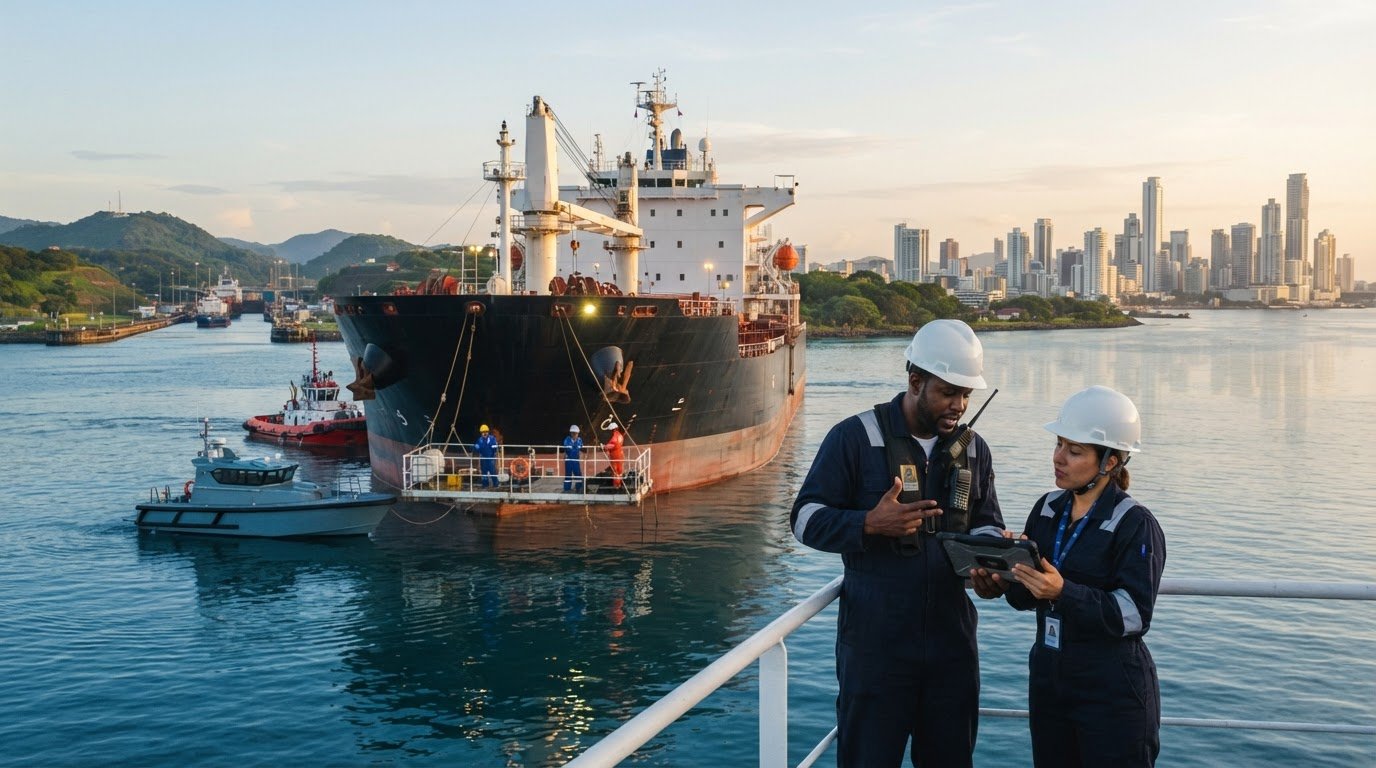
What if a repair window fits the vessel’s schedule but complicates its next Panama Canal call? A ship agent for afloat repairs Panama operators rely on can connect local agency coordination with the vessel’s operational priorities. The repair plan and canal-side arrangements need to be considered together.
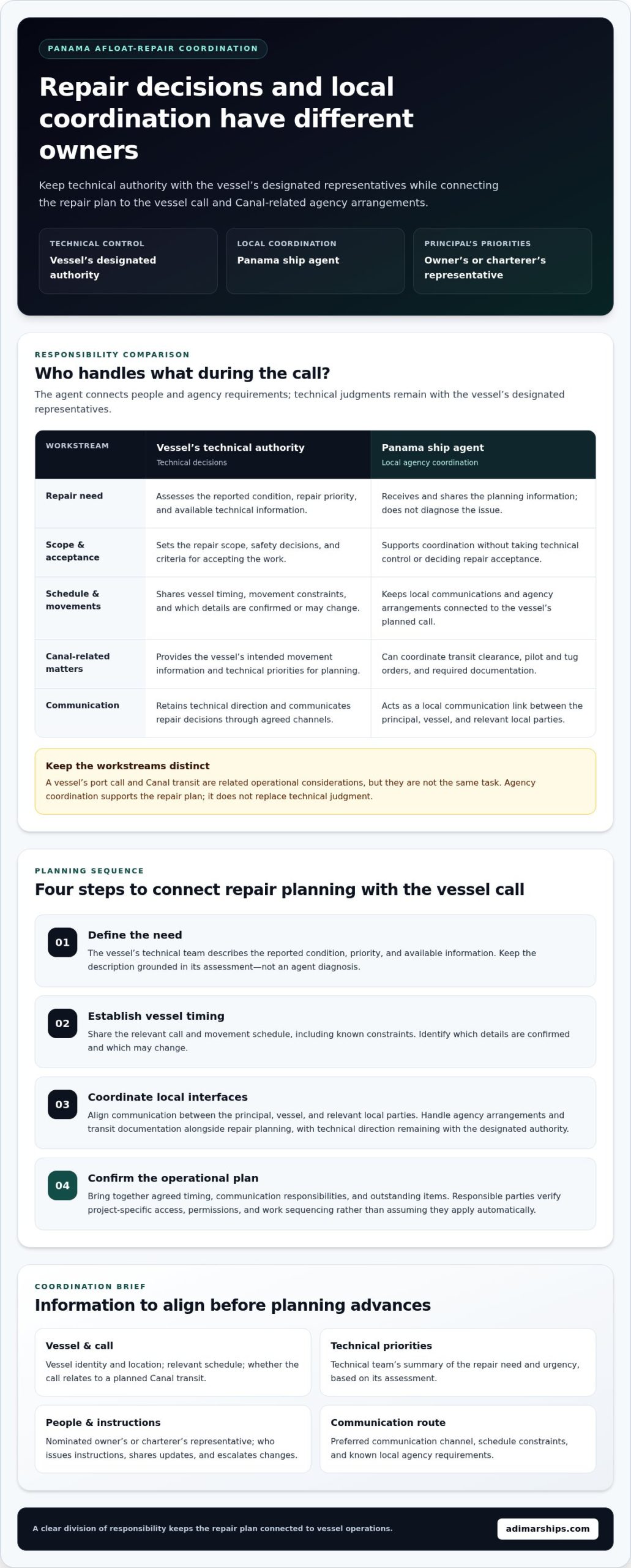
Timing is only part of the challenge. Owners, the vessel, repair teams, and local parties need clear communication, while transit arrangements and documentation remain in view. A Panama-based agent can represent the owner’s or charterer’s interests and coordinate transit clearance, pilot and tug orders, and required documentation.
This guide covers the decisions that shape an afloat-repair call, how to compare afloat work with dry-docking, and which vessel and repair details to prepare for agency coordination. It also explains how a local representative can keep the repair plan connected to the vessel’s schedule and canal operations, without confusing agency coordination with technical diagnosis or repair work.
Key Takeaways
- Keep the repair scope and acceptance criteria, set by the vessel’s technical decision-makers, separate from the agency coordination needed to support the call.
- Plan the repair window in a clear sequence: define the need, map vessel timing, align local communications, and review the operational plan.
- Compare afloat repairs with dry-docking based on access, work scope, vessel condition, schedule, and operational constraints.
- Prepare technical priorities, schedule constraints, communication responsibilities, and agency requirements to make coordination more precise.
- A ship agent for afloat repairs Panama operators work with can represent owners’ or charterers’ interests and coordinate relevant canal transit arrangements and documentation.
Why a Ship Agent Matters for Afloat Repairs in Panama
A repair call involves more than the work itself. The vessel’s schedule, port-call requirements, and planned Panama Canal movements also need attention. When communication between the vessel, its principal, and local parties is unclear, even a well-defined repair plan can be difficult to coordinate.
Afloat repairs are carried out while a vessel remains afloat rather than in dry dock. That affects how the work fits around the vessel’s movements and operations, but it does not establish whether a particular job is technically suitable. The vessel’s designated technical representatives assess its condition, define the scope, and decide whether the work and its results are acceptable.
An afloat-repair ship agent is the local coordination link between the vessel-call and agency requirements and the principal’s plan. Technical representatives retain authority over the repair.
What does a ship agent do during an afloat repair call?
The agent serves as a local communication link for the principal and vessel, helping relevant parties work from consistent call information. This clarifies who needs updates, what timing has been shared, and how agency matters relate to the vessel’s schedule. The agent’s role is separate from technical diagnosis, repair specifications, and responsibility for repair workmanship.
Transit documentation and vessel-call coordination may also need to be considered alongside repair planning. If the vessel’s intended movements affect the repair window, the principal and vessel representatives need a clear view of that timing before finalizing the operational plan. Agency coordination supports communication but does not replace technical judgment or determine repair acceptance.
Why Panama-specific coordination matters
In Panama, a vessel’s port call and Canal transit are related operational considerations, but they are not the same task. General call coordination concerns local agency arrangements. Transit-related matters can include clearance, pilot and tug orders, and required passage documentation. Keeping these workstreams distinct helps teams identify what needs attention without treating repair planning as a substitute for transit preparation.
The Canal’s importance to maritime trade makes the operational context relevant to repair timing. For background on the route and its function, see Panama Canal operations. A Panama-based agency can represent an owner’s or charterer’s stated interests and keep agency communications connected to the vessel’s planned call.
Start by sharing consistent planning details with the principal, vessel, and local agency: the intended call timeline, known schedule constraints, communication responsibilities, and the technical team’s repair priorities. This gives the ship agent for afloat repairs Panama operators need a clear coordination picture, while repair scope and technical decisions remain with the vessel’s designated representatives. For additional transit context, consult the Panama Canal transit guide.
How Afloat Repair Coordination Works Alongside Panama Canal Operations
A clear sequence connects repair planning to the vessel’s call without confusing agency coordination with technical control. The vessel’s designated technical decision-makers define the work and decide whether it is acceptable. The agent supports local communication and agency arrangements, including transit documentation where relevant.
What information helps start repair planning?
Start with a shared, current picture of the vessel and its intended Panama call. Provide the vessel’s identity and location, relevant schedule, and whether the call relates to a planned Canal transit. Add the technical team’s summary of the repair need and urgency, identify the owner’s or charterer’s nominated representative, and specify the preferred communication route.
Once those details are aligned, work through the planning sequence:
- Define the need. The vessel’s technical team describes the reported condition, priority, and available information. Keep the description grounded in its assessment rather than asking the agent to diagnose the issue.
- Establish vessel timing. Share the relevant call and movement schedule, including known constraints. Make clear which details are confirmed and which may change.
- Coordinate local interfaces. The agent helps maintain communication between the principal, vessel, and relevant local parties. Agency arrangements and transit documentation can be handled alongside repair planning, while technical direction stays with the vessel’s designated authority.
- Confirm the operational plan. Bring together agreed timing, communication responsibilities, and outstanding items. Before work proceeds, the responsible parties should verify project-specific access, permissions, and work sequencing rather than assume those arrangements apply automatically.
Who handles decisions and communication?
Clear ownership helps prevent crossed instructions. The vessel’s designated technical authority sets the repair scope, safety decisions, and acceptance criteria. The owner’s or charterer’s representative communicates the principal’s priorities. The agent serves as the local coordination link, while repair parties handle their assigned work. Agree on who issues instructions, shares updates, and escalates changes before the plan advances.
This division matters if the reported condition or vessel timing changes. The agent can relay updates and keep agency communications aligned, but technical representatives determine how a change affects the scope, safety, or acceptance of the repair. The responsible parties also need to confirm assumptions about work location, permissions, and how the work fits around planned movements for the specific call.
For a ship agent for afloat repairs Panama operators can use as a local coordination partner, Adimar Shipping, Inc. supports owners’ and charterers’ nominated agency arrangements and Panama Canal transit coordination, including clearance, pilot and tug orders, and required documentation. If you’re planning a canal-related vessel call, discuss Panama Canal agency coordination with Adimar.
Afloat Repairs vs. Dry-Docking: Which Arrangement Fits the Vessel?
The choice is not simply between a repair that fits the schedule and one that does not. The right arrangement depends on the work, the vessel’s condition, and whether the job can be carried out safely in the available setting. Afloat work may suit an approved scope, while other work may require dry-dock access. Neither option is automatically right for every vessel.
Use the comparison below to focus the discussion with the vessel’s technical decision-makers. It identifies factors to assess but does not replace a technical review of the specific job.
| Factor | Afloat repairs | Dry-docking |
|---|---|---|
| Access | Work is performed with the vessel afloat, so access to the relevant area and equipment must be assessed for that setting. | The vessel is placed in a dry-dock setting, which may provide access or inspection conditions needed for particular work. |
| Repair scope | Potentially suitable when the approved scope can be completed afloat with the required methods and controls. | May be more appropriate when the scope requires dry access, extensive dismantling, or broader inspection. |
| Vessel condition | The vessel’s condition must support the planned work and continued afloat status. | May be considered when the condition or technical assessment calls for the vessel to be out of the water. |
| Schedule | Planning must account for the vessel’s movements and the time available for work. | Requires a schedule that accommodates the dry-docking arrangement and associated work plan. |
| Operational constraints | Access, equipment, environmental conditions, and vessel movements can affect feasibility. | Work is shaped by dry-dock access, the planned scope, and the vessel’s operational requirements. |
Keep the technical and agency decisions separate. The technical team determines the repair method, scope, safety assessment, and acceptance criteria. Local agency coordination addresses the vessel call and related agency matters. A ship agent for afloat repairs Panama operators work with can support local communication and call coordination, but does not decide whether a repair is technically suitable or approve the finished work.
When might afloat repairs be considered?
Afloat work may be considered when the vessel’s technical assessment finds that the approved scope can be performed safely while the vessel remains afloat. For example, a limited job that does not require dry access may be assessed for afloat completion. That is not a blanket rule: access to the work area, required equipment, environmental conditions, and vessel movements all affect feasibility.
When might dry-docking be more appropriate?
Dry-docking may be considered when the work needs access or inspection conditions an afloat setting cannot provide. Extensive dismantling or a repair requiring the relevant area to be dry could be examples, depending on the vessel and technical scope. These are illustrative, not universal rules. The vessel’s technical authority should assess the condition, safety requirements, and work method before selecting an arrangement.
Once the technical team identifies a suitable approach, operators can plan the related call around it. The vessel’s schedule and local agency requirements still need coordination, but they do not determine the repair method. Keeping those responsibilities distinct helps the principal, vessel, and local parties work from a clear plan without blurring operational coordination and technical approval.
A Panama Afloat-Repair Planning Checklist for Ship Operators
A practical brief gives the vessel, principal, technical team, and local agency a shared reference point. Keep four inputs clear: the technical scope, vessel schedule, communication responsibilities, and applicable local agency requirements. These inputs organize the planning conversation; they do not guarantee a particular repair method, schedule, or outcome.
For Canal-related calls, distinguish repair planning from transit arrangements. Adimar Shipping coordinates Panama Canal transit clearance, pilot and tug orders, and required documentation. The Panama Canal Authority context matters to those agency arrangements, so operators can review this Panama Canal Authority guide alongside their vessel-specific planning.
Before the vessel reaches the repair location
Bring the core details together in one briefing and keep it current. Include vessel particulars, location, the latest schedule, the intended Panama call or transit context, the technical team’s repair summary, and the principal’s instructions. State the technical priorities, known constraints, and acceptance criteria plainly. Identify who can approve technical decisions, authorize operational changes, and represent the owner or charterer.
Use an agreed communication route and make responsibilities explicit: who sends updates, who receives them, and who escalates a change. If the vessel’s schedule shifts, share the update promptly through the agreed channel so the principal and relevant local parties work from the same information. Label provisional timing clearly rather than treating an early estimate as a confirmed movement or repair window.
- Technical scope: Record the reported condition, intended work, priority, constraints, and the technical authority responsible for approval.
- Vessel schedule: Share current timing, planned movements, and known changes relevant to the call.
- Communication: Name the owner’s or charterer’s representative, vessel contacts, and agreed update path.
- Agency context: Identify the call’s relationship to Canal transit and the applicable clearance, orders, or documentation being coordinated.
During coordination and after the work
Maintain a simple action record showing each open item, responsible party, latest status, and next decision point. Keep agency updates distinct from technical records: the agent supports local communication, while technical findings, approvals, and acceptance belong in the vessel’s established reporting process. After the work, record completion and outstanding follow-up through that process.
If movements change, reconcile the revised schedule with relevant transit and documentation arrangements. The responsible parties should verify project-specific access, permissions, and work sequencing for that call. Do not treat these arrangements as automatic or assume an earlier plan still applies.
For owners and charterers planning a Panama vessel call, a ship agent for afloat repairs Panama operators rely on can support agency coordination while the vessel’s technical team retains control of repair decisions. Discuss Panama ship agency coordination with Adimar as part of your call planning.
How Adimar Supports Panama Ship Agency Coordination for Afloat Repairs
A repair plan needs a clear local agency framework when a vessel’s Panama call involves Canal transit. Adimar Shipping, Inc. is a Panama-based ship agency representing owners and charterers. The company helps connect agency arrangements and communication to the vessel’s stated requirements, making responsibilities easier to follow as the principal, vessel, and relevant local parties manage the call.
Agency coordination is distinct from the repair itself. Adimar Shipping, Inc. does not make technical diagnoses, set repair specifications, perform repair work, or determine whether completed work is acceptable. Those decisions remain with the vessel’s designated technical representatives. The agency role is to support the vessel call and its related requirements, not to promise a repair window or a particular operational outcome.
Agency coordination that supports the vessel’s call
For a Canal-related call, agency work can include transit clearance, pilot and tug orders, and required passage documentation. Keeping these tasks visible alongside the principal’s instructions helps distinguish transit matters from the vessel’s technical repair process. Owners’ or charterers’ nominated agency representation also gives the principal a local point of coordination for its stated interests.
Clear instructions help maintain a consistent communication path between the principal and the vessel’s local agency arrangements, making call information and updates easier to track. The role of a local agent is explored further in why a Panama Canal ship agent matters.
- Transit coordination: Keep clearance, pilot and tug orders, and passage documentation within the agency workstream.
- Principal representation: Make the owner’s or charterer’s instructions and nominated representative clear in the communication flow.
- Repair decision-making: Keep technical scope, safety decisions, and repair acceptance with the vessel’s designated technical authority.
A clear next step for owners and charterers
A focused coordination conversation starts with practical vessel and call information. Share the vessel particulars, the Panama call or transit context, the current schedule, and agency requirements or instructions relevant to the principal. Include the appropriate owner’s or charterer’s representative and preferred communication route so the discussion has a clear point of reference.
As a ship agent for afloat repairs Panama operators can work with, Adimar Shipping, Inc. coordinates agency arrangements around the vessel’s stated requirements, including relevant Canal transit and passage-documentation arrangements. Repair feasibility and execution remain separate technical matters for the vessel’s designated decision-makers.
Talk with Adimar about Panama ship agency support and outline the vessel’s call requirements for a practical coordination discussion.
Set Up the Next Call With Clarity
Turn the repair discussion into a shared operating brief. Keep the vessel’s technical priorities, schedule assumptions, and communication responsibilities visible as the plan develops. If any details change, update the relevant parties through the agreed channel so decisions are based on current information, not an outdated call plan.
A ship agent for afloat repairs panama operators engage can support local agency coordination while the vessel’s technical representatives retain control of repair scope and acceptance. This clear division helps owners and charterers move the agency conversation forward without blurring responsibilities.
Bring your vessel particulars, Panama call context, schedule, and agency requirements to the first discussion. Talk with Adimar about Panama ship agency support and take the next step with a focused coordination conversation.
Frequently Asked Questions
What does a ship agent do for afloat repairs in Panama?
A ship agent for afloat repairs in Panama supports local agency coordination around the vessel’s call, not the technical repair itself. If repair planning coincides with a Canal transit, for example, the agent can handle agency matters such as transit clearance, pilot and tug orders, and required documentation. The vessel’s technical representatives remain responsible for diagnosing the issue, defining the work, and deciding whether the result meets their requirements.
Are afloat repairs the same as in-navigation repairs?
No. Afloat repairs are carried out while a vessel remains afloat, which can include periods when it is alongside or at anchor. In-navigation repairs refer to work undertaken while the vessel is underway. The distinction matters because vessel movement can affect access, safety planning, and the work method. Operators should use the technical team’s description of the proposed work and operating conditions rather than assume the terms are interchangeable.
Can a vessel undergo afloat repairs during a Panama Canal transit?
Do not assume repair work can take place while the vessel is transiting the Canal. Transit movements and repair activity are different operational circumstances. Feasibility depends on the specific task, vessel condition, safety assessment, and applicable operational requirements. The vessel’s technical authority should assess the repair, while transit-related agency arrangements are handled separately. A transit schedule is not approval to perform work underway.
What information should an operator provide when arranging repair coordination in Panama?
Provide the vessel’s identity and current location, the Panama call or transit context, the latest schedule, and the principal’s nominated representative. Add the technical team’s description of the reported issue, its priority, known constraints, and who can approve changes. If timing is provisional, label it clearly and identify who will send updates. This helps local agency communication stay aligned with the operator’s current instructions.
How do operators decide between afloat repairs and dry-docking?
The vessel’s designated technical decision-makers compare the repair requirements with the access and conditions each setting provides. They consider the vessel’s condition, required inspection or dismantling, safety controls, equipment, and operational constraints. A job requiring a dry work area may point toward dry-docking, but only the technical assessment can determine suitability for that vessel. Schedule and agency coordination inform planning but do not replace the method decision.
Does a ship agent carry out the technical repair work?
No. A ship agent handles agency coordination and communication, not technical diagnosis, repair execution, or acceptance of completed work. The vessel’s technical authority sets the scope and determines whether the work is satisfactory. Repair parties are responsible for their assigned tasks. Keeping these roles distinct helps prevent an agency update, such as a change to call timing, from being mistaken for technical approval or an instruction to proceed.
Why involve a local ship agent for a Panama repair call?
A local agent gives the owner or charterer a Panama-based agency contact familiar with the vessel-call context. That helps connect principal instructions, vessel updates, and transit-related agency matters as the plan develops. Adimar Shipping, Inc. represents owners and charterers and coordinates transit clearance, pilot and tug orders, and required documentation. The ship agent supports local coordination, while technical representatives remain responsible for repair decisions and safety assessments.