


Why does the “six-week black hole” still swallow your vessel’s liquid capital long after it has cleared the Miraflores Locks? It’s a common frustration for operators to see unexpected ACP surcharges or opaque husbandry fees surface weeks after a transit is complete. You need your final disbursement account panama canal to be more than just a receipt; it should be a strategic audit tool that confirms the efficiency of your local agent. We understand that in this high-stakes industry, financial ambiguity is a risk you simply cannot afford.
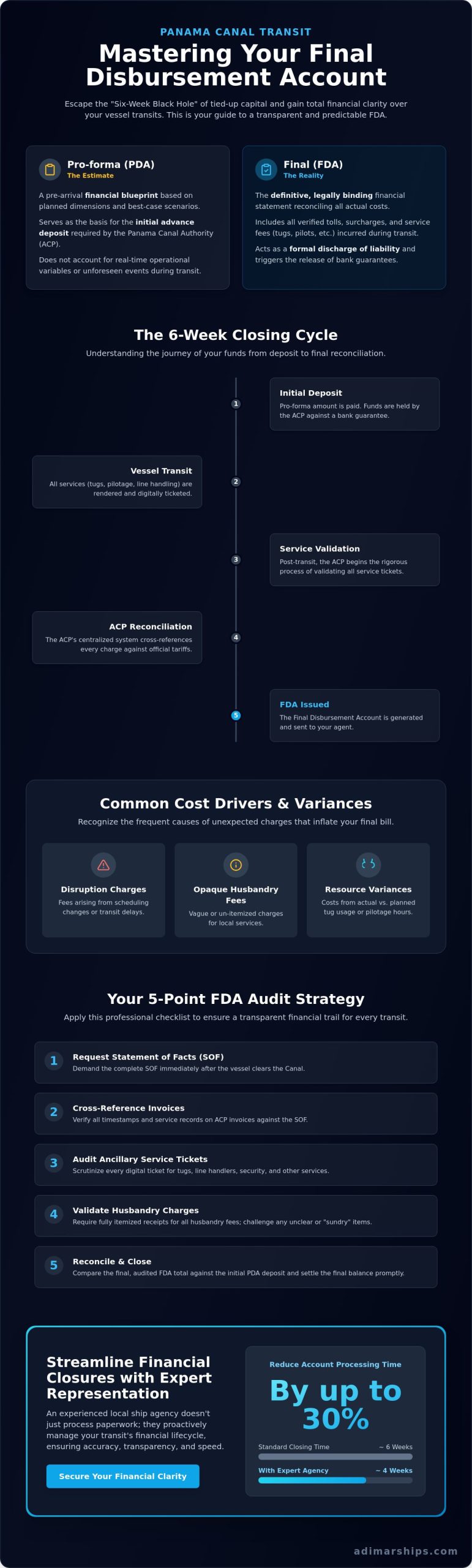
By mastering the reconciliation process, you’ll gain total financial clarity over your vessel transits and eliminate the stress of post-transit billing surprises. This guide provides a roadmap to bridge the gap between initial proforma estimates and final canal billing. We’ll explore the 2026 regulatory updates, including the latest OP Notice to Shipping No. N-01-2026, and show you how to build a transparent audit trail that ensures faster account closing and predictable costs for every voyage through the isthmus.
Key Takeaways
- Identify the critical differences between pro-forma estimates and the final disbursement account panama canal to ensure every dollar is accurately reconciled.
- Navigate the “Six-Week Rule” by understanding the journey of your funds from the initial ACP deposit to the final financial statement.
- Recognize common cost drivers like disruption charges and hidden husbandry fees that frequently cause unexpected variances in canal billing.
- Apply a professional 5-point audit strategy to cross-reference your Statement of Facts with final invoices for a transparent financial trail.
- Learn how expert ship agency representation can streamline your financial closures and reduce account processing times by up to 30%.
Understanding the Final Disbursement Account (FDA) in the Panama Canal Context
The final disbursement account panama canal is the definitive, legally binding financial statement issued at the conclusion of a vessel’s call. It represents the ultimate reconciliation of all expenses, ranging from official Panama Canal Authority (ACP) tolls to local husbandry services. Unlike standard port calls where billing might follow a predictable pattern, Panama Canal operations function under a unique pre-payment structure. Panama requires this specialized financial framework because the ACP operates on a mandatory advance-payment basis, unlike many other global waterways where credit terms are more common. This makes the final reconciliation a critical milestone for your treasury department.
Managing a vessel’s Profit and Loss (P&L) statement depends entirely on the accuracy of this document. Without a finalized account, your voyage books remain open, creating financial uncertainty that can complicate corporate tax compliance and year-end audits. A precise FDA ensures that every dollar sent as an advance is accounted for. This allows for a clean closure of the voyage account and protects the owner’s interests by providing a transparent audit trail for every cent spent during the transit.
PDA vs. FDA: Why Estimates and Reality Often Differ
A Pro-forma Disbursement Account (PDA) is a pre-arrival deposit requirement based on ACP tariffs. It serves as your financial blueprint, but it’s important to remember it’s only an estimate. Pro-forma accounts are typically based on planned dimensions and best-case transit times. In reality, the final accounts reflect actual tug usage, pilotage delays, and unforeseen surcharges that may arise during the transit. If a vessel requires additional resources or faces scheduling changes, the variance in the final disbursement account panama canal can be significant compared to the initial quote.
The Legal and Financial Weight of the FDA
The FDA is much more than a simple summary of costs; it acts as a formal discharge of liability for both the shipowner and the agency. Once the FDA is accepted and the final balance is settled, it signals the completion of the contractual relationship for that specific transit. This document is also the primary trigger for the release of bank guarantees held by the ACP. It’s a vital piece of the financial puzzle that ensures all local obligations are met.
For fleet managers, the FDA is an essential tool for resolving disputes with charterers. Since charter parties often dictate who is responsible for specific canal costs, a transparent and detailed final statement is the only way to ensure fair rebilling. It provides the concrete evidence needed to prove exactly what services were rendered and why certain costs were incurred. This clarity ensures that all parties fulfill their financial obligations correctly and maintains the integrity of the charter agreement.
The 6-Week Closing Cycle: Navigating the Timeline of Canal Finances
Many operators find the delay between a vessel’s departure and the receipt of the final statement frustrating. In Panama, this period is commonly known as the “Six-Week Rule.” This isn’t a delay caused by administrative laziness. It’s a direct result of the rigorous reconciliation required by the Panama Canal Authority (ACP) to ensure every charge aligns with the official Panama Canal tariffs. Your funds move through a complex verification chain that begins the moment your initial deposit is confirmed.
The ACP bank guarantee system plays a significant role in this timeline. When you submit your proforma payment, the ACP holds these funds against a guarantee to cover potential transit costs. This system protects the waterway’s operations but adds a layer of bureaucracy to the final release. Only after the vessel has cleared the locks and all service tickets are digitally validated does the formal reconciliation begin. This journey involves cross-referencing tug usage, pilotage hours, and any transit-related surcharges before the final disbursement account panama canal can be issued.
The ACP Financial Reconciliation Process
The ACP processes tolls and ancillary charges through a centralized system that requires the manual and digital verification of service tickets. These tickets document everything from line handling to security fees. They aren’t always available for final accounting immediately after transit. If your vessel faced disruptions, such as draft restrictions or scheduling changes due to lock maintenance, the ACP’s internal audit takes longer. This administrative lag is the primary reason your final disbursement account panama canal isn’t ready the moment your ship reaches the open sea.
Aggressive Vendor Management
While the ACP has its own fixed timeline, third-party vendors often represent the real bottleneck in closing accounts. Bunker suppliers, surveyors, and providores have independent billing cycles that can stretch for months if left unmonitored. This is where the choice of a specialized ship agency makes a measurable difference in your cash flow.
Experienced agents don’t simply wait for invoices to arrive in the mail. They proactively track every service ticket from the moment it is signed on board. By maintaining strong local relationships with Panamanian service providers, a vigilant agent can compress the billing lag. This proactive approach ensures that your account is compiled and closed within the standard six-week window, rather than drifting into a three-month financial limbo. Digital tracking of these tickets provides the transparency needed to close accounts significantly faster than the industry average.
Identifying Hidden Cost Drivers and Variance in Canal Billing
Variance is the enemy of financial predictability. It’s rare for a proforma estimate to match the final disbursement account panama canal down to the last cent. Disruption charges remain the most significant driver of this gap. If a vessel misses its assigned slot or arrives with technical deficiencies, the Panama Canal Authority (ACP) applies heavy penalties. These aren’t just administrative fees. They’re operational realities that can inflate a voyage’s cost by tens of thousands of dollars.
Ancillary services like tug assistance and line handling are equally dynamic. While a PDA provides a baseline, the actual usage depends on the ACP pilot’s assessment of current weather and vessel handling characteristics. If your ship requires an extra tug for safe maneuvering, that cost will appear as a variance. We believe in absolute transparency. This means providing original invoices from third-party vendors to ensure no hidden markups are buried in the final statement.
ACP Surcharges and Operational Penalties
Technical deficiencies and regulatory fines can devastate a budget. Non-compliance with PCSOPEP or specific requirements in the “OP Notice to Shipping No. N-01-2026” often results in fines starting at $15,000. Additionally, 2026 water levels continue to dictate strict draft restrictions. If a Neopanamax vessel’s draft exceeds the 15.2 meter (Tropical Fresh Water) limit due to loading errors, the final toll calculation will be adjusted accordingly. Booking slot changes and “Daylight Transit” premiums also represent significant cost drivers that must be reconciled.
Husbandry and Protective Agency Fees
Managing husbandry and crew-related expenses is where “miscellaneous” fees often hide. Reconciling Cash to Master (CTM) and coordinating crew changes requires precise documentation. Spare parts clearance and port storage are particularly prone to cost creep if not monitored by a vigilant local representative. For more detail on these logistics, read A Comprehensive Guide to Ship Husbandry Services in Panama. A protective agent’s role is to audit every launch service and port fee, ensuring you only pay for what was actually delivered.
How to Audit Your Panama Canal FDA for Accuracy and Transparency
Auditing a final disbursement account panama canal requires a vigilant eye and a deep understanding of local billing cycles. It’s the only way to ensure your vessel’s P&L isn’t eroded by administrative errors or overcharges. A thorough audit doesn’t just save money; it establishes a culture of accountability with your local partners. We recommend a systematic approach to verify every line item before closing the voyage books.
Our 5-Point Audit Strategy provides a framework for fleet managers to maintain total financial control:
- Balance Reconciliation: An audit should begin by matching the PDA deposit to the FDA total.
- Timestamp Verification: Cross-reference the Statement of Facts (SOF) with the final invoice. If the SOF shows a tug was dismissed at 14:00 but the invoice charges until 16:00, you’ve identified a discrepancy.
- Tariff Compliance: Verify all ACP service tickets against the official 2026 tariff to ensure no outdated rates were applied.
- Voucher Inspection: Scrutinize third-party vouchers for original signatures and official stamps. Missing timestamps or unverified signatures are immediate red flags.
- Rounding Analysis: Look for rounded numbers. In the specialized maritime sector, precise services rarely result in perfectly even dollar amounts like $1,000.00 or $500.00.
The Importance of Original Documentation
Never accept a “summary” invoice. A summary is merely a list that can easily hide markups or clerical errors. You must insist on original vouchers and receipts from the port or canal authority. This is where an Owner’s Nominated Agency becomes indispensable. They act as your local auditor, ensuring the charterer’s agent hasn’t overlooked credits or misapplied fees. Verifying the authenticity of these receipts protects you from the opaque “miscellaneous” fees that often plague the final disbursement account panama canal.
Digital Audit Tools and Transparency
Modern fleets now utilize digital portals to track expenses in real-time. This visibility eliminates the financial “black hole” that often follows a transit. Adimar prioritizes integrity by providing a clear, digital audit trail for every dollar spent. We ensure every receipt is uploaded and verified before the final statement is issued. This proactive documentation process fosters a sense of partnership and security for our clients. If you’re concerned about the transparency of your current billing, contact our ship agency team to discuss our rigorous auditing standards.
Streamlining Financial Closures with Expert Local Representation
Managing the financial closure of a voyage from thousands of miles away often leads to friction and administrative delays. By appointing a specialized Panama Canal ships agent, you effectively establish a local office on the ground in Balboa and Cristobal. This proximity allows us to act as your financial vanguard, catching errors and resolving disputes in real-time. Adimar’s commitment to integrity and transparency is reflected in our ability to deliver a final disbursement account panama canal with 30% faster closing times than the industry average. We don’t just pass invoices through; we audit them against local reality to ensure your funds are protected.
Ethical conduct is the cornerstone of our maritime financial management. In an industry where “miscellaneous” fees can quickly erode profits, we maintain a strict policy of original invoice transparency. Our team ensures that every credit is applied and every surcharge is verified against the actual transit events. This level of local oversight transforms the FDA from a source of stress into a predictable, manageable part of your operational cycle. You gain the peace of mind that comes from knowing your interests are being guarded by seasoned professionals who understand the nuances of Panamanian maritime law.
Your Eyes and Ears at the Panama Canal
Proactive communication is our primary tool for preventing financial surprises. We identify potential cost spikes while the vessel is still in the locks, allowing for immediate clarification before the paperwork enters the ACP’s reconciliation system. Our customized reporting provides a clear view for both owners and charterers, ensuring all parties have the data they need for fair rebilling. This local expertise, built over decades of vendor negotiation, ensures that you never pay for services that weren’t delivered as promised. We act as your vigilant representatives, providing the oversight that standard business language cannot achieve.
Next Steps for Your Next Transit
Transitioning your disbursement accounting to a more transparent model starts with a simple audit of your previous calls. We invite you to request a sample FDA from our team to compare against your current provider’s statements. Look for the level of detail, the presence of original vouchers, and the speed of reconciliation. When you’re ready for a more dependable approach, Adimar is prepared to represent your interests. You deserve a partner that simplifies complex processes rather than adding to them. Ensure your next transit is financially predictable and your final disbursement account panama canal is closed with the speed and accuracy your business demands.
Securing Financial Predictability for Your 2026 Transits
Mastering the reconciliation process is about more than just closing a file; it’s about reclaiming control over your vessel’s liquid capital. You’ve learned how to navigate the six-week closing cycle and identify the hidden drivers that cause variance between your estimate and the actual billing. By implementing a rigorous five-point audit strategy, you can transform the final disbursement account panama canal into a tool for operational efficiency rather than a source of post-voyage frustration.
Delegating these complex financial tasks to a seasoned partner ensures that your interests remain protected at every stage of the transit. As an authorized PCSOPEP representative with decades of regional expertise, Adimar Shipping provides the vigilance required to verify every charge. We stand by our commitment to 100% original invoice transparency, resolving discrepancies before they ever reach your desk. Our team acts as an extension of your own, providing the security you need in a high-stakes environment.
Partner with Adimar Shipping for Transparent Canal Accounting. Let’s work together to ensure your next Panama Canal transit is defined by total financial clarity and professional reliability.
Frequently Asked Questions
How long does it take to receive the Final Disbursement Account for the Panama Canal?
It typically takes approximately six weeks after your vessel departs to receive the final statement. This period allows the Panama Canal Authority (ACP) to reconcile all digital service tickets and for local vendors to submit their verified invoices. While some administrative cycles can stretch longer, a proactive agent monitors these timelines closely to ensure your account is closed within this standard industry window.
What is the difference between a PDA and an FDA?
A Pro-forma Disbursement Account (PDA) is a pre-transit estimate used to calculate the mandatory advance deposit. In contrast, the final disbursement account panama canal is the legally binding reconciliation of all actual expenses. While the PDA provides a financial blueprint based on planned dimensions, the FDA reflects the reality of the transit, including any additional tug usage or pilotage delays.
Why are there often discrepancies in Panama Canal billing?
Discrepancies usually arise from operational changes that occur during the transit itself. Factors such as fluctuating water levels, draft restrictions, or a pilot’s request for additional tug assistance can cause the final bill to vary from the initial pro-forma. Inaccurate reporting by third-party vendors also contributes to these gaps. A vigilant agent identifies these variances by cross-referencing the Statement of Facts with the final invoice.
Can I audit my Panama Canal fees directly through the ACP?
No, shipowners cannot audit the ACP directly. All financial communication must go through your appointed ship agent of record. The ACP only recognizes the authorized representative who handled the transit and the initial deposit. This makes it vital to choose an agent who provides 100% original invoice transparency and acts as your local auditor to ensure all fees align with the official 2026 maritime tariff.
What happens if there is a surplus in my pro-forma deposit?
Any surplus funds identified after the final disbursement account panama canal is closed are promptly credited back to your account. Once the ACP releases the bank guarantee and all local vendors are paid, the remaining balance is settled. A reliable agent ensures these funds aren’t tied up in administrative delays, providing you with a clear statement and a swift refund of any overpaid deposits.
Are husbandry fees included in the final disbursement account?
Yes, husbandry fees are consolidated into the FDA to provide a comprehensive financial overview of the vessel’s call. This includes expenses for crew changes, spare parts delivery, and Cash to Master. By including these items in a single statement, your agent provides a transparent audit trail. However, these charges should always be clearly itemized and supported by original vouchers from the service providers.
What documents should be attached to a professional Panama FDA?
A professional FDA must include the official ACP Statement of Account, the signed Statement of Facts (SOF), and all original third-party vouchers. You should also receive copies of pilotage and tug service tickets. These documents are essential for verifying timestamps and confirming that the services billed were actually rendered. Without these supporting vouchers, a final account cannot be considered a transparent or valid audit tool.
How can a local agent help reduce final transit costs?
A local agent reduces costs by auditing service tickets in real-time and negotiating with local vendors. By identifying errors in tug usage or pilotage hours before they are finalized in the ACP system, they prevent costly overcharges. Their local presence allows them to spot red flags, such as rounded numbers or vague descriptions, ensuring you only pay for the specific resources your vessel utilized during its transit.