
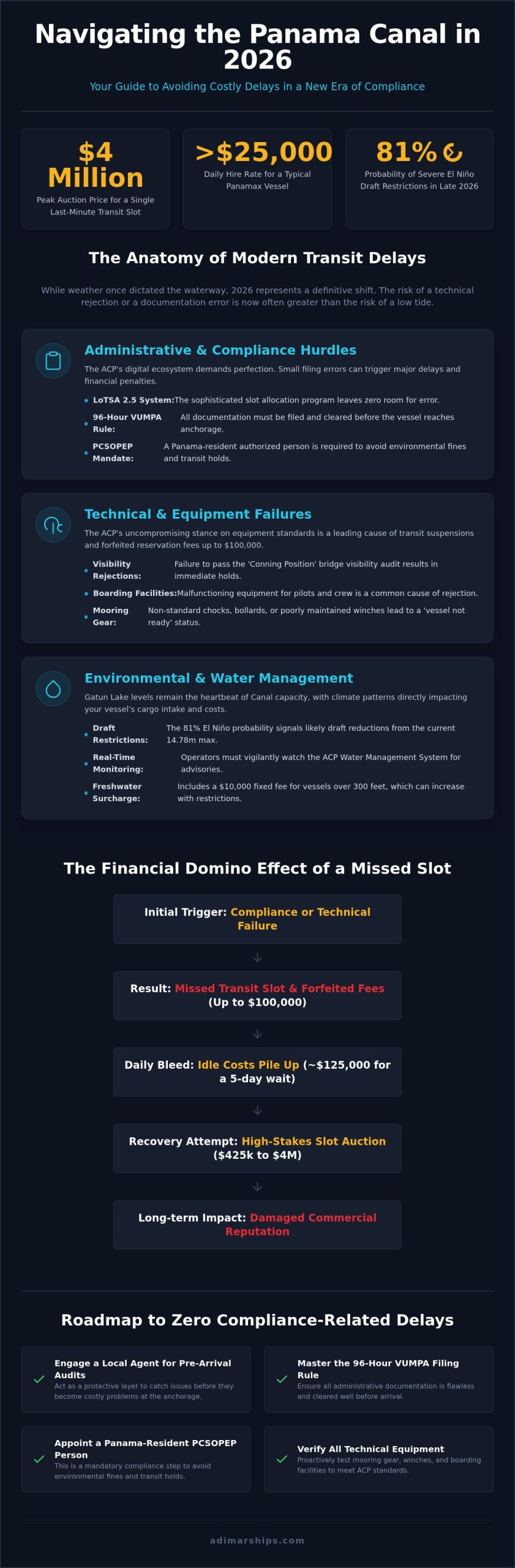
In April 2026, a single ship operator paid $4 million at auction just to secure a last-minute transit slot. This staggering figure highlights a new reality where the cost of administrative or scheduling errors is now as high as the risks posed by a historic drought. You have likely felt the frustration of unpredictable queues or the stress of navigating the ACP’s complex digital filing requirements while watching your daily hire rates climb beyond $25,000. It’s clear that common delays Panama Canal transit teams encounter are increasingly tied to compliance rather than just water levels.
We understand that your bottom line depends on precision and predictability. This 2026 guide identifies the root causes of modern delays and explains how strict adherence to new standards can safeguard your operations. You’ll learn the nuances of VUMPA filings, the impact of the LoTSA 2.5 booking system, and how to manage the looming 81% probability of severe El Niño draft restrictions. We will provide a roadmap for achieving zero compliance-related delays and maintaining predictable transit costs throughout the year, ensuring your vessel remains a priority in a crowded waterway.
Key Takeaways
- Understand the shift from purely environmental issues to regulatory-driven bottlenecks within the 2026 ACP traffic management system.
- Identify and mitigate the technical equipment failures and visibility issues that represent the most common delays Panama Canal transit teams encounter.
- Learn why appointing a Panama-resident PCSOPEP authorized person is a mandatory step to avoid environmental fines and transit holds.
- Master the 96-hour VUMPA filing rule to ensure all administrative documentation is cleared before your vessel reaches the anchorage.
- Discover how a local ship agent’s pre-arrival auditing acts as a protective layer to secure your transit slot and protect your bottom line.
The Landscape of Common Delays in Panama Canal Transit for 2026
The Panama Canal Authority (ACP) now operates under a highly sophisticated traffic management framework known as the Enhanced Long-Term Slot Allocation Program (LoTSA 2.5). This system is designed to provide certainty, yet it leaves very little room for error. We define Panama Canal Transit Delays as the result of environmental factors, vessel equipment failures, or administrative non-compliance. While weather once dictated the pace of the waterway, 2026 represents a definitive shift toward regulatory-driven bottlenecks. For modern operators, the risk of a technical rejection or a documentation error is often greater than the risk of a low tide.
The financial consequences of these delays have reached unprecedented levels. In May 2026, auction premiums for unreserved Neopanamax slots surged to $425,000, and extreme cases have seen operators pay $4 million just to skip a mounting queue. While a PCSOPEP fine might start at $2,500, the true cost is the lost transit slot. If your vessel is pushed out of its scheduled window, you aren’t just paying a penalty; you’re entering a high-stakes bidding war to regain your place in the schedule. Our role as your local partner is to provide the vigilance necessary to ensure your vessel meets every ACP standard before it reaches the anchorage.
Water Management and the 2026 Draft Outlook
Gatun Lake levels remain the heartbeat of the canal’s capacity. As of August 15, 2026, the maximum authorized draft for the Neopanamax locks is set at 14.78 meters (48.5 feet) Tropical Fresh Water (TFW). However, data indicates an 81% probability of a severe El Niño event in the latter half of 2026. This forecast suggests that the ACP will likely issue ‘Advisories to Shipping’ to implement stricter draft restrictions. Ship operators must monitor the ACP Water Management System closely, as these real-time changes directly impact cargo intake and the variable freshwater surcharge, which includes a $10,000 fixed fee for vessels over 300 feet.
The Financial Domino Effect of a Missed Slot
Missing a transit window triggers a costly chain reaction. With daily hire rates for Panamax vessels exceeding $25,000, a five-day wait in the unreserved queue results in $125,000 in idle costs alone. These common delays Panama Canal transit teams face also create friction with charterers and damage your commercial reputation. Avoidable technical rejections, such as visibility issues or boarding facility failures, don’t just delay one voyage; they disrupt your entire 2026 fleet deployment. Using a local agency to conduct pre-arrival audits is the only way to protect your schedule from these administrative and technical pitfalls.
Technical and Equipment Standards: Hidden Causes of Rejection
Technical rejections often strike without warning, turning a scheduled transit into a costly stay at the anchorage. While many operators focus on toll calculations, the ACP’s uncompromising stance on equipment standards remains a leading cause of common delays Panama Canal transit coordinators face. If a vessel arrives with bridge visibility that fails the ‘Conning Position’ audit or a malfunctioning boarding facility, the transit is suspended immediately. These rejections aren’t just inconvenient; they’re financially devastating, often resulting in the forfeiture of reservation fees that can reach $100,000 for Neopanamax vessels.
Mooring Gear and Chock Requirements for 2026
Mooring gear must satisfy specific 2026 requirements for both lock types to avoid a ‘vessel not ready’ status. The ACP requires standardized placement of chocks and bollards to ensure safe interaction with locomotives in the Panamax locks and tugboats in the Neopanamax locks. Non-standard gear or poorly maintained winches often lead to an immediate administrative hold. Pre-arrival testing of heavy-duty lines and winches is essential. These technical reporting protocols are as rigorous as the standards outlined in the U.S. Code of Federal Regulations for vessel entries. If your equipment doesn’t align with the pilot’s expectations, your vessel won’t move.
Neopanamax vs. Panamax: Different Locks, Different Risks
Neopanamax vessels navigate a different set of risks compared to their Panamax counterparts. The expanded locks accommodate a maximum beam of 51.25 meters and an LOA of 366 meters, but the mandatory tugboat assistance for these larger ships creates unique scheduling pressures. As of August 15, 2026, the maximum authorized draft for Neopanamax locks is 14.78 meters (48.5 feet) Tropical Fresh Water. Exceeding this limit or arriving with machinery failures, such as steering gear malfunctions or engine room automation errors, results in an immediate removal from the transit schedule. Larger vessels also face a mandatory $30,000 tugboat charge, which becomes a sunk cost if the transit is aborted due to equipment failure.
Hull and machinery maintenance is a pre-arrival priority that directly impacts your bottom line. ACP pilots have zero tolerance for malfunctioning whistle systems, faulty AIS units, or inadequate boarding facilities. Partnering with a dedicated Panama Canal ships agent allows you to delegate these complex technical audits to local experts who understand the ACP’s specific 2026 expectations. This vigilance ensures your vessel is truly ‘ready’ before the pilot ever steps on board, protecting you from the domino effect of a missed slot.
Environmental Compliance and PCSOPEP Protocols
Environmental standards aren’t just suggestions; they’re rigid operational barriers. In 2026, the ACP has intensified its focus on ecosystem protection. Failing to meet these standards is one of the most common delays Panama Canal transit operators face. Every vessel over 400 gross tons must have an approved Panama Canal Shipboard Oil Pollution Emergency Plan (PCSOPEP). Fines for non-compliance start at $2,500, but the real cost is the loss of your transit window.
A critical component of this plan is the appointment of a PCSOPEP authorized person. This individual must be a resident of Panama and serves as the primary liaison between your vessel and the ACP during an environmental incident. Beyond spill plans, the ACP enforces strict ballast water management and biofouling rules. Discharging untreated ballast water or arriving with a hull that poses an invasive species risk can lead to immediate transit suspension.
Oil Spill Response and Communication Protocols
Having a Panama-based representative isn’t just a legal formality; it’s an operational necessity. If a spill occurs, the communication chain must be instantaneous. The ACP requires a direct line to someone who can authorize local resources and make binding financial commitments on behalf of the shipowner. Without this authorized presence, your vessel stays at the anchorage. Adimar Shipping acts as this vigilant local office, fulfilling the PCSOPEP mandate to ensure administrative holds don’t derail your schedule. By monitoring Panama Canal transit and booking data, we help you time your arrival to ensure all environmental clearances are active before you reach the locks.
Fuel and Emission Standards in the Canal Zone
The ACP’s Greenhouse Gas (GHG) Emissions Ranking now influences scheduling priority. Ships with better environmental ratings often find it easier to secure preferred slots. Additionally, fuel switching is mandatory. You must transition to low-sulfur fuel before entering canal waters. Managing the resulting waste is equally important. Compliance with husbandry services for sludge disposal ensures you don’t face penalties for improper waste storage. These environmental protocols protect the local ecosystem, but they also serve as a filter for professional operators.
Administrative Requirements: Navigating the VUMPA Ecosystem
The VUMPA system acts as the digital gatekeeper for every vessel entering Panamanian waters. As a Maritime Single Window system, it consolidates requirements from the ACP, the Ministry of Health, and Immigration into a single platform. The 96-hour rule is your most critical deadline. Missing this window or submitting an inaccurate ETA triggers an automatic administrative hold. These clerical errors are among the most common delays Panama Canal transit operators encounter today. You must have your International Tonnage Certificate (PC/UMS), Ship Sanitation Control, and manifest data verified and uploaded before your vessel reaches the breakwater.
Digital Filing and the ‘Incomplete Document’ Trap
Digital filing is a complex verification sequence where digital signatures must be authenticated by authorized local agents. The latest ACP Panama Annual Report highlights a trend of stricter enforcement for manifest and crew list data. Even a minor typo in a passport number or a mismatch in cargo weight can trigger an ‘Incomplete Document’ trap. We act as your local office to verify these details in real-time. This vigilance ensures that every digital filing aligns with the ACP’s evolving standards. Verification protocols for manifests and health declarations must be completed with 100% accuracy to avoid being pushed to the back of the transit queue.
Vessel Inspections and Transit Clearance
Once the digital hurdles are cleared, the physical inspection begins. When the ACP boarding officer arrives, they don’t just glance at your papers; they conduct a thorough audit of crew lists, health declarations, and cargo manifests. They’ll compare your onboard logs against the VUMPA entries, and any discrepancies here lead to immediate transit holds. Common issues include outdated sanitation clearances or crew changes that weren’t updated in the digital system. Managing these health and quarantine protocols requires constant coordination between the Master and your local representative to ensure the inspection is a mere formality rather than a bottleneck.
Our Ship Agency Services provide the local oversight needed to audit your digital filings and physical logs before the ACP officer ever steps on board. We handle the complexities of the VUMPA ecosystem so you can focus on safe navigation. Contact our team today to ensure your administrative paperwork is as ready as your crew.
Mitigating Risk: The Strategic Role of a Panama Canal Ships Agent
Effective risk management in the canal zone requires more than just following a manual. It demands a local partner who can interpret the subtle shifts in ACP policy and weather patterns in real time. A Panama Canal ships agent is much more than a clerical assistant; they’re a regulatory necessity and your primary line of defense against operational bottlenecks. Our ‘Vigilance’ approach involves a rigorous pre-arrival audit that identifies potential issues before the ACP pilot ever boards your vessel. This proactive oversight is the most effective way to eliminate the common delays Panama Canal transit teams experience when left to navigate the system alone.
We handle the complex coordination with pilots, tugboat captains, and port authorities on your behalf. This ensures that every logistical cog in the machine turns smoothly. Nominating Adimar as your ship agency in Panama for 2026 ensures that your fleet is managed by seasoned experts who treat your schedule as their own. We act as your eyes and ears on the ground, providing a level of protection that standard business language can’t achieve.
Your Local Advocate During Technical Disputes
When a technical discrepancy arises during an inspection, the difference between a minor delay and a total transit cancellation often comes down to the agent’s ability to negotiate. We provide real-time traffic intelligence that the official ACP feeds simply can’t match. If a scheduling shift occurs due to water level changes or lock maintenance, we’re on the ground to advocate for your position. As an extension of the owner’s nominated agency, we ensure your interests are protected at every level of the Panamanian maritime hierarchy. We don’t just report problems; we solve them before they impact your bottom line.
Strategic Preparation for a Smooth 2026 Transit
Checklists are a master’s best friend when preparing for a 2026 transit. Our specialized guides help your crew avoid the technical and administrative rejections that often lead to missed slots. Financial transparency is equally paramount. We manage all tolls and husbandry expenses in USD, providing clear accounting that prevents administrative holds due to payment issues. Securing your 2026 transit slots requires expert local oversight and early planning. By delegating these complex tasks to our team, you gain the operational freedom to focus on your core maritime business while we handle the intricacies of the Panama Canal. If your firm’s growth extends to new facility developments or infrastructure on land, you may wish to check out ADI Construction Group for expert structural foundation and new build services.
Navigating the waterway in 2026 requires a shift from reactive management to proactive vigilance. Success is no longer just about monitoring Gatun Lake levels; it’s about mastering the digital VUMPA ecosystem and ensuring your equipment meets the ACP’s uncompromising technical standards. By prioritizing early documentation and rigorous technical audits, you can effectively bypass the common delays Panama Canal transit operators often face during peak seasons. These steps don’t just save time; they protect your commercial reputation and your bottom line.
Your operations deserve the protection of a partner who understands the high stakes of maritime logistics. Adimar Shipping provides the local oversight needed to turn complex regulations into a smooth, predictable flow. We act as your vigilant representative on the ground, ensuring every detail is cleared before your vessel reaches the anchorage. Secure Your Seamless Panama Canal Transit with Adimar Shipping and leverage our expert PCSOPEP Authorized Person services and 24/7 local coordination in Panama City. We specialize in both Neopanamax and Panamax lockage, providing the reliability you need to sail through 2026 with confidence. We look forward to ensuring your fleet moves through the locks without a hitch.
Frequently Asked Questions
What are the most common Panama Canal regulations that ships fail to meet?
Ships most frequently fail to meet the ACP’s strict bridge visibility and ‘Conning Position’ requirements. These technical failures are among the leading common delays Panama Canal transit teams encounter during pre-arrival audits. Other frequent compliance gaps include inadequate boarding facilities and outdated Panama Canal Universal Measurement System certificates. Ensuring your vessel’s equipment is tested and verified before reaching the breakwater is the only way to avoid an immediate transit suspension.
Do I need a new PCSOPEP for every Panama Canal transit?
You don’t need a new Panama Canal Shipboard Oil Pollution Emergency Plan for every voyage, but you must appoint a Panama-resident authorized person for each transit. The plan itself requires a formal review and update every two years or whenever significant vessel changes occur. Failure to maintain an active, ACP-approved plan or a valid local representative results in administrative holds and fines starting at $2,500 per violation.
How much in advance must I submit my vessel’s documentation to the ACP?
You must submit all mandatory vessel documentation to the ACP at least 96 hours before your scheduled arrival at the canal’s designated anchorage. This timeline is strictly enforced through the VUMPA digital platform. Missing this deadline often leads to the forfeiture of your transit slot. Early submission allows your ship agent to identify and correct clerical errors in manifests or crew lists before they trigger a formal administrative delay.
Are there specific 2026 draft restrictions for Neopanamax vessels?
As of August 15, 2026, the maximum authorized draft for the Neopanamax locks is 14.78 meters (48.5 feet) Tropical Fresh Water. However, with an 81% probability of a severe El Niño event in late 2026, these limits are subject to rapid change via ‘Advisories to Shipping’. We recommend coordinating closely with your local agent to monitor real-time Gatun Lake levels and adjust your cargo intake accordingly to avoid costly draft-related rejections.
What happens if my ship is found non-compliant during the ACP inspection?
If a vessel is found non-compliant during the ACP boarding inspection, the transit is suspended immediately. Depending on the severity of the violation, you may face fines and the loss of your booking fee, which can reach $100,000 for Neopanamax ships. The vessel is typically moved to an anchorage until the issue is rectified. Regaining a transit slot often requires entering the expensive auction system, where premiums recently hit $425,000.
Can a ship agent help reduce my Panama Canal transit delays?
A local ship agent reduces common delays Panama Canal transit operators face by conducting pre-arrival audits of all technical and administrative files. We act as your local office in Panama City, interpreting dense ACP jargon and coordinating directly with pilots and tugboat crews. This vigilance ensures your vessel is truly ‘ready’ for the locks. Delegating these specialized tasks to experts provides the operational freedom and financial predictability your bottom line requires.
Is VUMPA registration mandatory for all vessels transiting the canal?
VUMPA registration is mandatory for all vessels intending to transit the canal or enter Panamanian ports. This Maritime Single Window system consolidates documentation for the ACP, Ministry of Health, and Immigration. Navigating the VUMPA ecosystem requires a verified digital signature and local representation to authenticate filings. Without a complete and approved VUMPA profile, your vessel won’t be cleared for inspection or transit, leading to significant scheduling bottlenecks and idle costs.
What mooring equipment is required for the Neopanamax locks in 2026?
Neopanamax vessels must be equipped with heavy-duty chocks and bollards that meet specific ACP strength and placement standards for tugboat assistance. In 2026, all mooring gear must be in excellent working condition to handle the stresses of the expanded locks. Pilots have zero tolerance for faulty winches or non-standard line configurations. We recommend a thorough pre-transit inspection of all mooring equipment to ensure compatibility with the mandatory $30,000 tugboat service required for Neopanamax transits.