

A single financial oversight at the Panama Canal can cost your operation more than the vessel’s entire fuel budget for the month. Managing a Panama Canal disbursement account often feels like navigating a dense fog of opaque billing and shifting surcharges. You’re likely all too familiar with the frustration of hidden agency fees or the high-stakes pressure of ensuring 100% of estimated tolls are cleared at least 48 hours before your vessel arrives. It’s a complex system where a missed 96-hour pre-payment deadline can stall your schedule and drain your bottom line.
We understand that you need more than just a ledger; you need a strategic partner on the ground. This guide empowers you to master the complexities of your account to ensure transparent, timely, and cost-efficient vessel transits. We’ll explore the current 2026 toll structures, the impact of the Fresh Water Surcharge, and how to use a Proforma Disbursement Account to gain total financial predictability. By the end of this article, you’ll know exactly how to secure your transit slots without the risk of expensive delays or unexpected billing surprises.
Key Takeaways
- Understand the mandatory pre-funding requirements of the Panama Canal Authority to prevent operational friction before your vessel arrives.
- Master the lifecycle of a Panama Canal disbursement account, from the initial Pro-forma estimate to the audited Final Disbursement Account.
- Learn to budget accurately for core transit costs, including ACP tolls, tugboat fees, and pilotage, to eliminate unexpected financial surprises.
- Mitigate the risks of underfunding and currency fluctuations that can lead to missed transit slots and expensive port delays.
- Discover the value of a local agency partner in providing vigilant oversight and ethical financial reporting for every canal transit.
What is a Panama Canal Disbursement Account?
Transiting one of the world’s most vital waterways requires more than just expert navigation; it demands precise financial coordination. Long before your vessel reaches the first set of locks, a specialized financial structure must be established. This structure is the Panama Canal disbursement account. In maritime logistics, this account acts as a dedicated fund used to settle all expenses related to a vessel’s call at the Canal. It’s the financial engine that keeps your transit moving without friction.
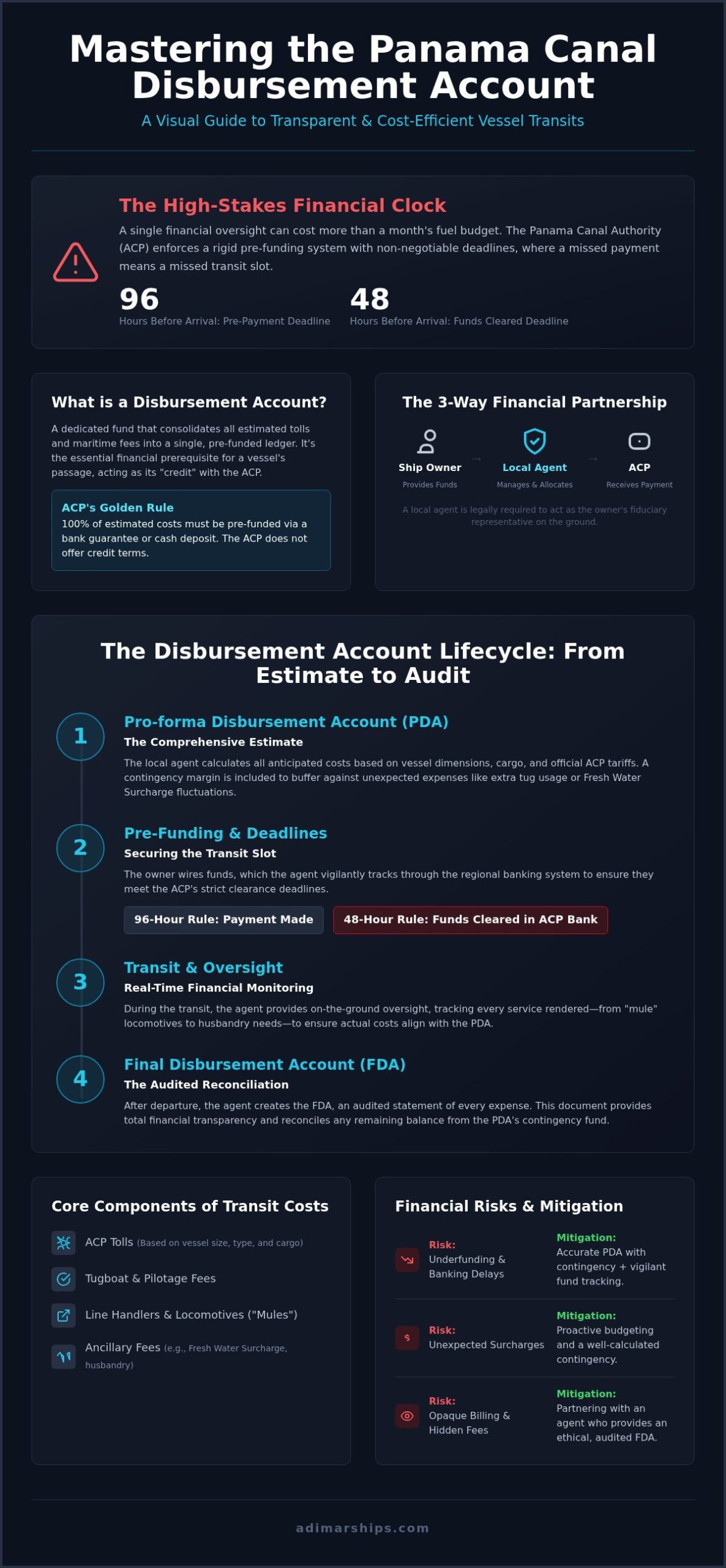
The Panama Canal Authority (ACP) maintains a unique and rigid stance on financial pre-funding. Unlike many international ports that might offer credit terms, the ACP requires a bank guarantee or a cash deposit covering 100% of the estimated tolls and maritime service charges. These funds must be cleared in the ACP’s accounts at least 48 hours before the vessel’s arrival. Because the ACP doesn’t interact directly with international ship owners for these payments, a local agent is legally required to manage these funds on your behalf. This agent acts as your fiduciary representative, ensuring that every dollar is accounted for and every deadline is met.
The Purpose of the Disbursement Account
The primary goal of this account is consolidation. A single transit involves numerous vendors and service providers, including tugboat operators, line handlers, and pilots. A Panama Canal disbursement account is the essential financial prerequisite that consolidates all estimated tolls and maritime fees into a single pre-funded ledger for a vessel’s passage. This consolidation ensures that the vessel has sufficient “credit” with the ACP to begin its transit immediately upon arrival. Without this verified credit, your ship won’t be allowed to enter the queue, leading to costly delays and missed slots.
Key Parties Involved in Financial Coordination
Managing these funds requires a three-way partnership between the ship owner, the local agent, and the ACP. Most owners rely on an owner’s nominated agency to protect their interests on the ground. This agency receives the funds from the owner via international wire transfer and then manages the allocation to the ACP and other service providers. The History of the Panama Canal shows how the complexity of these operations has grown, making local expertise indispensable. Banking requirements in Panama can be stringent, and international transfers often face delays in the regional banking system. Your agent monitors these transfers vigilantly, acting as an extension of your own team to confirm that the ACP acknowledges the funds in time to secure your transit slot.
The Lifecycle of a Panama Canal DA: From PDA to FDA
Managing a Panama Canal disbursement account involves a multi-stage workflow that begins weeks before arrival and concludes months after departure. It’s a journey from estimation to final audit. Success depends on the seamless transition from the Pro-forma Disbursement Account (PDA) to the Final Disbursement Account (FDA). This lifecycle ensures that every maritime service is accounted for and that the vessel remains in good standing with the Canal Authority throughout its journey.
Calculating the Pro-forma Disbursement Account (PDA)
The lifecycle starts with the PDA. This document is a comprehensive estimate of all anticipated costs. Agents calculate base tolls by evaluating vessel dimensions, type, and cargo volume against the official Panama Canal Authority Maritime Tariffs. It’s not just about tolls; the PDA must include tugboat fees, pilotage, and line handlers. Because the ACP requires 100% pre-funding, agents typically include a contingency margin. This buffer protects you from unexpected expenses, such as extra tug usage or fluctuations in the Fresh Water Surcharge, which could otherwise halt your transit.
Once the PDA is approved, the pre-funding phase begins. To secure a transit slot, all anticipated costs must be paid at least 96 hours before arrival. However, the strict “48-hour rule” is the final hurdle; funds must be cleared in the ACP’s bank account two full days before the vessel’s arrival. During the transit itself, your agent provides real-time oversight of the Panama Canal disbursement account to ensure actual costs stay within the projected budget. They track every service rendered, from “mule” locomotives to husbandry requirements, confirming that the actual costs align with the initial estimate.
The Final Reconciliation Process
The final phase is the creation of the FDA. This document is the audited statement of every expense incurred during the transit. According to current industry standards for 2026, owners can typically expect to receive their FDA within 60 to 90 days after completing the transit. This gap exists because the ACP takes time to issue final, verified invoices for all maritime services and surcharges.
During reconciliation, your agent compares the actual ACP charges against the initial PDA funds. If there’s a surplus, you receive a refund; if there’s a deficit, a supplementary payment is required. Accurate and timely delivery of the FDA is vital for your internal accounting and voyage profitability analysis. Partnering with a vigilant team for owner’s nominated agency services ensures this reconciliation process is transparent and that any financial friction is resolved quickly.
Core Components of Panama Canal Transit Costs
A Panama Canal disbursement account is more than just a simple toll payment. It consolidates a variety of mandatory and optional charges that ensure your vessel’s operational readiness. Beyond the base tolls, you must account for specialized maritime services and local compliance fees that vary based on vessel type and current environmental conditions. Understanding these specific line items is the first step toward achieving predictable transit costs.
Tolls and Mandatory ACP Charges
Base tolls remain the most significant entry in your account. These are calculated using the Panama Canal Universal Measurement System (PC/UMS). Environmental factors now play a larger role in your final bill. The Fresh Water Surcharge, for instance, includes a fixed portion of $10,000 for vessels over 300 feet plus a variable percentage based on the total tolls. You also face a strategic choice between standard booking fees and high-stakes auctions. While a Neopanamax reservation fee is $100,000, auction premiums reached as high as $425,000 in May 2026 to secure last-minute slots. These costs must be precisely captured in your Panama Canal disbursement account to avoid funding shortfalls.
Maritime Services and Compliance
Safe passage through the locks requires heavy-duty support from ACP-managed equipment. Tugboat fees for Neopanamax vessels average approximately $30,000 per transit. Additionally, every vessel must pay a mandatory security charge of $1,250. To navigate these complex requirements, you need the expertise of a ship agency Panama to coordinate directly with the Canal Authority. This coordination includes managing compliance through a PCSOPEP authorized person, which is a legal requirement for oil spill response readiness for vessels transiting the waterway.
Husbandry and Operational Expenses
Operational needs don’t stop at the locks. Integrating husbandry services into your account allows for seamless logistics while your vessel is in Panamanian waters. Your account covers crew change coordination, medical assistance, and provisioning. Your agent also manages Cash to Master (CTM) requests, ensuring your captain has the necessary funds for onboard operations without requiring separate wire transfers. Consolidating these costs into one ledger simplifies your financial reporting and ensures your vessel is fully supported throughout its entire stay.
Financial Risks and How to Mitigate Them
Financial friction is the silent killer of voyage profitability. Even with a confirmed slot, your vessel remains at risk if the underlying capital isn’t managed with extreme vigilance. The primary threat to your schedule isn’t always the weather; it’s administrative delay. A Panama Canal disbursement account that’s underfunded by even a few dollars can trigger an immediate stop-work order from the ACP. This financial friction leads to missed slots and massive auction premiums if you’re forced to re-book at the last minute.
Avoiding Transit Delays Due to Funding
Timing is everything when moving capital into Panama. International wire transfers typically require three to five business days to clear the regional banking system. If your funds aren’t visible in the ACP’s ledger at least 48 hours before arrival, your vessel won’t move. We’ve seen many owners struggle because they don’t account for local bank holidays or intermediary bank delays. A proactive agent acts as your early warning system. They monitor the account balance daily, alerting you to potential gaps before they become operational crises. This vigilance ensures you never face the stress of a vessel idling at sea because of a bank processing error.
Ensuring Invoice Accuracy
Transparency is your best defense against maritime fraud and hidden costs. When your vessel receives bunkers, spares, or medical assistance, the resulting invoices must be meticulously vetted. It’s common for third-party vendors to apply “Panama premiums” that aren’t always justified by current market conditions. Adimar Shipping utilizes 20 years of data to spot pricing anomalies in third-party invoices, ensuring you only pay fair market rates. We act as your on-the-ground auditor, verifying every receipt for accuracy before it’s included in your final statement.
Ethical financial management is a core brand promise we deliver for every client. By delegating your financial oversight to a seasoned partner, you gain the peace of mind that your funds are protected and your transit is secure. To ensure your next transit is managed with this level of precision, contact Adimar Shipping today for expert assistance with your maritime logistics and account management.
Adimar Shipping: Your Partner for Transparent Financial Management
At Adimar Shipping, we believe transparency is the bedrock of a successful maritime partnership. Managing a Panama Canal disbursement account requires absolute precision and an unwavering commitment to ethical standards. Our philosophy of “Integrity Every Time” ensures that every financial transaction is documented, verified, and reported with total clarity. We know the high stakes of the industry and the stress caused by opaque billing; therefore, we’ve built our service model around alleviating that pressure for our clients.
We provide a personalized service that larger, impersonal agencies often overlook. You gain a direct line of communication to a team that knows your account status in real time. Whether we are acting as your Owner’s Nominated Agency or Charterer’s Nominated Agency, we serve as a vigilant extension of your own office. We eliminate confusion by providing clear, concise DA breakdowns that strip away the complexity of ACP toll structures and maritime fees. This direct approach ensures you always have a predictable view of your transit costs.
The Adimar Advantage in Cost-Efficiency
Our 20 years of experience as a Panama Canal ship agent allows us to protect your bottom line with local vigilance. We leverage deep regional knowledge to identify and reduce unnecessary husbandry markups that can quietly drain your budget. Because we understand the importance of timing in maritime finance, we prioritize rapid response to financial queries and the swift closing of your Final Disbursement Account (FDA). By delegating these specialized tasks to our team, you gain the operational freedom to focus on your core business while we handle the local financial oversight.
Getting Started with a Quote
Securing an accurate Pro-forma Disbursement Account (PDA) is the first step toward a stress-free transit. To provide a precise estimation, our team requires specific vessel details, including dimensions, cargo type, and your estimated time of arrival. We use this data to build a comprehensive financial roadmap for your vessel’s passage, ensuring no hidden fees surprise you later. Our goal is to provide the security and reliability you need to navigate the Canal with total confidence.
Request a personalized PDA from Adimar Shipping today and experience the difference that local expertise and ethical financial management can make for your fleet.
Securing Your Financial Path Through the Panama Canal
Navigating the financial requirements of the Panama Canal doesn’t have to be a source of operational stress. By mastering the lifecycle of your Panama Canal disbursement account, you ensure that your vessel meets strict pre-funding deadlines while avoiding the volatility of last-minute auctions. Success depends on maintaining total transparency in your Proforma and Final Disbursement Accounts to protect voyage profitability and eliminate hidden markups.
You need a vigilant partner who acts as your local office on the ground. Adimar Shipping brings 20+ years of maritime expertise and specialized status as an authorized PCSOPEP representative to every transit. We provide 100% guaranteed shipping services that prioritize ethical reporting and direct communication. Don’t let financial friction stall your fleet’s progress or drain your budget.
Request a Transparent PDA for Your Panama Canal Transit today to secure your next slot with confidence. We’re ready to protect your interests and ensure your vessel moves through the locks with total efficiency.
Frequently Asked Questions
What is the difference between a PDA and an FDA at the Panama Canal?
The Pro-forma Disbursement Account (PDA) is a projected estimate based on vessel dimensions and current tariffs, used to secure mandatory pre-funding. In contrast, the Final Disbursement Account (FDA) is the actual, audited statement issued after the transit is complete. While the PDA guides your initial wire transfer, the FDA reconciles every penny spent against the original estimate. This final document typically arrives 60 to 90 days after departure once the ACP confirms all charges.
How far in advance must I fund my Panama Canal disbursement account?
You should initiate your wire transfer at least seven to ten days before your vessel’s expected arrival. While the Panama Canal Authority requires funds to be cleared 48 hours before transit, international banking delays often occur. Your Panama Canal disbursement account must show a full balance to avoid being bumped from the queue. Relying on a proactive agent helps you track these funds and ensures your vessel remains in good standing with the Authority.
Can I use one disbursement account for multiple vessel transits?
Most owners prefer separate accounts for each transit to maintain clean voyage accounting for tax and reporting purposes. However, you can maintain a standing credit balance with your agent to cover multiple vessels or frequent transits. This “running account” approach reduces the frequency of international wire transfers and helps you avoid repeated intermediary bank fees. It’s a strategic way to manage fleet finances while still receiving individual Final Disbursement Accounts for every passage.
What happens to the excess funds in my DA after the transit is completed?
Excess funds identified during the final reconciliation are handled according to your specific instructions. You can choose to have the surplus refunded directly to your corporate account or kept as a credit for your next scheduled transit. Most long-term partners prefer the credit option as it simplifies the pre-funding process for future voyages. Your agent provides a detailed statement showing the exact surplus amount once all third-party invoices are cleared and audited.
Are ACP tolls paid directly to the Authority or through the ship agent?
All ACP tolls and maritime charges are paid through your ship agent. The Panama Canal Authority doesn’t accept direct payments from international ship owners; instead, they require a local, legally registered agent to manage the transaction. This agent acts as a fiduciary, holding your funds in a dedicated Panama Canal disbursement account and transferring them to the ACP’s treasury. This system ensures that all local regulations are met and that payments are processed securely.
What are the most common “hidden costs” found in a Panama Canal DA?
The most common unexpected costs include variable Fresh Water Surcharges, which change based on Gatun Lake levels, and additional tugboat usage for difficult maneuvers. You might also encounter “Panama premiums” on local supplies or unplanned medical and husbandry expenses. These aren’t necessarily hidden but can vary from the initial estimate. A vigilant agent vets every invoice against local market rates to ensure you aren’t overcharged for services provided by third-party vendors during the transit.
How does Adimar Shipping ensure the transparency of my disbursement account?
We utilize our 20-year database of historical costs to spot pricing anomalies and overcharges from local vendors. Our “Integrity Every Time” commitment means we provide original receipts for every expense incurred. We don’t hide markups in husbandry or maritime services. Instead, we offer a transparent breakdown of every charge in your Panama Canal disbursement account. You receive direct communication from our Panama City office, ensuring you have total visibility into your vessel’s financial status.
Can husbandry services be billed separately from the main transit DA?
Yes, you can request separate billing for husbandry services if your internal accounting requires it. While most owners consolidate crew changes, provisioning, and medical services into the main transit account for efficiency, we can provide separate ledgers. This flexibility allows you to allocate costs to different departments or charterers more easily. Regardless of the billing structure, we maintain the same high level of transparency and ethical reporting for every service we provide on the ground.