
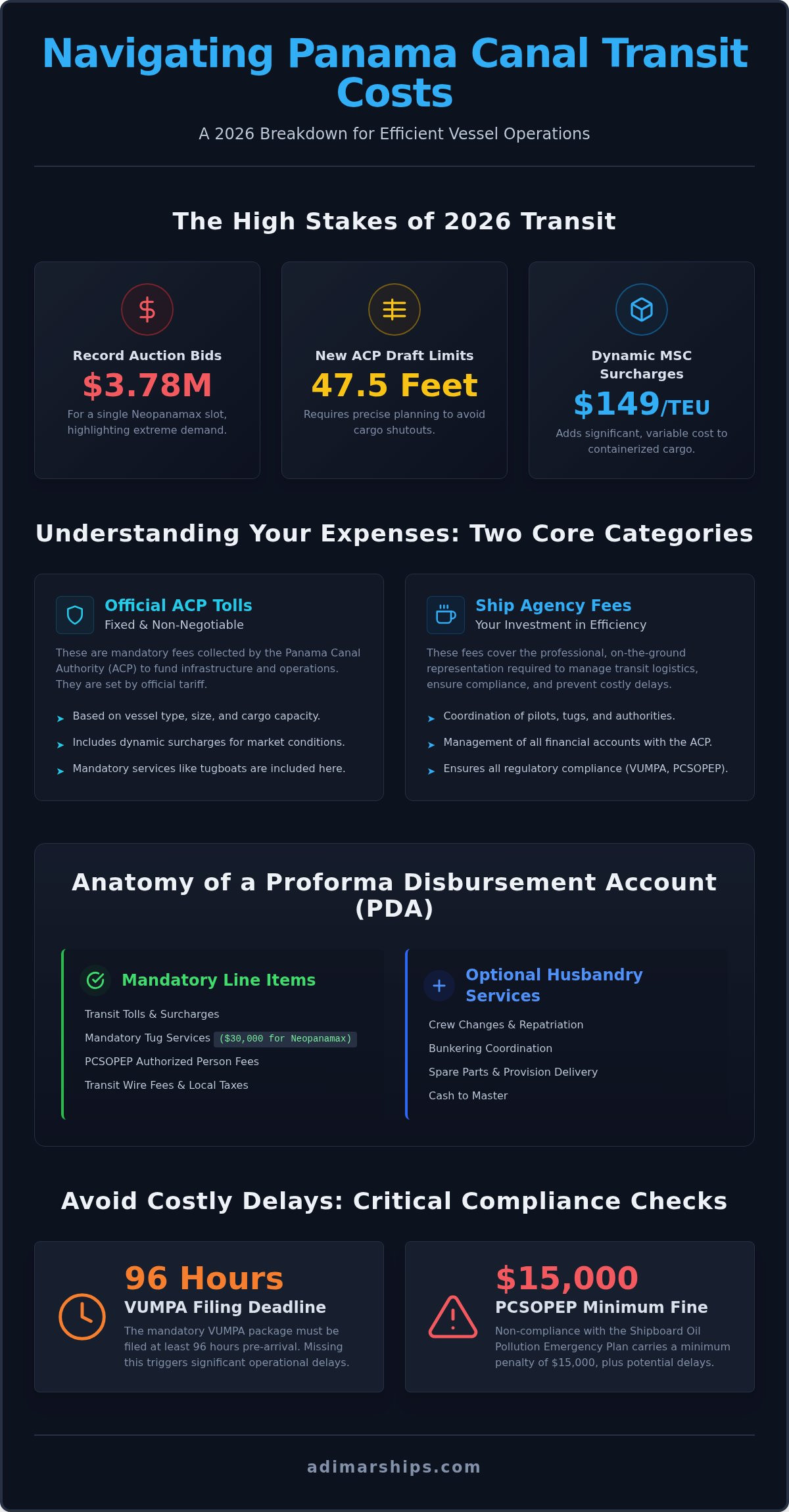
With auction bids for Neopanamax slots reaching a staggering $3.78 million, the financial stakes for a single transit have never been higher. You are likely feeling the pressure of unpredictable ship agency fees Panama Canal and escalating surcharges that seem to change with every tide. It is frustrating to receive a Proforma Disbursement Account (PDA) that feels like a moving target; especially when new ACP draft restrictions of 47.5 feet and shifting MSC surcharges of $149 per TEU are suddenly added to your costs.
We understand that you need transparency and a vigilant partner on the ground to prevent hidden husbandry costs from inflating your final invoice. This 2026 guide provides a clear breakdown of official tolls, agency structures, and the critical VUMPA requirements you must meet 96 hours before arrival. You will gain the confidence to optimize your disbursement accounts and minimize expensive wait times. We will explore the current market rates for tug services, auction trends, and how specialized local expertise acts as a secure, dependable extension of your own team in Panama.
Key Takeaways
- Differentiate between fixed ACP tolls and negotiable service costs to ensure your disbursement account remains accurate and predictable throughout the transit.
- Benchmark your ship agency fees Panama Canal against 2026 market standards to identify red flags and avoid overpaying for standard transit services.
- Master the management of husbandry and ancillary service costs to keep variable expenses like crew changes and supply deliveries under control.
- Learn how a local, PCSOPEP-authorized partner uses 20 years of experience to navigate complex ACP regulations and minimize costly operational delays.
- Gain the tools to evaluate Proforma Disbursement Accounts (PDAs) with confidence, ensuring every line item reflects actual market conditions.
Understanding the Structure of Panama Canal Transit Costs
Managing a transit involves balancing two distinct categories of expense. The first category includes the official tolls and maritime services collected by the Panama Canal Authority (ACP). The second category consists of the ship agency fees Panama Canal providers charge for professional representation and logistical management. These two elements form the backbone of your financial planning for any vessel crossing.
The ship agent acts as your financial intermediary. We manage the complex flow of funds to the ACP, ensuring your vessel meets all financial requirements before it reaches the locks. This role is vital because the ACP operates on a strict pre-payment basis. Without a local agent to coordinate these payments and verify documentation, your vessel risks being denied entry or facing significant fines. In 2026, regulatory changes regarding draft restrictions and dynamic surcharges make this financial oversight even more critical.
Official ACP Tolls vs. Agency Service Fees
Official tolls are non-negotiable fees determined by the ACP based on vessel type, size, and cargo capacity. For a comprehensive Panama Canal overview, it’s helpful to understand that these tolls fund the infrastructure and operation of the locks. In 2026, these costs are often supplemented by dynamic surcharges, such as the $149 per TEU fee recently introduced by major carriers like MSC for certain trade routes. While tolls are fixed, ship agency fees Panama Canal experts provide are the investment that protects you from operational risks.
Agency fees cover the expert coordination required to move your vessel through this system. This includes filing the mandatory VUMPA (Ventanilla Única Marítima de Panamá) package at least 96 hours before arrival. Missing this deadline or submitting incorrect data can trigger delays that far exceed the cost of professional representation. Your agent ensures compliance with regulations like the PCSOPEP (Panama Canal Shipboard Oil Pollution Emergency Plan), where non-compliance carries a minimum fine of $15,000. Paying for a local agent is the most effective way to prevent costly fines and transit delays.
The Anatomy of a Proforma Disbursement Account (PDA)
The Proforma Disbursement Account is the primary tool for budgeting your transit. It separates mandatory costs from the optional husbandry services you might require. A Proforma Disbursement Account (PDA) is a binding estimate of all port and canal expenses.
Mandatory line items in 2026 include:
- Transit tolls and surcharges
- Mandatory tug services (currently $30,000 for Neopanamax locks)
- PCSOPEP authorized person fees
- Transit wire fees and local taxes
Optional items often include husbandry services like crew changes, bunkering coordination, or spare parts delivery. Clear separation between these items prevents the hidden costs that often plague generic agency quotes. By reviewing the PDA early, you can ensure your funds are allocated efficiently for the specific draft and slot conditions of your 2026 transit.
Breaking Down Standard Ship Agency Fees in Panama
Standard service is not a commodity in this environment. In 2026, the ship agency fees Panama Canal experts charge reflect the intense coordination required to manage shifting slot availability and draft restrictions. A standard service scope typically includes processing all arrival and departure clearances, pilot and tug coordination, and the management of the vessel’s financial accounts with the authorities. It is the baseline of expertise that keeps your vessel moving through the locks without administrative friction.
Several factors influence the variability of these fees. Vessel size and type are the primary drivers; a Neopanamax container ship requires significantly more logistical oversight than a smaller bulk carrier. Transit direction also plays a role, as traffic patterns often face different congestion levels and slot auction pressures. The 2026 slot reservation changes have made communication the most valuable part of your agency fee. Having a partner who provides a vigilant, on the ground presence ensures you aren’t left in the dark when auction prices surge or schedules shift.
Nomination Types and Their Fee Implications
The structure of your agency fee often depends on who appoints the representative. An Owner’s Nominated Agency (ONA) focuses strictly on the interests of the vessel owner, while a Charterer’s Nominated Agency (CNA) handles the requirements of the party hiring the vessel. Many owners choose to appoint a Protective Agent (OPA) even when a charterer has nominated the primary agent. This ensures an independent expert is watching over the owner’s specific interests, such as verifying the accuracy of the final disbursement account. For a deeper look at protecting your assets, see our Owner’s Nominated Agency guide.
Administrative and Documentation Costs
Administrative fees cover the specialized labor of filing complex documentation. This includes the mandatory VUMPA submission, which must be completed at least 96 hours before your vessel enters canal waters. Errors in these filings lead to immediate delays and potential penalties. The Panama Canal Authority Maritime Tariffs provide the baseline for official costs, but your agency fee covers the human expertise needed to navigate them. This includes managing your vessel’s financial needs through a local office and ensuring compliance with PCSOPEP regulations.
Adimar Shipping, Inc. acts as an authorized PCSOPEP representative, a role that is essential for avoiding the minimum $15,000 fine for non-compliance. Our team manages these administrative hurdles with the precision that only 20 years of local experience can provide. We focus on delivering personalized service at competitive costs, acting as a dependable extension of your own team. If you’re unsure how these variables affect your specific vessel, you can request a tailored consultation from our specialists to clarify your 2026 transit budget.
Husbandry and Ancillary Service Costs Beyond the Transit
While the base ship agency fees Panama Canal providers charge cover the transit’s administrative skeleton, husbandry services represent the variable muscle of your operation. These costs fluctuate based on specific vessel needs during the port call or transit. Logistical coordination for crew and supplies often makes up a significant portion of the final invoice. Managing these requires deep local vendor relationships to keep costs predictable and avoid the markups often found with generic global networks. We focus on cost-conscious efficiency to ensure your husbandry budget doesn’t spiral out of control.
Crew Changes and Medical Assistance
Panama is a strategic hub for crew rotations. The costs involved extend beyond simple transport; they include immigration processing, lodging, and shore passes. Coordinating these movements requires precision to avoid vessel delays at the anchorage. Managing medical evacuations or seafarer medical visits also demands a partner who can act immediately. Our team acts as a vigilant extension of your team on the ground, ensuring your crew’s welfare doesn’t compromise your schedule. For a detailed look at these requirements, refer to our Guide to Ship Husbandry Services in Panama.
Spares, Provisions, and Cash to Master (CTM)
Spare parts delivery involves more than just transportation. It requires navigating Panamanian customs and port authority regulations. Logistics fees for customs clearance and delivery to the vessel can escalate if they aren’t managed by an experienced agent. Coordinating bunker supplies and fresh water provisioning requires a vigilant eye on local market rates and delivery windows. We also ensure the secure handling and delivery of Cash to Master (CTM) during the transit. This provides the financial security your crew depends on while at sea, managed with the ethical standards we’ve upheld for 20 years.
Adimar Shipping focuses on cost-conscious efficiency for every non-transit operation. We understand that husbandry costs can quickly inflate a Proforma Disbursement Account if not monitored closely. By leveraging our long-standing history in the region, we provide transparent billing and reliable coordination. This approach eliminates confusion and ensures your husbandry budget reflects actual market conditions rather than hidden administrative surcharges. We act as your local eyes and ears, protecting your interests at every terminal and anchorage.
How to Evaluate a Proforma Disbursement Account (PDA)
Evaluating a Proforma Disbursement Account (PDA) requires a keen eye for detail. This document is your financial roadmap for a transit, and its accuracy determines the success of your voyage’s budget. One major red flag in any quote is a set of unusually low ship agency fees Panama Canal. While these might seem attractive, they often mask hidden markups on husbandry services or administrative surcharges later. You should always prefer an itemized billing structure over “all-in” fees. Itemization allows you to verify that official ACP charges are passed through at cost, without arbitrary additions from the agent.
The 2026 landscape adds a layer of complexity with transit slot auctions. Your PDA must reflect the latest auction trends to be realistic. With starting bids for smaller vessels at $15,000 and Neopanamax slots often exceeding $55,000, an agent who ignores these market conditions isn’t protecting your interests. We ensure every estimate is grounded in current market data, providing you with a reliable forecast of your total disbursement. This vigilance helps you avoid the shock of a final invoice that bears little resemblance to the initial estimate.
The PDA Checklist for Ship Owners
Owners must verify several critical data points before approving a PDA. First, ensure the agent has used the correct tonnage measurements and vessel dimensions, as these dictate the base toll. Second, confirm the inclusion of mandatory PCSOPEP authorized person fees. Failing to account for these leads to the minimum $15,000 non-compliance fine mentioned earlier. Finally, check that pilotage and tugboat requirements match the current 2026 tariffs. An accurate PDA should reflect these specific, verified costs rather than vague approximations.
Transparency and Ethical Standards in Billing
Integrity is the foundation of our 20-year history in Panama. We believe transparent pricing is the only way to build long-term trust with vessel owners and operators. Adimar Shipping, Inc. emphasizes integrity and ethical conduct in all quotes, which means providing rapid response times to clarify any discrepancies you find. If a line item feels unclear, your agent should be able to provide the official ACP tariff or local vendor invoice to support it. This level of oversight prevents the lack of transparency many owners face with generic global agencies.
By choosing a partner that prioritizes honesty, you gain confidence that your PDA reflects actual market conditions. Our role is to act as a dependable extension of your team, protecting your capital as if it were our own. We eliminate confusion by providing clear, documented breakdowns of every transit expense. To ensure your next transit budget is accurate and transparent, request a professional PDA review from our experienced team today.
Why Adimar Shipping is the Strategic Choice for Cost-Efficiency
Celebrating our 20th year in business, Adimar Shipping, Inc. has established itself as a cornerstone of reliability for owners and operators. We understand that ship agency fees Panama Canal providers charge are often viewed as a fixed cost. However, we position these fees as a strategic investment in risk mitigation. Our deep local knowledge allows us to eliminate the confusion that often arises from shifting ACP regulations and dynamic surcharges. By acting as a vigilant extension of your team on the ground, we ensure that every dollar in your disbursement account is spent with purpose and precision.
Local expertise is the only way to navigate the logistical complexities of 2026. While global networks offer broad coverage, they often lack the technical depth required to manage the specific draft reductions and slot auction surges currently impacting the canal. We monitor these trends daily. This proactive oversight prevents the administrative errors and timing delays that lead to expensive fines. Our goal is to provide peace of mind, allowing you to delegate specialized tasks to a partner that prioritizes your vessel’s interests above all else.
A Local Partner vs. A Global Aggregator
The primary advantage of working with a specialized local agency is direct, unfiltered communication. When you deal with a global aggregator, your requests often pass through several layers of bureaucracy before reaching the person actually coordinating with the authorities. This lag time is dangerous in an environment where missing a VUMPA deadline by a few hours can disrupt an entire voyage. Adimar’s regional expertise translates to fewer delays because we have the direct relationships needed to resolve issues immediately. You can learn more about how this specialized representation protects your interests in our guide on Why a Panama Canal Ships Agent is Your Most Valuable Asset.
Secure Your 2026 Transit with Confidence
Navigating the upcoming year requires a partner who anticipates regulatory changes before they impact your bottom line. Whether you are managing an Owner’s Nominated Agency requirement or need specialized husbandry coordination, our team is ready to provide the stability you need. We maintain the highest ethical standards, ensuring that every quote and final invoice is transparent, accurate, and free of hidden surcharges. This commitment to integrity has been our signature for two decades.
Securing your 2026 transit budget starts with a reliable estimate. We invite you to request a customized Proforma Disbursement Account (PDA) that reflects the actual market conditions for your vessel type and transit window. Nominating Adimar as your agent means choosing a partner dedicated to operational freedom and financial security. Contact Adimar Shipping for a transparent quote and experience the difference that 20 years of local vigilance makes for your fleet.
Secure Your Transit Budget with Expert Local Oversight
Managing your fleet’s expenses in 2026 requires more than just a spreadsheet; it demands a vigilant partner who understands the nuances of the ACP’s evolving landscape. You’ve learned that controlling ship agency fees Panama Canal providers quote is only half the battle. True cost-efficiency comes from accurately evaluating your PDA, managing variable husbandry services, and ensuring your agent is an authorized PCSOPEP representative. By focusing on transparency and ethical standards, you can turn logistical complexity into a manageable operational advantage.
Adimar Shipping, Inc. acts as a dependable extension of your team on the ground. With 20 years of specialized experience as a husbandry specialist and local ships agent, we provide the transparency you need to navigate these waters with confidence. We don’t just process paperwork; we protect your interests at every terminal and lock. It’s time to eliminate the stress of hidden costs and unpredictable invoices that disrupt your financial planning.
Take the first step toward a more secure and predictable transit experience today. Request a Transparent PDA Quote from Adimar Shipping, Inc. to lock in your 2026 budget with a partner you can trust. We look forward to helping your vessel achieve a smooth and efficient passage through Panama.
Frequently Asked Questions
What are the average ship agency fees for a Panama Canal transit in 2026?
Ship agency fees Panama Canal providers charge depend on the specific requirements of your voyage. A pure transit typically costs less than a transit requiring bunkering or full husbandry support. Factors like vessel size, type, and the complexity of your documentation also influence the final quote. Because these fees represent the professional management of your transit, they vary based on the level of personalized oversight and local expertise your agent provides for the 2026 season.
Does the ship agency fee include official Panama Canal Authority (ACP) tolls?
No, the ship agency fee is separate from the official tolls. The Panama Canal Authority (ACP) sets non-negotiable tolls based on vessel tonnage and cargo capacity. Your agency fee covers the professional coordination, documentation, and local representation required to manage the transit process. The agent acts as your financial intermediary, ensuring that all ACP tolls and surcharges are paid correctly and on time to avoid vessel delays or administrative penalties.
Are there extra fees for crew changes during a canal transit?
Yes, crew changes involve additional costs as they fall under husbandry services. These expenses include immigration processing, transport, and lodging for incoming and outgoing seafarers. Because Panama is a major maritime hub, coordinating these movements requires precise timing with the vessel’s arrival at the anchorage. Professional agents manage these logistical details to ensure your crew rotation is seamless and doesn’t interfere with your scheduled transit window or increase port stay durations.
How can I verify the accuracy of a Proforma Disbursement Account (PDA)?
You can verify a PDA by cross-referencing all official line items with the latest Panama Canal Authority maritime tariffs. Ensure that mandatory costs, such as the $30,000 tug fee for Neopanamax locks, are correctly listed based on your vessel class. A transparent agent will provide an itemized breakdown rather than a lump sum. This allows you to confirm that all ACP charges are passed through at cost without hidden markups or administrative padding.
What is a PCSOPEP authorized person fee, and is it mandatory?
The PCSOPEP authorized person fee covers the mandatory local representative required for the Panama Canal Shipboard Oil Pollution Emergency Plan. Every vessel transiting the canal must have a designated person on the ground to coordinate response efforts in the event of a spill. Because non-compliance with this regulation carries a minimum fine of $15,000, it is a critical and mandatory component of your transit budget. Adimar Shipping provides this specialized compliance service as an authorized representative.
Why do agency fees vary between different ship agents in Panama?
Variation in ship agency fees Panama Canal agents offer often reflects the difference between generic global networks and specialized local partners. A local agent with 20 years of experience provides a higher level of vigilant, on the ground oversight that prevents costly errors. Fees may also vary based on whether you require a simple transit coordination or a full suite of husbandry services. Choosing an agent based on expertise rather than the lowest price often yields better long-term cost-efficiency.
Can a ship agent help reduce the costs associated with transit delays?
A proactive ship agent reduces costs by preventing delays before they occur. This is achieved through the accurate filing of the VUMPA package at least 96 hours before arrival and the efficient coordination of pilots and tugs. By acting as a vigilant extension of your team, an agent can navigate changing ACP regulations and slot auction trends. This local oversight ensures your vessel maintains its schedule, avoiding the massive financial penalties associated with missed transit windows or port congestion.
What is the difference between an agency fee and a husbandry fee?
The agency fee covers the administrative and coordination tasks directly related to the vessel’s transit through the canal locks. In contrast, a husbandry fee covers services dedicated to the vessel and crew’s physical needs. This includes provisioning, spare parts delivery, fresh water supply, and crew medical visits. While the agency fee is the baseline for any transit, husbandry fees are variable and depend on the specific logistical support you require during your port call or transit.