
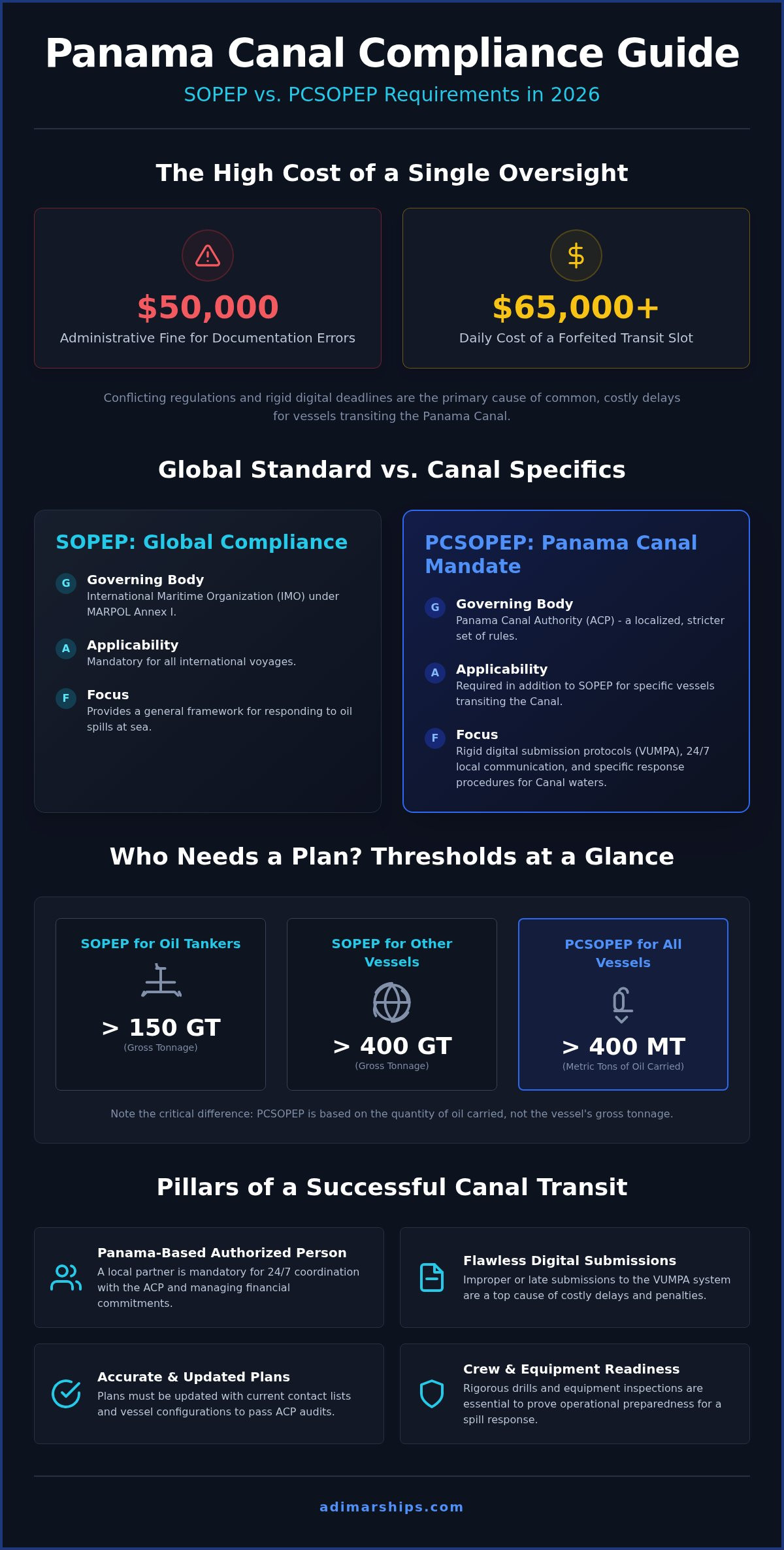
A single documentation oversight at the locks can trigger an administrative fine of $50,000 and the immediate forfeiture of a transit slot worth upwards of $65,000 per day. You’ve likely spent weeks ensuring your fleet meets global MARPOL Annex I standards, yet the Panama Canal Authority (ACP) enforces a localized set of rules that often catch even experienced operators off guard. It’s a high-stakes environment where conflicting regulations and rigid digital submission deadlines frequently cause common delays Panama Canal transits simply cannot afford. We understand the pressure of managing these logistical hurdles while protecting your bottom line from unnecessary penalties.
This guide provides the expert clarity you need to master the complexities of SOPEP and PCSOPEP compliance in 2026. By delegating these specialized tasks to a vigilant local partner, you can ensure your vessel meets every ACP requirement before it ever reaches the breakwater. We’ll explore the latest VUMPA submission protocols, the specific 400-metric-ton threshold for emergency plans, and the essential role of a Panama-based Authorized Person in maintaining seamless, 24/7 communication with canal authorities.
Key Takeaways
- Understand mandatory MARPOL Annex I requirements for tankers and ships over 400 GT to ensure global environmental compliance.
- Distinguish between standard global plans and the specific PCSOPEP requirements mandated by the Panama Canal Authority for all vessels carrying 400 metric tons of oil.
- Identify how improper plan submissions and documentation errors rank among the most common delays Panama Canal transits face.
- Learn the critical role of a Panama-based Authorized Person in managing 24/7 coordination and financial commitments with the ACP.
- Implement a rigorous schedule for crew drills and equipment inspections to ensure your vessel is always prepared for a spill response.
What is SOPEP? Understanding MARPOL Annex I Compliance
Environmental protection isn’t just a moral duty; it’s a legal mandate that dictates whether your vessel stays on schedule or sits idle. The Shipboard Oil Pollution Emergency Plan (SOPEP) serves as the primary response manual for oil spill incidents at sea. Mandated by MARPOL Annex I, this document provides the Master and crew with a clear, structured framework to follow when things go wrong. It ensures that every action taken during a spill is coordinated, fast, and compliant with international law. In 2026, the International Maritime Organization (IMO) and Flag States have intensified their focus on these plans, moving toward stricter digital verification and real-time reporting standards to prevent maritime disasters.
The Legal Framework: MARPOL 73/78
MARPOL 73/78 remains the bedrock of international maritime pollution prevention. Over the decades, Annex I regulations have evolved from simple containment strategies to complex, proactive management systems. In the current 2026 regulatory environment, enforcement is more rigorous than ever. International maritime law treats oil pollution as a top-tier operational priority because the environmental and financial stakes are immense. If a vessel fails to produce a valid, updated SOPEP during an inspection, the consequences are immediate. Beyond heavy administrative fines and vessel detentions, your company faces long-term reputational damage that can affect insurance premiums and future chartering opportunities. We see many owners struggle with these nuances, but staying ahead of global enforcement trends is the only way to safeguard your fleet’s operational freedom.
Vessel Categories and Mandatory Thresholds
Not every vessel follows the same rulebook. Mandatory thresholds for SOPEP compliance depend strictly on the type of ship and its gross tonnage (GT). For oil tankers, the threshold is low; any tanker over 150 GT must carry an approved plan. For other vessel types, such as dry bulk carriers or container ships, the requirement kicks in at 400 GT. These figures aren’t suggestions. Port State Control (PSC) officers across the globe use these specific markers to determine compliance during boarding.
Discrepancies in these documents are among the most common delays Panama Canal inspectors report during pre-transit checks. While your global SOPEP might satisfy a standard port visit, it often lacks the local specificities required for a Canal transit. Ensuring your plan accurately reflects your vessel’s current configuration and gross tonnage is essential for a smooth arrival. By delegating the review of these complex thresholds to a specialized agent, you eliminate the risk of a simple documentation error turning into a multi-day delay. We act as your vigilant representatives on the ground, ensuring your global compliance translates perfectly to local requirements.
Essential Components of an Effective SOPEP Plan
The Master bears ultimate responsibility for the execution of the plan during an emergency. When a spill occurs, the officers don’t have time to debate their next move; they rely on the SOPEP as a definitive, step-by-step checklist. This response framework must clearly define the hierarchy of reporting between Coastal States and Port Authorities. Following the International Maritime Organization (IMO) guidelines ensures that your vessel remains compliant with global standards, but the real challenge lies in bridging the gap between shipboard action and shore-side coordination. A successful plan transforms a chaotic event into a manageable operation through clear communication and pre-defined duties.
The Reporting Hierarchy and Contact Lists
Inaccurate contact lists are among the most frequent causes for common delays Panama Canal inspectors identify during pre-transit audits. If your digital records don’t match the current requirements of the Panama Canal Authority (ACP), your transit can be halted before it even begins. The role of the Qualified Individual (QI) has become more integrated into digital response platforms like VUMPA in 2026. Maintaining real-time accuracy in your contact information for the Flag State, Coastal State, and shipowner is no longer optional; it’s a prerequisite for clearance. A single outdated phone number in your submission can lead to the common delays Panama Canal transits often suffer, costing thousands in forfeited slots.
Operational Procedures for Oil Spill Control
Effective plans provide specific guidance for various crisis scenarios. These include pipe leakages, tank overflows, and hull damage. Your SOPEP locker must be fully stocked with essential items such as sorbent pads, booms, and non-sparking tools. In 2026, many operators choose to integrate their SOPEP with the Shipboard Marine Pollution Emergency Plan (SMPEP) to address potential chemical spills. This unified approach reduces confusion during high-stress moments and ensures the crew uses the correct containment methods for the specific substance involved. Realistic procedures focus on immediate actions to reduce or control accidental discharge before it escalates into a major environmental incident.
Delegating the management of these complex components to a PCSOPEP authorized person provides the peace of mind that your documentation is always ready for scrutiny. We act as your vigilant representatives, ensuring your local coordination is as robust as your global compliance.
PCSOPEP vs. Standard SOPEP: Requirements for the Panama Canal
The Panama Canal Shipboard Oil Pollution Emergency Plan (PCSOPEP) is not a mere extension of your global MARPOL plan. It’s a distinct, localized requirement for any vessel with an oil carrying capacity of 400 metric tons or more, including fuel and cargo. While a standard SOPEP satisfies international ports, the Canal’s inland waters demand a bilingual response framework tailored to its specific geography. Inadequate or non-compliant documentation remains one of the most common delays Panama Canal authorities report. Relying on a generic plan can lead to administrative fines starting at $15,000 or the total loss of your transit slot, which can cost upwards of $65,000 per day for Neo-Panamax vessels.
The Role of the Panama Canal Authority (ACP)
The Panama Canal Authority maintains strict oversight through the VUMPA digital portal. All PCSOPEP documents must be submitted at least 96 hours before your vessel reaches Canal waters. Late submissions trigger an automatic $2,500 fine; however, the real cost lies in the operational disruption. The ACP uses a tier-based classification system to manage risk. Tier 1 covers vessels with 400 to 1,000 metric tons of oil, whereas Tier 3 applies to those carrying over 7,000 metric tons. Miscalculating your tier or failing to update your plan every two years creates the common delays Panama Canal inspectors use to halt transits and demand immediate corrections.
The Authorized Person (AP) Requirement
A critical component of this local mandate is the designation of a Panama-based Authorized Person (AP). This individual must be available 24 hours a day to coordinate with the ACP and local Oil Spill Response Organizations (OSROs). The AP holds the legal power to commit shipowner funds for emergency cleanup, ensuring that response efforts aren’t stalled by financial bureaucracy during a crisis. Without a registered and verified AP on file, your Panama Canal transit cannot proceed. By delegating this role to a specialized ship agent, you gain a vigilant partner who understands the local landscape and protects your interests on the ground. We act as your local office, simplifying these complex requirements so your crew can focus on a safe passage.
Best Practices for SOPEP Maintenance and Crew Drills
Vigilance on the bridge must be matched by readiness on the deck. A plan is only as effective as the crew executing it and the equipment supporting it. Establishing a rigorous schedule for SOPEP inspections ensures that sorbent materials, containment booms, and protective gear are always functional. Neglecting these checks often results in common delays Panama Canal transits experience when ACP inspectors discover degraded equipment during a boarding. Maintenance isn’t just a box to tick; it’s your vessel’s first line of defense against an escalating incident.
Designing Effective Response Drills
Realistic training moves beyond simple checklists. Your drills should simulate diverse scenarios, such as minor pipe leakages or catastrophic hull breaches, to build genuine muscle memory. During these exercises, you must test the entire communication hierarchy. The Master needs to know exactly who to contact at the local response organization without hesitation. By evaluating drill performance, you can identify technical training gaps or equipment shortages before they manifest in a real emergency. We’ve seen that vessels with high drill frequency navigate inspections with far more confidence.
Record Keeping and Audit Readiness
If an activity isn’t documented in the Oil Record Book (ORB), authorities treat it as if it never happened. Accurate, real-time logging of all SOPEP drills and inspections is essential for passing maritime audits in 2026. Whether you use digital platforms or traditional paper logs, your records must be transparent and immediately accessible. Incomplete drill descriptions or missing signatures are the types of deficiencies that lead to the common delays Panama Canal inspectors impose to ensure safety standards are met.
Preparing for a ship agency Panama inspection requires a proactive approach to compliance. We recommend reviewing and updating your plan annually, or whenever significant crew changes occur, to ensure everyone understands their specific roles. Delegating the oversight of these complex tasks to a dedicated partner allows you to focus on the technical aspects of navigation. You can safeguard your transit schedule by partnering with a vigilant representative who understands the local audit landscape.
Adimar Shipping, Inc.: Your Authorized Person for Seamless PCSOPEP Compliance
Adimar Shipping, Inc. acts as your dedicated PCSOPEP authorized person, providing the vigilance required to manage the Canal’s complex regulatory environment. We understand that the stakes are high. A single documentation error or a delayed response to the ACP can trigger the common delays Panama Canal transits frequently encounter, leading to massive financial losses. By delegating these specialized compliance tasks to our team, you transform a potential logistical nightmare into a predictable process. We serve as your eyes and ears in Panama, ensuring every detail of your emergency plan is verified and submitted well before your vessel arrives at the breakwater.
The Value of Local Expertise in the Canal Zone
Our deep local knowledge allows us to anticipate challenges before they disrupt your schedule. As your on-the-ground representative, Adimar Shipping, Inc. maintains proactive communication with the Panama Canal Authority, resolving potential issues in the VUMPA system in real-time. This level of oversight is essential for avoiding the steep fines and transit interruptions that plague unprepared operators. We don’t just process paperwork; we actively safeguard your vessel’s interests by ensuring all local environmental regulations are met with precision. This expertise delegation narrative is at the core of our service, allowing you to focus on global operations while we handle the intricacies of the Canal Zone.
Integrated Solutions: Beyond Compliance
Operational success in Panama requires more than just a valid emergency plan. We provide integrated solutions that combine PCSOPEP representation with expert husbandry services and crew support. Whether you need spare parts delivery, crew changes, or medical assistance, our team manages every requirement with transparency and speed. As an owner’s nominated agency, we prioritize your vessel’s needs above all else, protecting you from the common delays Panama Canal traffic often faces due to poor coordination between different service providers.
Our commitment to ethical standards and reliability makes Adimar Shipping, Inc. a dependable extension of your own team. We’ve built our reputation on being a stable partner in an unpredictable industry. We invite you to contact us today to develop a tailored transit and compliance strategy for 2026. Let our experienced problem-solvers simplify your next transit, providing the security and peace of mind your fleet deserves in this high-stakes maritime corridor.
Safeguarding Your Transit Operations for 2026
The shift toward stricter environmental oversight in 2026 makes the distinction between global SOPEP and local PCSOPEP a critical factor for operational success. As discussed, maintaining updated documentation and rigorous crew response training are the most effective ways to mitigate the risk of common delays Panama Canal authorities impose during inspections. Success depends on a response framework that’s as dynamic as the waterway itself. Protecting your bottom line requires a strategy that eliminates the friction between international standards and local mandates.
Adimar Shipping, Inc. provides the expert local representation necessary to navigate these high-stakes requirements with confidence. By delegating the role of the Authorized Person and ship agency coordination to our team, you gain a vigilant partner committed to protecting your interests and ensuring your vessel remains on schedule. We serve as your local office, simplifying the complex digital and regulatory hurdles of the Canal Zone with transparency and reliability.
Secure your Panama Canal transit with Adimar Shipping, Inc.’s PCSOPEP Authorized Person services today. We’re ready to act as your dependable partner, ensuring a seamless and secure passage for your fleet through Panama’s vital corridor.
Frequently Asked Questions
What is the primary difference between SOPEP and SMPEP?
The distinction lies in the pollutants covered under MARPOL regulations. A SOPEP targets oil pollution as defined in Annex I, while a SMPEP (Shipboard Marine Pollution Emergency Plan) addresses both oil and noxious liquid substances under Annex II. Vessels carrying chemicals or other hazardous liquids must maintain a SMPEP to ensure they meet the broader environmental compliance standards required for international voyages in 2026.
Is a PCSOPEP mandatory for all vessels transiting the Panama Canal?
A PCSOPEP is only mandatory for vessels with an oil carrying capacity of 400 metric tons or more. This calculation includes all oil carried as cargo and fuel used for propulsion. If your vessel falls below this threshold, you aren’t required to submit a specialized Panama plan, though you must still comply with standard MARPOL SOPEP requirements for your flag state and international port entries.
Who is legally allowed to serve as an Authorized Person (AP) for PCSOPEP?
The Panama Canal Authority requires the Authorized Person to be a resident of Panama with 24/7 availability. This individual or entity, such as Adimar Shipping, Inc., must have the legal authority to coordinate with the ACP and commit shipowner funds for spill response operations. Because the AP acts as the primary link between the vessel and local response organizations, they must possess deep technical knowledge of canal regulations.
How often must a SOPEP plan be reviewed and updated by the shipowner?
The ACP mandates a formal review of the PCSOPEP every two years to ensure all contact data and response protocols are current. Failing to update these records is a primary source of the common delays Panama Canal transits suffer during documentation audits. Beyond the biennial requirement, you must also revise the plan if the vessel undergoes major structural changes or a change in management to maintain its validity.
What are the common equipment requirements for a SOPEP locker in 2026?
Standard lockers must include sorbent pads, containment booms, non-sparking shovels, and sealable bags. In 2026, inspectors also verify the presence of chemical-resistant gloves and portable containers for recovered residue. Ensuring these items are well-maintained prevents the common delays Panama Canal authorities impose when equipment is found to be degraded or incomplete during a pre-transit inspection. Regular deck inspections are essential for maintaining audit readiness.
What happens if a vessel does not have a valid PCSOPEP upon arrival in Panama?
Arrival without a valid plan results in immediate transit denial and potential administrative fines starting at $15,000. The vessel will be forced to anchor until a plan is approved and an Authorized Person is registered, which can take several days. This leads to the forfeiture of your transit slot, resulting in significant financial losses and disrupting the entire supply chain for your charterers and owners.
Can a ship agent also act as the PCSOPEP Authorized Person?
Yes, Adimar Shipping, Inc. provides integrated ship agency and Authorized Person services to streamline your transit. This dual role is highly efficient because your agent already manages your vessel’s arrival documentation and ACP communications. Delegating both tasks to a single specialized partner ensures that your local representative has immediate access to all necessary data, which significantly reduces the risk of administrative friction during an emergency.
What are the reporting requirements for a minor oil spill on deck during transit?
Any spill, regardless of its size or whether it reaches the water, must be reported to the Panama Canal Authority immediately. The Master must notify the ACP via radio or the VUMPA system and inform the designated Authorized Person. There’s no minimum threshold for reporting; even minor leaks during bunkering or maintenance must be logged and disclosed to ensure compliance with the Canal’s strict environmental protection standards.