
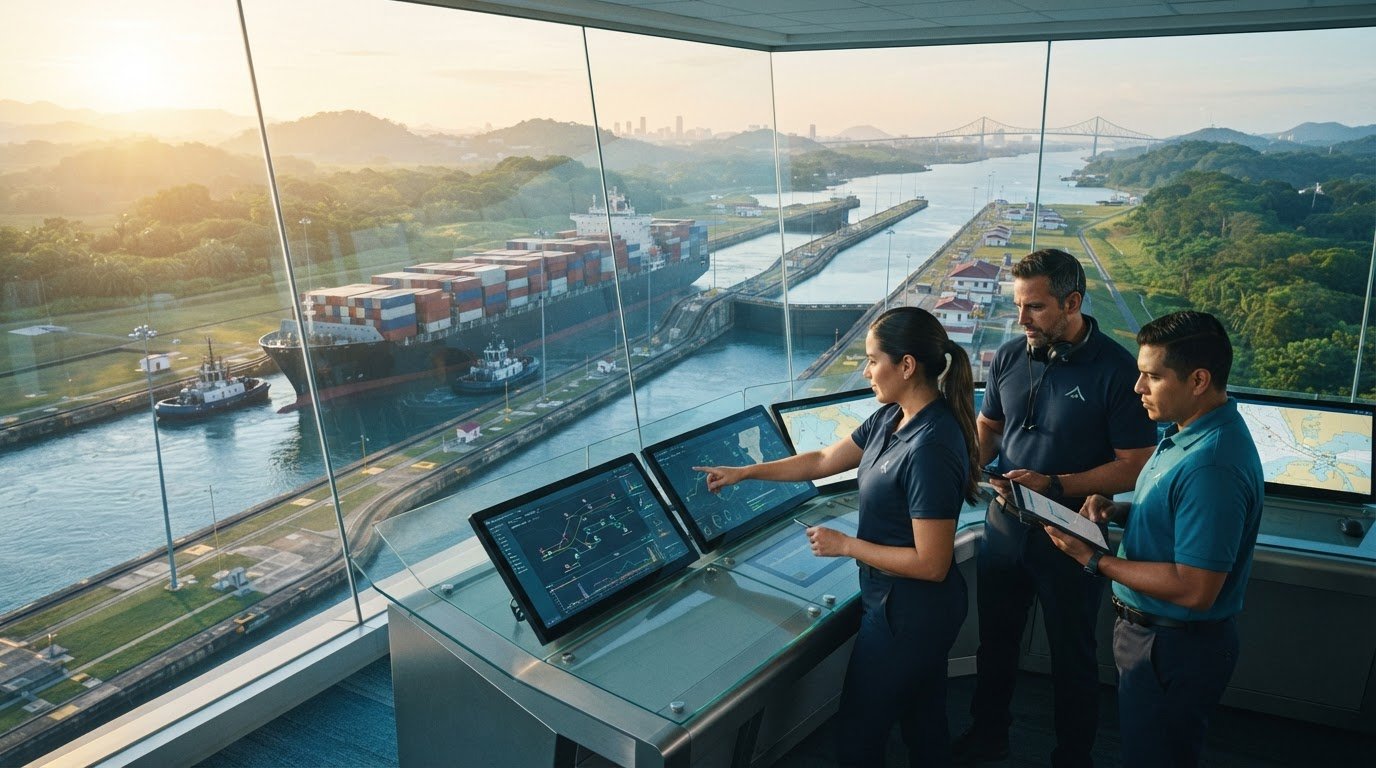
A missed handoff between booking, documentation, and vessel readiness can disrupt a Canal transit even when no single task seems complicated. Effective panama canal transit coordination keeps these steps connected, with clear responsibilities and timely updates as the plan develops.
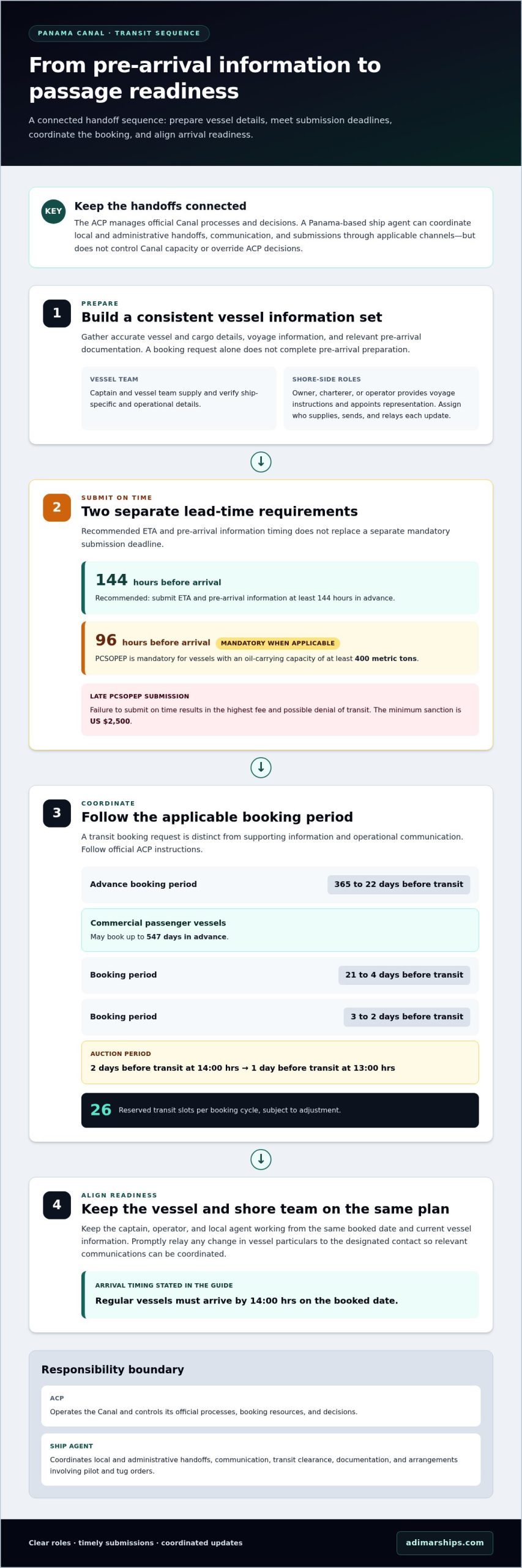
For owners, charterers, and operators, several parties need accurate information at the right time. PCSOPEP is mandatory for vessels with an oil-carrying capacity of at least 400 metric tons and must be submitted at least 96 hours before arrival. Recommended ETA and pre-arrival information should be submitted at least 144 hours in advance. Meeting these deadlines is essential, but so is keeping communication clear across the full transit sequence.
This guide outlines the information and operational handoffs to track, how official Panama Canal Authority (ACP) processes fit into the plan, and how local agency coordination supports the work. It also covers how booking periods and vessel requirements affect preparation, and how Adimar Shipping, Inc.’s presence at Balboa and Cristóbal connects operators with local transit processes.
Key Takeaways
- Treat panama canal transit coordination as a sequence of connected handoffs, and distinguish ACP decisions from an agency’s coordination role.
- Build a pre-arrival timeline that includes recommended ETA and information submission at least 144 hours in advance.
- Assign clear responsibility for vessel details, submissions, and updates, while recognizing that Canal capacity and operating conditions are outside an agency’s control.
- Assess coordination arrangements by local presence, assigned responsibilities, communication practices, documentation support, and service scope.
- Adimar Shipping connects transit booking requests and the Panama Canal Service Portal with communication and local support at Balboa and Cristóbal.
What Panama Canal Transit Coordination Covers Beyond the Booking
A booking request is one handoff, not the whole transit plan. Panama canal transit coordination connects accurate vessel information with official Canal processes, local operational arrangements, and communication among the people responsible for the voyage. A request can be submitted, but vessel readiness and stakeholder alignment still need attention as pre-arrival tasks and operational updates are handled.
Transit coordination aligns vessel information, Canal procedures, local arrangements, and stakeholder communication. Transit booking is the specific process of requesting or securing a place in the Canal’s schedule. The ACP operates the Canal and controls its official processes and decisions. A ship agent represents the vessel’s interests in Panama and coordinates local and administrative handoffs. The agent supports the process but does not determine Canal capacity or override Authority decisions.
This distinction is easier to understand with a little context. The Panama Canal overview explains the waterway’s history and role in global trade. For vessel operators, the practical focus is how information and responsibilities move between parties for a particular transit.
Which parties and handoffs shape a Canal transit?
The vessel operator, owner or charterer, captain, ship agent, and ACP each have a role. The operator, owner, or charterer provides voyage instructions and appoints representation. The captain and vessel team supply and verify ship-specific information, including operational details needed for planning. The agent organizes information for local coordination, communicates with the relevant parties, and supports submissions through applicable official channels. The ACP manages its own booking and operating processes.
Confusion often starts when responsibility is implied rather than assigned. Agree on who supplies each vessel detail, who sends it, and who relays updates. For example, if vessel particulars change, the captain or operator should promptly notify the designated contact, who can coordinate the relevant communication. This keeps stakeholders working from consistent information without suggesting that the agent controls the Authority’s response.
What does a Panama-based ship agent coordinate?
A Panama-based ship agent can coordinate transit clearance, documentation, and arrangements involving pilot and tug orders. These tasks connect vessel information and operational requirements with local processes. The agent manages communication and representation, not Canal operations, official Canal decisions, or the Authority’s booking resources.
That distinction helps keep the plan practical. The ACP determines official processes and operational conditions; the agent helps owners, charterers, operators, and captains manage related information and local handoffs. A booking request alone does not cover every pre-arrival or operational task. Clear roles and direct communication keep those tasks visible as the transit approaches. For broader passage context, the existing Panama Canal transit guide can complement this coordination overview.
Panama Canal Transit: From Pre-Arrival to Passage
A well-organized transit develops through preparation, submissions, booking coordination, and arrival checks. Each stage depends on timely, consistent information from the vessel and the people coordinating ashore. The ACP controls its official processes, while a Panama-based agent can help connect vessel details and stakeholder communications to those processes.
Submit recommended ETA and pre-arrival information no less than 144 hours before arrival, while meeting every separate mandatory deadline that applies to the vessel. This recommended lead time does not replace specific requirements, including PCSOPEP submission.
- Prepare vessel information. Gather accurate vessel and cargo details, voyage information, and relevant pre-arrival documentation. For a first-time transit, allow time to organize the required documents. A booking request alone does not complete pre-arrival preparation.
- Submit information on schedule. Recommended ETA and pre-arrival information should be submitted at least 144 hours in advance. Separately, PCSOPEP is mandatory for vessels with an oil-carrying capacity of at least 400 MT and must be submitted at least 96 hours before arrival. Failure to submit on time results in the highest fee and possible denial of transit. The minimum sanction is US $2,500.
- Coordinate the booking. A transit booking request is distinct from the supporting information and operational communication around it. Follow the official ACP instructions. Booking periods include 365 to 22 days before transit, with commercial passenger vessels able to book up to 547 days in advance; 21 to 4 days; and 3 to 2 days. The auction period runs from 2 days before transit at 14:00 hrs to 1 day before transit at 13:00 hrs. There are 26 reserved transit slots per booking cycle, subject to adjustment. The Panama Canal Authority official site is the source for official Canal procedures. For detailed booking-period instructions, consult the dedicated transit-slot booking guide.
- Align arrival readiness. Keep the captain, operator, and local agent working from the same booked date and current vessel information. Regular vessels must arrive by 14:00 hrs on the booked date; Supers vessels must arrive by 02:00 hrs on the booked date. A booked date cannot be changed, so plan arrival readiness around that requirement.
- Maintain communication through passage. Keep operational updates flowing between the vessel and shore-side contacts as the transit approaches and proceeds. This helps stakeholders respond to new information without confusing coordination updates with an official change to the booking or Canal schedule.
What belongs in the pre-arrival coordination phase?
Pre-arrival work starts with collecting vessel and cargo details and organizing the information for connection to the Panama Canal Service Portal. First-time transits also require document preparation. The required documents depend on the applicable process, so use the current requirements rather than relying on an assumed certificate list. A clear submission timeline helps the operator, captain, and agent track what is due and who owns each handoff.
How do communication and arrival readiness stay aligned?
Adimar’s operation managers maintain constant communication with vessel captains, connecting vessel updates with arrival planning. This local coordination supports readiness but cannot alter the booked date or replace ACP requirements. Operators can use a defined communication path to keep responsibilities visible from pre-arrival through passage. For vessels transiting Panama, Adimar’s Panama-based agency coordination connects operators with local support across the process.
Where Panama Canal Transit Coordination Can Break Down, and How to Control Handoffs
Many avoidable coordination problems begin with a small gap: vessel details are incomplete, a submission has no clear owner, or an ETA update does not reach everyone who needs it. These are issues the operator’s coordination process can address. Canal capacity, weather, operating conditions, and ACP decisions are not within the operator’s control. Clear handoffs help prevent avoidable errors without promising control over the transit schedule.
Keep those responsibilities distinct. The U.S. Department of State’s History of the Panama Canal provides historical context; current operating requirements come from applicable ACP information. Panama canal transit coordination helps the vessel team manage information and communication, but it cannot override official Canal decisions.
How can operators reduce information and deadline gaps?
Assign a named owner to each document, submission, operational update, and confirmation. Record who supplies the information, who sends it, and how receipt is tracked. This accountability makes it easier to identify a missing item before it becomes a last-minute problem.
- Keep vessel details aligned. Use a consistent source for vessel particulars and ETA information across operator, captain, and agent communications. If information changes, send the revised details through the agreed channel.
- Track deadlines and confirmations. Maintain a shared record of what was submitted, when it was sent, and whether confirmation was received. Preparing a document does not mean it has been submitted.
- Escalate changes promptly. If a detail is missing or the ETA changes, notify the designated contacts without delay. State what changed and which information or planned action it affects.
These controls help prevent confusion among stakeholders. They do not guarantee a particular transit date or outcome, since operating conditions and ACP decisions remain outside the vessel team’s control.
What compliance points require special attention?
For vessels with an oil-carrying capacity of at least 400 MT, PCSOPEP submission is mandatory at least 96 hours before arrival. Failure to submit on time results in the highest fee and possible denial of transit. The minimum sanction is US $2,500. This sanction is mandatory and cannot be waived through agency coordination. A PCSOPEP Authorized Person must reside in Panama, so assign this responsibility to a Panama-resident representative.
Boarding readiness matters too. All vessels must comply with the boarding facility requirements in SOLAS Regulation 17, Chapter V. Treat this as a vessel-readiness responsibility, not simply a paperwork handoff, and keep the relevant shipboard team informed. Adimar Shipping provides Panama-based agency coordination and can act as the Panama-resident PCSOPEP Authorized Person. Learn about Adimar’s local agency support for managing these responsibilities.
How to Assess a Panama Canal Transit Coordination Arrangement
A coordination arrangement should make responsibilities easier to see, not add another layer of uncertainty. Assess how the agent works alongside the vessel team and official ACP resources. The ACP controls its booking systems and Canal decisions; local agency coordination supports the vessel’s information flow, representation, and operational handoffs.
Use this framework to compare the practical scope of an arrangement:
| Area | What to look for |
|---|---|
| Local presence | A Panama-based team with a defined role in local transit coordination and terminal support. |
| Named responsibilities | Clear ownership for transit clearance, pilot and tug orders, documentation, and follow-up. |
| Communication | A direct channel between the operator, captain, and agency team, with updates relayed to the right stakeholders. |
| Documentation | A process for organizing vessel information, monitoring submissions, and tracking confirmations. |
| Service scope | A clear distinction between transit agency tasks and separate services such as husbandry. |
Using official booking resources directly and appointing an agent are related but different functions. Users engage with ACP booking processes through the official system. An agent coordinates vessel information and local responsibilities around that process. Defined task ownership can reduce duplicate messages and make it clear who handles each next step.
Which service responsibilities should be explicit?
Establish who coordinates transit clearance, pilot and tug orders, and the relevant documentation. Spell out how updates and confirmations move between the vessel, operator, and agency team. Keep transit agency responsibilities distinct from husbandry, which covers separate vessel support needs, and technical fleet support. Adimar provides transit agency, nominated agency, protective agency, and husbandry services. This clarity helps owners and charterers understand the scope of local representation. Adimar Shipping’s ship agency services in Panama provide further context on the agency role.
Why do local presence and communication matter?
A Panama-based team can provide local coordination, while Adimar’s presence at both Balboa and Cristóbal connects its agency team to the Canal’s terminal locations. Ongoing communication between Adimar’s operation managers and vessel captains helps keep relevant parties informed. Daily communication and transparent, cost-conscious quotes also help operators understand the coordination being provided and plan their agency arrangements with a clear scope.
Adimar’s full agency service is available 24/7. This provides continuous agency coverage, while Canal capacity and ACP decisions remain outside the agency’s control. Clear scope and communication show which tasks are assigned locally and which remain with the vessel team or Authority.
If you’re assessing local support for an upcoming transit, discuss Panama Canal coordination with Adimar and clarify how agency responsibilities can fit your vessel’s operational requirements.
How Adimar Shipping Coordinates Panama Canal Transits
For owners, charterers, and vessel operators, panama canal transit coordination works best when local representation, vessel information, and communication stay connected. Adimar Shipping, Inc. is a Panama-based ship agency supporting that coordination. The ACP controls its official systems and transit decisions; Adimar helps clients manage agency handoffs and local processes around them.
Adimar handles transit booking requests, connects with the Panama Canal Service Portal for vessel and cargo details, and integrates the coordination process with its DA desk. These are connected parts of the agency workflow, not a substitute for the Canal Authority’s official booking processes. The aim is to keep information moving between the vessel and shore-side team, with responsibilities clear to the client.
What does Adimar handle during transit coordination?
Adimar’s ship agency coordination covers transit clearance, pilot and tug orders, and required inbound and outbound documentation. Owners and charterers can appoint Adimar as their nominated agency, with the representation role and communication path established for the vessel. Adimar also provides protective ships agency, with responsibilities distinguished from those of a nominated agency.
Adimar provides husbandry and technical fleet support for separate vessel needs, including crew changes, provisioning, and other port-call arrangements. This distinction helps clients understand which tasks belong to transit coordination and which are additional vessel support. Further husbandry information is available in Adimar’s husbandry services guide.
How can operators start coordination with Adimar?
Share the vessel’s particulars, cargo information, current ETA, and transit-planning details. This gives the agency team a starting point to organize the booking request and related information, align responsibilities, and communicate with the vessel’s captain and operator. Promptly share changes to plans or vessel details so the coordination picture stays current.
Adimar maintains constant communication with operation managers and captains, and has a presence at both Balboa and Cristóbal. That local connection supports direct coordination with stakeholders in Panama. Adimar’s full agency service is available 24/7, and transparent, cost-conscious quotes help clients understand the proposed scope. Canal decisions and transit outcomes remain subject to the relevant official processes and operating conditions.
For a tailored quote, provide the vessel and voyage details relevant to your requirements. To discuss panama canal transit coordination for an upcoming passage, contact Adimar Shipping about vessel transit support.
Put a Clear Transit Plan in Place
Before the next voyage enters its Panama planning window, turn coordination into a working plan your shore team and vessel can use. Set a point of contact, assign ownership for submissions and updates, and agree how changes will be shared. A concise, vessel-specific plan gives everyone a clear reference as schedules and operational details develop.
Aligning owners’, charterers’, and operators’ instructions early helps prevent the vessel team from having to reconcile conflicting messages as the transit approaches. Strong panama canal transit coordination does not remove uncertainty from a complex passage. It gives your team a dependable way to manage its responsibilities and keep communication organized as plans develop.
Adimar Shipping can coordinate local agency support around your vessel’s requirements. Discuss your transit plans, representation needs, and preferred communication flow with a Panama-based agency partner. Discuss your Panama Canal transit coordination with Adimar and put a practical plan in place for your operation.
With clear responsibilities and local support, your team can move forward with greater confidence.
Frequently Asked Questions
Is Panama Canal transit coordination the same as booking a transit slot?
No. Booking a slot is one official step; panama canal transit coordination also connects vessel information, documentation, operational communication, and local support. The Panama Canal Authority controls its booking systems and transit decisions. A ship agent coordinates related tasks and communications without replacing the Authority’s processes. For example, an operator can use official booking resources while relying on an agent to organize vessel updates and keep stakeholders aligned.
Can a booked Panama Canal transit date be changed?
No. A booked date cannot be changed. Plan vessel readiness, ETA information, and related arrangements around the confirmed date rather than treating it as flexible. If an operational circumstance affects the plan, notify the relevant parties promptly and share the revised information. Communication does not change the booked date or waive the restriction.
What arrival times apply to Regular and Supers vessels?
Regular vessels must arrive by 14:00 hrs on the booked date; Supers vessels must arrive by 02:00 hrs on that date. Use the vessel’s applicable classification when planning arrival readiness and communicating ETA details. For example, a team coordinating a Supers vessel should not use the Regular-vessel cutoff as its planning target. A late arrival does not change the booked date.
Is PCSOPEP required for every vessel transiting the Panama Canal?
No. PCSOPEP is mandatory for vessels with an oil-carrying capacity of at least 400 MT, and it must be submitted at least 96 hours before arrival by an Authorized Person residing in Panama. Adimar can act as the Authorized Person. Failure to submit on time results in the highest fee and possible denial of transit; the minimum sanction is US $2,500. This sanction is mandatory and cannot be waived through agency coordination.
How are PCSOPEP oil-carrying capacity tiers classified?
The classifications are Tier S for 400 MT to 1,000 MT; Tier 1 for more than 1,000 MT to 7,000 MT; Tier 1 & 2 for more than 7,000 MT to 15,000 MT; and Tier 1, 2, 3 for more than 15,000 MT. Use the vessel’s oil-carrying capacity to identify the applicable range, and follow current Canal guidance when applying a tier to a specific vessel.
Do Panama Canal vessels need compliant boarding facilities?
Yes. All vessels must comply with SOLAS Regulation 17, Chapter V boarding facility requirements. Include boarding arrangements in vessel-readiness planning, and ensure the relevant shipboard team understands its role before arrival. This is a vessel compliance matter, not an optional agency service or a substitute for other applicable requirements. Treating it as a separate readiness item keeps it visible alongside transit documentation and operational planning.