

If you’re asking “what happens if my vessel misses its transit slot,” the next steps depend on why the vessel missed its required arrival time and whether it was ready for transit. Late arrival, a readiness issue, and a documentation problem are different situations, so establish the cause before drawing conclusions about the outcome.
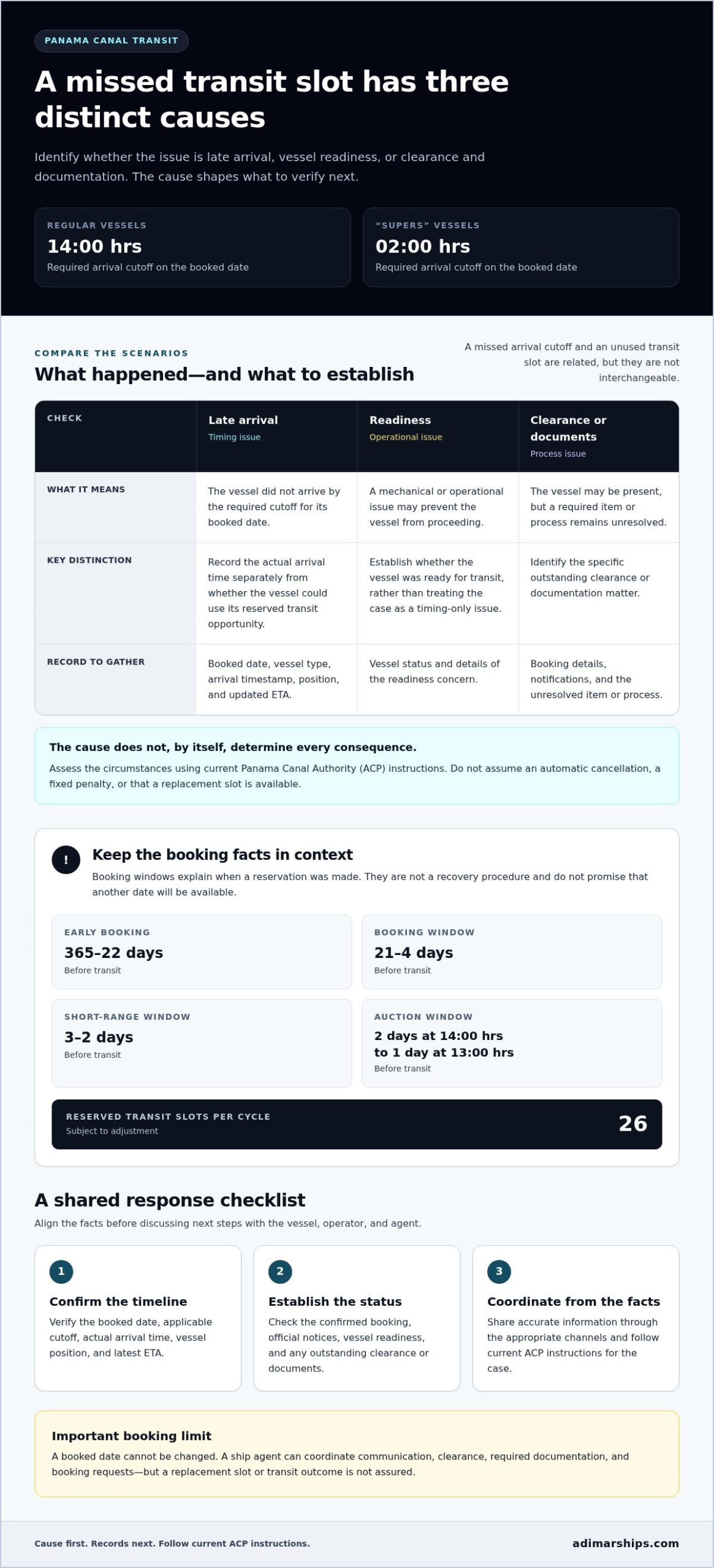
Regular vessels must arrive by 14:00 hrs on the booked date, while “Supers” vessels must arrive by 02:00 hrs. Missing the applicable cutoff can disrupt the vessel’s schedule. A booked date cannot be changed, so do not assume the reservation can simply be moved.
This guide explains what to establish first, which vessel details and records to gather, and how to coordinate a timely response. Adimar Shipping’s Panama-based ship agency team coordinates transit booking requests, clearance, required documentation, and communication with the vessel and operator. Start by identifying the cause and sharing accurate information with the relevant parties.
Key Takeaways
- The reason for the missed transit opportunity shapes the response, whether the issue is late arrival, clearance, documentation, or vessel readiness.
- Use current Panama Canal Authority booking instructions to guide next steps. Do not assume a replacement slot is available.
- To understand what happens if my vessel misses its transit slot, assemble the booking details, notifications, timestamps, and ETA updates.
- Establish the vessel’s status, document the issue, coordinate with stakeholders, and follow official instructions.
- A Panama-based ship agent can coordinate booking requests, clearance, required documents, and communication with the vessel and operator.
What Happens If a Vessel Misses Its Panama Canal Transit Slot?
The outcome depends on why the vessel missed its booked transit opportunity. A vessel arriving after the required cutoff presents a different situation from one that arrives on time but cannot meet readiness or clearance requirements. Booking and documentation problems also need to be assessed on their own facts. If you’re asking “what happens if my vessel misses its transit slot,” establish what occurred before assuming a particular consequence applies.
A missed slot can disrupt the vessel’s schedule and require the operator to reassess its transit plans. The specific implications and next steps depend on the circumstances and current Panama Canal Authority (ACP) instructions. An agent can coordinate communication and booking requests, but a booked date cannot be changed and a replacement slot is not assured. The canal’s lock system is central to transit operations. The Panama Canal locks provide background on how vessels pass between water levels.
Missed arrival deadline versus missed transit slot
An arrival cutoff and a confirmed transit slot are connected, but they are not interchangeable. The cutoff sets the required arrival time for the booked date; the slot is the vessel’s reserved transit opportunity. Regular vessels must arrive by 14:00 hrs on the booked date. “Supers” vessels must arrive by 02:00 hrs on the booked date.
Missing the applicable cutoff is a timing issue to report and assess. It does not, by itself, establish every subsequent consequence. Distinguish the vessel’s actual arrival time from whether it was able to proceed with its reserved transit. Keep the date and time records precise, including the vessel’s position and updated ETA, so everyone coordinating the response is working from the same timeline.
Why the reason for the missed slot matters
Separate late arrival from other possible causes. A late arrival concerns the vessel’s progress toward the Canal. A readiness concern could involve a mechanical or operational issue that prevents the vessel from proceeding. A clearance or documentation problem is different: the vessel may be present, but a required item or process may remain unresolved.
A missed slot is a booked transit opportunity the vessel could not use as scheduled. The reason and applicable ACP instructions determine what follows. Do not treat every case as an automatic cancellation or assign a fixed penalty without checking the circumstances.
Before discussing options, establish the cause and gather the relevant records. Confirm the booked date, arrival time, vessel status, and any outstanding readiness, clearance, or document issues. Then share the facts through the appropriate channels and follow the ACP’s current instructions for the case. A clear account helps the vessel, operator, and local ship agent respond consistently without assuming the booked date can be changed.
How Panama Canal Booking Rules Shape the Next Steps
Booking windows explain how a transit reservation was obtained, but they do not determine what happens after a vessel misses its slot. Treat them as booking context, not as a recovery procedure or a promise that another date is available. The vessel’s confirmed status, the reason it could not proceed, and current Panama Canal Authority (ACP) instructions all matter.
For general context on planning and coordinating a Canal transit, see this Panama Canal transit guide. After a disruption, keep general planning information separate from the vessel’s specific booking record and any official communication it has received.
Which booking window applied to the vessel?
Booking periods are grouped by how far ahead of transit a reservation is made. The auction window has its own opening and closing times:
- Early booking: 365-22 days before transit.
- Booking window: 21-4 days before transit.
- Short-range window: 3-2 days before transit.
- Auction window: 2 days at 14:00 hrs to 1 day at 13:00 hrs before transit.
The total number of reserved transit slots per cycle is 26, subject to adjustment. These periods describe booking windows; they do not establish that a missed reservation can be shifted into another window or that a slot will be open. If you’re assessing what happens if my vessel misses its transit slot, use the window to understand the original booking context. Confirm the vessel’s reservation and follow the current ACP process for its circumstances.
What operators should verify with current ACP instructions
Start with the vessel’s confirmed booking status and any official notices or messages already received. Then identify why transit did not proceed, such as late arrival, a readiness concern, or an unresolved clearance or documentation matter. Refer to current ACP guidance for the specific cause rather than assuming the same process applies to every case.
Keep official Canal booking requirements distinct from other reporting obligations. For example, operators with applicable U.S. reporting requirements can refer to the U.S. Customs and Border Protection Panama Canal Reporting Requirements. That reference does not establish the vessel’s ACP reservation status or the steps following a missed slot.
Align the booking record, the vessel’s timeline, and ACP communications before discussing the case with the operator and agent. A Panama-based ship agent can coordinate those details and transit booking requests without assuring a new date or transit outcome. Adimar Shipping provides local coordination as part of its ship agency work. Its Panama Canal ship agency team helps keep communication focused while the operator follows official instructions.
Late Arrival, Compliance Issue, or Vessel Readiness: Compare the Scenarios
Different causes call for different follow-up. A vessel may miss its booked arrival cutoff, be unable to complete a clearance requirement, or not be ready to proceed. These situations are not interchangeable. Establish what prevented transit, then coordinate the response around that issue. This helps the operator share accurate facts with the agent and follow applicable Panama Canal Authority (ACP) instructions.
| Scenario | Information to establish | Next coordination step |
|---|---|---|
| Late arrival | Booked date, applicable cutoff, actual position, and latest ETA | Record timestamps and updates, then coordinate follow-up using current ACP instructions |
| Documentation or clearance issue | Which document, submission, or clearance item is outstanding, and its status | Identify the responsible party and coordinate accurate information through the appropriate channel |
| Vessel readiness | What operational or technical issue prevented the vessel from being ready | Establish the vessel’s current status and communicate it for case-specific direction |
When arrival timing is the issue
Compare the vessel’s actual arrival information with the booked date and required cutoff. Regular vessels must arrive by 14:00 hrs on the booked date; “Supers” vessels must arrive by 02:00 hrs on the booked date. Keep the latest ETA, position reports, relevant timestamps, and communications together. This timeline helps the operator and agent discuss the event consistently instead of relying on an estimate that may have changed during the approach.
An ETA update can show when a delay became apparent, but it does not explain by itself why the vessel missed the cutoff or determine what the ACP will require next. Preserve earlier updates alongside the latest one, and distinguish projected arrival from actual arrival in reports.
When compliance or vessel readiness is the issue
Check separately whether the matter concerns documentation, clearance, or the vessel’s ability to proceed. For vessels with oil-carrying capacity of at least 400 MT, PCSOPEP submission is mandatory at least 96 hours before arrival. Failure to submit PCSOPEP on time results in the highest fee and possible denial of transit. The minimum sanction is US$2,500. These consequences apply to late PCSOPEP submission, not automatically to every missed slot or readiness issue.
For detailed requirements and coordination context, consult the PCSOPEP authorized-person guide. If the issue is mechanical or operational readiness, record what is affected, the vessel’s present condition, and any updates to its readiness status. Do not describe a readiness concern as a documentation failure, or vice versa. When considering what happens if my vessel misses its transit slot, identifying the precise cause gives the operator and local agent a sound basis for following the applicable instructions.
What to Do Immediately After Your Vessel Misses Its Slot
A missed slot calls for a clear, factual response. Establish the vessel’s current status, identify what prevented transit, and bring the relevant records together before discussing next steps. Prompt communication between the master, operator, charterer, and appointed agent helps everyone work from the same information. These actions support coordination; they do not change the booked date or guarantee another slot.
Use this sequence to organize the response:
- Establish the vessel’s status. Confirm its actual position, whether it has arrived in the relevant Canal area, its operational condition, and its latest ETA if it is still approaching. Separate confirmed facts from estimates. If the ETA changes, record when the update was issued and who received it.
- Identify the cause. Determine whether the issue was late arrival, clearance or documentation, compliance, or vessel readiness. Be specific. Record which document remains outstanding or what condition prevented the vessel from being ready, rather than reporting only that transit could not proceed.
- Gather the incident record. Collect the booked date and confirmed booking details, relevant ACP notifications, arrival and communication timestamps, current clearance status, vessel reports, and ETA updates. Keep original messages alongside later updates so the sequence of events is clear. A concise, consistent record helps prevent conflicting accounts among the vessel, operator, and charterer.
- Coordinate with the appointed agent and stakeholders. Share verified facts promptly with the agent, master, operator, and charterer. Identify who is handling each communication and what information remains outstanding. The agent can coordinate the case, while the vessel and operator provide accurate updates on position, readiness, and documentation.
- Follow official instructions. Use current ACP communications to guide the case-specific next steps. Keep a record of new instructions and any information submitted in response. Do not assume a replacement slot is available or treat a booking request as confirmation of a new transit date. The appointed agent can help maintain communication, but the booked date cannot be changed.
A useful first update is short and verifiable: identify the vessel and booked date, state its present position and latest ETA, describe the known cause, and list any outstanding clearance or readiness items. If the cause is still being assessed, say so rather than presenting an unconfirmed explanation as fact. This gives the operator and agent a sound basis for coordinated follow-up.
If you’re asking “what happens if my vessel misses its transit slot,” a timely, accurate incident record is the starting point for understanding the case and responding to official directions. Coordinate your Panama Canal ship agency response with Adimar Shipping.
How a Panama Canal Ship Agent Helps Coordinate After a Missed Slot
A missed transit creates several parallel tasks: establish the vessel’s status, communicate with relevant parties, and follow current Panama Canal Authority (ACP) instructions. A Panama-based ship agent can organize that coordination while the operator assesses the situation. Adimar Shipping works with ship owners, charterers, and operators to coordinate transit booking requests, clearance, required documentation, pilots and tugs, and stakeholder communication.
Agency support does not change a booked date, control ACP decisions, or guarantee a replacement slot or transit outcome. Its role is local coordination and clear communication, helping the vessel and shore-side teams act on the same verified facts.
Local coordination without unsupported promises
Adimar’s Panama-based team has a presence at Balboa and Cristóbal and maintains constant communication with operation managers and captains. During a disruption, that communication helps bring together status updates, booking information, clearance matters, and outstanding documentation. A consistent operational picture can reduce confusion among stakeholders, while slot allocation and official transit decisions remain with the Canal Authority.
The agent can help coordinate practical workstreams, including:
- Organizing the vessel’s booking and transit-clearance information for follow-up.
- Coordinating required documents and communicating their status to the relevant parties.
- Coordinating pilots and tugs as part of agency support.
- Keeping the captain, operator, and operation managers aligned as the situation develops.
Clear updates matter. If the ETA changes, a clearance item is resolved, or the vessel’s readiness status shifts, the relevant parties need the same timely, accurate information. This helps distinguish confirmed facts from estimates and direct questions through the appropriate channels.
When to involve your nominated ship agent
Bring the appointed agent into the discussion as soon as the operator identifies a schedule, clearance, documentation, or readiness risk. Early coordination gives the agent time to organize the relevant booking details and current vessel information while the operator determines the cause. It does not alter the reservation or assure a new transit date.
For an efficient handover, share the confirmed booking details, latest vessel position and ETA, relevant ACP notifications, and a concise description of the issue. Identify outstanding documents or readiness concerns rather than sending an incomplete account. Adimar coordinates communication and booking requests through the applicable channels, while the operator follows official instructions for the case.
If you need local help coordinating your vessel’s Panama Canal transit, contact Adimar Shipping for Panama Canal ship agency support.
Turn the Disruption Into a Clear Next Move
A missed transit can put several teams under pressure at once. Agree on one source of truth for vessel status, one point of coordination, and a clear way to share updates as the situation changes. This helps prevent uncertainty from carrying into subsequent operational decisions.
If you’re still assessing what happens if my vessel misses its transit slot, focus first on verified information and the current instructions that apply to your vessel. Avoid schedule assumptions until the relevant parties have aligned on the facts. Once the immediate response is underway, review how the issue surfaced and where earlier communication or planning could be strengthened for future voyages.
Adimar Shipping coordinates Panama Canal agency services for ship owners, charterers, and operators. Contact Adimar Shipping to coordinate your vessel’s Panama Canal transit.
Frequently Asked Questions
What happens if a vessel arrives late for its Panama Canal transit slot?
There is not one automatic outcome for every late arrival. The vessel’s booking status, actual arrival, reason for delay, and current Panama Canal Authority (ACP) instructions shape the next steps. Compare the vessel’s actual position and arrival time with its booking details, then give the appointed agent the latest ETA and relevant circumstances. Keep the original booking record and subsequent updates together so the operator can refer to a consistent timeline.
Can a Panama Canal transit date be changed after a vessel misses its slot?
No. A booked date cannot be changed, and a missed slot is not a simple date amendment. Establish the vessel’s current status, document why it could not use the booking, and follow the ACP process that applies to the case. Keep the original booking reference in communications, and do not describe a booking request or discussion as confirmation of a new date.
What time must a vessel arrive on its booked Panama Canal transit date?
Regular vessels must arrive by 14:00 hrs on the booked date. “Supers” vessels must arrive by 02:00 hrs on the booked date. Identify which category applies before comparing actual or expected arrival with the booking information. If an ETA changes, send the updated estimate and the time it was issued to the appointed agent so the operational record reflects the latest information.
Does missing a transit slot automatically mean a vessel will be denied passage?
Do not assume that missing a slot automatically results in denial or the same consequence for every vessel. The cause and applicable ACP instructions matter. Failure to submit PCSOPEP on time results in the highest fee and possible denial of transit. The minimum sanction is US$2,500. This consequence applies to late PCSOPEP submission, not every missed slot. For other causes, follow current official guidance for the vessel’s circumstances.
What should an operator do first after learning a vessel may miss its slot?
Confirm the booking details, vessel position, and latest ETA, then identify the cause of the risk. It may involve timing, documentation, compliance, or vessel condition. Preserve relevant ACP messages and pass verified information to the master, charterer, and appointed agent. If the cause is still being investigated, label it as unresolved. This helps stakeholders coordinate without relying on an unconfirmed explanation or assuming another slot is available.
How early must PCSOPEP be submitted before a Panama Canal transit?
For a vessel with oil-carrying capacity of at least 400 MT, PCSOPEP submission is mandatory at least 96 hours before arrival. An Authorized Person residing in Panama must submit it. The minimum sanction is US$2,500. Adimar can act as the Authorized Person. Include the submission deadline in the vessel’s pre-arrival compliance planning.
Can a ship agent secure another transit slot after a vessel misses its booking?
An agent can coordinate a booking request and communicate with the relevant parties, but cannot promise that another slot will be available. The operator should provide the vessel’s current status and follow the ACP procedure that applies. Adimar coordinates Panama Canal agency matters, including booking requests and communication. The Canal Authority governs slot allocation, so a request or agent coordination is not confirmation of a new transit date.