
May 2018 stands out in the Panama Canal’s PC/UMS net-tonnage toll-traffic record: the figure reached 38,186.75 thousand tonnes, the highest recorded in the monthly series from January 2000 through May 2018. That historical total gives context for the pc/ums calculation for canal tolls, but it isn’t a toll quote for an individual vessel.
Canal-wide traffic statistics are easy to confuse with the vessel measurements used to estimate a transit charge. They answer different questions, so keeping them separate makes planning clearer.
This guide explains what the May 2018 figure represents, how PC/UMS net tonnage is calculated, and which alternative vessel measurements appear in a toll estimate when PC/UMS is unavailable.
Vessel type, size, and laden or ballast status can all relate to toll calculations. Understanding these inputs helps you prepare before coordinating a Panama Canal transit.
Key Takeaways
- May 2018 recorded the highest PC/UMS net-tonnage toll traffic in the monthly series, reaching 38,186.75 thousand tonnes.
- Learn how PC/UMS net tonnage is calculated and which vessel dimensions, displacement, cargo capacity, and draft can support an estimate when PC/UMS is unavailable.
- Understand how laden and ballast status affect toll calculations, including the ballast rate exception for container ships.
- See why vessel type and size matter when assessing toll charges, and how ship agency coordination can support a Panama Canal transit.
What was Panama’s Panama Canal: PC/UMS: Net Tonnage: Toll Traffic in May 2018?
PC/UMS net-tonnage toll traffic is a monthly aggregate of canal traffic measured in thousand tonnes. In May 2018, the Panama Canal recorded 38,186.75 thousand tonnes, the highest value in the series. The monthly series runs from January 2000 through May 2018. This figure describes traffic, not an individual vessel’s toll.
Related indicators put the peak in context. April 2018 recorded 36,605.56 thousand tonnes, below May’s total. The minimum in the series was 16,847.00 thousand tonnes in September 2001. These figures track changes in aggregate traffic over time. They don’t give a per-transit rate or reveal what a particular ship owed.
Transitional tonnage relief is an exemption tied to a vessel’s transit history and structural condition. It applies to a vessel that transited the Canal between March 23, 1976 and September 30, 1994, inclusive, if it has had no significant structural change since its last transit during that period. A change in total volume of at least 10 percent is considered significant.
A Panama Canal toll estimate is a preliminary calculation based on the vessel information declared for a visit. It is generated when the visit is created and the required information has been accurately declared. Use it as a planning figure: it is not guaranteed to be accurate and does not create an enforceable right.
Keep toll calculations separate from other maritime service charges. PC/UMS traffic totals do not determine vessel support charges or provide a vessel-specific toll. To prepare a useful estimate, organize the vessel’s relevant records and visit declarations. This helps distinguish the Canal’s toll assessment from the separate costs of coordinating a transit.
PC/UMS and alternative vessel measurement inputs
A PC/UMS ton represents 100 cubic feet of a ship’s net capacity. A PC/UMS net-tonnage calculation takes account of a vessel’s enclosed-space volume. For standard calculations, K4 equals {0.25 + [0.01 × Log 10 (V)]} × 0.830. The calculation includes appendages, while spaces open to the sea may be excluded.
Average depth is the vessel’s total volume divided by its length in meters multiplied by moulded breadth in meters: DA=V/(L × MB). K5 equals zero when the passenger count is greater than 100 or DA is 20.0 meters or less. For vessels designed to carry containers on or above the upper deck, the calculation uses a container factor of 0.031.
When PC/UMS is unavailable, alternative measurement inputs include vessel dimensions and capacity figures. The estimate form requests ITC length, beam, and gross tonnage, along with ITC length and beam in meters. It also requests fully loaded displacement in metric tons, summer loaded displacement in long tons, cargo cubic capacity in cubic meters, and transit or docking draft in meters.
Container capacity inputs require careful distinction. For maximum above-deck container capacity, each container may be counted as 29.2 cubic meters. The stated outside dimensions of a container are 8 feet by 8 feet by 20 feet, or 36.25 cubic meters. These figures serve different roles in the vessel measurement process, so don’t substitute one for the other when entering data.
A reliable pc/ums calculation for canal tolls depends on consistent vessel records. Compare tonnage documents, dimensions, displacement, cargo capacity, and draft before preparing the estimate. A vessel’s PC/UMS net tonnage is considered to have undergone significant structural change when total volume changes by at least 10 percent. For practical Panama Canal transit coordination, keep these measurement inputs organized alongside visit details.
Are PC/UMS toll rates different for loaded and ballast vessels?
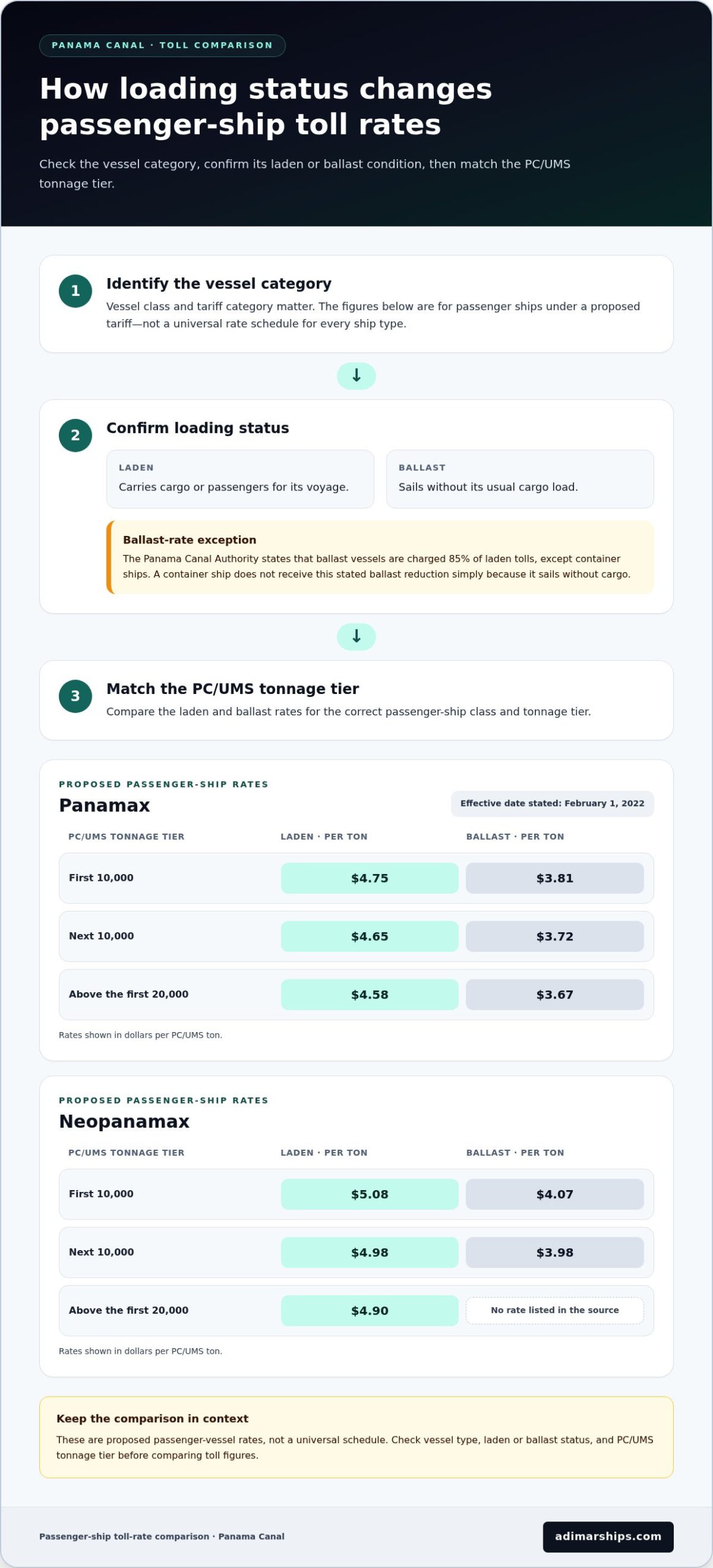
A laden vessel carries cargo or passengers for its voyage, while a ballast vessel sails without its usual cargo load. These operating conditions can affect Panama Canal toll treatment, but the vessel’s class and tariff category also matter. For passenger ships, the proposed tariff effective February 1, 2022, used different laden and ballast rates by PC/UMS tonnage tier.
According to the Panama Canal Authority, ballast vessels are charged 85% of laden tolls, except container ships, which do not receive this ballast rate. The Panama Canal Authority also states that ballast vessels, except container ships, are charged 85% of the toll. The exception is important: a container ship should not be assigned the ballast reduction simply because it sails without cargo.
The proposed passenger-ship rates show how loading status changes the amount per PC/UMS ton. For Panamax passenger ships, the laden rates were $4.75 for the first 10,000 PC/UMS tons, $4.65 for the next 10,000, and $4.58 above the first 20,000. The corresponding ballast rates were $3.81, $3.72, and $3.67 per PC/UMS ton.
- Panamax laden: $4.75, $4.65, and $4.58 across the stated tiers.
- Panamax ballast: $3.81, $3.72, and $3.67 across the stated tiers.
- Neopanamax laden: $5.08, $4.98, and $4.90 across the stated tiers.
- Neopanamax ballast: $4.07 for the first 10,000 and $3.98 for the next 10,000 PC/UMS tons.
These are proposed passenger-vessel rates, not a universal schedule for every ship type. For example, a container vessel in ballast does not receive the stated 85% rate. Apply the correct vessel category and loading condition before comparing toll figures; a mismatch can make a preliminary calculation misleading.
For a practical review, identify three details: vessel type, laden or ballast status, and PC/UMS tonnage tier. Then match them to the applicable tariff structure. This keeps the rate comparison grounded in the vessel’s actual category rather than assumptions about its load.
How do vessel type and size affect PC/UMS toll charges?
A vessel class groups ships by dimensions and the Canal locks they can use. A Panamax tanker and a Neopanamax tanker therefore may face different capacity tariffs. In January 2025, the listed Panamax tanker tariff was $5.25 per PC/UMS ton. The Neopanamax tanker tariff was $3.25 per PC/UMS ton.
PC/UMS tonnage measures a ship’s net capacity for toll purposes. Size indicators help describe the scale of vessels in different classes, but don’t replace the applicable tariff. A Super-class specification lists a length of 965.0 feet, a beam of 105.8 feet, capacity of 5,000 TEUs, and 45,701 PC/UMS tons. The Neopanamax specification lists 1,096 feet, 159 feet, 12,000 TEU, and 116,295 PC/UMS tons.
These specifications show why length or container capacity alone cannot establish a toll. The tariff depends on vessel type and its applicable charging basis, while PC/UMS capacity contributes to tonnage-based charges. To estimate the toll, identify the vessel category first, then use the relevant tonnage and tariff structure. Keep units consistent, especially when comparing PC/UMS tons, TEUs, feet, and meters.
Passenger vessels show how vessel category and tonnage tiers work together. These examples use a specific passenger tariff, so they do not apply to tankers or other vessel types.
Before comparing estimates, record the ship type, class, PC/UMS tonnage, and applicable tariff basis. Then separate those inputs from dimensions and TEU capacity, which describe the vessel but don’t independently determine its charge. For help coordinating the operational details of a Panama Canal transit, arrange Panama Canal transit support.
Adimar Shipping: Ship Agency Services
Adimar Shipping, Inc. supports vessel owners and charterers coordinating a Panama Canal transit through Ship Agency Services. When toll inputs, visit details, and vessel arrangements need to come together, a local agency partner can coordinate communication and help keep the process organized.
Owners can appoint Owner’s Nominated Agency, while charterers can use Charterer’s Nominated Agency for their representation. Husbandry Services support vessel needs connected with a port call. These services complement toll planning by helping coordinate the wider vessel visit, but they do not replace the Panama Canal Authority’s toll calculation or tariff rules.
For a transit involving PC/UMS documentation or alternative measurement inputs, Adimar Shipping, Inc. can support the agency coordination around the vessel’s passage. Contact Adimar Shipping, Inc. or visit adimarships.com to discuss your Panama Canal transit.
Prepare the Next Transit with Clear Agency Coordination
Make the next step a clear handoff between vessel records, transit planning, and the people coordinating the visit. A well-organized pc/ums calculation for canal tolls gives your team a useful planning basis, while agency coordination helps organize the wider passage around the vessel’s needs.
Adimar Shipping, Inc. offers Ship Agency Services, with Owner’s Nominated Agency for owners and Charterer’s Nominated Agency for charterers. Choose the representation that matches your role in the voyage, then bring the relevant vessel and visit details into the coordination process. This gives the responsible parties a clearer path from preparation to transit.
For support with Panama Canal vessel coordination, contact Adimar Shipping, Inc. for assistance. A focused conversation can help you identify the appropriate agency arrangement and move forward with greater clarity.
Frequently Asked Questions
What does PC/UMS mean in canal toll calculations?
PC/UMS means Panama Canal/Universal Measurement System, the Canal’s system for measuring vessel capacity. One PC/UMS ton represents 100 cubic feet of net ship capacity. It isn’t a cargo-weight unit or a toll amount by itself. For toll planning, it provides a tonnage basis when the applicable tariff charges by PC/UMS capacity; vessel category determines which rate applies.
How is a vessel’s PC/UMS tonnage determined?
PC/UMS tonnage is determined from the volume of a vessel’s enclosed spaces and the prescribed calculation factors. The measurement accounts for qualifying spaces and appendages, while spaces open to the sea may be excluded. Passenger count, average depth, and container-carrying design can affect calculation components. Keep measurement records aligned with the vessel’s current structure, since changes to total volume can affect its tonnage basis.
What is the canal toll rate per PC/UMS unit?
There isn’t one rate for every vessel; the applicable rate depends on ship type, class, and tariff category. For example, the January 2025 capacity tariffs listed for tankers were $5.25 per PC/UMS ton for Panamax and $3.25 for Neopanamax. These dated tanker figures illustrate how classifications can differ; they shouldn’t be treated as a universal rate for other vessel types.
How are canal tolls calculated using PC/UMS?
To estimate a PC/UMS-based toll, use the vessel’s applicable PC/UMS tonnage and match it to the tariff for its type and transit category. Passenger tariffs, for example, may use progressive tonnage tiers rather than one rate across all capacity. Laden or ballast status may also affect the calculation. Keep these inputs distinct from TEU capacity, which describes container capacity rather than PC/UMS tonnage.
What surcharges or additional fees apply to PC/UMS canal tolls?
Additional charges may be separate from a PC/UMS capacity calculation. Panama Canal anchorage fees apply if a ship has to wait for more than one day. January 2025 references also list fixed transit fees by lock class, so the final transit amount may combine distinct charge components. Separate tolls, anchorage, and other transit charges in your estimate to see what each item represents.
What are the current PC/UMS toll rates for the Panama Canal?
Panama Canal tolls don’t have one universal current rate per PC/UMS ton. The applicable amount depends on vessel type, class, and tariff structure. The January 2025 tanker references are $5.25 per PC/UMS ton for Panamax and $3.25 for Neopanamax. Passenger-vessel tariff examples are tied to a proposed schedule effective February 1, 2022, so they are not a single rate for all ships.