
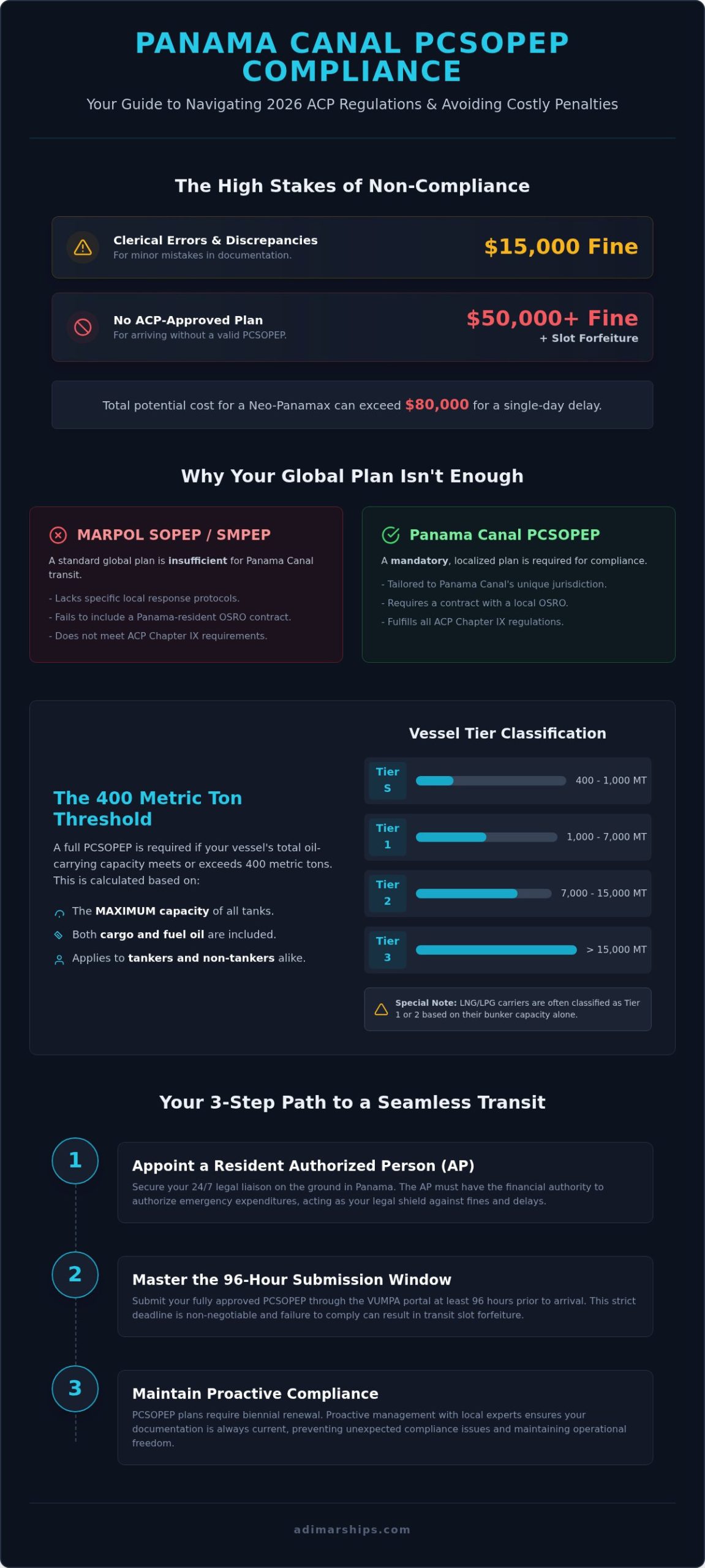
A single clerical error on your Panama Canal Shipboard Oil Pollution Emergency Plan (PCSOPEP) can trigger an immediate $15,000 administrative fine before your vessel even reaches the locks. For ships arriving without an ACP-approved plan in 2026, the stakes are even higher: a minimum $50,000 penalty and the immediate forfeiture of your hard-earned transit slot. Understanding the nuances of PCSOPEP non-compliance penalties Panama Canal is no longer just about environmental safety; it’s about protecting your bottom line from avoidable regulatory traps.
We understand the pressure of balancing global MARPOL requirements with the Panama Canal Authority’s unique, often more stringent, local standards. The strict 96-hour notification window through the VUMPA portal leaves no room for hesitation or data entry mistakes. This guide provides the clarity you need to navigate these digital protocols with confidence. You’ll gain a comprehensive submission checklist, a guide to verifying your vessel’s Tier status, and expert advice on selecting a dependable resident Authorized Person to act as your legal shield on the ground.
Key Takeaways
- Identify the specific financial risks of PCSOPEP non-compliance penalties Panama Canal, including $15,000 administrative fines for clerical errors and $50,000 for arriving without an approved plan.
- Determine your vessel’s Tier classification to ensure your response resources and documentation align with the latest 2026 ACP requirements.
- Secure a Panama-resident Authorized Person (AP) to act as your 24/7 legal liaison and protect your transit slot from unexpected regulatory delays.
- Master the 96-hour pre-arrival notification window to guarantee a seamless VUMPA submission and avoid the immediate forfeiture of your transit booking.
- Maintain operational freedom by prioritizing biennial plan renewals and proactive compliance management with local experts.
Navigating PCSOPEP Non-Compliance Penalties Panama Canal (2026)
The Panama Canal Authority (ACP) enforces some of the world’s most rigorous environmental standards. While most operators are familiar with international MARPOL Annex I, the Panama Canal operates under its own distinct legal framework. Specifically, Chapter IX of the ACP Navigation Regulations mandates a localized plan known as PCSOPEP. Relying on a standard global plan is a fast track to PCSOPEP non-compliance penalties Panama Canal. In 2026, even minor administrative discrepancies in your documentation can trigger fines starting at $15,000. These aren’t just suggestions; they’re rigid enforcement mechanisms designed to protect the watershed and ensure transit safety.
The financial stakes extend beyond simple fines. A rejected plan often results in the immediate forfeiture of your transit slot. For a Neo-Panamax vessel, the combined cost of the administrative penalty and the lost revenue from a one-day delay can easily exceed $80,000. Avoiding these risks requires a shift in perspective. You must view PCSOPEP not as a formality, but as a specialized local mandate that requires a Panama-resident Authorized Person (AP) to act as your 24/7 legal liaison.
MARPOL vs. PCSOPEP: Stricter Local Jurisdictions
MARPOL provides a broad framework for international waters, but the ACP functions as a stricter, localized jurisdiction with zero tolerance for ambiguity. A standard SOPEP or SMPEP lacks the specific response resource allocations and local contact protocols required by Panamanian law. Global plans fail to meet ACP Chapter IX standards because they don’t account for the mandatory contractual relationship with a Panama-resident Oil Spill Response Organization (OSRO). Without these local ties, your vessel is legally unprepared for the transit. The ACP requires dedicated equipment and personnel ready for immediate deployment within the Canal’s jurisdiction, a level of specificity global plans simply don’t provide.
The 400 Metric Ton Threshold
The requirement for a full PCSOPEP and a resident Authorized Person hinges on a specific volume: 400 metric tons of oil. The ACP calculates this by totaling the capacity of all cargo and fuel tanks, regardless of how much oil is actually on board during the panama canal transit. This threshold applies to both tankers and non-tanker vessels. If your vessel meets this criteria, you must follow these steps:
- Total the maximum capacity of all oil-carrying tanks to determine your Tier status.
- Appoint a resident AP who has the financial authority to authorize emergency expenditures.
- Ensure your PCSOPEP is submitted and approved through the VUMPA portal at least 96 hours before arrival.
Failing to meet these requirements doesn’t just result in fines; it can lead to the immediate suspension of your transit slot, costing your operation thousands in daily standing charges. Delegating this to local experts ensures your vessel remains compliant and your schedule stays on track.
Understanding PCSOPEP Tiers and Automatic Reclassification Risks
The ACP classifies vessels into four distinct tiers based on their total oil-carrying capacity. This classification determines your specific response requirements and the associated tariffs for spill preparedness. Miscalculating your tier or failing to provide accurate data is a primary cause of PCSOPEP non-compliance penalties Panama Canal. In 2026, the ACP’s automated validation systems leave no room for error when cross-referencing your vessel’s universal measurement with your submitted plan. It’s vital to understand that your tier is based on maximum capacity, not just the cargo or fuel currently on board.
Vessel Classification Breakdown
Each tier carries specific obligations for response resource allocation. The breakdown includes:
- Tier S: Small vessels with a capacity between 400 and 1,000 metric tons.
- Tier 1: Capacity between 1,000 and 7,000 metric tons.
- Tier 2: Capacity between 7,000 and 15,000 metric tons.
- Tier 3: High-capacity vessels exceeding 15,000 metric tons, including most large tankers and container ships.
Special considerations apply to LNG and LPG carriers in 2026. While these vessels don’t carry oil as cargo, their bunker capacity often pushes them into Tier 1 or Tier 2. You must ensure your plan reflects the technical response requirements for these specific fuel types to avoid delays. This tier-based structure is detailed within the Panama Canal Authority Maritime Regulations, which serves as the final word on compliance standards.
The Financial Impact of Tier Bumping
The most severe “silent” penalty is automatic reclassification. If you arrive without an approved plan or miss the critical submission window, the ACP automatically schedules your vessel as Tier 3. This happens regardless of your actual size or capacity. You’ll be forced to pay the highest possible tariff for oil spill response resources, creating a massive financial drain on your voyage. The cost difference between Tier 1 and Tier 3 response tariffs is substantial and completely avoidable with proper oversight.
Consult an owner’s nominated agency to manage these classifications and verify your standing before arrival. Working with a local expert helps you maintain your rightful classification and avoid the unnecessary costs of automatic reclassification. We recommend verifying your vessel’s Tier status at least 30 days before your scheduled transit to ensure all documentation is perfectly aligned with ACP expectations.
Mastering the 96-Hour Rule: Submission Timelines and NOA
Precision is the cornerstone of a successful transit. The Panama Canal Authority (ACP) operates on a rigid schedule, and nowhere is this more evident than in the 96-hour pre-arrival notification window. Missing this deadline by even a few minutes triggers an immediate $2,500 late-submission sanction. Worse, it often results in the immediate forfeiture of your transit slot. Considering the economic impact of Panama Canal regulations, where a single day’s delay can cost a Neo-Panamax vessel over $65,000 in lost revenue, local vigilance is your best defense against PCSOPEP non-compliance penalties Panama Canal.
Digital Submission Roadmap
The Vessel Universal Measurement and Pre-Arrival (VUMPA) portal is the digital gatekeeper for your transit. To ensure a smooth approval, your submission must include precise vessel data: the IMO number, call sign, and certified oil capacity. Accuracy is paramount. The ACP’s 2026 automated systems cross-check every data field against international databases in real-time. A simple typo in the fuel tank capacity or a mismatched call sign can lead to a $15,000 administrative fine for clerical errors. We recommend a 6-week chronological roadmap for drafting your Panama-specific plan to allow for internal reviews and technical alignment before the 96-hour clock starts.
- Week 1-2: Appoint your resident Authorized Person (AP) and secure a contract with a local Oil Spill Response Organization (OSRO).
- Week 3-4: Compile technical ship data and draft the PCSOPEP to meet ACP Chapter IX standards.
- Week 5: Perform a final audit of all VUMPA entry fields to eliminate clerical risks.
- Week 6: Execute the submission at least 96 hours before arrival at the Canal.
The Notice of Acknowledgement (NOA) Process
Once your data is uploaded, the primary objective is to receive the Notice of Acknowledgement (NOA). For the vessel Master and technical superintendent, the NOA is the ultimate green light. It signifies that the ACP has verified your PCSOPEP and your vessel is cleared for transit from an environmental compliance standpoint. In the 2026 regulatory environment, typical turnaround times for approval range from 24 to 48 hours, provided the data is flawless. If your submission is flagged for corrections, the 96-hour clock restarts upon resubmission, which almost certainly guarantees a transit delay.
Our local team monitors these submissions around the clock, acting as the bridge between your vessel and the ACP. By delegating this oversight to resident experts, you ensure that any flags are addressed instantly. This proactive management secures your NOA and protects your transit slot from the severe financial consequences of documented non-compliance.
The Authorized Person (AP): Your Legal Shield Against ACP Fines
The Panama Canal Authority doesn’t just require a document; they mandate a dedicated representative. For every vessel transiting with 400 metric tons of oil or more, a Panama-resident Authorized Person (AP) is a legal necessity. This individual serves as the 24/7 liaison between your ship and the ACP, ensuring that communication remains unbroken throughout the transit. Without a verified AP, your vessel faces immediate PCSOPEP non-compliance penalties Panama Canal, which can include the loss of your transit slot and significant administrative fines.
The AP’s role is most critical during an emergency. If a pollution incident occurs, the ACP requires a local representative who can be reached instantly to coordinate with the Incident Management System (IMS). This isn’t just a clerical role; the AP must have the financial authority to authorize emergency expenditures for spill response. Having a resident expert who understands the local regulatory landscape is the only way to protect your interests when the stakes are at their highest.
AP Qualifications and Responsibilities
An effective AP must possess deep technical proficiency in the Canal’s specific pollution response protocols. They’re responsible for coordinating with the Oil Spill Response Organization (OSRO) and ensuring that all vessel crew members understand their roles within the localized plan. Because the ACP maintains a zero-tolerance policy, the AP must be available every hour of every day your vessel is within Panamanian waters. You can learn more about the pcsopep authorized person role and how it functions as a regulatory safeguard for international ship owners.
Adimar Shipping, Inc.: Your Eyes and Ears on the Ground
We act as a vigilant, on-the-ground extension of your technical team. At Adimar Shipping, Inc., we believe that compliance shouldn’t be a source of stress for ship managers. Our team provides the local oversight needed to identify potential documentation issues before they reach the ACP’s digital portal. By serving as your “local eyes,” we ensure that every aspect of your environmental protocol is current and accurate for the 2026 regulatory environment.
We streamline the liaison process by integrating our AP services with our broader ship agency panama offerings. This unified approach eliminates communication delays between different service providers, creating a seamless experience from pre-arrival to lock exit. Our priority is your peace of mind and the continued operational freedom of your fleet. If you need to secure a resident legal liaison for your next transit, contact Adimar Shipping, Inc. today to ensure your vessel remains fully compliant with all ACP mandates.
Ensuring Zero-Delay Transit with Expert Compliance Management
Maintaining a perfect transit record requires more than just meeting the 400 metric ton threshold; it demands a proactive approach to document lifecycle management. In the 2026 traffic environment, the direct relationship between PCSOPEP compliance and transit slot preservation is absolute. The ACP doesn’t offer grace periods for expired plans. Because a standard PCSOPEP is valid for exactly two years, technical superintendents must track renewal dates with the same rigor as class surveys. Arriving at the locks with an expired plan triggers the same severe PCSOPEP non-compliance penalties Panama Canal as arriving without one, leading to immediate slot forfeiture and heavy fines.
Delegating this complex task to a specialized partner is a strategic financial decision. While internal management might seem cost-effective, a single clerical error can wipe out months of operational savings. Before your vessel reaches the Gatun Locks, ensure your team has completed this final compliance checklist:
- Verify that your vessel’s Tier status matches its current certified oil capacity.
- Confirm the resident Authorized Person (AP) appointment is active and documented.
- Ensure the contract with a Panama-resident Oil Spill Response Organization (OSRO) is fully executed.
- Submit the VUMPA package at least 96 hours before arrival and confirm receipt of the Notice of Acknowledgement (NOA).
- Audit the plan for any recent vessel modifications that might require an ACP update.
Avoiding Avoidable Delays
In 2026, the $15,000 administrative fine for clerical errors is the most common pitfall for ship operators. These triggers are often as simple as a mismatched IMO number or an outdated contact list for the response team. Local oversight acts as a filter, catching these discrepancies before they reach the ACP inspectors. By utilizing a panama canal ships agent, you gain a partner who understands the nuances of the digital VUMPA portal. We provide the “local eyes” necessary to prevent minor technicalities from evolving into major financial losses and transit delays.
Onboarding with Adimar Shipping, Inc.
At Adimar Shipping, Inc., we’ve designed our onboarding process to be as efficient as the transits we manage. For fleet operators, we offer consolidated husbandry and compliance packages that unify vessel services under a single point of contact. Transitioning your existing vessels to Adimar Shipping, Inc. for AP representation is a straightforward process that begins with a comprehensive data audit. Our team reviews your current PCSOPEP against the latest 2026 ACP mandates to identify any gaps in coverage or documentation. To secure your fleet’s schedule and protect against PCSOPEP non-compliance penalties Panama Canal, we recommend requesting a formal compliance audit at least 60 days before your next scheduled arrival. This proactive step ensures your vessel is ready for a seamless lock entry without the threat of unexpected regulatory sanctions.
Securing Your 2026 Transit Strategy
Navigating the Panama Canal in 2026 requires more than technical skill; it demands total regulatory precision. We’ve discussed how easily minor clerical errors trigger PCSOPEP non-compliance penalties Panama Canal, potentially costing your operation $15,000 in administrative fines or leading to immediate slot forfeiture. By mastering the 96-hour VUMPA window and verifying your vessel’s Tier classification, you protect both your schedule and your bottom line. It’s clear that a standard global SOPEP isn’t enough. You need a localized plan and a resident legal liaison who can authorize emergency response actions instantly.
As a specialized ship agency in Panama City, Adimar Shipping, Inc. provides the 24/7 local oversight you need to transit with confidence. Our Panama-resident experts act as your vigilant eyes at the canal, ensuring every document meets the ACP’s zero-tolerance standards. We serve as your Authorized Person for Panama Canal compliance, offering a dedicated legal shield against avoidable delays. Contact Adimar Shipping, Inc. for PCSOPEP Authorized Person Services to secure your fleet’s interests today. With the right partner on the ground, your next transit will be defined by operational efficiency rather than unexpected regulatory hurdles.
Frequently Asked Questions
Is a standard MARPOL SOPEP plan enough for the Panama Canal?
No, a standard MARPOL SOPEP plan isn’t sufficient for transiting the Panama Canal. The Panama Canal Authority (ACP) mandates a specialized PCSOPEP that includes unique local response resources and a contractual relationship with a Panama-resident Oil Spill Response Organization (OSRO). Relying on international standards alone results in immediate rejection at the digital gatehouse. You must ensure your plan meets the specific technical requirements of ACP Chapter IX to avoid delays.
What happens if we miss the 96-hour PCSOPEP submission deadline?
Missing the 96-hour PCSOPEP submission deadline triggers an immediate $2,500 late-submission sanction. Beyond the financial penalty, the ACP typically cancels the vessel’s reserved transit slot. This forced rescheduling often results in multi-day delays, with lost revenue for Neo-Panamax vessels exceeding $65,000 daily. Local oversight is essential to ensure your VUMPA package is uploaded and acknowledged well before this critical 96-hour cutoff point.
Does every vessel need an Authorized Person (AP) in Panama?
Every vessel with a total oil capacity of 400 metric tons or more must appoint a resident Authorized Person (AP). This requirement includes the combined capacity of all cargo and fuel tanks. The AP acts as the 24/7 legal liaison between the ship and the ACP. Vessels failing to designate a qualified resident expert will face severe PCSOPEP non-compliance penalties Panama Canal and will be barred from entering the locks.
How much are the fines for PCSOPEP non-compliance in 2026?
In 2026, the ACP enforces a zero-tolerance fine structure for environmental non-compliance. Minor clerical errors on documentation start at $15,000. Arriving at the Canal without an approved PCSOPEP results in a minimum $50,000 fine and immediate slot forfeiture. Additionally, late submissions incur a $2,500 sanction. These costs highlight the financial importance of delegating compliance management to experienced local ship agency experts who understand the PCSOPEP non-compliance penalties Panama Canal.
How long is a Panama Canal SOPEP approval valid?
A Panama Canal SOPEP approval is valid for exactly two years from the date of the Notice of Acknowledgement. However, you must update the plan immediately if the vessel undergoes major modifications or changes its oil-carrying capacity. Keeping track of this biennial renewal cycle is vital for continuous fleet operations. Our team provides proactive monitoring to ensure your approvals never lapse during your 2026 transit schedule.
Can my ship agent also act as my Authorized Person?
Yes, your ship agent can and should act as your Authorized Person to ensure maximum operational efficiency. Adimar Shipping, Inc. integrates these roles to provide a unified point of contact for both husbandry and compliance. This prevents communication gaps between different service providers. By appointing a specialized agent who is also a resident AP, you create a legal shield that protects your vessel from unexpected regulatory scrutiny.
What is an “Automatic Tier 3” classification?
An “Automatic Tier 3” classification is a financial penalty applied to vessels that fail to submit a compliant plan on time. Regardless of your ship’s actual size or capacity, the ACP will charge you the highest possible oil spill response tariff. This reclassification can drastically increase your transit costs. It serves as a significant deterrent against late or inaccurate data entries in the Vessel Universal Measurement system.
How do I receive the Notice of Acknowledgement (NOA) from the ACP?
You receive the Notice of Acknowledgement (NOA) through the ACP’s digital VUMPA portal once your documentation is validated. This document serves as the final confirmation that your vessel is environmentally cleared for transit. The ACP’s 2026 automated systems usually issue the NOA within 24 to 48 hours of a successful submission. Our local team monitors the portal around the clock to address any technical flags instantly.