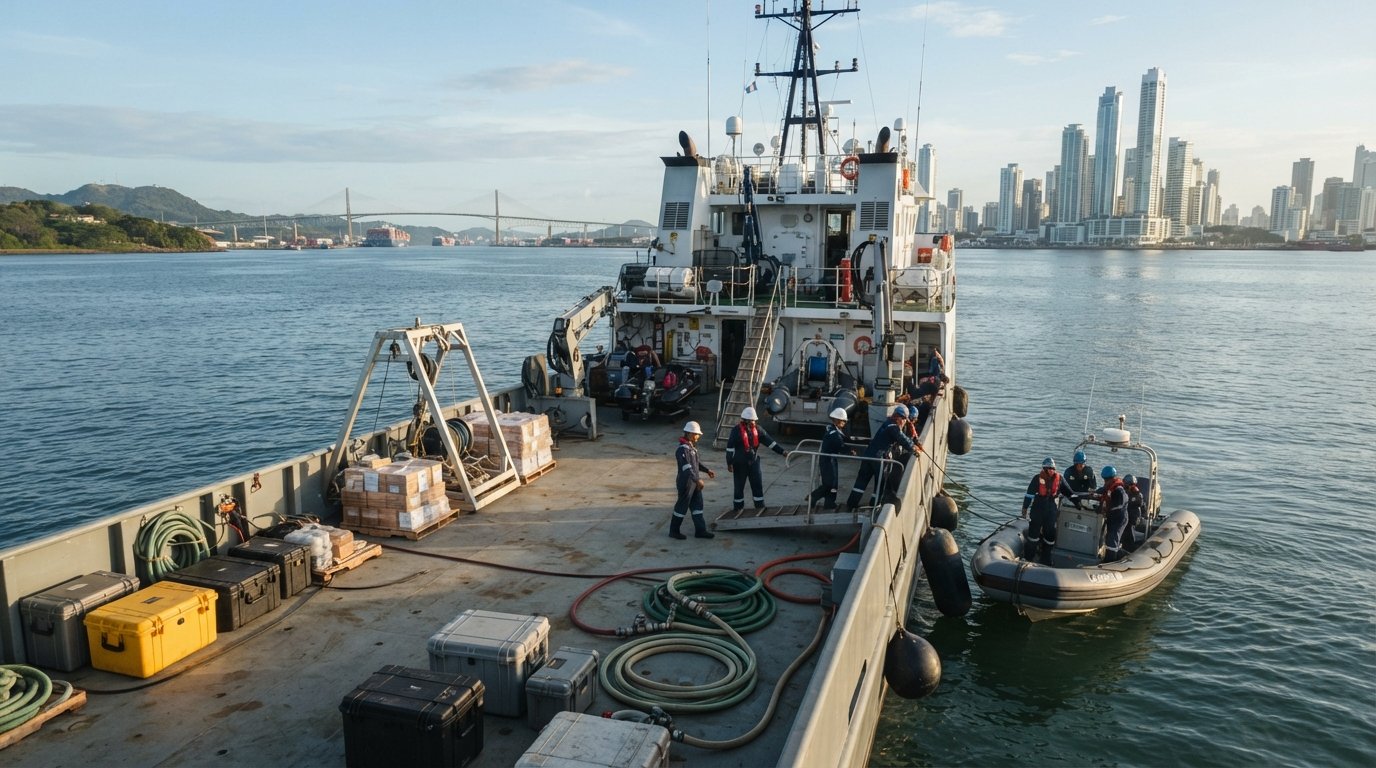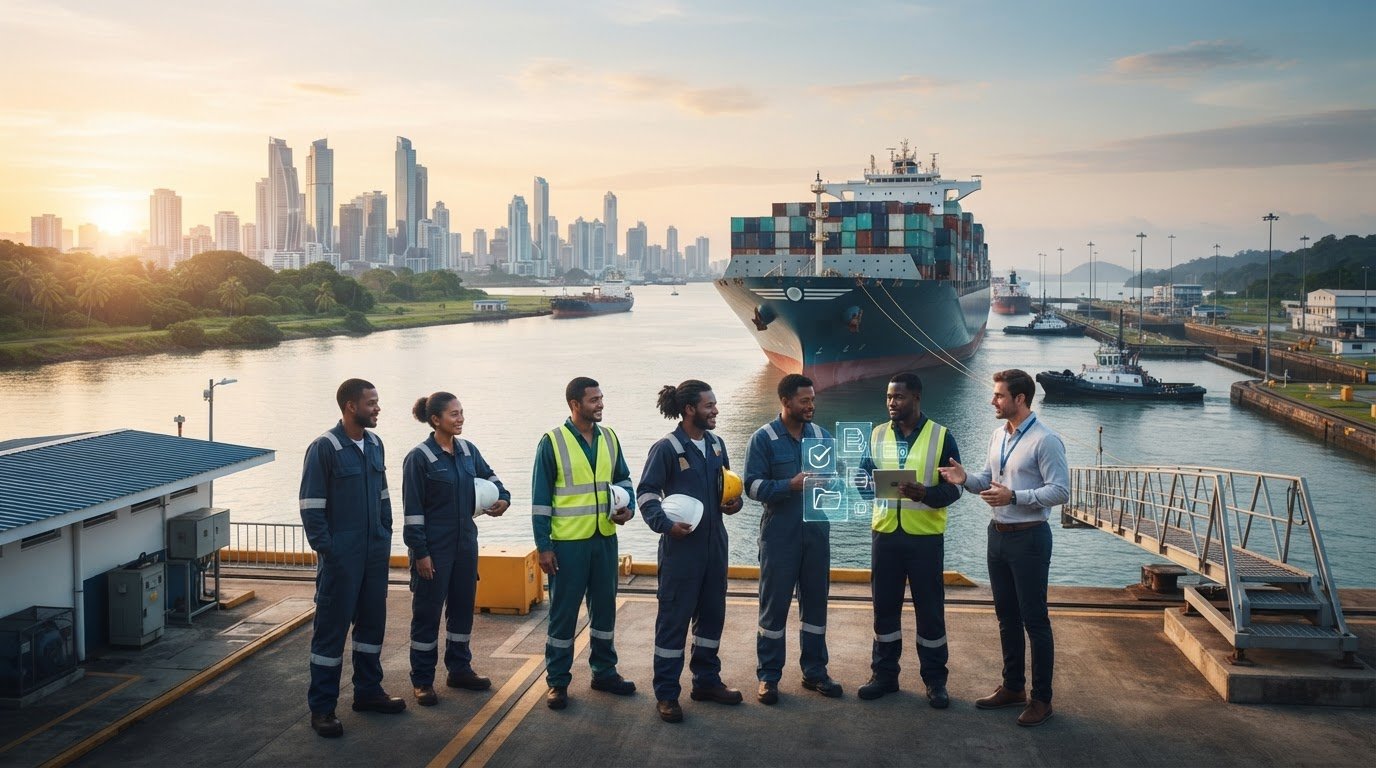


A single discrepancy in your vessel’s reported dimensions can trigger a $12,500 penalty from the Panama Canal Authority (ACP) before your transit even begins. In a high-stakes environment where standard Neopanamax booking fees reach $100,000, there’s no room for financial ambiguity. You need a proforma disbursement account panama canal that acts as a strategic safeguard, not just a rough estimate. It’s frustrating to manage transit costs when unexpected freshwater surcharges or hidden husbandry fees suddenly inflate your bottom line.
We understand the pressure of maintaining a predictable budget while coordinating complex logistics across different time zones. This guide provides the tools you need to master Panama Canal financial planning by auditing Proforma Disbursement Accounts and protecting your cargo interests from owner-biased overbilling. You’ll learn to navigate the 2026 toll freeze, identify common hidden surcharges, and ensure full compliance with ACP payment timelines. By the end of this article, you’ll have a clear roadmap for securing a seamless and cost-effective transit through the waterway.
Key Takeaways
- Understand why a proforma disbursement account panama canal is the foundation of a successful transit and how it meets strict ACP advance payment rules.
- Learn to navigate the 2026 toll structure and official service fees for tugs and pilots to ensure your budget remains accurate.
- Apply a professional 5-step framework to audit your PDA, cross-referencing vessel dimensions with current tariffs to prevent overbilling.
- Discover why an independent review is essential for charterers to eliminate conflicts of interest and reduce the risk of costly demurrage.
- Explore how local oversight and proactive auditing can provide the financial transparency needed for secure canal transits.
What is a Proforma Disbursement Account (PDA) for the Panama Canal?
A successful transit through the Panama Canal begins long before the vessel reaches the breakwater. It starts with a document that dictates every financial move: the Proforma Disbursement Account (PDA). At its core, a proforma disbursement account panama canal is a detailed estimate of all expenses a vessel is expected to incur during its passage or port call. This isn’t a mere suggestion or a loose quote. It’s the financial foundation that allows operators to secure a transit slot and meet the rigorous advance payment requirements set by local authorities. We understand that for ship owners and charterers, this document represents the difference between a predictable voyage and a logistical nightmare.
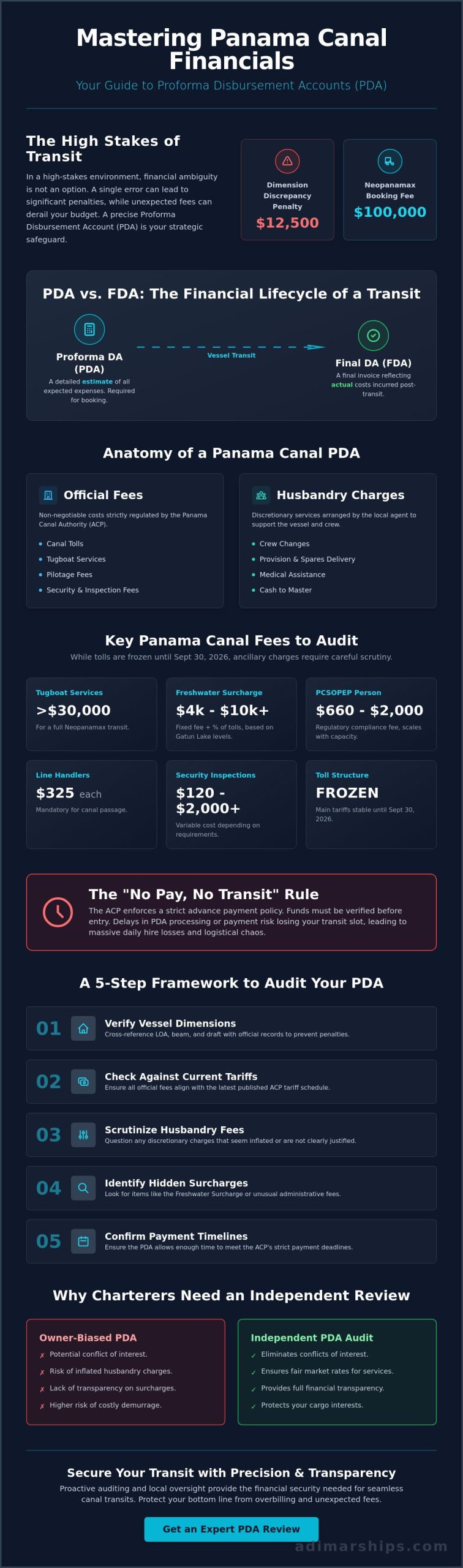
While the PDA is an estimate based on current tariffs and vessel specifications, the Final Disbursement Account (FDA) reflects the actual costs incurred after the transit is complete. Discrepancies between these two documents often cause friction, making a precise and transparent proforma essential for smooth operations. By establishing clear expectations from the outset, the PDA helps avoid the stress of unexpected invoices. It ensures all stakeholders are aligned on the projected costs, allowing you to focus on the operational success of the voyage rather than financial surprises.
The Anatomy of a Panama Canal PDA
A well-structured PDA divides costs into two primary categories to provide full transparency for your accounting team:
- Official Fees: These include non-negotiable costs like tolls, tugboat services, and pilotage, which are strictly regulated by the canal authorities.
- Husbandry Charges: These cover discretionary services such as crew changes, provision deliveries, or medical assistance.
The PDA serves as a binding financial roadmap for ship operators. In a global industry, currency transparency is paramount. All costs in Panama are handled in US Dollar ($), and an experienced agent ensures that exchange rates don’t hide additional surcharges. This clarity provides you with the security that your budget is protected. We take pride in our role as your local representative, ensuring every line item is accurate and justified before you commit your capital.
Why Timing Matters: The ACP Advance Payment Rule
The Panama Canal Authority (ACP) enforces a strict “no pay, no transit” policy. Funds must be in place and verified before a vessel is allowed to enter canal waters. This rule makes the timing of your proforma disbursement account panama canal critical. If the PDA is delayed or the advance payment is late, your vessel risks losing its scheduled slot, leading to massive daily hire losses and logistical chaos. We act as your vigilant partner on the ground, ensuring that the ACP receives the necessary funds within the required window. Our deep local knowledge helps navigate these timelines, preventing the costly delays that often plague less experienced operators who don’t prioritize these strict regulatory windows.
Key Components of Panama Canal Fees in 2026
Managing a vessel transit requires a granular understanding of the 2026 fee structure. The Panama Canal Authority (ACP) has frozen the main toll structure until September 30, 2026; however, the complexity of ancillary charges continues to grow. When you review a proforma disbursement account panama canal, you aren’t just looking at a single price tag. You’re analyzing a composite of tolls, official services, and regulatory compliance fees that vary based on vessel type and lake levels. Understanding What is a Proforma Disbursement Account? is the first step in identifying where your capital is actually going.
Beyond the base tolls, official services like tugs and pilots represent a massive portion of your budget. For a Neopanamax vessel, tugboat services for a full transit can exceed $30,000. Line handlers cost $325 each, and security inspections can range from $120 to over $2,000. You also need to account for the Freshwater Surcharge, which fluctuates based on Gatun Lake levels and can add a fixed fee of $4,000 to $10,000 plus a percentage of tolls. Regulatory compliance also carries a cost, particularly for a PCSOPEP authorized person, with fees scaling from $660 to $2,000 based on capacity.
Navigating Official ACP Tariffs
Vessel dimensions are the primary driver of cost differences. A Panamax container ship might face a $60,000 fixed tariff, while a Neopanamax vessel starts at a $300,000 fixed tariff. The 2026 transit reservation system has also introduced significant premiums. Standard Neopanamax bookings now sit at $100,000, but last-minute slots can double that price. We verify every tugboat requirement based on your specific draft and length to ensure you aren’t paying for unneeded units. If you’re looking for expert oversight on these complex calculations, our ship agency services provide the local vigilance you need.
Husbandry and Protective Agency Costs
While official tolls are fixed, discretionary costs are where budgets often spiral. These include husbandry services such as crew changes, medical assistance, and spare parts delivery. You should also factor in the logistics of bunkering in Panama if your vessel requires fuel at either the Pacific or Atlantic entrances. It’s a hard truth in this industry that discretionary costs often contain the most hidden margins when managed by unvetted agents. We eliminate this risk through transparent auditing and local oversight, ensuring that every spare part delivery or crew transfer is billed at fair market rates without surprise surcharges.
How to Audit a Proforma Disbursement Account: A 5-Step Framework
Auditing a proforma disbursement account panama canal isn’t just about checking the math. It’s about verifying the operational reality of your transit against strict local regulations. We’ve seen how a single discrepancy in reported vessel dimensions can lead to a $12,500 ACP penalty. To prevent these avoidable costs, you need a rigorous verification process. This framework empowers your team to identify inaccuracies before the advance payment is sent.
- Step 1: Cross-reference vessel dimensions. Verify that the PC/UMS tonnage and physical dimensions match the current ACP tariffs. Even a minor error in beam or length can shift your vessel into a higher toll bracket or trigger mandatory admeasurement fees of $1,100.
- Step 2: Verify tug and pilotage requirements. Review your vessel’s transit history and draft. Neopanamax tug services often exceed $30,000, but agents sometimes include extra units “just in case” that aren’t actually required by ACP regulations.
- Step 3: Audit husbandry markups. Compare discretionary charges for crew handling or deliveries against local market averages in Panama. Discretionary costs shouldn’t be a black box for ship operators.
- Step 4: Check for cost duplication. Ensure that “Owner’s Matters” aren’t being double-billed under “Charterer’s Responsibilities.” This is a frequent area of friction in multi-party maritime contracts.
- Step 5: Confirm compliance and bank details. Verify the agent’s bank information and ensure they meet international anti-corruption standards. Ethical conduct is a core brand promise we uphold in every transaction.
Identifying Common Red Flags in a PDA
Vague language is the enemy of financial transparency. Be wary of “miscellaneous” or “sundry” charges that lack specific documentation. These often hide padded margins or unauthorized surcharges. We also frequently see overestimated pilotage fees that don’t align with standard transit times. If the port facility security fees seem inconsistent with previous calls, it’s time to demand a detailed breakdown. Our role is to act as your vigilant representative, spotting these red flags before they impact your cash flow.
The Value of Independent Verification
A second opinion from an experienced Panama Canal ships agent can save you thousands of dollars in overpayments. Adimar Shipping, Inc. acts as a financial watchdog for charterers, ensuring the PDA aligns perfectly with your specific Charter Party clauses. We don’t just process papers; we provide the local oversight needed to challenge unjustified costs. By delegating this complex task to a specialized partner, you gain the peace of mind that your interests are protected by experts with deep local knowledge.
Charterer’s Interest: Why You Need an Independent PDA Review
In the maritime industry, a conflict of interest often hides in plain sight. When a vessel transits the canal, the Owner’s Nominated Agency typically manages the disbursements for all parties. While this seems efficient, it creates a significant risk for the charterer. The agent may naturally prioritize the owner’s relationship, potentially allowing vessel maintenance costs or owner-related husbandry fees to leak into the charterer’s portion of the proforma disbursement account panama canal. Without an independent set of eyes, these errors are nearly impossible to spot until the final account arrives and the funds are already spent.
Preventing demurrage is another critical reason for an independent review. An inaccurate PDA or poor scheduling coordination can lead to missed transit slots, resulting in costly off-hire periods for the charterer. We provide the financial oversight needed to ensure that “Cash to Master” (CTM) requests and cargo-specific port expenses are handled with total transparency. By verifying every line item against the Charter Party agreement, we protect your capital from being used to cover expenses that are legally the ship owner’s responsibility. This level of vigilance is the only way to maintain a predictable transit budget.
Protecting the Bottom Line for Cargo Owners
Independent auditing is your strongest defense against the inflation of port dues and official fees. We’ve seen how small, unjustified markups can add up to thousands of dollars across a fleet’s annual transits. Beyond the numbers, an unbiased Statement of Facts (SOF) is essential for defending against future claims or demurrage disputes. Using a local ship agency in Panama allows you to bridge the communication gap between your global operations desk and the ACP. We act as your on-the-ground representative, ensuring that the reporting is accurate, timely, and free from owner-biased narratives.
Fiduciary Duty and Ethical Standards
Transparent financial reporting is a core brand promise at Adimar Shipping. We take our fiduciary duty seriously, ensuring that every proforma disbursement account panama canal we review complies with international regulations like the FCPA and the UK Bribery Act. In an environment as complex as the Panama Canal, ethical conduct isn’t just a buzzword; it’s a requirement for secure and sustainable operations. Local vigilance is the only way to ensure absolute integrity in maritime financial oversight. We invite you to experience the security of a partnership built on trust and local expertise by inquiring about our Charterer’s Nominated Agency services today.
Adimar Shipping: Precision and Transparency in Canal Disbursements
Managing the financial complexities of a transit requires more than just a calculator. It requires a partner on the ground who understands the nuances of ACP regulations. We provide a proforma disbursement account panama canal that reflects true operational costs, eliminating the padding often found in unvetted estimates. Our commitment to precision ensures that your capital isn’t tied up in unjustified advance payments. We don’t just guess; we use the latest 2026 tariff data to build a financial roadmap that stands up to the closest audit.
The Adimar methodology is built on three pillars: detailed auditing, local oversight, and proactive communication. We don’t just relay information from the authorities; we verify every line item against your vessel’s actual requirements. By acting as your specialized Charterer’s Nominated Agency, we protect your interests from the inherent conflicts of interest often found in maritime logistics. This financial clarity removes the stress of logistical delays, allowing your team to focus on cargo operations while we secure the transit with the ACP. We’ve seen how a single error in a PDA can derail a voyage, which is why we approach every account with the same level of vigilance.
Vigilant Oversight for Every Transit
We act as your eyes and ears on the ground in Panama City, providing a level of protection that remote agencies can’t offer. Our team monitors every update from the ACP to ensure your funds are exactly where they need to be at the right time. We’ve built a legacy of reliability by managing complex financial requirements for the world’s leading ship operators and cargo owners. This isn’t just a service; it’s a partnership. We treat your disbursements as if they were our own, providing personalized attention that respects the high stakes of your transit. Our local presence allows us to resolve disputes or discrepancies in real-time, preventing them from becoming costly delays.
Request Your Preliminary PDA Today
Securing a competitive and transparent PDA is the first step toward a successful 2026 transit. To provide an accurate cost estimate, we typically require your vessel’s PC/UMS certificate, current draft, and any specific husbandry requirements. Our team will then cross-reference your data with the latest ACP tariffs to build a binding financial roadmap. Don’t leave your transit budget to chance when you can have the security of local expertise. We’re ready to show you the difference that transparency and local vigilance can make for your bottom line.
Contact Adimar Shipping to secure a transparent PDA for your Panama Canal transit.
Secure Financial Predictability for Your Next Transit
Mastering the financial complexities of the waterway requires more than just a rough estimate. It demands a proactive approach to auditing every line item. By verifying vessel dimensions against official tariffs and scrutinizing discretionary husbandry costs, you protect your capital from unnecessary leakages. A precise proforma disbursement account panama canal is your primary defense against unexpected ACP penalties and owner-biased overbilling. We’ve established that local vigilance is the only way to bridge the gap between global operations and the strict requirements of the Panama Canal Authority.
As an authorized PCSOPEP representative with decades of Panama Canal transit expertise, we provide 24/7 proactive operational and financial oversight. We act as your dependable partner on the ground to ensure your interests remain the priority at every stage of the voyage. Secure your cargo’s passage with Adimar’s specialized Charterer’s Agency and PDA auditing services.
Navigating these financial waters doesn’t have to be a source of stress. With the right local partner, you can achieve a predictable budget and a seamless transit experience every time.
Frequently Asked Questions
What is the difference between a Proforma Disbursement Account (PDA) and an Estimated Port Disbursement Account (EPDA)?
In the Panama market, a Proforma Disbursement Account (PDA) is the primary estimate used to satisfy ACP advance payment rules. While some global regions use the term Estimated Port Disbursement Account (EPDA), they essentially serve the same purpose of providing a budget for the transit. The PDA is the binding financial roadmap used to secure your vessel’s slot and verify that all official fees are covered before arrival.
How much time before transit must the funds from the PDA be received by the agent?
Funds must be received and cleared by the agent at least 48 to 72 hours before the vessel arrives at canal waters. The ACP enforces a strict “no pay, no transit” policy that leaves no room for banking delays. Early payment ensures your vessel’s scheduled reservation is protected and that the agent can verify the credit with the authorities well in advance of the transit window.
Can a charterer request an independent audit of the owner-appointed agent’s PDA?
Absolutely. Charterers frequently hire a specialized agent to perform an independent audit of the proforma disbursement account panama canal provided by the owner’s agent. This process identifies potential overbilling and ensures that vessel maintenance costs aren’t incorrectly passed to the cargo interests. It’s a standard practice for protecting the charterer’s financial interests during a transit.
What happens if the final costs of the Panama Canal transit are lower than the PDA amount?
If the actual transit costs are lower than the estimate, the agent will issue a credit in the Final Disbursement Account (FDA). The surplus funds are then either refunded to your account or held as a credit for future transits. We ensure this reconciliation is handled quickly and transparently so that your capital is returned or credited without unnecessary administrative delays.
Are Panama Canal tolls fixed, or can they change after the PDA is issued?
The ACP has frozen the main toll structure until September 30, 2026. However, variable costs like the Freshwater Surcharge can fluctuate based on Gatun Lake levels. Your PDA will include an estimate of these variables based on the most recent data available at the time of issuance, but the final cost may adjust slightly depending on the environmental conditions on the day of transit.
Does the PDA include PCSOPEP authorized person fees by default?
Yes. A proforma disbursement account panama canal for any vessel over 400 gross tons must include PCSOPEP authorized person fees. These regulatory costs are mandatory and scale based on the vessel’s oil-carrying capacity. We ensure these fees are correctly calculated to maintain full compliance with local environmental protection standards and avoid any last-minute regulatory delays.
How does Adimar Shipping ensure transparency in its disbursement reporting?
We provide detailed auditing and local oversight for every line item in our reports. Our team cross-references every official fee against current ACP tariffs and verifies all discretionary charges against local market averages. This proactive communication ensures you have a clear understanding of every cost, and we provide full supporting documentation for all husbandry and agency expenses.
What are the most common hidden costs found in Panama Canal ship agency PDAs?
The most common hidden costs are vague “sundry” or “miscellaneous” charges that lack specific documentation. Other red flags include overestimated tugboat hours and inflated margins on husbandry services like crew transfers or provision deliveries. Vigilant auditing is the only way to eliminate these unnecessary markups and ensure your transit budget remains accurate and fair.