
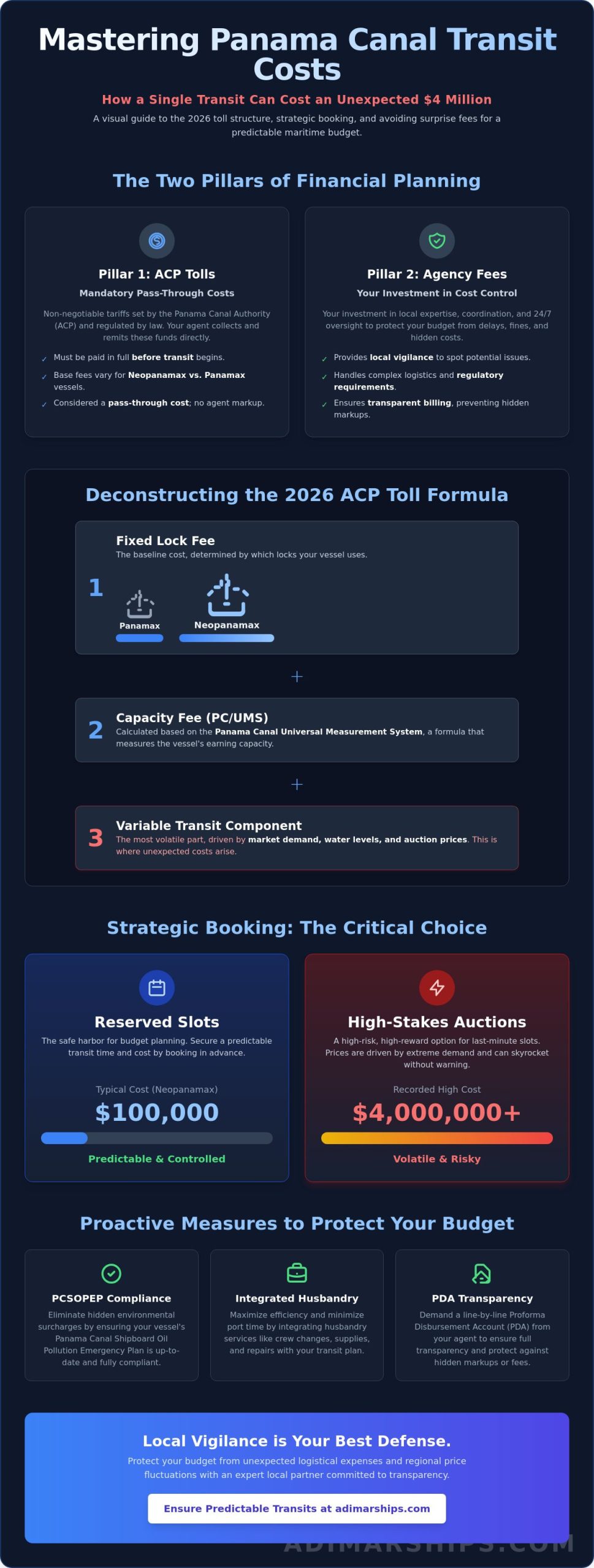
Could a single transit through the Panama Canal really cost your operation an unexpected $4 million in auction fees? While the base toll structure is frozen through September 2026, the reality of the waterway today is a dynamic financial ecosystem where a lack of local oversight leads to massive cost overruns. Having the Panama Canal transit fees explained is no longer just about reading a price list; it’s about anticipating the interplay between mandatory tolls, water level surcharges, and shifting auction demands.
We understand that managing a maritime budget feels like hitting a moving target when opaque pricing and sudden surcharges appear on your Proforma Disbursement Account. It’s frustrating to face delays or fines that could have been avoided with better local intelligence. This guide will help you master the 2026 toll structure and optimize your vessel’s transit costs to ensure a predictable budget. We will break down the specific fees for Neopanamax and Panamax vessels, clarify the mandatory service charges, and show you how to navigate the reservation system without the sting of surprise expenses.
Key Takeaways
- Distinguish between mandatory Panama Canal Authority (ACP) tolls and agency service fees to ensure your Proforma Disbursement Account remains accurate and predictable.
- Master the 2026 Panama Canal transit fees explained through the lens of the Universal Measurement System (PC/UMS) and fixed lock charges to calculate your base costs with precision.
- Determine the financial ROI of securing a reserved transit slot versus participating in the high-stakes auction market to avoid costly operational delays.
- Leverage PCSOPEP compliance and integrated husbandry services to eliminate hidden environmental surcharges and maximize the efficiency of every canal call.
- Implement a strategy of local vigilance and line-by-line transparency to protect your maritime budget from unexpected logistical expenses and regional price fluctuations.
The Two Pillars of Panama Canal Financial Planning
Successful transit planning begins with a clear division of costs. To build a reliable budget, you must distinguish between the statutory tariffs paid to the canal authorities and the service fees paid for local representation. Having the Panama Canal transit fees explained requires looking at these two pillars as separate but interconnected financial streams. Your ship agent functions as your local financial fiduciary, protecting your interests on the ground while managing high-value transactions. They ensure that funds move efficiently between your accounts and the canal’s treasury.
The Proforma Disbursement Account (PDA) is a comprehensive estimate of all transit-related costs including tolls, taxes, and services. This document serves as your financial roadmap. It allows owners and operators to allocate funds accurately before the vessel even arrives at the breakwater. Without a precise PDA, you’re essentially sailing blind into one of the world’s most complex maritime environments. A well-constructed PDA eliminates the guesswork, providing a line-by-line breakdown of every anticipated expense.
ACP Tolls: The Mandatory Pass-Through Costs
The first pillar consists of the tariffs set by the Panama Canal Authority (ACP). These fees are non-negotiable and strictly regulated by the Panamanian government. They’re considered pass-through costs because your agent collects them only to remit them directly to the ACP. Understanding Panama Canal history and operations reveals how these tolls have evolved into a sophisticated tiered system designed to reflect the value of the shortcut provided.
You must pay these tolls in full before the transit begins. The canal operates on a prepaid basis, and any delay in fund settlement can result in the loss of a transit slot. The base lock fee depends heavily on your vessel type. Neopanamax vessels, which utilize the larger locks, face a significantly higher base rate than standard Panamax ships. Since these costs are fixed by law, your agent’s role here is one of verification, calculation, and timely execution rather than negotiation.
Agency Fees: Your Investment in Cost Control
The second pillar is the agency fee. While the ACP tolls are the larger expense, your agency fee is the investment that protects the rest of your budget. This fee covers the coordination, documentation, and 24/7 oversight required to keep a vessel on schedule. A professional ship agency Panama partner provides the vigilance needed to spot potential issues before they become expensive fines. They handle the complex logistics of scheduling, ensuring your vessel meets every regulatory requirement.
Transparent agency fees are a hallmark of a reliable partner. They prevent hidden markups in other service categories like tug assistance or line handling. By delegating these complex logistical tasks to a specialist, you gain peace of mind and operational freedom. You aren’t just paying for paperwork; you’re paying for a local representative who acts as an extension of your own team. This local expertise is what keeps a predictable budget from being derailed by unexpected surcharges or logistical friction.
The 2026 ACP Toll Formula: How Costs are Calculated
The ACP calculates costs using a multi-layered approach that prioritizes vessel size and market demand. While the official 2026 ACP toll structure remains frozen until September 30, 2026, the final invoice often varies due to dynamic surcharges. Panama Canal transit fees explained in their simplest form consist of a fixed lock fee, a capacity fee, and a variable transit component. The fixed lock fee acts as the baseline for your transit, determined solely by whether your vessel utilizes the Panamax or the larger Neopanamax locks.
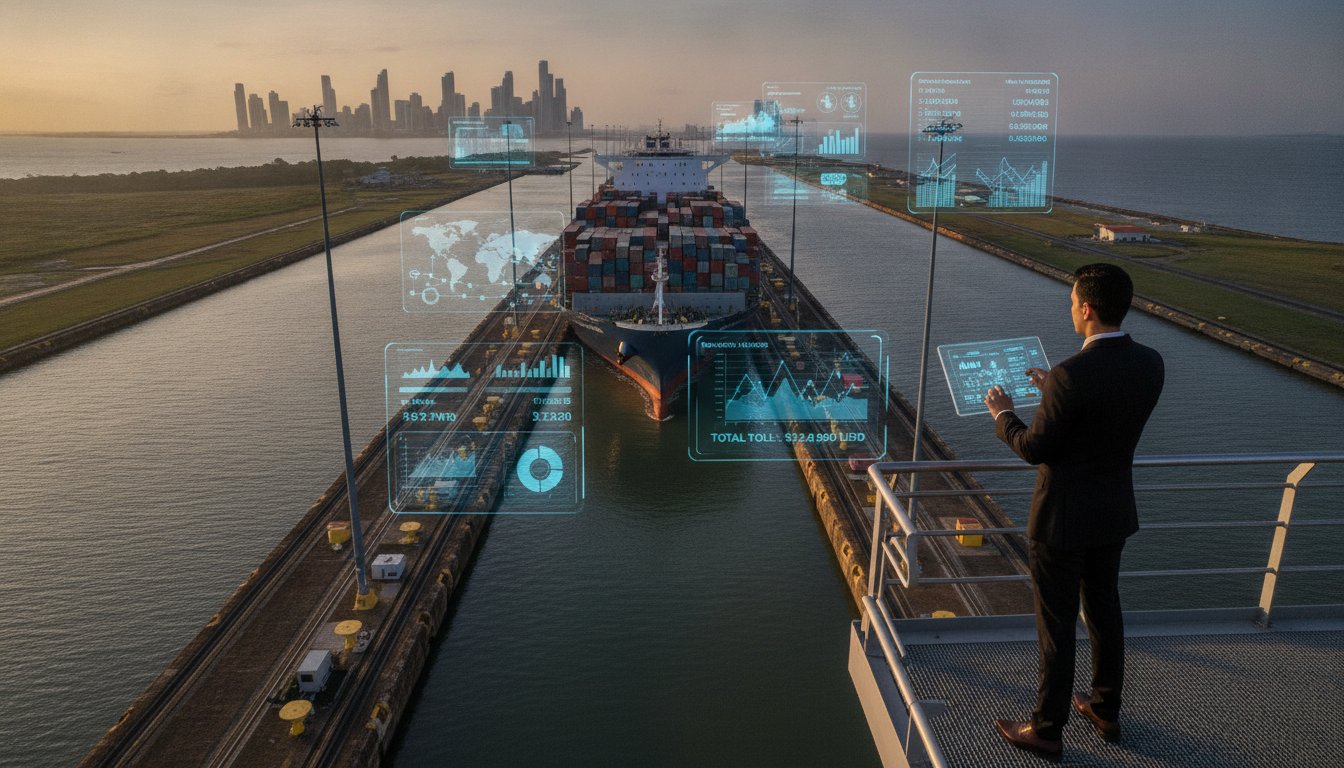
The variable transit component is the most volatile part of the 2026 formula. It’s driven by market demand and geopolitical stability. Recent events in the Middle East have increased demand for the Panama Canal, causing auction prices to climb significantly. While a standard Neopanamax reservation fee is $100,000, last-minute auction slots have reached much higher figures. This volatility makes it essential to work with a partner who understands the nuances of the auction system and can provide real-time cost projections.
PC/UMS and Tonnage Measurements
The capacity fee relies on the Panama Canal Universal Measurement System (PC/UMS). PC/UMS is a mathematical formula used by the ACP to determine a vessel’s total volume. It’s different from standard net tonnage measurements used in other international waterways. For example, container ships are often charged based on Total TEU capacity, whereas tankers and bulk carriers are assessed on their volumetric capacity. Precise measurement is critical for your budget. If the ACP identifies a discrepancy during inspection, you’ll face remeasurement fees and potential transit delays. A first-time transit admeasurement service fee is currently set at $1,100. Accurate documentation prevents these friction points. Engaging an experienced ship agency ensures your paperwork aligns with ACP standards before your arrival.
The Fresh Water Surcharge (FWS)
Environmental factors now play a direct role in your financial planning. The Fresh Water Surcharge was implemented to manage the canal’s operational reliability during periods of low rainfall. This fee fluctuates based on the daily water levels of Gatun Lake. For vessels with a length overall (LOA) greater than 300 feet, the surcharge includes a fixed portion of $10,000 plus a variable percentage based on the vessel’s total tolls. Understanding how the Fresh Water Surcharge fits into the broader Panama Canal transit fees explained narrative is vital for 2026 voyage planning.
Predicting these costs requires constant monitoring of local climate data. Analyzing the ACP Panama annual report provides the historical context needed to anticipate seasonal water level shifts. When the lake level falls below specific thresholds, the variable portion of the FWS increases, adding a layer of complexity to your Proforma Disbursement Account. We act as your eyes on the ground, monitoring these daily changes to ensure your budget reflects the most current environmental data.
Strategic Booking: Auctions vs. Reserved Slots
Securing a transit slot is a high-stakes exercise in financial trade-offs. While understanding the base formula is essential, your final invoice depends heavily on how and when you book your passage. In a high-traffic environment, Panama Canal transit fees explained through the lens of scheduling reveal that the base toll is often just the starting point. Operators must choose between the predictability of the standard reservation system and the volatility of the auction market. Each path carries distinct risks and rewards that directly impact your voyage’s bottom line.
The financial risk of arriving without a booking is significant. During peak periods or disruptions, non-booked vessels can face wait times exceeding 10 days. If your daily vessel operating cost is $50,000, a 10-day delay translates to a $500,000 loss in efficiency. In this context, paying a premium for a reserved slot or winning an auction bid is often a strategic investment rather than a mere expense. We help you calculate the ROI of these decisions, ensuring your choice aligns with your charter requirements and budget constraints.
The Transit Reservation System
The standard reservation system offers the most predictability for your budget. For Neopanamax vessels, the standard transit reservation fee is $100,000. Super vessels are charged $50,000, while regular vessels pay $12,000. These fees are tiered based on vessel dimensions and the lead time of the booking. It’s vital to respect the ACP’s strict deadlines; a last-minute Neopanamax reservation can jump to $200,000. Scheduling logistics are complex, as vessel dimensions strictly dictate the availability of specific slots. For a deeper look at these requirements, refer to our guide on Panama Canal transit to align your timeline with ACP availability.
Navigating the Auction Market
When reserved slots are sold out, the auction system becomes the only path for high-priority transits. This market is driven by supply and demand, often influenced by global events. Recent geopolitical instability has pushed average auction prices to a range of $385,000. In extreme cases, last-minute auction fees have reached as high as $4 million. These fluctuations represent the logistical and financial impacts of canal capacity constraints on global trade routes.
Entering an auction requires nerves of steel and local intelligence. We provide real-time data on recent bidding trends to help you determine when to enter the fray and when to wait in the queue. Our role is to act as your vigilant representative, monitoring the auction board and advising on a bidding strategy that secures your slot without overpaying. By delegating this task to Adimar Shipping, Inc., you gain the operational freedom to focus on your cargo while we manage the complexities of the bidding process.
Compliance and Husbandry: Avoiding Hidden Surcharges
Hidden costs often lurk in the gaps between mandatory tolls and actual operations. While the Panama Canal transit fees explained in previous sections focus on the ACP’s primary formula, your final disbursement account can swell due to regulatory fines or inefficient logistics. Vigilance on the ground is the only way to ensure these expenses don’t derail your voyage’s profitability. By addressing compliance early, you transform potential liabilities into predictable, manageable line items.
PCSOPEP (Panama Canal Shipboard Oil Pollution Emergency Plan) compliance is a prime example of where local expertise saves money. Every vessel over 400 gross tons must have an approved plan and a designated representative on the ground. Failing to maintain an updated plan or lacking a qualified PCSOPEP authorized person can result in significant transit delays and environmental fines. We act as your proactive partner to ensure every document is filed correctly long before your vessel reaches the breakwater.
Regulatory Compliance Costs
The ACP conducts rigorous inspections for every transit to ensure safety standards are met. If a vessel arrives with faulty equipment or incomplete paperwork, the financial consequences are immediate. For instance, a vessel with 3,000 PC/UMS tons or more faces a mandatory security charge of $1,250. However, non-compliance can trigger far more expensive pilotage or tugboat surcharges. A mandatory tug service for a complete Neopanamax transit costs $30,000. If your vessel requires additional assistance due to a failure to meet canal standards, these costs multiply quickly. Perfection in documentation isn’t just about following rules; it’s about protecting your bottom line from avoidable ad hoc charges.
Bundling Husbandry Services
Efficiency in Panama is found in consolidated logistics. Combining husbandry services with your scheduled transit window reduces the per-service cost significantly. Instead of arranging separate deliveries for spares, provisions, and bunkering, we coordinate these movements to happen simultaneously. This approach eliminates redundant launch fees and minimizes the time your vessel spends at anchor. Managing Cash to Master (CTM) through a single point of contact also prevents excessive banking or delivery fees that often go unnoticed in larger invoices. We simplify the complex coordination of crew changes and supplies, giving you operational freedom and a more transparent budget.
Understanding how these administrative details interact with the Panama Canal transit fees explained in this guide is the difference between a smooth passage and a financial headache. By delegating these specialized tasks to an experienced local partner, you ensure that your Proforma Disbursement Account remains accurate and free of surprises.
Ready to optimize your next transit? Contact us to secure comprehensive ship agency services that prioritize your financial transparency.
Adimar Shipping, Inc.: Your Local Partner for Financial Transparency
Managing maritime logistics in Panama is a high-stakes endeavor. You need more than just a service provider; you need a partner who treats your budget with the same care as their own. At Adimar Shipping, Inc., we’ve built our reputation on a foundation of local vigilance and absolute financial transparency. Having the Panama Canal transit fees explained is the first step, but having them managed by a local expert is what actually secures your bottom line. We act as your eyes and ears on the ground, ensuring that every dollar in your Proforma Disbursement Account is accounted for and justified.
Our “Vigilance” approach to financial management eliminates the confusion often associated with canal transits. We provide line-by-line transparency in every quote, ensuring you understand the distinction between mandatory ACP tariffs and essential service fees. Local expertise is your only real defense against unexpected ACP tariff changes or sudden shifts in the auction market. We monitor these developments in real-time, allowing us to provide the most accurate and up-to-date financial projections for your 2026 transit.
The Adimar Shipping, Inc. Difference in Financial Management
We operate as a direct extension of your own office in Panama City. This partnership model means we don’t just process paperwork; we actively protect your interests. Our commitment to ethical standards ensures zero hidden markups on third-party services like tugs, launches, or line handlers. We believe that long-term reliability is more valuable than short-term gains. For example, our proactive planning recently saved a client from significant delay fines by identifying a discrepancy in their vessel’s documentation before it reached the canal inspectors. By catching this error 72 hours early, we prevented a forced remeasurement that would’ve cost the operator both time and thousands in additional fees.
Securing Your 2026 Transit
The complexity of the 2026 toll structure and the volatility of the auction market require early action. Appointing an owner’s nominated agency well in advance is the most effective way to protect your vessel’s interests. This early appointment allows our team to conduct a thorough review of your vessel’s PC/UMS measurements and current compliance status long before arrival. We provide a customized PDA that reflects the specific needs of your vessel, from husbandry requirements to the most cost-effective booking strategy.
Don’t let the intricacies of the waterway disrupt your operational flow or your budget. Our team is ready to provide the local oversight and protection you need for a successful and predictable passage. Contact Adimar Shipping, Inc. today for a transparent Panama Canal transit quote.
Secure Your 2026 Transit with Financial Predictability
Navigating the waterway in 2026 requires more than just a standard calculator. It’s about mastering the shift from static tariffs to a dynamic financial ecosystem where water levels and auction demands dictate your final invoice. By understanding the interplay between fixed ACP tolls and essential husbandry coordination, you can transform logistical uncertainty into operational freedom. Having the Panama Canal transit fees explained provides the foundation, but local oversight is what prevents those fees from escalating into unmanageable overhead.
Adimar Shipping, Inc. provides the vigilance required to protect your maritime budget. With decades of local expertise, we serve as an authorized PCSOPEP representative and a dedicated partner for Owner’s and Charterer’s Nominated Agency services. We don’t just process transits; we safeguard your interests through ethical standards and line-by-line transparency. Let us handle the complexities of the waterway so you can focus on your vessel’s performance and your cargo’s security.
Request a Transparent PDA Quote for Your Next Transit with Adimar Shipping, Inc.
Frequently Asked Questions
How much are the Panama Canal transit fees for a Neopanamax vessel in 2026?
Neopanamax transit fees are calculated based on vessel type and capacity, with a base reservation fee of $100,000 for standard bookings. You must also account for mandatory service charges, such as the $30,000 tugboat fee and the $1,250 vessel security charge. These costs are part of the broader Panama Canal transit fees explained in our guide, reflecting the current 2026 pricing freeze maintained by the ACP.
What is the Fresh Water Surcharge and how is it calculated?
The Fresh Water Surcharge is a dynamic fee applied when Gatun Lake water levels drop below specific thresholds. For vessels longer than 300 feet, the charge includes a fixed $10,000 component plus a variable percentage based on the vessel’s total tolls. This variable portion fluctuates daily according to lake level data provided by the ACP, making real-time monitoring essential for accurate budgeting.
Can I pay my Panama Canal tolls after the vessel has transited?
No, you cannot pay Panama Canal tolls after transit. The Canal Authority operates on a strict prepaid basis, requiring all funds to be settled and confirmed before your vessel is permitted to enter the locks. Any delay in the transfer of funds can result in the loss of your transit slot and additional administrative penalties, which is why working with a dependable agent is vital.
What is the difference between ACP tolls and ship agency fees?
ACP tolls are mandatory statutory tariffs paid directly to the Panamanian government for the use of the waterway. In contrast, ship agency fees cover the professional services required to coordinate your transit, manage documentation, and oversee husbandry needs. While tolls are non-negotiable pass-through costs, agency fees are an investment in local expertise to prevent delays and manage your Proforma Disbursement Account.
How do I avoid unexpected fines during a Panama Canal transit?
Avoiding unexpected fines requires rigorous pre-arrival planning and strict adherence to ACP regulations, particularly regarding PCSOPEP compliance and accurate PC/UMS measurements. Ensuring your vessel’s equipment meets all safety standards prevents the “ad hoc” surcharges often triggered during mandatory inspections. Delegating these specialized tasks to a local partner with deep regional knowledge is the most effective way to protect your budget from surprise expenses.
What is a Proforma Disbursement Account (PDA) in maritime logistics?
A Proforma Disbursement Account (PDA) is a comprehensive financial estimate that outlines all anticipated costs for a vessel’s port call or canal transit. It includes mandatory tolls, taxes, and service fees, providing owners and charterers with a predictable budget. Within the context of Panama Canal transit fees explained, the PDA serves as a critical document for fund allocation and financial transparency before operations begin.
Is it cheaper to use the Panamax or Neopanamax locks?
Using the Panamax locks is generally cheaper because they accommodate smaller vessels with lower base toll requirements. A standard reservation for a Panamax vessel is $12,000, while a Neopanamax reservation starts at $100,000. However, the choice is usually dictated by the vessel’s dimensions and cargo volume rather than price alone, as larger ships require the expanded capacity of the Neopanamax locks.
How does the Panama Canal auction system affect my total transit cost?
The auction system can significantly increase your total transit cost during periods of high demand or canal congestion. While a standard reservation has a fixed price, auction slots are awarded to the highest bidder, with recent average prices rising to $385,000. In extreme cases, these bids have reached millions of dollars, making it crucial to weigh the cost of the bid against the expense of a long queue.