
What if the unusual detail in your vessel’s profile is the one that delays its Panama Canal transit? A ship agent for non-standard transits should help surface vessel-specific requirements and open questions early, before missing information or unclear responsibilities disrupt coordination.
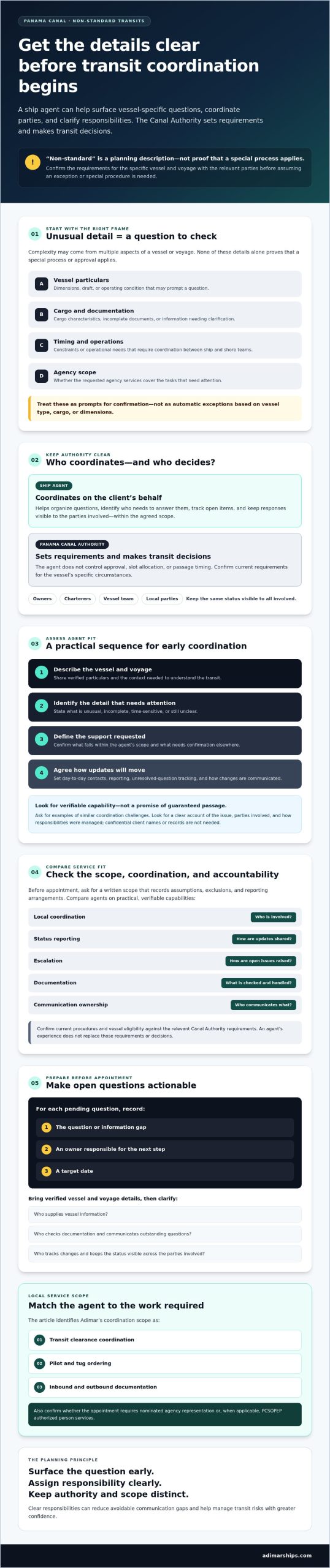
It’s not enough to know that an agent handles routine transits. You need to understand their local capabilities, the exact scope of their support, and how they’ll keep owners, charterers, the vessel team, and local parties aligned. The Canal Authority sets transit requirements; a ship agent coordinates on the client’s behalf and doesn’t control approval, slot allocation, or passage timing.
This guide explains how to assess an agent’s fit, prepare the vessel and transit information needed for early coordination, and clarify who owns each action. It also covers how to evaluate relevant local experience and service scope, including nominated agency representation and, when applicable, PCSOPEP authorized person services. With a clear picture of the dependencies and responsibilities, you can reduce avoidable communication gaps and manage transit risks with greater confidence.
Key Takeaways
- Treat “non-standard” as a planning description, then verify which requirements apply to the specific vessel and transit.
- Assess a ship agent for non-standard transits by describing the vessel, identifying the exception, and confirming service scope and communication responsibilities.
- Compare agents on local coordination, reporting, escalation, and documentation, and look for verifiable capabilities rather than promises of guaranteed passage.
- Prepare verified vessel and voyage details, then assign an owner and target date to each pending question.
- Match your needs to a clearly defined local service scope; Adimar coordinates transit clearance, pilot and tug ordering, and inbound and outbound documentation.
When a Panama Canal transit calls for a specialist ship agent
“Non-standard transit” is a useful planning description, not necessarily a single formal category used by the Panama Canal Authority (ACP). The term signals that a vessel’s circumstances may call for closer review. Confirm the terminology and requirements that apply to the specific vessel and voyage with the relevant parties before assuming a special procedure is needed.
Complexity can come from more than one source. A vessel’s dimensions, draft, cargo characteristics, operating condition, or intended timing may prompt questions, but none alone should be treated as proof that a special process or approval applies. The wider context matters. For background on the waterway’s history and basic function, see this overview of the Panama Canal.
What can make a transit non-standard?
Use unusual details as prompts to check, not as a checklist of automatic exceptions. For example: Do the vessel’s particulars or draft raise a question that needs confirmation? Does the voyage involve documentation that’s incomplete or subject to clarification? Are there timing constraints or operational needs that depend on coordination between the vessel, owners, charterers, and local parties? Does the requested agency scope cover the tasks that need attention? These questions help identify gaps early without assuming that vessel type, cargo, or dimensions alone determine the process.
A ship agent for non-standard transits should help organize those questions, identify who needs to answer them, and clarify which coordination tasks are within the agreed scope. Early review matters when an open item could affect documentation, readiness, or a handoff between ship and shore teams.
Why early local coordination matters
In Panama, a local representative can help bring unresolved questions to the relevant parties sooner and keep responses visible to the people who need them. That doesn’t replace checking current ACP requirements for the vessel’s specific circumstances. It does give the owner, charterer, vessel team, and agent a clearer way to track what’s confirmed, what remains open, and who is responsible for the next step.
A ship agent coordinates on the client’s behalf; the ACP determines canal requirements and makes decisions about transit. Keeping that distinction clear helps set realistic expectations and prevents local coordination from being mistaken for control over approval, slot allocation, or passage timing.
Clear responsibilities reduce handoff gaps. Confirm who supplies vessel information, who checks documentation, and who communicates outstanding questions, then keep the same status visible across the parties involved. For routine passage context, consult the Panama Canal transit guide. Use it alongside vessel-specific checks, not as a substitute for confirming current requirements.
How to assess a ship agent’s capability for unusual transit requirements
Assess fit in a sequence: describe the vessel and voyage, identify the detail that needs attention, define the support you’re requesting, then agree how updates will move between the parties. This gives an agent enough context to explain what falls within its scope and what needs confirmation elsewhere. A capable ship agent for non-standard transits should be clear about both its coordination role and the limits of its authority.
Ask for examples of similar coordination challenges, such as resolving documentation questions or aligning communication between vessel and shore teams. You don’t need confidential client names or records. Look for a clear account of the issue, the parties involved, and how responsibilities were managed. Confirm current procedures and vessel eligibility directly against relevant Panama Canal Authority regulations; an agent’s experience doesn’t replace the ACP’s requirements or decisions.
Questions to ask before appointing a Panama Canal ship agent
Turn general assurances into practical answers. Ask who will coordinate your case and act as the day-to-day contact. Find out how the vessel and appointing party will receive status updates, how unresolved questions will be tracked, and how changes will be communicated. Before appointment, request a written scope that records assumptions, exclusions, reporting arrangements, and an escalation path. This helps owners, charterers, and vessel teams understand who owns each follow-up.
Check specific tasks rather than relying on a broad description of “full agency.” Does the proposed scope include transit clearance, pilot and tug orders, and inbound and outbound documentation? Ask what information the agent needs from you, what it will coordinate, and which matters remain for the vessel, owner, charterer, or relevant authority to confirm.
Matching agency services to the appointment
Choose representation based on whose interests the agent is appointed to serve and which tasks the vessel needs. Owner’s or charterer’s nominated agency can align local coordination with the appointing party’s role. Standard ship agency may address the transit coordination requested, while husbandry or protective agency should be considered only if those services fit the vessel’s needs. Confirm the exact scope and availability with the agent.
PCSOPEP authorized person support is relevant only where the vessel’s confirmed requirements call for it. Verify those requirements for the specific transit with the ACP, and don’t treat the appointment of an authorized person as a substitute for that check. For a Panama-based coordination partner, you can review Adimar’s ship agency services and confirm directly whether the requested tasks fit its scope.
Compare ship agents by scope, local coordination, and accountability
A useful ship-agent comparison comes down to scope, accountability, and communication fit. The right choice depends on the vessel’s circumstances and the appointing party’s priorities, not on broad claims of “complete control.” Compare what each agent will do, how responsibilities are documented, and how local coordination connects the vessel with the parties involved.
Use the table to structure questions for each candidate. Ask for evidence of relevant capabilities, such as a sample reporting format or a clear explanation of how a task is handled. Check current, vessel-specific requirements against the Panama Canal Authority’s official transit requirements. No agent can guarantee passage or replace authority decisions.
| Compare | What to clarify | Useful evidence |
|---|---|---|
| Service scope | Are transit clearance, pilot and tug orders, and inbound and outbound documentation included? Which services need a separate appointment? | A written scope listing inclusions, exclusions, and assumptions. |
| Local coordination | Who coordinates with the vessel, appointing party, and relevant local parties? | A named contact and a defined responsibility map. |
| Reporting | What updates will be shared, with whom, and through which agreed channels? | A sample status update or reporting outline. |
| Escalation | Who handles unresolved questions or changes to the vessel’s situation or schedule? | A documented escalation path and decision owners. |
| Documentation | Who provides, checks, submits, and tracks each required document? | A clear allocation of responsibilities and open items. |
What a transparent agency scope should clarify
Ask the agent to distinguish coordination tasks from items the owner, charterer, or vessel team must supply or confirm. The scope should identify who provides vessel information and who checks requirements with the relevant authorities. It should also explain how a change, such as revised voyage details or schedule information, will be communicated and assessed. Treat vague promises as prompts for specific answers.
How to evaluate communication and representation
Compare named contacts, agreed update frequency, and the process for raising urgent questions. Owner-nominated and charterer-nominated agency align representation with the appointing party; protective agency has a distinct role, so confirm its purpose and scope rather than assuming it is included. For broader service context, see this guide to Panama Canal ship agency. A ship agent for non-standard transits should make accountability visible, not leave it to assumption.
Prepare the vessel information and coordination plan before appointment
A clear information pack helps a prospective agent assess the vessel’s needs and identify questions before responsibilities are assigned. Use current, internally approved records, and label each item as confirmed or pending. Don’t present an estimate or assumption as a verified vessel detail.
Build a practical pre-appointment information pack
Organize the information so the agent can quickly understand the vessel, voyage, requested support, and known constraints. Include:
- Vessel details: identity and current particulars, including any information relevant to the transit that needs confirmation.
- Voyage context: planned arrival and departure, requested transit preferences, and relevant voyage details.
- Known constraints: operational considerations, schedule dependencies, and documentation questions already identified.
- Requested services: list transit agency tasks separately from any husbandry, protective agency, or compliance support being considered.
For every open question, record the person responsible for resolving it and a target date. This turns an incomplete item into a trackable action and helps the appointed agent distinguish what’s ready from what still needs an answer.
Before relying on a document list or submission schedule, confirm the current instructions for the vessel and transit with the relevant authority. Requirements and timing can depend on the specific circumstances. A ship agent for non-standard transits can help coordinate information and follow-up within its agreed scope, but the vessel team and appointing party should know which details they must supply or confirm.
Set communication and escalation responsibilities
Agree on the communication chain before work begins. Name the contacts for the owner, charterer, vessel, and local agency, then specify who may issue instructions, approve requested services, and receive operational updates. Set out how the agent should flag missing information, changes to vessel or voyage details, and questions that need a decision. For urgent matters, identify the escalation contact and the route for reaching them, rather than assuming every recipient is authorized to act.
Where PCSOPEP authorized person support is relevant, first confirm the vessel-specific requirement and the service scope. The PCSOPEP authorized person guide provides further context; it doesn’t replace checking applicable requirements for the transit.
Once your information pack and contact plan are ready, discuss your Panama Canal agency requirements with Adimar and confirm which requested services fall within the agreed appointment.
Choose a Panama-based agent and confirm the next steps with Adimar
Choose an agent whose documented scope matches the vessel’s actual needs, with clear responsibilities for local coordination and communication. For unusual requirements, a ship agent for non-standard transits should be able to discuss what it can coordinate, what information it needs, and which questions must be confirmed with the Panama Canal Authority (ACP). The agent represents and coordinates on the client’s behalf; it doesn’t operate the Canal or decide transit approval, slot allocation, or timing.
Where Adimar’s Panama Canal agency services fit
Adimar Shipping, Inc. is a Panama-based ship agency with an office in Panama City. Its confirmed transit coordination services include clearance, pilot and tug ordering, and inbound and outbound documentation. Confirm directly which tasks are included for your vessel and appointment, along with any assumptions or exclusions. Owners and charterers can also appoint Adimar for nominated agency representation, aligning local coordination with the interests of the appointing party.
Husbandry, protective agency, or PCSOPEP authorized person support may be relevant depending on the vessel’s needs and confirmed requirements. Raise these separately in your enquiry and verify any applicable PCSOPEP requirements for the specific transit. Local presence supports coordination, but it isn’t a promise of approval, a particular slot, or delay-free passage.
What to include in an agency enquiry
Give the agency enough context to assess fit without treating preliminary details as confirmed. A concise enquiry can include:
- Vessel particulars: current identity and technical information relevant to the transit.
- Voyage context: intended transit, planned timing, and relevant voyage details or constraints.
- Known exceptions and open questions: distinguish verified facts from items that still need confirmation.
- Requested scope: identify the transit coordination and any separate husbandry, protective agency, or PCSOPEP support being considered.
- Appointment authority: state whether you represent the owner, charterer, or another authorized party, and who can approve instructions and services.
This gives Adimar a practical basis to discuss the requested scope and identify what needs further checking. Current ACP requirements remain vessel-specific, so confirm them with the relevant authority rather than assuming an agent’s appointment settles eligibility or procedure.
To discuss the vessel’s circumstances and outstanding questions, discuss your Panama Canal transit requirements with Adimar. The conversation can clarify service fit and coordination responsibilities without implying a particular transit outcome.
Set up your transit coordination with confidence
A well-planned unusual transit starts with a clear picture of the vessel’s circumstances, verified information, and responsibilities everyone understands. When choosing a ship agent for non-standard transits, look beyond broad assurances: confirm the service scope, local coordination role, reporting process, and who will resolve open questions. Vessel-specific requirements still need to be checked with the Panama Canal Authority.
Adimar Shipping, Inc. is a Panama-based agency with an office in Panama City. Its transit coordination includes clearance, pilot and tug orders, and inbound and outbound documentation. Owners and charterers can also appoint Adimar Shipping, Inc. for nominated agency representation. Confirm the precise scope of any requested service directly with the agency.
Share your vessel particulars, intended transit context, known exceptions, and outstanding questions to help establish whether the requested support is a fit. Discuss your Panama Canal transit requirements with Adimar and take the next step with a clearer coordination plan.
Frequently Asked Questions
What counts as a non-standard Panama Canal transit?
“Non-standard transit” is a planning description, not necessarily a single formal category used by the Panama Canal Authority (ACP). It can describe a transit with unusual vessel, voyage, timing, documentation, or coordination questions that need early review. These details don’t automatically trigger a special procedure or approval. Confirm the correct terminology and current requirements for the specific vessel and circumstances with the ACP and relevant parties.
Can a ship agent guarantee a Panama Canal transit slot or passage?
No. A ship agent coordinates services on the client’s behalf, but the ACP determines applicable requirements and makes decisions about transit. An agent cannot guarantee a slot, approval, passage timing, or delay-free transit. Ask what tasks the agent will handle, how it will report status, and which decisions remain with the ACP. Clear boundaries help owners, charterers, and vessel teams set realistic expectations and plan follow-up.
How do I choose a ship agent for unusual vessel requirements?
Choose based on relevant local coordination experience, a written service scope, clear accountability, and communication arrangements. Ask how the agent has handled similar coordination challenges without requesting confidential client details. Confirm whether transit clearance, pilot and tug orders, and documentation fall within scope, and how unresolved questions will be escalated. A ship agent for non-standard transits should explain what it can coordinate and what needs confirmation by the ACP or another party.
What information should I send a Panama Canal ship agent?
Send current vessel particulars, intended transit and voyage context, planned timing, known operational constraints, and the services you’re requesting. Mark each detail as confirmed or pending, then identify an owner and target date for open questions. State whether you represent the owner, charterer, or another authorized party, and name the contacts for instructions and updates. Confirm current document requirements and submission timing for the specific vessel rather than relying on assumptions.
Does every non-standard transit require PCSOPEP support?
No. A transit being described as non-standard doesn’t by itself establish a PCSOPEP requirement. Applicability depends on the vessel’s circumstances and current Panama Canal Authority requirements. Confirm the specific obligation with the ACP before arranging support. If an authorized person is required, clarify the agency scope and appointment directly. Adimar provides PCSOPEP authorized person services, but that service doesn’t replace checking vessel-specific requirements.
What is the difference between an owner’s and charterer’s nominated ship agent?
An owner’s nominated agent is appointed to represent the owner’s interests in local agency coordination; a charterer’s nominated agent is appointed by and represents the charterer. The right appointment depends on the parties’ arrangements and the scope they agree with the agent. Clarify who may issue instructions, approve services, and receive updates. Adimar offers both owner’s and charterer’s nominated agency services in Panama.