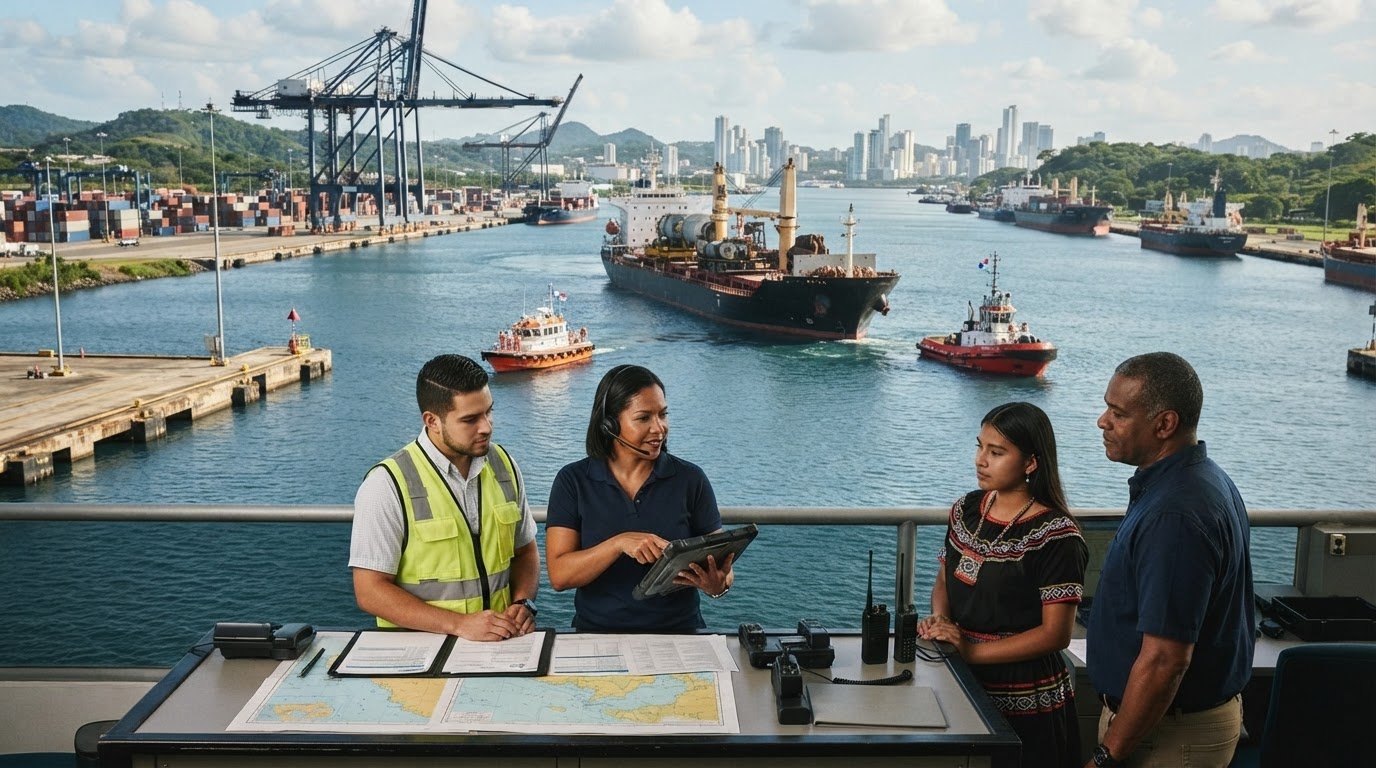


Could a ship agent help control avoidable transit costs, even while adding an agency fee? The ship agent role in cost efficiency isn’t about promising savings or controlling Panama Canal decisions. It’s about giving owners and charterers clearer oversight of expenses and coordinating local operations before gaps become delays, duplicated work, or confusion.
When transit arrangements involve multiple parties, it can be difficult to see where costs are building or who is responsible for the next step. A local representative can coordinate transit clearance, pilot and tug orders, and required documentation while keeping communication clear between the vessel and relevant parties.
This guide explains how an agent can contribute to cost efficiency in Panama and how to assess that value beyond routine formalities. It covers useful expense visibility, coordination practices that can reduce avoidable friction, and practical indicators for evaluating an agency relationship. It also explains how owners’ or charterers’ nominated representation supports client-specific oversight, while transit availability and Canal Authority decisions remain outside an agent’s control.
Key Takeaways
- The ship agent role in cost efficiency is to improve visibility and coordination, not guarantee lower total costs.
- Map transit clearance, pilot and tug orders, and documentation to the expenses and operational risks they can affect.
- Assess agency value through scope, communication, expense reporting, and clear responsibility boundaries, not the fee alone.
- Set transit objectives, reporting needs, instructions, and decision authority early, then review expenses after transit.
- Panama-based representation can help owners and charterers maintain clearer oversight while Canal Authority decisions remain outside the agent’s control.
Ship Agent Role in Cost Efficiency: Where Operational Costs Can Accumulate
Panama Canal transit involves more than a vessel’s passage. The owner or charterer, vessel, ship agent, service providers, and Canal Authority processes all have their own instructions, documents, and timing needs. When updates are unclear or responsibilities overlap, teams may repeat checks, correct information, or coordinate the same task more than once.
Cost efficiency in ship agency means improving expense visibility and controlling avoidable work, not guaranteeing a lower total bill. It is not the same as choosing the lowest agency fee. The fee is one line item. Clear communication, coordinated execution, and transparent expense information help decision-makers understand the wider cost picture. The broader role of a shipping agency includes representing a vessel’s interests ashore, but the agent does not set every charge or control every decision affecting a transit.
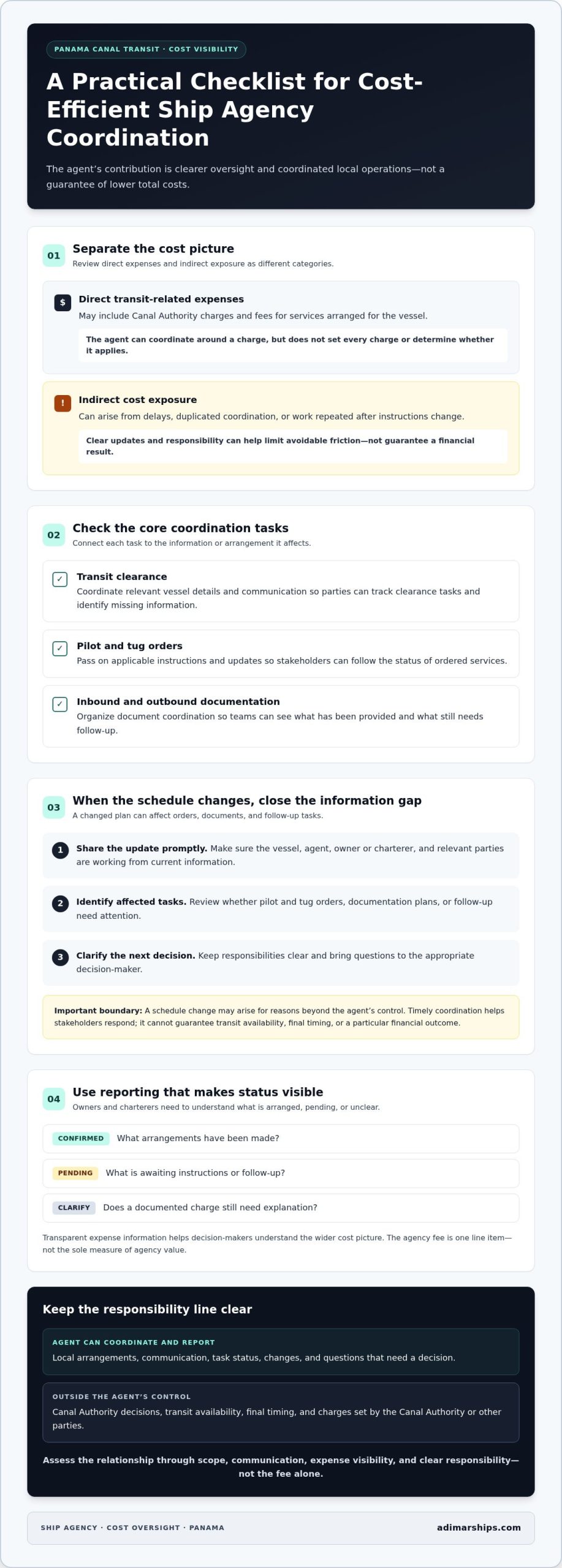
Separate costs into two groups when reviewing a call. Direct transit-related expenses may include Canal Authority charges and fees for services arranged for the vessel. Indirect cost exposure can arise from delays, duplicated coordination, or work that must be repeated after instructions change. These categories are different: an agent may coordinate the steps around a cost without determining its amount or whether it applies.
Which vessel-call costs can coordination influence?
In Panama, an agent can coordinate transit clearance, place pilot and tug orders, and manage inbound and outbound documentation. These tasks connect instructions with the operational arrangements they affect. Charges set by the Canal Authority or other parties remain outside the agent’s control, as do transit availability and final timing. If the schedule changes, timely updates help the team identify which orders, documents, or follow-up tasks need attention. They cannot guarantee a particular financial result.
Why small communication gaps can have wider consequences
Unclear instructions can lead to duplicate follow-up: the vessel asks whether an order changed, the agent checks with a service provider, and the owner or charterer requests the same confirmation separately. A missed schedule update can create a wider chain. If the vessel’s revised arrival estimate does not reach the agent, pilot and tug orders may need review, documentation plans may rely on outdated details, and shore-side teams may repeat checks.
The schedule itself may change for reasons beyond the agent’s control. The practical opportunity is to communicate the change promptly, identify affected tasks, and ensure stakeholders are working from the same information. This is where the ship agent role in cost efficiency becomes visible: not through control over every expense, but through disciplined local coordination and a clear record of what was arranged, changed, or still needs a decision. That visibility helps distinguish unavoidable charges from avoidable friction.
How a Panama Canal Ship Agent Supports Cost Efficiency
A ship agent supports cost efficiency by turning instructions into coordinated local actions and keeping the principal informed as arrangements progress. For a Panama Canal transit, this can include aligning vessel information and transit-clearance details, placing pilot and tug orders, and coordinating required inbound and outbound documentation. Accurate shared information can limit correction work, clear order details can reduce repeated confirmation, and organized documents make it easier to see what has been submitted or remains outstanding.
Timely information, clear responsibility, and consistent reporting give owners and charterers a stronger basis for expense oversight. These practices do not determine every expense. They help principals understand which arrangements are underway, what has changed, and where a decision is needed. That is the practical ship agent role in cost efficiency: supporting a clearer operational picture without promising a lower bill.
- Transit clearance: Coordinate relevant vessel details and communication so the parties can track clearance-related tasks and identify missing information.
- Pilot and tug orders: Pass on applicable instructions and updates so stakeholders can follow the status of ordered services.
- Documentation: Organize inbound and outbound document coordination so teams can see what has been provided and what needs follow-up.
Coordination that reduces preventable operational friction
One local point of coordination can help owners, charterers, the vessel, and service providers work from the same current instructions. A nominated agent represents the principal’s stated interests, relays priorities, communicates changes, and brings questions to the appropriate decision-maker. This can reduce duplicated follow-up, while the Canal Authority and individual providers remain responsible for their own decisions, requirements, and charges. Similarly, for businesses managing time-critical cargo connecting across global supply routes, working with freight specialists like ICAT Detroit provides dedicated coordination to minimize friction and prevent costly delays.
Financial oversight and transparent communication
Useful updates distinguish confirmed arrangements from pending items and explain when a change may affect the operational plan. For example, the principal should be able to tell whether an order has been placed or is awaiting instructions, and whether a documented charge still needs clarification. The agent can coordinate and report this information, but does not set or control third-party charges. For wider transit context, consult this Panama Canal transit guide.
Owners and charterers can make oversight more effective by agreeing early on who can approve changes, what updates they need, and how expenses should be reported. That keeps operational communication tied to the principal’s priorities instead of leaving each stakeholder to interpret instructions independently.
For Panama Canal transits, Adimar provides local ship agency coordination for clearance, service orders, and documentation, while keeping the principal informed.
Comparing Ship Agency Value: Fee, Visibility, and Cost Exposure
An agency fee is easy to see on a quote. The wider operational value takes more careful comparison. For a Panama Canal transit, owners and charterers should examine how the agency scope supports coordination, what information they will receive, and which decisions remain with the principal, the Canal Authority, or other service providers. The lowest quoted fee alone does not establish the lowest overall cost if responsibilities are unclear or important updates are difficult to track.
The ship agent role in cost efficiency is easier to assess through observable practices than through a promise of savings. Use the same framework to compare the working relationship:
| What to compare | Useful indicators | Responsibility boundary |
|---|---|---|
| Scope | Transit tasks, orders, and document coordination are clearly described. | The agent coordinates agreed work; third parties retain their own operational decisions. |
| Communication | Updates identify what changed, what action is needed, and who owns the follow-up. | The principal retains decisions assigned to its authority. |
| Expense visibility | Planned arrangements and changes are reported in a way the principal can review. | Reporting supports oversight but does not set third-party charges. |
| Accountability | Instructions, approvals, and open items have clear ownership. | The agent represents the principal within the agreed scope, not the Canal Authority. |
What to compare beyond the quoted agency fee
Look for a clear description of the included coordination and communication responsibilities. Who follows up on transit tasks, service orders, and required documents? Can the principal distinguish the agent’s work from charges set by the Canal Authority or a service provider? These details show whether the quoted scope gives the team usable oversight or leaves gaps that may require extra follow-up.
How owners and charterers can assess accountability
Useful updates explain what changed, what is affected, and whether the principal needs to act. Representation should also match the owner’s or charterer’s stated interests and instructions, rather than relying on assumptions about whose priorities come first. For more detail on this distinction, the owners’ nominated agency guide explains the role of owner-focused representation.
Before comparing proposals, write down your priorities and use the same questions for each scope: Which tasks are coordinated? How are updates shared? How is expense information made visible? Who approves a change? Clear answers make the comparison more practical than looking at the fee alone. They also give the agency a defined basis for acting as the principal’s local representative in Panama.
For owners and charterers seeking locally coordinated Panama Canal representation, Adimar’s ship agency services connect transit coordination with client-specific instructions and communication.
A Practical Cost-Efficiency Checklist for Panama Canal Transit
A repeatable review process turns cost-control goals into clear instructions and gives the local agent a practical framework for coordinating the transit and reporting relevant changes. The ship agent role in cost efficiency is easier to evaluate when the principal can trace instructions, decisions, services, and expense explanations from planning through post-transit review.
Before transit: set the cost-control expectations
Agree on who gives instructions, who can approve changes, and who should receive operational and expense updates. Define the agency scope for transit clearance, ordered services, and required documentation. Set expectations for reports, including how the agent should flag open items or changes that may affect arrangements.
- Define the objective. Identify what the principal wants to monitor, such as clear ownership of transit tasks, timely change notices, or an organized record of expenses.
- Set decision authority. Name the person or role authorized to issue instructions and approve changes. Clarify how the agent should proceed when an update requires the principal’s decision.
- Map scope and reporting. Confirm which party coordinates clearance, pilot and tug orders, and inbound and outbound documentation. Agree on how updates, pending items, and expense information will be shared.
For wider transit context, including factors that can shape planning, consult this Panama Canal fees and dimensions guide. Use it to inform preparation, then keep the agency review focused on the arrangements and expenses for the specific transit.
During and after transit: keep decisions and expenses traceable
Maintain a simple record as the transit progresses. The goal is not paperwork for its own sake. A clear record makes later review more precise and helps the team distinguish a changed plan from an unexplained discrepancy.
- 4. Track changes and approvals. Record significant instruction or schedule changes, who approved them, when they were communicated, and which arrangements they affected.
- 5. Review the completed call. Compare planned activities with documented services, relevant paperwork, and expense explanations. Note items that changed or need clarification.
- 6. Apply the learning. Use differences to refine instructions, reporting needs, or decision paths for the next voyage. A variance is a prompt to understand what happened, not evidence of misconduct by itself.
Clear records help owners and charterers ask focused questions: Was the service ordered as instructed? Did a change lead to a revised arrangement? Is the related expense explained? The agent can coordinate information and make the operational sequence easier to follow. The principal retains its decision authority, while third parties retain control of their own charges and decisions.
For Panama Canal transits, Adimar coordinates local ship agency services to align transit instructions, documentation, and reporting with your operational priorities.
Adimar Shipping’s Panama Canal Agency Role in Cost Efficiency
Cost efficiency depends on knowing what is being coordinated, what information is still needed, and where a principal’s decision is required. As a Panama-based ship agent, Adimar Shipping, Inc. coordinates Panama Canal transit arrangements and communicates with owners and charterers. This local representation supports oversight of operational tasks and expense-related information without implying control over Canal Authority decisions, transit availability, or third-party charges.
Local coordination for owners and charterers
Adimar coordinates transit clearance, pilot and tug orders, and required inbound and outbound documentation. Bringing these tasks into a coordinated local workflow helps principals follow the status of arrangements and identify where follow-up or an instruction may be needed. The agent organizes and communicates the work, but does not operate the Canal or determine the decisions of the Panama Canal Authority and service providers.
Representation can be tailored to the interests being served. As an owner’s nominated agent, Adimar represents the owner’s stated priorities; as a charterer’s nominated agent, it acts on the charterer’s instructions. This establishes whose perspective guides coordination and who receives updates. Clear instructions from the principal also give the agency a practical basis for referring decisions to the appropriate party.
For more context on how these responsibilities fit into transit planning, Adimar’s Panama Canal ship agency guide outlines the agency role in a Canal transit.
A clear next step for evaluating agency support
Owners and charterers can make an agency discussion more useful by identifying the vessel’s operational requirements, the intended representation, and the expense and progress reporting they need. Clarify which decisions the agent can carry out under the principal’s instructions and which require approval. These points create a shared working framework before coordination begins.
That framework is central to the ship agent role in cost efficiency. Adimar’s local coordination makes responsibilities, updates, and transit arrangements easier for the principal to follow. It does not guarantee savings, but it supports a more organized view of operational work and related expense exposure.
If you’re planning a Panama Canal transit, discuss your vessel requirements and agency scope with Adimar Shipping, Inc., including how updates and expense information should be communicated.
Build Better Cost Visibility Into the Next Transit
The ship agent role in cost efficiency can support more than a single transit review. Treat each completed call as a source of practical learning. Note which updates arrived at the right time, where approval paths were unclear, and what expense explanations would have helped the team make decisions sooner. Carry those lessons into the next voyage’s instructions. This creates a more consistent working rhythm and gives owners or charterers a clearer basis for assessing operational exposure, without assuming every transit will follow the same pattern.
Improvement starts with a clear discussion of priorities. Share the vessel’s requirements, the decisions your team needs to retain, and the reporting that helps you stay informed. Adimar Shipping, Inc. uses that context to align Panama Canal agency coordination with your operational needs and representation.
Discuss your Panama Canal agency requirements with Adimar Shipping, Inc. and take a clear, practical approach to the next transit.
Frequently Asked Questions
How does a ship agent improve cost efficiency?
A ship agent improves cost efficiency by helping the principal see how operational tasks connect and where follow-up is needed. If vessel information changes, for example, the agent can help identify which transit arrangements or records may need attention instead of leaving each stakeholder to discover the change separately. The ship agent role in cost efficiency is visible in organized communication and traceable tasks, not a promise to lower every expense.
Can a ship agent reduce Panama Canal transit costs?
A ship agent can help manage avoidable cost exposure, but cannot guarantee a lower total transit bill. If a vessel’s arrival information changes, timely communication may help relevant parties review affected arrangements and decide what action is appropriate. Charges and operational decisions set by the Panama Canal Authority or service providers remain outside the agent’s control. Evaluate the agent’s contribution by the clarity of updates and records, not assumed savings.
What costs can a ship agent help a vessel owner monitor?
A ship agent can help an owner track services and requirements within the agreed agency scope, along with related documentation and communications. The owner can review whether a service order matches the vessel’s instructions and whether a changed arrangement is explained in the call record. The agent can organize and report this information while distinguishing it from charges determined by the Canal Authority or other parties.
Is the lowest ship agency fee always the most cost-efficient choice?
No. A low agency fee does not show, by itself, how the scope handles changing instructions, document follow-up, or reporting to the principal. Compare the quoted work with the vessel’s needs: an owner may prioritize direct owner representation, while a charterer may need communication tied to charter instructions. Also distinguish agency work from third-party charges. A fee comparison is useful, but it cannot establish total cost or guarantee operational outcomes.
How can a charterer evaluate a ship agent’s cost-efficiency contribution?
A charterer can evaluate the agent’s contribution by checking whether records make instructions, approvals, and outstanding questions easy to follow. After a service order changes, for instance, the charterer should be able to identify what was revised, who authorized it, and what supporting information is available. Review this against the agreed reporting expectations. The aim is to assess representation and coordination, not attribute every cost outcome to the agent.
What information should an owner share with a ship agent to support cost control?
Share accurate vessel and voyage information, the owner’s operational instructions, relevant contacts, and a clear approval chain. State who should receive routine updates, who can authorize a change, and what expense details the owner needs to review. For example, identify the person to refer a revised service requirement to before action is taken. Transit requirements can vary, so use current Panama Canal Authority guidance for applicable procedures.