
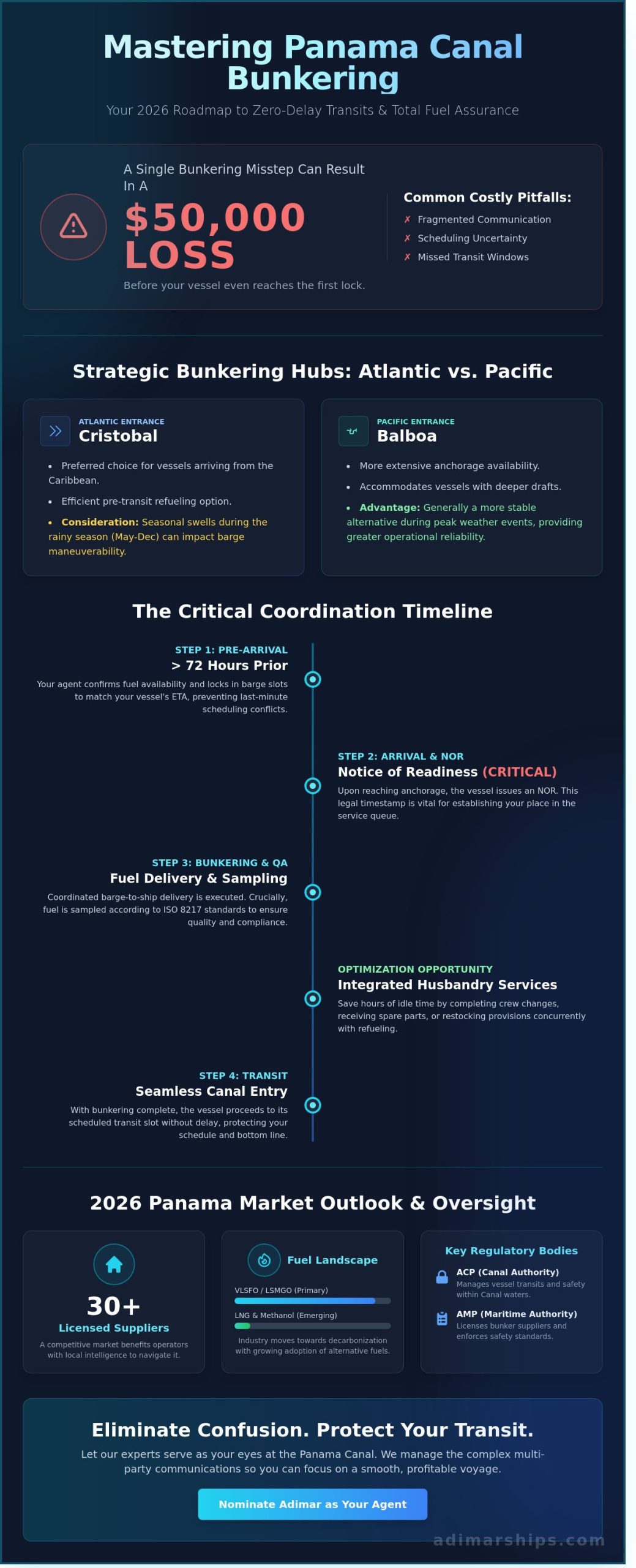
A single misstep in your bunkering schedule at the Panama Canal can result in a $50,000 loss before your vessel even reaches the first set of locks. You already know that timing isn’t just a logistical detail; it’s the heartbeat of your entire operation. Coordinating fuel delivery with reliable bunker coordination services panama while navigating MARPOL compliance is a high-stakes balancing act. This complexity often leads to fragmented communication and costly uncertainty that threatens your transit window. It’s frustrating when poor timing disrupts your schedule, but we believe your transit should be handled with absolute integrity and precision.
We are experts so you don’t have to be, serving as your local office and your eyes at the Panama Canal to eliminate confusion. You can master the complexities of refueling while protecting your transit schedule and your bottom line through expert coordination. This guide provides a clear roadmap for 2026 to achieve zero-delay transits and total fuel quality assurance. We will preview how the seamless integration of bunkering with husbandry services creates a more efficient, secure, and reliable experience for every vessel in your fleet.
Key Takeaways
- Discover how to leverage the dual-hub advantage of the Atlantic and Pacific bunkering zones to optimize your vessel’s refueling logistics and costs in USD.
- Learn the critical 72-hour coordination timeline and NOR protocols required to protect your high-stakes Panama Canal transit window from costly delays.
- Ensure fuel quality and regulatory compliance by implementing ISO 8217 sampling standards through expert bunker coordination services panama.
- Reduce operational stress by delegating complex multi-party communications to a local partner who serves as your vigilant eyes at the Canal.
The Strategic Landscape of Bunker Coordination Services in Panama
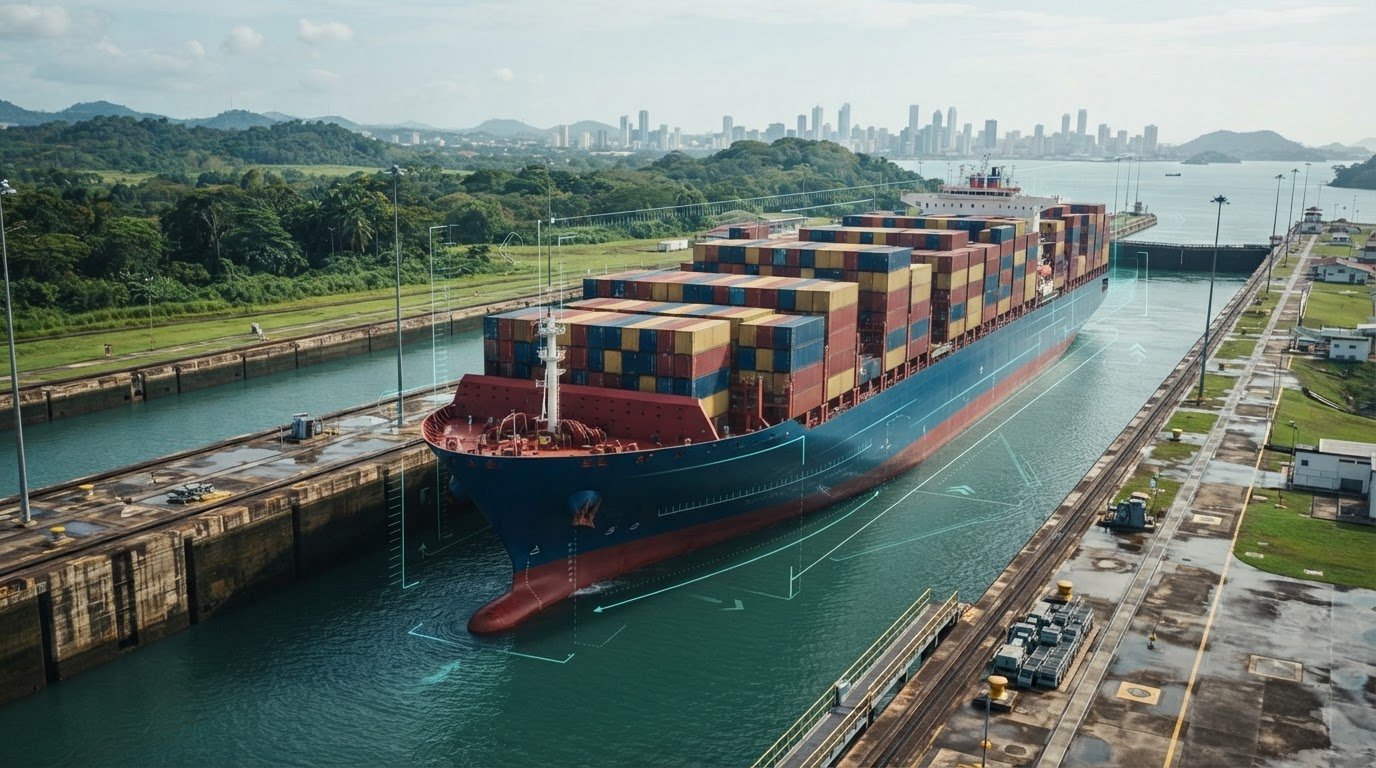
Misjudge your timing at the canal and your operational costs skyrocket. Bunker coordination services in Panama represent the specialized management of refueling logistics, ensuring a vessel receives the correct fuel grade without missing its transit slot. It isn’t just about ordering fuel; it’s about the precise synchronization of barge arrival, fuel testing, and canal scheduling. We act as your eyes at the canal, providing the local oversight required to eliminate confusion and protect your bottom line.
The strategic importance of this region is undeniable. For a comprehensive Panama Canal overview, it’s clear that this waterway is the pulse of global trade. Local coordination serves as the missing link for international ship operators who don’t have a physical presence in the country. Without a dedicated partner to manage these moving parts, even small delays in the refueling process can lead to missed windows and thousands of dollars in lost time. We are experts so you don’t have to be, handling the intricate details of bunker coordination services panama with total transparency.
Refueling Hubs: Balboa vs. Cristobal
The Pacific entrance at Balboa and the Atlantic entrance at Cristobal offer distinct operational advantages. Balboa generally features more extensive anchorage availability and can accommodate vessels with deeper drafts. In contrast, Cristobal is often the preferred choice for ships arriving from the Caribbean that need to refuel before their transit. Choosing between pre-transit and post-transit bunkering often depends on current barge availability and canal congestion. During the rainy season from May to December, seasonal swells can impact barge maneuverability in the open Atlantic waters, making Balboa a more stable alternative during peak weather events.
The 2026 Market Dynamics
By 2026, the Panama bunkering market will see over 30 licensed suppliers competing for business. This competition benefits operators, but only if they have the local intelligence to navigate it. While VLSFO and LSMGO remain the primary fuels, 2026 is a pivotal year for the adoption of alternative fuels like LNG and methanol as the industry moves toward decarbonization. Recent infrastructure upgrades, including new storage terminals with increased capacity and high-capacity barge fleets, ensure Panama remains a premier global hub. Effective bunker coordination services panama allow owners to leverage this modern infrastructure while maintaining strict adherence to quality and safety standards.
Technical Mechanics of Bunker Coordination
Effective bunker coordination services panama depend on a synchronized communication loop. This chain links the vessel owner, the local agent, the fuel supplier, the bunker barge, and the Panama Canal Authority (ACP). We act as your eyes at the canal, managing these moving parts so you don’t have to. The process begins long before the ship arrives, with the agent confirming fuel availability and barge slots to match the vessel’s Estimated Time of Arrival (ETA).
The Notice of Readiness (NOR) protocol is the heartbeat of this operation. Once a vessel reaches the designated Balboa or Cristobal anchorage, it issues an NOR. This timestamp is vital; it establishes the vessel’s legal readiness to receive fuel and determines its place in the service queue. Mismanaging this step leads to lost time and increased costs. Environmental factors like the 2023-2024 drought have impacted water levels, disrupting global trade and forcing stricter scheduling for every vessel in the queue.
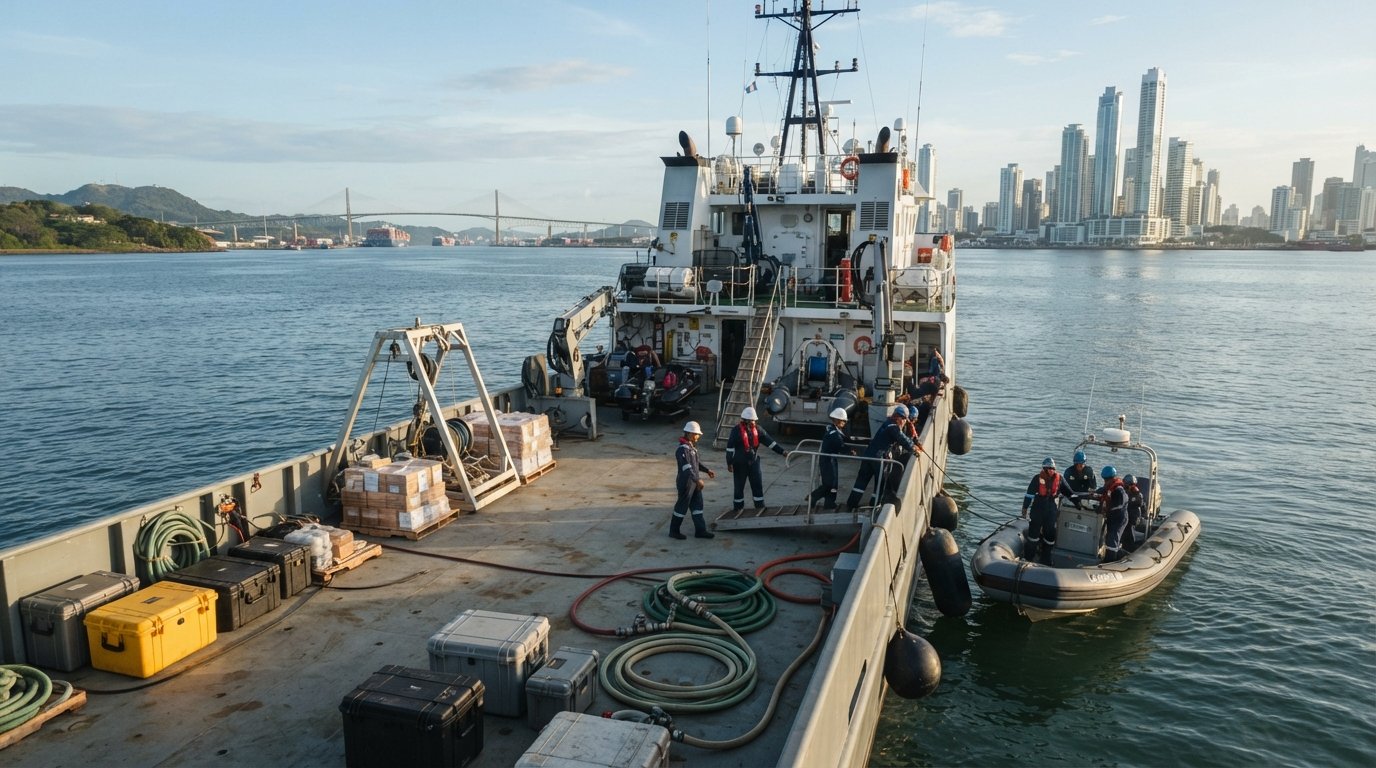
Logistically, Panama relies almost entirely on barge-to-ship deliveries at the anchorages. While shore-to-ship options exist at specific terminals, they lack the flexibility needed for ships in transit. Barge operations require precise coordination to ensure the barge is loaded and positioned exactly when the ship is cleared. To maximize this window, we often integrate husbandry services. This allows you to complete crew changes, deliver spare parts, or restock provisions while the fuel is being pumped, saving hours of idle time. You can nominate Adimar as your agent to ensure these concurrent operations run without a hitch.
Regulatory Oversight: ACP and AMP
Bunkering in Panama falls under two distinct jurisdictions. The Panama Canal Authority (ACP) manages everything related to the actual transit and safety within the Canal’s waters. The Panama Maritime Authority (AMP) handles the licensing of bunker suppliers and enforces safety standards. Ships must maintain strict documentation for environmental compliance, including the Bunker Delivery Note (BDN) and updated Oil Record Books. Failure to present the correct MARPOL documentation can result in delays and significant fines, always calculated in USD.
Ship-to-Ship (STS) Transfer Logistics
Ship-to-Ship transfers at Panama’s anchorages require specialized equipment and high levels of expertise. Local authorities mandate that all fenders and hoses meet ISO 17357:2014 standards to withstand the heavy swells often found at the Pacific entrance. Safety protocols are especially rigorous for volatile fuel blends. Coordination teams must monitor weather conditions and mooring tensions constantly to prevent spills. These offshore transfers are complex, but they remain the most efficient way to refuel without interrupting a tight transit schedule.
Risk Mitigation: Quality Control and Compliance
Fuel quality remains the primary concern for operators entering the Balboa or Cristobal hubs. Our bunker coordination services panama act as a shield against off-specification deliveries. We mandate that every delivery meets ISO 8217:2024 standards, which define the latest requirements for marine fuels. By overseeing the sampling process, we ensure that continuous drip samples are taken at the bunker manifold. This physical evidence is vital if a dispute arises later in the voyage.
We coordinate independent surveyors to verify quantities in real-time. This prevents common issues like the “cappuccino effect” air entrainment or short deliveries that can cost owners thousands of dollars. Beyond the fuel itself, environmental safety is a top priority. Engaging a PCSOPEP authorized person is a legal necessity for spill prevention and response readiness during any Panama Canal transit. We see ourselves as your local office, ensuring that every safety protocol is followed to the letter.
MARPOL Annex VI Compliance in Panama
By 2026, Panama’s Maritime Authority will enforce stricter digital reporting for sulfur content and carbon intensity. Vessels must maintain an accurate Bunker Delivery Note (BDN) for three years. We verify these documents against actual lab results before the ship departs the anchorage. If fuel is off-spec, we manage the local legal protest process immediately. This stops a technical issue from becoming a massive liability in a foreign jurisdiction.
Mitigating Financial and Operational Risks
Unmanaged bunkering leads to “hidden costs” like barge demurrage, which often exceeds $1,200 per hour during peak traffic weeks. We eliminate these surprises through transparent Disbursement Accounts (D/A) that provide a clear breakdown of every cent. Our team vets suppliers daily, checking their recent performance history and barge equipment standards. Since time is money, we don’t leave supplier integrity to chance. We are your eyes at the Panama Canal, ensuring that every dollar spent is accounted for and every operational risk is neutralized through proactive bunker coordination services panama.
Optimizing the Bunker-Transit Window
Misjudging your timing in the Panama Canal doesn’t just result in a late arrival; it leads to a total loss of your transit slot. In the high-pressure maritime environment of 2026, a missed window can cost a vessel owner upwards of $50,000 per day in idle time and rescheduling fees. Our bunker coordination services panama focus on eliminating these risks by synchronizing fuel delivery with the strict requirements of the Panama Canal transit schedule. We operate on a strict “just-in-time” model. This ensures your vessel spends minimum time at anchorage and maintains its position in the canal queue.
The 72-Hour Coordination Protocol
Precision bunkering requires a rigid timeline that starts long before the vessel reaches the breakwater. We follow a proven three-step protocol to secure your window:
- Step 1 (72 Hours Out): We perform preliminary nominations and vet suppliers based on current barge availability and the latest ACP schedule updates. We only work with suppliers who have a 98% on-time delivery record.
- Step 2 (48 Hours Out): Our team finalizes the bunkering window with the ACP traffic control center. We lock in the specific location at the Atlantic or Pacific anchorage to minimize the vessel’s deviation.
- Step 3 (24 Hours Out): We initiate real-time monitoring of barge movements. We track the physical location of the fuel barge to ensure it’s ready to meet the vessel the moment it arrives.
Managing Delays and Contingencies
Weather shifts or mechanical issues often change a vessel’s ETA at the last minute. When these delays happen, you need more than an email update; you need an advocate. We act as your local office to reschedule bunkering without incurring massive penalties from suppliers. Our team leverages 20 years of local influence to prioritize our clients’ bunkering even during periods of heavy canal congestion.
We take a “eyes on the ground” approach to every delivery. This means we don’t just take a supplier’s word for it. We verify that barges are actually loaded and ready to move before the vessel arrives. This level of transparency protects your interests and keeps your transit on track. We are experts so you don’t have to be. Put your coordination in our hands and we will eliminate the confusion with personalized service.
Ready to secure your next transit window with confidence? Get a quote from Adimar Shipping today and experience the difference of expert local coordination.
Adimar Shipping: Your Eyes at the Panama Canal
Misjudging your timing at the Panama Canal leads to immediate revenue loss. With over 20 years of experience in the region, Adimar Shipping operates on a simple, powerful principle: “Expertise so you don’t have to be.” We serve as the definitive partner for ship agency in Panama, ensuring your vessel is never just another number in a crowded queue. We eliminate the frustration and confusion that owners and charterers often face by providing a personalized service layer built on absolute integrity and transparency.
Our role goes beyond simple logistics. We act as your advocate on the ground, protecting your commercial interests during every hour of the transit. Every decision we make is cost-conscious, aiming to protect your bottom line while maintaining the highest safety standards. We understand that in the maritime world, trust is the most valuable currency. That’s why we provide clear, honest communication that keeps you in control of your assets without the stress of managing local variables yourself.
The Adimar Coordination Model
Effective bunker coordination services panama require a constant, vigilant presence. Our coordination model is built around 24/7 availability and a disciplined communication rhythm. We don’t just wait for updates; we actively seek them out to keep you informed. Adimar acts as your local office at the Panama Canal, standing between you and potential delays or supplier errors. We verify every delivery and monitor every bunker barge movement to ensure compliance with your specific requirements.
One of the primary advantages of working with us is our ability to provide bundled services that simplify your administrative burden. By integrating your needs into a single point of contact, we offer:
- Bunkering Coordination: Precise timing to match your transit window.
- Husbandry Services: Managing crew changes, spare parts delivery, and provisions.
- PCSOPEP: Ensuring full compliance with Panama Canal Shipboard Oil Pollution Emergency Plan regulations.
This holistic approach reduces the risk of miscommunication between different vendors, keeping your operations seamless and efficient.
Securing Your Next Transit
As we look toward the 2026 season, the complexity of Canal transits continues to grow. Planning ahead is the only way to guarantee the best outcomes for your fleet. When you choose our bunker coordination services panama, you gain a partner that understands the nuances of the local market and the latest Canal Authority regulations. We make it easy to get a transparent quote for your upcoming voyages, allowing you to budget with confidence in USD.
Nominating Adimar as your agent is a straightforward process that grants you immediate access to our extensive local network and 20 years of technical heritage. We take the guesswork out of the equation so you can focus on your core business. Don’t let your vessel get caught in the shuffle of a busy port. Contact Adimar Shipping to coordinate your next bunkering operation.
Securing Your Competitive Edge at the Panama Canal in 2026
Navigating the 2026 maritime landscape requires more than just standard logistics; it demands a proactive approach to the bunker-transit window to avoid costly delays. With over 20 years of experience as a trusted Panama Canal ship agent, Adimar Shipping understands that timing is everything. We act as an authorized PCSOPEP person to ensure your fleet meets every compliance security standard without fail. Our team provides personalized, 24/7 coordination to eliminate the confusion that often plagues busy canal transits.
By integrating technical precision with local expertise, we help you manage the complex mechanics of fuel procurement and quality control. Choosing the right partner for bunker coordination services panama means you can focus on your core business while we protect your interests on the ground. We’re your eyes at the Panama Canal, ensuring every drop of fuel and every minute of transit time is accounted for with total integrity. Nominate Adimar Shipping for your next bunker coordination in Panama and put your transit in the hands of seasoned experts who prioritize your efficiency.
Frequently Asked Questions
What fuel grades are currently available for bunkering in Panama in 2026?
Panama provides VLSFO (0.50% sulfur), LSMGO (0.10% sulfur), and increasingly B24 biofuel blends to meet updated IMO carbon intensity standards. By early 2026, over 92% of local suppliers have standardized these grades to accommodate the diverse needs of the global fleet. You can also secure high-sulfur fuel oil (HSFO) for vessels equipped with scrubbers through our specialized bunker coordination services panama.
How much time should I allow for bunkering before my Panama Canal transit?
You should allow between 24 and 48 hours for bunkering operations at the Balboa or Cristobal anchorages before your scheduled transit time. While the actual pumping process typically takes 6 to 12 hours, barge availability and terminal scheduling often add to the total duration. We recommend arriving at the anchorage at least 36 hours early to ensure all bunker coordination services panama are finished without risking your Canal slot.
Can bunkering be performed while the vessel is transiting the locks?
No, bunkering isn’t permitted while a vessel is transiting the locks or navigating the Gaillard Cut. The Panama Canal Authority (ACP) requires all fueling to take place at designated anchorages or authorized private terminals outside the main transit channel. Performing these operations before or after your transit ensures compliance with safety regulations and avoids the heavy fines associated with unauthorized maneuvers in the waterway.
What are the main causes of bunkering delays at the Panama Canal anchorages?
Barge congestion and adverse weather conditions at the Pacific entrance account for approximately 68% of bunkering delays in Panama. High swells during the rainy season can occasionally suspend operations at the Balboa anchorage, while terminal maintenance can limit supply flow. Our team acts as your eyes at the Panama Canal, monitoring these variables in real-time to adjust your schedule and minimize expensive idle time.
Do I need a separate agent for bunkering and husbandry services?
You don’t need a separate agent for bunkering and husbandry services. Consolidating these tasks under a single ship agent reduces communication errors and can lower your total agency fees by as much as 15%. We handle everything from fuel coordination to crew changes and spare part deliveries, providing a seamless experience that keeps your operations efficient and your costs transparent.
How does the Panama Canal Authority (ACP) regulate bunkering operations?
The ACP regulates bunkering through the OP Notice to Shipping N-1-2026 and strict environmental protocols within the Canal’s watershed. Every bunker barge must hold a valid Operation License and comply with the Panama Maritime Authority (AMP) safety standards. These regulations ensure that all transfers follow MARPOL Annex VI requirements to prevent pollution and maintain the safety of the 14,000 vessels that transit the waterway annually.
What documentation is required for a successful bunkering operation in Panama?
A successful operation requires the Bunker Delivery Note (BDN), a formal Bunker Requisition, and the vessel’s updated manifest. You must also submit the Panama Customs “Declaración de Movimiento de Carga” at least 24 hours before the barge arrives for delivery. We manage this paperwork for you to ensure every document meets the 2026 regulatory standards for a smooth, delay-free clearance process.
Is it cheaper to bunker on the Atlantic or Pacific side of the canal?
Prices are generally similar on both sides, but the Pacific side (Balboa) often offers more barge flexibility due to its larger fleet of over 35 delivery vessels. While the Atlantic side (Cristobal) can sometimes be $5 to $12 cheaper per metric ton depending on specific terminal stock levels, the Pacific side remains the preferred choice for most operators. We analyze current market data on both coasts to find you the most cost-effective solution for your specific route.