

Vigilant protective agents saved ship owners an average of 4% to 7% on total port call costs last year. In a high-stakes environment where Neopanamax reservation fees now reach $100,000, even a minor oversight in billing can lead to significant financial leakage. You likely feel the pressure of rising ACP tariffs and the inherent risk of navigating the owner’s agent vs protective agent panama decision when a charterer-nominated agent is managing your vessel’s arrival.
It’s natural to worry about hidden costs or a lack of transparency during complex transits. This guide will clarify the critical differences between these roles to help you safeguard your vessel’s interests and finances. We’ll explore how having a vigilant partner on the ground provides the strategic oversight needed to manage 2026 slot auctions, crew changes, and husbandry services with total peace of mind. By the end, you’ll know exactly how to eliminate conflicts of interest and ensure every charge in your final account is accurate and justified.
Key Takeaways
- Distinguish between the operational control of a nominated agent and the strategic verification role of a protective watchdog.
- Identify how the owner’s agent vs protective agent panama decision directly impacts your bottom line by auditing proforma and final disbursement accounts.
- Gain clarity on managing 2026 ACP slot auctions and mandatory PCSOPEP compliance through specialized local expertise.
- Ensure seamless husbandry services and crew changes by delegating complex logistics to a partner focused exclusively on your interests.
The Agency Dilemma at the Panama Canal
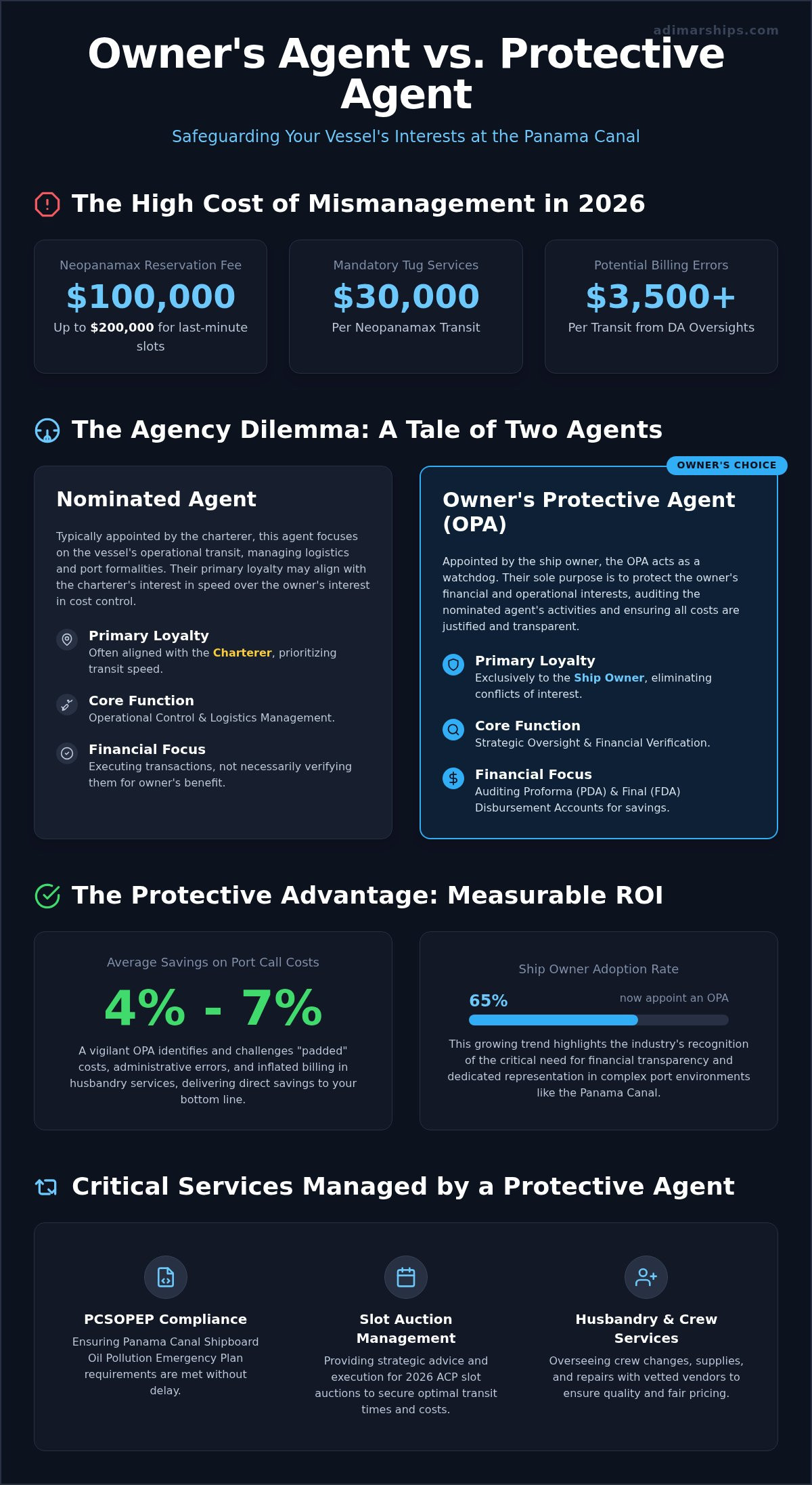
2026 has introduced a new era of complexity for Panama Canal transits. With Neopanamax reservation fees now set at $100,000 and last-minute slots reaching $200,000, the margin for error has vanished. Ship owners face a fundamental question of representation that directly affects their bottom line. When a charterer nominates the primary agent, that agent’s loyalty often aligns with the party paying the freight, not the party maintaining the asset. This creates a recurring conflict of interest. Understanding the nuance of owner’s agent vs protective agent panama is no longer just a logistical choice; it’s a critical financial safeguard.
The unique regulatory environment of the Panama Canal Authority (ACP) demands a level of vigilance that generic agencies often overlook. Transit success depends on balancing slot auction costs with operational efficiency. If your representative is focused solely on the charterer’s speed, they might ignore “padded” costs in the Disbursement Account (DA) or fail to prioritize your vessel’s long-term maintenance needs. To mitigate these risks, many owners look into What is a Protective Agent to provide a second set of eyes on the ground, ensuring that every dollar spent is verified and every regulation is met.
The Cost of Mismanagement in 2026
A single scheduling oversight in the current ACP environment can trigger massive cancellation penalties that erase voyage profits. Beyond the headline tolls, owners are increasingly frustrated by “miscellaneous” port expenses that appear in the final DA. These costs often hide in husbandry services, where lack of transparency leads to inflated billing. In 2026, while the ACP simplified its toll structure to provide better visibility, port-side expenses remain the primary red flag. For instance, tug services for Neopanamax vessels now cost $30,000 per transit. Without a watchdog to verify these mandatory services, owners are left vulnerable to administrative errors that quickly escalate into five-figure losses.
Delegating to a Local Specialist
Effective canal management requires more than a global brand name; it demands deep, local vigilance. Adimar Shipping, Inc. acts as a direct extension of your fleet team, navigating the specific nuances of ACP compliance, including PCSOPEP requirements and the $10,000 fresh water surcharge for vessels over 300 feet. Generic global agencies often struggle with these local intricacies, leading to avoidable delays at the locks. By choosing a partner with specialized regional knowledge, you ensure your vessel is treated as a priority. This level of oversight is exactly Why a Panama Canal Ships Agent is Your Most Valuable Asset when transit windows are tight and costs are at an all-time high.
Defining the Roles: Owner’s Nominated Agent vs. Protective Agent
The distinction between an owner’s agent vs protective agent panama often centers on the source of the appointment and the resulting chain of accountability. When you appoint the primary agent, they serve as your Nominated Agent, handling every operational detail of the transit. However, when a charterer exercises their right to nominate the agent, the ship owner is frequently left without a direct advocate on the ground. This is where the Owner’s Protective Agent (OPA) becomes essential, acting as an independent auditor to ensure the charterer’s agent remains compliant with your specific interests.
Ship owners must recognize that while both roles involve canal logistics, their objectives differ. Adhering to international maritime regulations is a baseline requirement for any agency, but local oversight ensures these rules don’t become a source of financial leakage. Approximately 65% of ship owners now appoint a protective agent to oversee their transits, a trend driven by the need for financial transparency in an environment where errors in disbursement accounts can cost upwards of $3,500 per transit. Selecting the right ship agency services ensures your interests remain the priority throughout the voyage.
The Owner’s Nominated Agent (Full Agency)
The Nominated Agent is the primary coordinator. They manage the heavy lifting of transit clearance, pilotage, and the coordination of mandatory services. For a Neopanamax vessel, this includes managing the $30,000 tug service fee and the $1,250 security charge. This agent handles all documentation for both inbound and outbound passage, maintaining direct accountability to the owner for the vessel’s physical movement. They are the operational engine of the transit, ensuring the ship meets every ACP requirement for a smooth passage through the locks.
The Protective Agent (OPA) Explained
An OPA acts as your “eyes and ears” when you don’t have operational control. Their primary role is verification rather than execution. They audit the proforma and final disbursement accounts to ensure that port and canal dues are calculated with absolute precision. This is particularly vital in 2026, as owners navigate the $10,000 fresh water surcharge and complex slot auction results. You should use an OPA whenever a charterer nominates the primary agent or when your vessel requires complex husbandry services, such as crew changes or specialized repairs, that require a dedicated representative focused solely on your budget and timeline.
The Critical Difference: Operational Control vs. Strategic Oversight
The fundamental distinction between an owner’s agent vs protective agent panama lies in the nature of their authority. While one manages the vessel’s physical movement, the other manages the owner’s financial and regulatory risk. This distinction becomes visible during the creation and auditing of the Disbursement Account (DA). A nominated agent creates the DA, estimating costs for tolls, tugs, and pilotage. Conversely, a protective agent audits these figures, ensuring that the $30,000 Neopanamax tug fee or the $10,000 fresh water surcharge isn’t applied incorrectly. Understanding what is a protective agent helps clarify this shift from operational execution to strategic verification.
The following breakdown highlights how these roles diverge in daily practice at the Panama Canal:
- Primary Responsibility: The nominated agent focuses on execution, ensuring the vessel clears the locks on schedule. The protective agent focuses on verification, ensuring that the schedule doesn’t come at an inflated price.
- Financial Authority: One agent handles the primary funding and payment to the ACP. The other provides a rigorous audit of every line item to prevent financial leakage.
- Husbandry Focus: While the primary agent coordinates crew changes and supplies, the protective agent oversees the efficiency of these services, ensuring third-party vendors aren’t overcharging for local logistics.
- ACP Relations: The nominated agent handles the technical slot booking. The protective agent verifies the timing and auction results to ensure the owner isn’t paying for unnecessary premium slots.
When to Appoint an Owner’s Nominated Agent
You should appoint a full Nominated Agency when you have total control over the selection process. This provides a single point of contact for all vessel and crew needs, ensuring total alignment between the agent and your budget. By delegating the entire transit to a trusted specialist, you eliminate the need for a secondary watchdog. This setup is ideal for owners who prioritize streamlined communication and want their agent to act as a direct extension of their own fleet team, managing everything from pilotage coordination to final port clearance with absolute transparency.
When a Protective Agent is Non-Negotiable
A protective agent is essential whenever a charter party agreement grants nomination rights to the charterer. In these scenarios, the primary agent’s priority is often the charterer’s timeline, which may lead to overlooked savings for the ship owner. For high-value transits, particularly Neopanamax passages, an OPA can save thousands of dollars by identifying padded costs in the proforma DA. Additionally, ensuring specialized PCSOPEP compliance is handled by your own representative is vital. A protective agent acts as your vigilant local partner, verifying that all environmental and safety regulations are met without the conflict of interest inherent in charterer-nominated scenarios.
Financial Safeguards: How an OPA Protects Your Bottom Line in 2026
Financial transparency is the cornerstone of a successful Panama Canal transit. In the current maritime economy, ship owners cannot afford to treat the Disbursement Account (DA) as a mere formality. Navigating the owner’s agent vs protective agent panama decision requires a proactive approach to cost control. While the primary agent manages the technical transit, an Owner’s Protective Agent (OPA) acts as your vigilant “eyes and ears” on the ground. They are tasked with scrutinizing every invoice to ensure that expenses are billed with absolute precision and reflect actual services rendered.
The financial risk in 2026 extends beyond standard tariffs to the volatile nature of operational delays. A protective agent manages this risk by verifying arrival windows and monitoring vessel readiness in real time. They ensure that the owner isn’t penalized for administrative delays that fall outside their control. This provides a layer of financial security that a charterer-nominated agent, whose priorities may lie with cargo interests, might overlook. Implementing a strategic owner’s agent vs protective agent panama framework ensures your budget remains protected from these high-stakes variables.
Auditing the Disbursement Account (DA)
The real value of an OPA is found in the meticulous comparison between the Proforma and the Final DA. Hidden costs frequently appear in “miscellaneous” port charges or inflated vendor quotes for local launches. By auditing third-party invoices for spares and logistics, a protective agent identifies and challenges padded expenses before they are paid. The ROI is clear. While a protective agency fee is a modest investment, it has the potential to save $15,000 or more in unnecessary leaks. This auditing process ensures that your funds are used efficiently and that every dollar spent contributes directly to the vessel’s operational success.
Operational Efficiency & Husbandry Oversight
Beyond the ledger, a protective agent ensures that essential husbandry services do not interfere with the transit schedule. Coordinating crew changes, medical services, and Cash to Master (CTM) requires a representative who answers only to you. When these tasks are left to a charterer’s agent, they may take a backseat to the charterer’s cargo priorities. An OPA provides the dedicated oversight needed to manage these complex logistics with total transparency, ensuring your crew receives the support they need without avoidable administrative markups.
Protect your interests by appointing a vigilant local partner to oversee your next transit. Contact Adimar Shipping, Inc. to secure your bottom line.
Choosing Your Representative: Why Local Expertise in Panama is Non-Negotiable
Selecting a representative at the Panama Canal is about more than ticking a regulatory box. It’s about finding a partner who prioritizes your financial security and operational success. Adimar Shipping, Inc. provides the vigilance required to navigate the complex owner’s agent vs protective agent panama landscape. Our team acts as a direct extension of your own crew, ensuring that local nuances never translate into avoidable delays or hidden costs. By focusing on personalized service, we eliminate the administrative confusion that often arises during high-traffic periods at the locks.
The 2026 maritime environment demands a representative with deep regional roots who can navigate the increasingly competitive slot environment. We simplify this process by providing customized proforma DAs and protective quotes that reflect the current market reality. Our role is to ensure your passage is smooth, cost-efficient, and free from the administrative friction that often plagues generic agencies. We don’t just process paperwork; we provide the strategic oversight necessary to protect your bottom line through every mile of the canal.
Our Commitment to Ethical Representation
We treat your vessel as if it were our own. Integrity is not just a buzzword for us; it’s a core operational standard that defines every interaction. Our deep local knowledge allows us to anticipate challenges before they impact your transit schedule. Whether we are acting as your primary agent or your protective watchdog, we maintain a focus on absolute transparency. This dual perspective is invaluable because we understand both the owner’s need for cost control and the charterer’s demand for speed. For a deeper dive into how we protect your asset, explore our Owner’s Nominated Agency guide.
Securing Your 2026 Panama Canal Transits
The next steps in securing your transit are straightforward. You can contact Adimar Shipping, Inc. for a customized proforma or a protective quote tailored to your vessel’s specific dimensions and cargo requirements. Our team is ready to manage the complexities of PCSOPEP compliance, husbandry logistics, and ACP coordination. We provide the peace of mind that comes from knowing your vessel is in the hands of seasoned experts who prioritize your interests above all else.
Ready to safeguard your next voyage? Deciding between an owner’s agent vs protective agent panama depends on your specific charter party terms, but our commitment to your interests remains constant. We are here to eliminate confusion and provide the local expertise your fleet deserves. Contact Adimar Shipping, Inc. for expert agency services and experience the difference that dedicated local vigilance makes for your fleet.
Secure Your Competitive Edge at the Panama Canal
The 2026 maritime landscape leaves no room for financial ambiguity or administrative oversight. Successfully managing the owner’s agent vs protective agent panama decision is the most effective way to eliminate conflicts of interest and ensure your vessel’s needs remain the top priority during every transit. By prioritizing strategic oversight over mere operational execution, you protect your bottom line from hidden costs and ensure total compliance with evolving ACP regulations. This proactive approach transforms a standard logistical requirement into a powerful financial safeguard.
Adimar Shipping provides the vigilant local oversight your fleet needs to thrive in this high-stakes environment. Our specialized role as a PCSOPEP Authorized Person and our long-standing expertise in auditing complex Disbursement Accounts ensure that your funds are used with absolute precision. We don’t just process transits; we act as a dependable extension of your own team. This partnership provides the transparency and security required for a smooth, predictable passage through the canal. We look forward to being your eyes and ears on the ground.
Protect your interests at the Panama Canal with Adimar Shipping. Our experienced team is ready to guide you through every logistical challenge with confidence and integrity.
Frequently Asked Questions
What is the difference between a protective agent and a husbanding agent?
A protective agent focuses on financial and strategic oversight, while a husbanding agent manages physical vessel requirements. The OPA acts as an independent auditor of the charterer’s agent to prevent conflicts of interest. In contrast, husbanding services cover crew changes, spare parts delivery, and medical assistance. Owners often combine these roles to ensure local logistics are handled with absolute transparency and without the markups common in unmonitored accounts.
Can a protective agent also handle crew changes and spare parts?
Yes, a protective agent can manage these logistics. Delegating husbandry tasks to your OPA ensures that crew changes and spare parts delivery don’t become a source of financial leakage. By using your own representative for these services, you bypass potential markups from a charterer-nominated agent. This ensures your crew and vessel receive the necessary support while maintaining strict control over your operational budget.
Who pays the protective agent’s fee in a charterer-nominated transit?
The ship owner is responsible for the protective agent’s fee. Because the OPA is hired exclusively to represent the owner’s interests and audit the charterer’s nominated agent, they are an independent appointment. This small investment provides a high return by identifying padded costs in the Disbursement Account. It’s a standard practice that ensures the owner has a loyal advocate on the ground throughout the transit.
Is it common to have two agents for one Panama Canal transit?
It is very common. Statistics show that roughly 65% of ship owners appoint an OPA when a charterer selects the primary agent. This dual-layer approach provides the best of both worlds: operational execution from the main agent and strategic verification from the protective agent. Navigating the owner’s agent vs protective agent panama choice this way ensures your vessel moves efficiently while your finances remain protected.
How does a protective agent save me money on ACP tolls?
A protective agent saves you money by auditing the accuracy of applied surcharges. While ACP tolls are fixed, errors in calculating ballast status or the $10,000 fresh water surcharge can lead to overpayment. Your OPA verifies every line item in the proforma and final Disbursement Account. This vigilant oversight prevents administrative errors from turning into costly financial leaks during high-value Neopanamax transits.
What happens if there is a dispute between the main agent and the protective agent?
The protective agent acts as your advocate if a dispute arises. When the OPA identifies an error in the Disbursement Account or an operational delay, they report it directly to the owner. You then have the documented evidence needed to instruct the main agent to correct the issue. This creates a clear chain of accountability, ensuring the charterer’s agent remains compliant with your specific financial and safety standards.
Do I need a protective agent for every Panama Canal transit?
You don’t need an OPA if you have full control over the agency nomination. However, a protective agent is essential whenever a charterer selects the primary representative. For high-stakes 2026 transits, the owner’s agent vs protective agent panama decision becomes a question of risk management. Having an independent watchdog is the only way to guarantee transparency and prevent conflicts of interest during the transit process.
How do I appoint Adimar Shipping as my protective agent?
You can appoint Adimar Shipping by sending a formal nomination via email. Simply provide your vessel’s name, ETA, and the details of the charterer-nominated agent. Our team will immediately contact the primary agent to establish oversight and begin auditing the proforma DA. We act as your vigilant local partner, ensuring a smooth and cost-efficient passage through the locks from start to finish.