
Did you know that a single Neopanamax auction slot recently reached nearly $4 million? For ship operators, the Panama Canal toll calculation is no longer a simple line item; it’s a high-stakes financial puzzle. Between the fixed tariff freeze through September 2026 and the volatile auction market, a minor miscalculation can lead to devastating budget overruns. We recognize the stress of managing these shifting costs while trying to maintain tight operational margins in an increasingly unpredictable maritime environment.
We understand that the transition between PC/UMS and TEU capacity metrics often creates more confusion than clarity. You’re likely facing the frustration of unexpected freshwater surcharges or the pressure of the new sustainable shipping tolls arriving in February 2026. This guide promises to help you master these multi-layered tariffs to ensure precise voyage budgeting and total cost optimization. We’ll break down every variable component, from draft restrictions to reservation tiers, giving you the clarity needed to eliminate financial discrepancies with the ACP. It’s time to transform your transit planning from a “black box” into a predictable, manageable process that protects your bottom line.
Key Takeaways
- Master the 2026 simplified toll structure and the PC/UMS measurement system to establish a reliable baseline for your voyage expenses.
- Identify the specific capacity and usage-based charges for Panamax and Neopanamax vessels to refine your Panama Canal toll calculation.
- Account for variable surcharges, including climate-driven freshwater fees and transit reservation premiums, to protect your budget from unforeseen operational shifts.
- Follow a structured data collection framework to accurately assess vessel dimensions and transit status before arriving at the locks.
- Leverage local agency expertise to audit official ACP estimates and synchronize husbandry costs for a transparent, discrepancy-free final invoice.
The Foundation of Panama Canal Toll Calculation
Predicting your 2026 voyage costs starts with understanding a fundamental shift in how the Panama Canal Authority (ACP) views vessel value. The ACP has streamlined its tariff structure to provide more stability through September 30, 2026, yet the underlying math remains complex. You can’t rely on standard international metrics alone. While the History of the Panama Canal reflects various pricing philosophies, the modern era prioritizes a vessel’s earning capacity and physical footprint within the locks. This makes the Panama Canal toll calculation a specialized exercise that differs significantly from Suez or port-specific billing.
The ACP functions as the sole regulator of these rates, adjusting tariffs annually based on water availability and global trade demand. It’s vital to recognize that vessel displacement and net tonnage are no longer the primary drivers of your invoice. Instead, the system focuses on a proprietary volumetric measurement that ensures the Canal captures value based on the specific space your ship occupies during its transit.
What is PC/UMS and How is it Calculated?
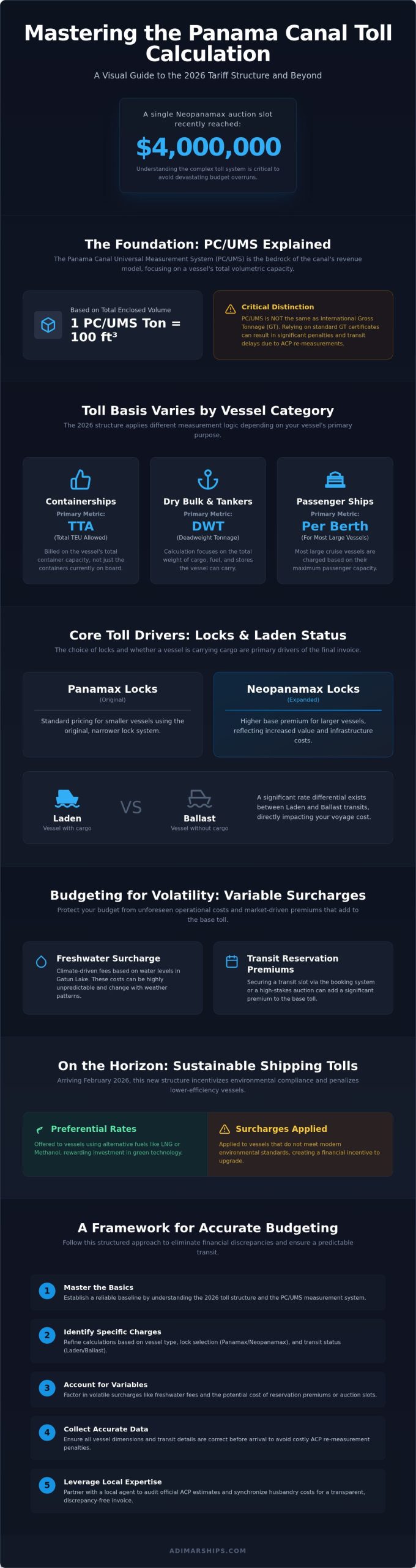
PC/UMS stands for the Panama Canal Universal Measurement System. It’s the bedrock of the canal’s revenue model. Unlike International Gross Tonnage (GT), which follows the 1969 Tonnage Convention, PC/UMS uses a specific mathematical formula to calculate the total volume of all enclosed spaces on a ship. One PC/UMS ton is equivalent to 100 cubic feet of capacity.
Accurate measurement is critical because the ACP reserves the right to conduct “re-measurements” upon arrival. If your documentation doesn’t match their physical inspection, you risk significant penalties and transit delays. We’ve seen many operators face budget overruns simply because they relied on a standard GT certificate rather than a Panama-specific volume audit. Our role as your agent is to verify these figures early, acting as a protective layer between your budget and ACP inspectors.
Toll Basis by Vessel Category
Not all vessels are measured by volume alone. The 2026 structure applies different logic depending on your ship’s purpose:
- Containerships: These are billed on a capacity basis using Total TEU allowed, combining fixed and variable charges.
- Dry Bulk and Tankers: These vessels typically follow Deadweight Tonnage (DWT) logic, focusing on the weight of the cargo, fuel, and stores the ship can carry.
- Passenger Ships: The “berth” vs. “PC/UMS” debate continues here. Most large cruise vessels are charged per berth, while smaller ones may still fall under the volumetric PC/UMS system.
By delegating the verification of these metrics to a local expert, you gain the peace of mind that your initial estimate will align with the final ACP invoice. We provide the vigilance needed to ensure your vessel’s dimensions are recorded correctly the first time.
Decoding the 2026 Primary Toll Components
Understanding the layers of a Panama Canal toll calculation requires a clear view of the lock system you intend to use. The 2026 tariff environment distinguishes sharply between the original Panamax locks and the expanded Neopanamax lane. This isn’t just about vessel size; it’s about the infrastructure utilized and the operational complexity involved in each crossing. While the Official Panama Canal Tariffs provide the raw numbers, the logic behind these charges is designed to maximize throughput and reward efficiency.
For container carriers, the Total TEU Allowed (TTA) metric is the dominant factor. This metric calculates the total capacity of the ship rather than just the containers on deck, ensuring the ACP captures revenue based on the vessel’s potential. Starting in February 2026, the ACP will also introduce a sustainable shipping toll. This new tier offers preferential rates for vessels using alternative fuels like LNG or methanol, while applying surcharges to those that don’t meet modern environmental standards. This shift makes the accuracy of your Panama Canal toll calculation even more dependent on technical compliance. It’s why many owners rely on an experienced ship agency to verify vessel ratings before arrival.
Neopanamax vs. Panamax Lock Pricing
Neopanamax transits carry a higher base premium because these locks use water-saving basins and accommodate much larger tonnages. The lock selection directly influences your final invoice, as Neopanamax rates are scaled to the increased value of the transit. You’ll also notice a significant differential between “Laden” and “Ballast” rates. A ship in ballast pays a reduced rate, but even a small amount of cargo can trigger the full laden tariff. We help owners audit these statuses to ensure you aren’t overcharged for a vessel that isn’t truly in laden condition.
The Fixed Capacity Charge Explained
Beyond usage-based fees, every transit includes a base component that provides revenue stability for the Canal. For non-container vessels, the ACP calculates “utilized” capacity based on specialized metrics like DWT or PC/UMS volume. The Fixed Capacity Charge is the minimum financial threshold for transit. This fee applies regardless of whether your ship is carrying a full load or just a fraction of its capacity. By understanding this baseline, you can better predict the break-even point for your voyage and avoid the budget overruns that occur when these fixed costs are overlooked.
Understanding Variable Surcharges and Operational Fees
A precise Panama Canal toll calculation isn’t complete without factoring in variable surcharges that respond to environmental and market conditions. While base tariffs provide a starting point, these additional fees represent a significant portion of your total disbursement account. For a detailed analysis of these specific line items, see our Panama Canal Fees: A 2026 Cost Breakdown. Beyond the primary tolls, operators must account for mandatory services like tugboats, which cost $30,000 for Neopanamax vessels, and vessel security charges typically set at $1,250. These costs are non-negotiable and must be integrated into your initial budget to avoid funding gaps during transit.
The Dynamics of the Freshwater Surcharge
Water availability is the most volatile factor in canal operations today. The Freshwater Surcharge applies to all vessels over 300 feet in length, consisting of a fixed $10,000 fee plus a variable percentage tied to the daily water level of Gatun Lake. This percentage fluctuates based on real-time hydrological data. With a severe El Niño event expected to peak between October 2026 and January 2027, water levels will likely drop, pushing the variable component higher. Forecasting these costs requires constant monitoring of ACP data. We help our clients model these scenarios to ensure voyage budgets remain realistic despite seasonal droughts. You can cross-reference current rates through the Official Panama Canal Maritime Tariffs to see how these tiers shift based on lake elevation.
Booking Fees and Auction Strategy
Securing a transit slot is a strategic decision that carries its own price tag. Standard reservation fees are currently $100,000 for Neopanamax vessels and $50,000 for Super vessels. However, when daily transit limits are reduced, as seen in September 2026 when capacity dropped to 32 crossings, the auction market becomes the only viable path for urgent transits. Auction premiums have historically reached $425,000, but extreme demand has pushed some slots close to $4 million.
The “Transit Slot” tier you select dictates your priority and the associated fee. It’s also vital to consider the hidden costs of flexibility. Cancellations or rescheduling can trigger heavy penalties that disrupt your financial reporting. By delegating these logistics to a specialized agent, you gain a vigilant partner who monitors slot availability and manages the documentation needed to avoid unnecessary late fees. We act as an extension of your team to ensure you don’t pay more than necessary for a guaranteed crossing.
A Step-by-Step Framework for Accurate Budgeting
Mastering the Panama Canal toll calculation requires a disciplined approach to data. You can’t rely on estimates when millions of dollars are at stake. A precise budget begins with a meticulous audit of your vessel’s technical specifications and the current environmental conditions of the Isthmus. By following a structured framework, you move from guesswork to a predictable financial roadmap that protects your voyage margins.
The Data Collection Phase
Your first priority is verifying the vessel’s International Tonnage Certificate (ITC-69). This document is the primary source for the volumetric data the ACP uses to determine PC/UMS tonnage. If your ship was recently modified, you must ensure the certificate reflects the current configuration to avoid costly re-measurement delays. For container carriers, you need to confirm the maximum TEU capacity. The Total TEU Allowed (TTA) metric applies based on the ship’s physical capacity, not just the containers currently on deck.
Vessel dimensions like Length Overall (LOA), Beam, and Draft are equally critical. You should also check the daily Gatun Lake levels to estimate the variable portion of the Freshwater Surcharge. With the Neopanamax draft limit currently restricted to 48 feet, knowing your vessel’s arrival draft is essential for predicting potential load restrictions or additional usage fees that could impact your final invoice.
Running the Preliminary Calculation
Once you have the data, apply the base toll rate found in the latest ACP tariff circular to your PC/UMS or TEU metric. You must accurately determine your transit status as either laden or ballast. It’s a common pitfall to assume ballast rates apply when a ship carries even a minimal amount of cargo; however, any cargo presence triggers the higher laden tariff. Verify your manifest carefully to avoid this discrepancy.
After establishing the base, layer on the operational costs. This includes the fixed $10,000 freshwater fee plus the variable percentage tied to water levels. You also need to account for mandatory tugboat usage and vessel security charges. Finally, factor in husbandry and agency-related disbursements. These include “Cash to Master” deliveries, crew change costs, and the professional fees for your Owner’s Nominated Agency. These services provide the vigilance needed to ensure your documentation is flawless. If you want to secure a predictable transit budget and eliminate financial discrepancies, contact our ship agency team for a comprehensive disbursement account estimate. Our local presence in Panama City allows us to verify every line item before you commit funds, protecting your bottom line from unexpected surcharges.
Navigating Financial Discrepancies with a Local Agent
Even with a meticulous Panama Canal toll calculation, owners often find that the official ACP estimate differs from the final invoice. These discrepancies usually arise because initial quotes rely on theoretical transit times and standard service blocks. In reality, the Canal is a dynamic environment where tugboat requirements or pilotage hours can shift based on real-time traffic congestion or specific vessel needs. Without a vigilant partner on the ground, you’re forced to accept these charges at face value. Learn Why a Panama Canal Ships Agent is Your Most Valuable Asset in managing these high-stakes financial complexities.
Managing the Disbursement Account (DA) requires more than just administrative processing; it demands active oversight. We recognize that budget overruns often stem from a lack of transparency in how ancillary fees are applied. By delegating the financial management of your transit to a specialized local agent, you ensure that every dollar spent is verified against actual operational logs. This level of scrutiny protects your bottom line and provides the peace of mind necessary to operate in a complex international waterway.
Verification and Auditing of Tolls
Our specialized role as your Owner’s Nominated Agency involves a thorough audit of every disbursement. We don’t just facilitate the transit; we act as your protective shield. If the ACP bills for additional tugboat hours or vessel security charges that weren’t operationally necessary, we provide the local advocacy needed to dispute the tariff effectively. By serving as your Owner’s Protective Agency (OPA), we ensure that your interests are prioritized. We identify overcharges in pilotage or line-handling hours by cross-referencing ACP records with our own on-the-ground observations, ensuring your final invoice reflects the reality of the crossing.
Financial Coordination and Peace of Mind
Streamlining payments to the ACP is essential to avoid transit delays that can cost thousands of dollars per hour. Adimar Shipping, Inc. acts as your local office at the Canal. We consolidate husbandry costs, PCSOPEP authorized person fees, and toll charges into a single, transparent report. This consolidation eliminates the administrative burden of tracking multiple vendors across different time zones. Our long-standing history of stability in Panama City means you can delegate these complex tasks with total security. We ensure that all financial reporting is direct and empathetic to your need for operational freedom, allowing your team to focus on the next leg of the voyage.
Securing Your 2026 Transit Strategy
Predictability in maritime logistics is a significant competitive advantage. As you prepare for the fiscal shifts of 2026, remember that a successful Panama Canal toll calculation relies on more than just a digital calculator. It requires a deep understanding of the ACP’s evolving measurement systems and the agility to account for climate-driven surcharges. By mastering the distinction between Panamax and Neopanamax lock pricing and implementing a rigorous data collection framework, you can eliminate the stress of unexpected financial discrepancies.
You don’t have to manage these complexities alone. We act as your local office at the Canal, providing the vigilance needed to audit every line item and protect your interests. Our team offers expert local knowledge of the 2026 tariff structure and serves as a trusted partner for PCSOPEP and husbandry services. We provide dedicated financial oversight to prevent overcharges, ensuring your voyage remains profitable and on schedule. Request a Precise Transit Quote from Adimar Shipping today to secure your budget with confidence. We look forward to facilitating your next successful transit through the Isthmus.
Frequently Asked Questions
Is there a difference in calculation for laden vs. ballast vessels?
Yes, the ACP applies a lower rate to vessels in ballast compared to those in a laden condition. A ship is considered laden if it carries any amount of cargo, regardless of how small the volume. We help owners verify their status before arrival to prevent paying the higher laden tariff for a ship that should qualify for ballast rates. This verification is a key step in a precise Panama Canal toll calculation.
How often does the Panama Canal Authority update its toll rates?
The Panama Canal Authority typically reviews and adjusts its tariff structure annually to reflect operational costs and market demand. However, the ACP has implemented a toll freeze until September 30, 2026, to provide the maritime industry with financial stability. This freeze covers the main toll components, though variable surcharges like the water fee still fluctuate based on environmental conditions. We monitor these announcements to keep your voyage budgets accurate.
What is the Freshwater Surcharge and why does it change?
The Freshwater Surcharge is a dynamic fee designed to manage the Canal’s water resources during periods of low rainfall. It consists of a fixed $10,000 charge for vessels over 300 feet plus a variable percentage tied to the water level of Gatun Lake. As lake levels drop, particularly during El Niño events, this percentage increases. We provide real-time estimates for this surcharge to help you forecast long-term transit expenses effectively.
Can a ship agent help reduce the total cost of transit?
A ship agent acts as your local advocate to prevent unnecessary overcharges and operational delays. We audit the ACP’s initial estimates against actual service logs for tugboat and pilotage hours. By managing husbandry services and PCSOPEP compliance in-house, we eliminate the need for multiple third-party vendors. This coordination reduces the risk of financial discrepancies and ensures that your final disbursement account remains within the projected budget.
How are tolls calculated for vessels carrying containers on deck?
Vessels that aren’t dedicated containerships but carry containers on deck are subject to a hybrid calculation. They pay the standard volumetric toll based on their PC/UMS tonnage plus an additional fee for every TEU carried on deck. This ensures the ACP captures revenue for the extra cargo capacity utilized. We verify your deck cargo manifest against your vessel’s measurement certificate to ensure your Panama Canal toll calculation reflects the actual load.
What happens if a vessel is measured differently by the ACP than its certificate?
If the ACP re-measures a vessel and finds it exceeds the dimensions on its certificate, the Canal’s measurement takes precedence. This often leads to immediate tariff increases and potential penalties for inaccurate documentation. It can also cause transit delays if the new dimensions change the vessel’s lock category. We work with owners to review their ITC-69 documentation early, helping to resolve measurement discrepancies before the ship reaches the locks.
Do Neopanamax vessels always pay more than Panamax vessels?
Neopanamax vessels generally pay higher base tolls than Panamax vessels due to the increased capacity and the specialized technology used in the expanded locks. The Neopanamax lane accommodates ships with much larger beam and draft dimensions, which carries a premium rate. However, the exact difference depends on the vessel category and whether the ship is laden. We analyze your ship’s specs to determine which lock system offers the most cost-effective passage.
What are the additional fees for a transit reservation (booking)?
Standard transit reservation fees are $100,000 for Neopanamax vessels and $50,000 for Super vessels. These fees guarantee a specific transit date, which is vital for maintaining tight delivery schedules. If slots are limited, you may also face auction premiums, which have recently reached nearly $4 million for urgent crossings. We manage the booking process and monitor auction trends to help you secure a slot without overpaying for priority.