
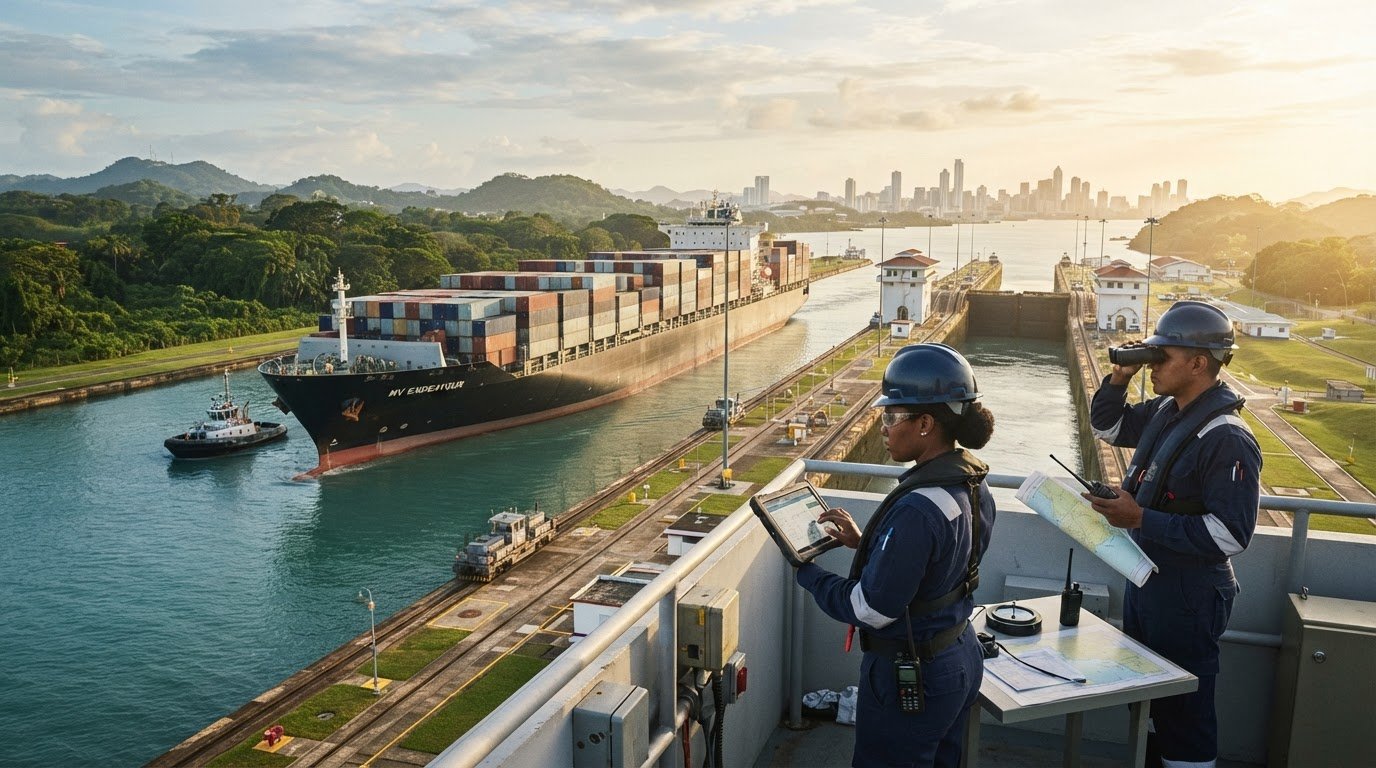
When a charterer appoints the vessel’s main agent, who keeps the owner’s interests in view during a Panama Canal transit? A protective agent panama canal appointment gives the principal a dedicated local representative to oversee another agent’s work and keep communication focused on the principal’s priorities. This added oversight can make it easier to follow what is happening during a Canal call.
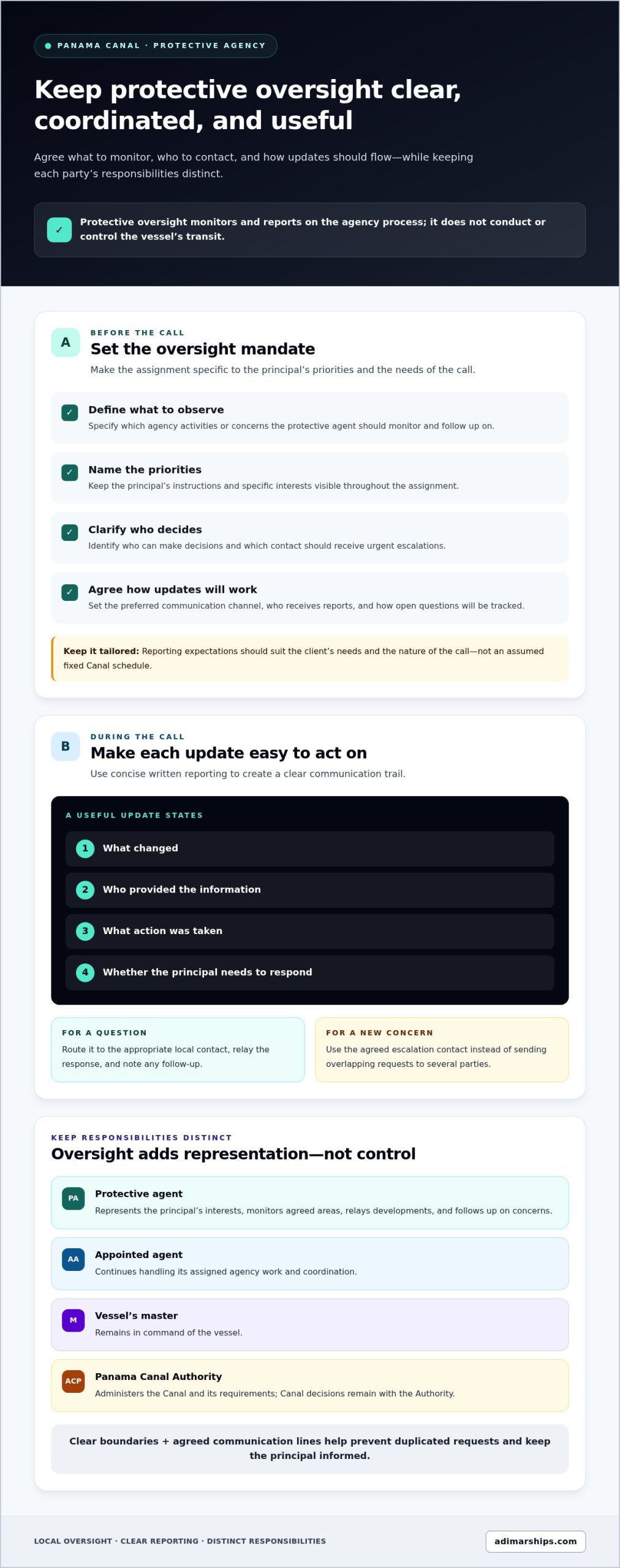
It helps to be clear about who does what. A protective agent complements the appointed ship agent rather than automatically replacing them. The Panama Canal Authority remains responsible for administering the Canal and its requirements, and the vessel’s master remains in command.
This guide explains what a protective agent does, how oversight can work alongside the appointed agent, and what to prepare before the vessel arrives. It also covers when dedicated representation may be useful and how to define a clear scope for the assignment.
Key Takeaways
- A protective agent represents a principal’s interests by overseeing another appointed agent’s work during a Canal call.
- A protective agent panama canal supports local oversight and communication, but does not replace the appointed agent, the Panama Canal Authority, or the vessel’s command.
- Clear instructions, vessel details, call objectives, key contacts, and known concerns help prepare for effective representation.
- Agreeing on communication expectations at the outset helps keep the principal informed throughout the agency process.
- Adimar Shipping, Inc. provides Panama-based protective agency focused on oversight and safeguarding vessel clients’ interests.
What Does a Protective Agent at the Panama Canal Do?
A protective agent represents a vessel principal’s interests while overseeing the work of another appointed agent. The role provides a local point of contact for the owner or charterer, helping them follow relevant developments without taking over the appointed agent’s responsibilities. For a principal considering a protective agent panama canal arrangement, the key question is whether dedicated oversight would improve visibility and communication during the call.
A Canal transit involves coordination among the vessel, its representatives, and local operational parties. A principal based elsewhere may want a local contact to relay updates, raise questions, and follow up on concerns. The protective agent’s focus is representation: keeping the principal’s priorities in view while the appointed agent carries out its assigned work.
What is a protective agent in a vessel call?
A protective agent is the principal’s local representative for oversight and interest protection. The assignment follows the client’s instructions and agreed scope. That scope should identify what to monitor, whom to contact, and how to raise matters requiring the principal’s input. Clear boundaries make the role useful and distinguish it from the appointed agent’s responsibilities.
Protective agency involves observing, communicating, and representing the principal’s interests. It does not mean personally conducting every transit operation. For example, the protective agent may monitor communication about transit clearance, pilot and tug arrangements, or vessel documentation while the appointed agent handles its own agency duties. The vessel’s command remains with its master, and Canal decisions belong to the Panama Canal Authority (ACP), not either agent.
When might a principal appoint protective representation?
Dedicated oversight may be useful when an owner or charterer wants a direct local channel during a time-sensitive call, particularly if the principal is not managing day-to-day coordination from Panama. It can also help when the principal wants visibility into how its instructions are being followed or needs a local representative alongside an agent appointed by another party. Not every transit requires a protective agent.
Consider the call’s complexity, the principal’s access to updates, and how responsibilities are divided. Practical reasons to appoint protective representation may include:
- The principal wants a local contact to relay operational updates and questions.
- Owners or charterers need clearer visibility while another party’s appointed agent coordinates the call.
- The principal has specific concerns or priorities that should be included in a defined oversight mandate.
When those needs are present, protective representation can provide a focused communication link and help keep the principal’s interests visible. Its value depends on a clear mandate and coordination with the appointed agent. It is an additional layer of representation, not a substitute for the vessel’s command or the Canal Authority’s role.
How Protective Agency Oversight Works Alongside the Appointed Agent
Effective oversight starts with the principal’s instructions, not a second set of competing directions. The principal defines the priorities and appoints a protective agent to monitor agreed areas, communicate relevant developments, and follow up on issues. The appointed agent continues handling its assigned agency work. Distinct responsibilities and clear communication lines help prevent duplicated requests and keep the principal informed.
Protective oversight monitors and reports on the agency process; it does not conduct or control the vessel’s transit. The appointed agent’s duties, the vessel master’s command, and decisions made by the Panama Canal Authority remain separate. A protective agent can relay the principal’s concerns to local parties and report responses, but does not direct Canal operations or replace the master’s authority.
Defining the mandate and responsibilities
Before the call, the principal and protective agent should establish the assignment’s scope. Identify what the agent is expected to observe, which interests take priority, who can make decisions, and which contact should receive urgent escalations. The mandate may focus on communication, monitoring specified agency activities, or following up on particular concerns. These are practical arrangements between the parties, not a universal procedure or official Panama Canal requirement.
Agree on reporting expectations as well, including the preferred channel, who receives updates, and how open questions will be tracked. Set expectations to suit the client’s needs and the nature of the call rather than assuming a fixed Canal reporting schedule.
Communication during a Panama Canal call
Once roles are clear, the protective agent can act as a local communication link. If the principal has a question about an operational update, for example, the agent can direct it to the appropriate local contact, relay the response, and note any follow-up. The appointed agent remains responsible for its own coordination, while the protective agent keeps the principal’s perspective visible and helps organize information across separate conversations.
Concise written updates make coordination easier. Each can state what changed, who provided the information, what action was taken, and whether the principal needs to respond. If a new concern arises, the agent can route it through the agreed escalation contact instead of sending overlapping requests to several parties. This creates a clear communication trail and helps distinguish confirmed information from an open question.
For a principal seeking a protective agent panama canal, setting these boundaries early makes local oversight more effective. Adimar Shipping, Inc. provides protective agency in Panama, coordinating communication while overseeing another appointed agent’s operations. Learn more about Adimar’s protective agency in Panama.
Protective Agent vs. Appointed, Owner’s, and Charterer’s Agent
These agency roles may be involved in the same vessel call, but they are not interchangeable. The appointed agent handles duties within its appointment. A protective agent focuses on oversight for the principal. An owner’s or charterer’s nominated agent is appointed to represent that party’s interests locally. The appointment and instructions for the call define each agent’s responsibilities.
| Agent role | Who the agent represents | Primary purpose and typical focus |
|---|---|---|
| Appointed ship agent | The party making the appointment, as set out for the call | Handles assigned agency coordination and local arrangements |
| Protective agent | The principal who appoints them for oversight | Monitors another agent’s work and keeps the principal’s interests in view |
| Owner’s nominated agent | The vessel owner | Provides local agency representation according to the owner’s instructions |
| Charterer’s nominated agent | The charterer | Provides local agency representation according to the charterer’s instructions |
Protective agent and appointed ship agent: different functions
The distinction comes down to the work each agent is assigned. An appointed ship agent may coordinate call-related arrangements such as transit clearance, pilot and tug coordination, or vessel documentation. A protective agent monitors and communicates on behalf of the principal rather than automatically taking over those arrangements. Read this Panama Canal ship agency guide for more on the coordination involved in a Canal call.
The principal’s instructions shape the protective agent’s remit, while the appointment defines the appointed agent’s responsibilities. Understand the roles from the actual arrangements for the call, rather than relying on titles alone. Separating contacts and tasks can also reduce duplicate requests to local parties.
Protective agency and nominated agency: understanding representation
Nominated agency describes who selects the agent and whose interests the agent is instructed to represent. An owner may nominate an agent to represent the owner locally; a charterer may do the same for the charterer. Protective agency has a different emphasis: overseeing another appointed agent on behalf of the principal. The distinction is the purpose of the appointment, not a universal rule that fixes every agent’s duties.
In some arrangements, an owner’s or charterer’s nominated agent handles agency coordination directly. In others, a principal may want protective oversight alongside an agent appointed by another party. A guide to owner’s nominated agency offers more detail on owner-focused local representation.
For a principal considering a protective agent panama canal appointment, identify whether the need is for local coordination, independent oversight, or both. Define who represents whom, which work each agent handles, and how information should flow before the vessel call. This gives each representative a clear role and keeps the principal’s priorities visible.
How to Prepare for Protective Agency at the Panama Canal
Good preparation gives a protective representative a clear brief and a practical way to keep the principal’s priorities in view. Start before the vessel’s Canal call, while there is time to share relevant information and agree on who handles questions. A concise mandate helps the agent focus on the requested oversight instead of duplicating the appointed agent’s work.
For broader voyage context, Adimar Shipping, Inc.’s complete Panama Canal transit guide covers the wider transit process. Keep protective-agency instructions distinct from formal Canal submissions and compliance obligations, which have their own processes and responsible parties.
Before the vessel’s Canal call
Appoint the representative and define the scope of oversight. Share vessel and voyage information relevant to the assignment, then agree on who should receive updates, which matters require escalation, and the preferred communication channels. The protective agent’s brief supports local representation; it does not replace official submissions, the appointed agent’s duties, or the master’s responsibilities.
A useful briefing can include:
- Vessel and voyage details: Vessel name and identifying details, itinerary, expected call milestones, and relevant local contacts.
- Call objectives: The principal’s priorities and what the protective representative should monitor or follow up on.
- Communication arrangements: Names and roles of recipients, preferred channels, and who can make decisions for the principal.
- Known concerns: Open questions, sensitivities, or issues that should be brought to the principal’s attention.
- Role boundaries: Which agent is handling each task and how questions should be routed to avoid conflicting or repeated requests.
Keep instructions direct. Identify the specific issue to monitor and the contact who should receive an escalation rather than asking the agent to oversee everything. Clear priorities help the local representative focus on what matters most to the principal.
During and after the call
During the call, the protective agent monitors activity within the agreed mandate and relays material developments through the selected channels. If an update raises a question or requires a decision, the agent can direct it to the appropriate principal contact. This supports visibility without promising a fixed reporting frequency or taking operational decisions away from the responsible parties.
Afterward, a concise record helps close the communication loop. Note significant updates, decisions, responses, and unresolved items that need follow-up. Separate confirmed information from questions still awaiting an answer. That gives the principal a clearer picture of the call and a useful reference for future instructions.
Preparing a clear brief is a practical first step toward appointing a protective agent panama canal. Arrange protective agency representation with Adimar Shipping, Inc. for local oversight aligned with your vessel’s call objectives.
Adimar Shipping: Local Protective Agency for Panama Canal Operations
A principal needs more than a name on a contact list. Adimar Shipping provides protective agency in Panama, overseeing another appointed agent’s operations to safeguard the client’s interests. Based in Panama City, Adimar acts as a local point of contact for owners and charterers who want focused oversight and clearer communication during a vessel call.
The assignment follows the principal’s instructions and priorities. Adimar maintains visibility on matters within the agreed remit, communicates with relevant local parties, and keeps the client’s interests in view. Protective agency complements the appointed agent’s work. It does not promise a particular transit result or take over the vessel’s command or Canal Authority decisions.
What working with Adimar’s protective agency involves
At the outset, the principal can outline the vessel call, the reason for requesting oversight, and any specific matters that need attention. Clear instructions help Adimar understand what to monitor, which contacts are relevant, and how updates should reach the client. This focused brief helps avoid unnecessary overlap with the appointed agent while giving the principal a local representative in Panama.
Communication follows the agreed scope. Adimar coordinates with the appointed agent and other relevant local parties to relay information and follow up on the principal’s concerns. Updates and actions reflect the client’s priorities and the assignment, rather than assuming every call follows the same process.
Protective agency is distinct from other forms of ship agency support. Adimar also coordinates Panama Canal vessel transits and acts as an owner’s or charterer’s nominated agent. Its agency work can include transit clearance, pilot and tug coordination, and inbound and outbound documentation. These coordination and nominated-agency roles are separate from protective oversight, even when responsibilities are tailored to the vessel call. PCSOPEP authorized-person compliance is another distinct function, not the definition of protective representation.
Discuss protective representation for your Panama Canal call
Owners and charterers considering a protective agent panama canal can start with a straightforward briefing. Share the vessel’s call context, the principal’s objectives, the appointed agent’s role, key contacts, and any concerns that need local attention. Adimar provides protective representation focused on the assignment and the principal’s interests.
Before representation begins, align on the scope, communication preferences, and how matters requiring the principal’s decision should be raised. A clear brief helps the local team keep the arrangement practical, transparent, and centered on the client’s interests.
For Panama-based protective representation, contact Adimar Shipping to discuss your vessel call and the oversight you need.
Set Your Priorities Before the Next Canal Call
Start by deciding what you need to see, hear, and follow up on during the vessel call. Identify the principal’s priorities, the questions that require attention, and who should receive important updates. A focused brief gives local representation a clear purpose and keeps communication aligned with your interests.
If you are weighing whether a protective agent panama canal appointment fits your vessel’s circumstances, define the oversight you want and how it should work alongside the appointed agent. Adimar Shipping can provide representation shaped around the call and the principal’s priorities.
Start a conversation about protective representation for your Panama Canal call. Share your objectives and the oversight you need to put a clear, focused brief in place.
Frequently Asked Questions
What is a protective agent at the Panama Canal?
A protective agent is a local representative appointed to oversee another agent’s work in the interests of a vessel principal. A protective agent panama canal appointment gives an owner or charterer a local channel for raising questions and receiving updates. For example, the principal can identify a specific concern to monitor and name the person who should be informed if it needs follow-up.
When should a shipowner appoint a protective agent in Panama?
A shipowner may appoint one when it wants a dedicated local perspective on a Canal call, particularly if another party appointed the agent handling the call. It can also suit a vessel with specific owner priorities that need follow-up. The decision depends on the owner’s oversight needs, the existing appointment, and whether a separate local representative would add useful visibility.
Can a protective agent replace the appointed ship agent?
Not by default. A protective appointment provides oversight for the principal; it does not automatically transfer the appointed agent’s duties. If the principal intends to change who handles agency coordination, that should be addressed as a separate appointment arrangement. Clear role descriptions help local parties know where to direct operational requests and which matters the protective agent should bring to the principal.
What does a protective agent monitor during a Canal transit?
The agent monitors matters within the principal’s agreed instructions, which may include relevant coordination by the appointed agent and follow-up on the principal’s concerns. For instance, a client may ask for visibility on communications about transit clearance or pilot and tug arrangements. The agent reports and represents the principal’s perspective but does not control the vessel or guarantee an operational outcome.
How does a protective agent differ from an owner’s nominated agent?
An owner’s nominated agent is appointed to represent the owner locally and handle the responsibilities defined for that appointment. A protective agent focuses on oversight on the principal’s behalf while another agent has an appointment. The owner should identify which function it needs: local agency coordination, oversight, or a clearly defined arrangement that covers both without confusing responsibilities.
Who gives instructions to a vessel’s protective agent?
The principal who appoints the protective agent gives the instructions. Depending on the arrangement, that may be the shipowner or charterer. The brief should identify the principal’s priorities, authorized contacts, and the circumstances that require an issue to be referred back for a decision. This helps the agent represent the client’s interests without assuming authority to make decisions the principal has retained.
Is a protective agent responsible for Panama Canal Authority decisions?
No. The protective agent does not make or control decisions of the Panama Canal Authority (ACP). Its role is client-side representation and oversight, such as relaying relevant information or bringing a concern to the principal’s attention. Canal decisions remain with the ACP, while vessel command remains with the master. Keeping those boundaries clear helps everyone understand who can act on each matter.