

What if the transit date that fits your voyage plan isn’t available in the booking period you’re relying on? The panama canal transit reservation system uses timed windows, so understanding when each applies is essential to protecting your options and planning vessel arrival.
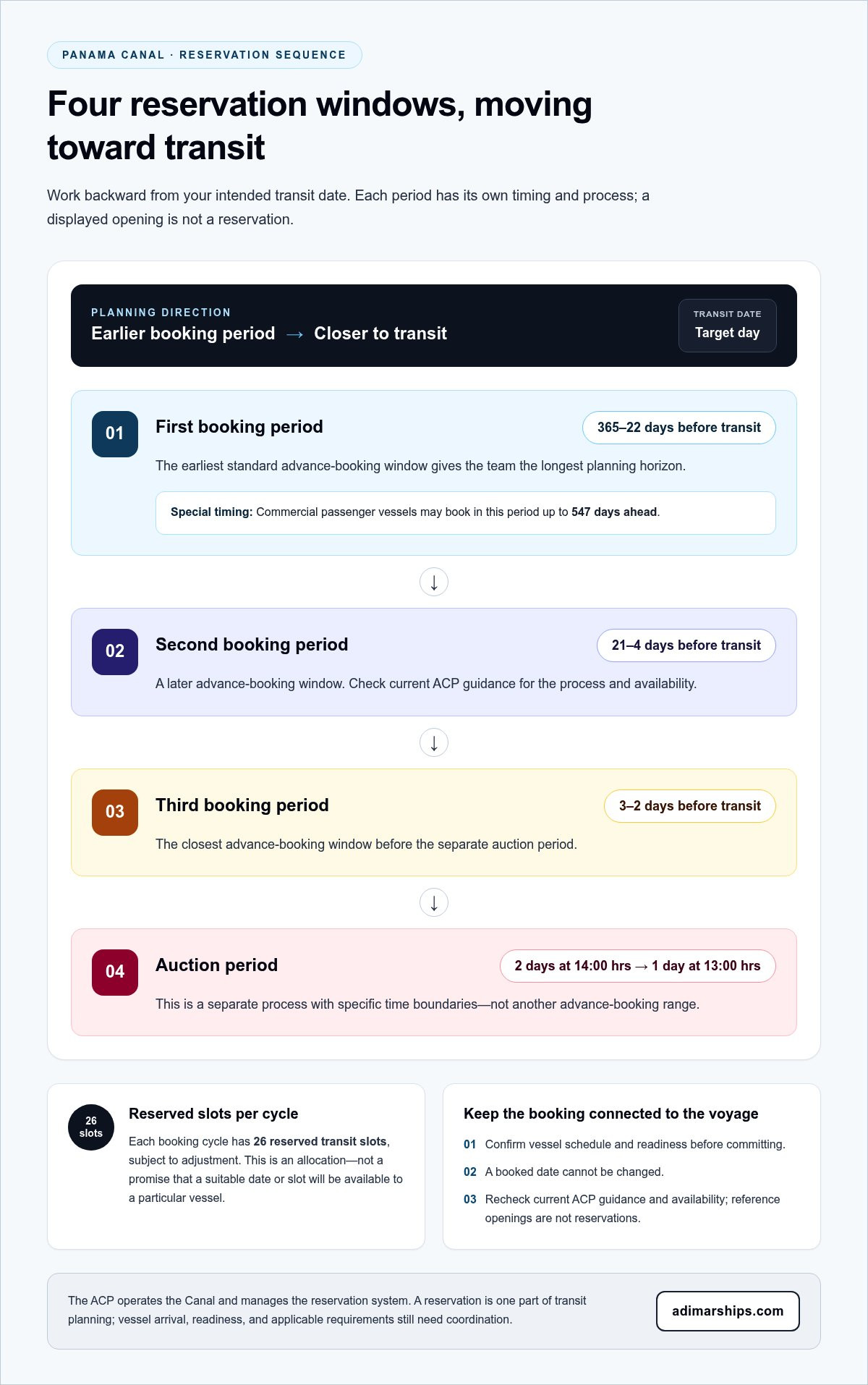
It’s reasonable to want a firm date before coordinating the rest of the voyage. Reservations are made 365-22 days, 21-4 days, or 3-2 days before transit, followed by an auction window from 2 days at 14:00 hrs to 1 day at 13:00 hrs. A booked date cannot be changed, so prepare early and confirm that your vessel details and schedule support the date you request.
This guide explains how the ACP booking windows work, what vessel information and compliance items to prepare, and why arrival timing matters. It also covers how Adimar Shipping coordinates reservation requests and transit logistics with your operations team and captain. The ACP operates the Canal and reservation system; Adimar coordinates your vessel’s agency requirements around its transit.
Key Takeaways
- Understand how the panama canal transit reservation system organizes booking windows, and why the right timing depends on your vessel and voyage plan.
- Compare the 365-22-day, 21-4-day, and 3-2-day booking periods. Commercial passenger vessels may book in the first period up to 547 days ahead.
- Prepare accurate vessel details early, review current ACP guidance, and align internal approvals with your preferred booking window.
- Submit ETA and pre-arrival information not less than 144 hours in advance, while tracking vessel readiness and applicable compliance deadlines.
- Coordinate booking requests and transit logistics with a Panama-based ship agent, with local presence at Balboa and Cristóbal.
What the Panama Canal Transit Reservation System Does
The Panama Canal Transit Reservation System is the Panama Canal Authority’s (ACP’s) framework for booking transit slots and dates. The ACP operates the Canal and manages the reservation process. Ship owners, charterers, and operators use the system to plan a slot, but the reservation is only one part of organizing a vessel’s transit.
A booking request concerns a specific transit date and slot. It does not, by itself, prepare the vessel for arrival or confirm that operational requirements are in order. Voyage timing, vessel readiness, arrival information, and compliance must be coordinated alongside the reservation.
The Panama Canal Authority (ACP) is responsible for the Canal and its reservation framework. A ship agent does not operate the Canal or control ACP decisions. Adimar coordinates on the vessel’s behalf, keeping booking requests and transit details connected and communication moving between the vessel, operator, and relevant parties.
What a reservation represents in transit planning
A reservation concerns a slot on a booked date. It gives the operator a date around which to plan the voyage, but it is not a substitute for the vessel’s arrival or readiness. For example, an operator may have a booked date while still needing to coordinate the vessel’s ETA and prepare required information. Keep these workstreams connected, but distinct.
A reservation should not be treated as a guarantee of a particular transit outcome. The ACP’s current requirements and operational guidance remain relevant, and the vessel must meet the applicable conditions for transit. Because a booked date cannot be changed, assess the vessel’s schedule and readiness before committing, then keep the team informed of any developments that could affect arrival.
Who uses the Panama Canal reservation system
Ship owners, charterers, and operators arranging commercial vessel transits use the system to match a transit date with their voyage plan. Booking timing affects how much time the team has to align the vessel schedule, internal approvals, and required information. Choose a window based on how settled the voyage is and how much time your team needs to prepare.
The ACP’s availability tool can help operators understand what is displayed for a booking period. Treat it as a planning reference, not a replacement for current ACP notices and system guidance. Availability and procedures can change, so review current official information before making a decision, especially when a voyage schedule is still shifting.
For a broader view of the operational steps around a canal passage, consult this Panama Canal transit guide. Adimar Shipping coordinates reservation requests through the Panama Canal Service Portal and provides local agency support at Balboa and Cristóbal. This connects booking coordination with the wider transit plan, while the ACP remains responsible for the reservation system and Canal operations.
Panama Canal Reservation Windows: Dates, Sequence, and Slot Limits
The ACP reservation calendar is easier to plan when you work backward from the intended transit date. The panama canal transit reservation system has three advance-booking periods, followed by a separate auction period. These windows are not interchangeable. A date or slot shown as available in a reference tool is not reserved, so confirm current ACP guidance and availability before finalizing voyage plans.
How the booking periods differ
The sequence moves from the longest planning horizon toward transit. Use the table to identify the period associated with your target date. Commercial passenger vessels may book during the first period up to 547 days before transit. The auction period has its own precise time boundaries, so include them in your planning rather than treating it as another advance-booking range.
| Booking period | Timing before transit | Planning note |
|---|---|---|
| First booking period | 365-22 days | Commercial passenger vessels may book up to 547 days ahead during this period. |
| Second booking period | 21-4 days | A later advance-booking window; check current ACP guidance for the process and availability. |
| Third booking period | 3-2 days | The closest advance-booking window before the auction period. |
| Auction period | From 2 days at 14:00 hrs to 1 day at 13:00 hrs | A separate process with specific time boundaries. |
Each booking cycle has 26 reserved transit slots, subject to adjustment. This describes the reserved-slot allocation, not a promise that a particular vessel will find a suitable date or secure a slot in any period. Access rules and availability can differ by period, so do not assume a later window offers the same options as an earlier one.
How to interpret slot availability
The reference tool groups displayed availability by booking period. Use it to guide planning, then consult current ACP information before acting. A displayed opening is a reference, not a reservation or a slot held for your vessel. Recheck the relevant period as plans develop and align the booking timeline with your voyage schedule and internal approvals.
For example, a vessel with a firm schedule can use its target transit date to identify the applicable window. A voyage still subject to change calls for closer coordination before the operator commits. Keep the period, date, and auction boundaries visible to everyone involved. Adimar coordinates booking requests and related transit details with your operations team. Coordinate your canal booking with a Panama-based ship agent as part of a disciplined reservation plan.
Choosing a Booking Window Around Vessel and Voyage Constraints
The most suitable booking window depends on how settled the voyage plan is, not on an assumed chance of securing a slot. Compare the windows by the preparation time they leave for vessel readiness, cargo-related details, schedule approvals, and the operator’s ability to act on a chosen date. The ACP’s stated allocation is 26 reserved transit slots per booking cycle, subject to adjustment. That figure does not guarantee a slot for a particular vessel or date.
Booked dates cannot be changed. Treat the date decision as a firm planning commitment, not a placeholder you can revise later. Before requesting a reservation, assess whether the vessel’s expected schedule and readiness support the proposed transit date and whether the people responsible for approvals can make a decision within the relevant period.
When earlier planning can support coordination
The first booking period opens 365 days before transit and runs through 22 days before transit. Commercial passenger vessels may book during this period up to 547 days ahead. For other voyages, using the earlier window can give the team more time to align schedules, gather vessel and cargo details, and coordinate internal decisions. It does not guarantee a preferred slot, so use the extra planning horizon to prepare rather than assume the date is secured.
For example, if a vessel’s voyage plan is developing well ahead of the intended transit, the operator can identify the relevant booking date and work backward to organize approvals and readiness information. If the schedule remains uncertain, consider the risk of committing to a date that may not fit the vessel’s actual arrival plan. A longer lead time supports coordination only when the information used to select the date is reliable enough for that commitment.
When later windows require tighter coordination
The second period runs from 21 to 4 days before transit. The third runs from 3 to 2 days before transit. These later windows leave progressively less time to align the booking decision with the voyage schedule, vessel readiness, and internal approvals. They are distinct periods, not interchangeable extensions of the first window. Use current ACP guidance to understand the process that applies.
The auction period is separate: it begins 2 days before transit at 14:00 hrs and ends 1 day before transit at 13:00 hrs. These boundaries are precise. Do not treat “two days before” as a full calendar day without accounting for the stated time. Review current ACP information and assess the vessel’s actual schedule before deciding how to proceed.
A practical check is to compare the planned transit date against three factors: schedule confidence, readiness, and the time needed for internal authorization. Resolve any open issues before committing to a date that cannot be changed. Adimar coordinates booking details with the operations team and captain, keeping the reservation request connected to the vessel’s plan.
Prepare Vessel Information, Arrival Timing, and Compliance Early
A reservation is only one part of transit preparation. A clear sequence connects the booking with vessel readiness, arrival planning, and compliance deadlines. Use the panama canal transit reservation system alongside current ACP guidance, and assign a person responsible for each information requirement.
- Gather vessel details. Assemble accurate vessel information and identify certificates, plans, and drawings required for a first-time transit. Use the current ACP checklist to confirm the exact documents.
- Review ACP guidance. Check current instructions for booking, pre-arrival submissions, and vessel requirements. Keep reservation information distinct from other compliance documents.
- Coordinate the ETA. Align the vessel’s expected arrival with the booked date and share updates with the operations team and captain.
- Track deadlines. Assign responsibility for each submission and monitor due dates against the vessel’s arrival and transit plan.
Pre-arrival information and first-time transit documents
Submit ETA and pre-arrival information not less than 144 hours in advance. This recommended lead time gives the team room to coordinate information before arrival; it does not replace any separate deadline or requirement. First-time transits require certificates, plans, and drawings. Use current ACP guidance for the exact document checklist rather than relying on a general list.
Keep the reservation request and vessel compliance workstreams distinct. A booking concerns the transit slot and date; compliance requirements relate to the vessel and its preparation. PCSOPEP submission is mandatory for vessels with oil-carrying capacity of at least 400 MT and must be completed at least 96 hours before arrival by an Authorized Person residing in Panama. Adimar provides the PCSOPEP Authorized Person service. Failure to submit on time results in the highest fee, a minimum sanction of US $2,500, and possible denial of transit. The PCSOPEP Authorized Person guide explains the role in more detail.
Arrival and boarding requirements to account for
Arrival timing is tied to the booked date, so build the applicable cutoff into the voyage plan and communicate it clearly to the vessel and operations team. Regular vessels must arrive by 14:00 hrs on the booked date; “Supers” vessels must arrive by 02:00 hrs on the booked date. Booked dates cannot be changed, making accurate ETA coordination especially important.
All vessels must meet the boarding facility requirements under SOLAS Regulation 17, Chapter V. Treat this as a vessel-readiness item, not as part of the reservation paperwork. Keep these separate checks visible to the responsible team:
- Current ACP pre-arrival and document instructions
- ETA submission timing and updates
- Booked-date arrival cutoff for the vessel type
- Applicable vessel compliance and boarding facility requirements
Adimar Shipping coordinates canal booking requests and related agency logistics with operators, operation managers, and captains. Coordinate your vessel’s transit preparation with Adimar for Panama-based agency support.
Coordinate Your Panama Canal Reservation with a Local Ship Agent
The ACP operates the Canal and its reservation system. A ship agent does not control slot availability or ACP decisions. Adimar coordinates the vessel’s booking request and related agency logistics, helping owners, charterers, and operators keep communication organized as the transit plan develops.
Adimar Shipping connects with the Panama Canal Service Portal to coordinate canal transit booking requests. Its full agency service is available 24/7, with a presence at both Balboa and Cristóbal terminals. Local coordination keeps vessel representatives, operation managers, and captains aligned as details are shared and plans progress. The focus is clear communication, personalized service, and cost-conscious coordination, without promising a particular slot, transit time, or outcome.
What Adimar coordinates for a transit
Transit agency coordination brings several connected workstreams into view: booking requests, transit clearance, arrangements involving pilots and tugs, and required documentation. Adimar coordinates these details as part of the vessel’s agency process, while the ACP retains control of Canal operations and reservations. This local point of contact connects vessel representatives with operation managers and keeps relevant updates moving between the parties.
Coordination is especially useful when information comes from several sources. A change to the vessel’s schedule, for example, may affect the ETA being communicated or the timing of related preparations. Keeping the captain and operations team in regular communication with Adimar helps maintain a shared picture of the plan. It does not remove ACP requirements or guarantee a transit result.
For a closer look at the agency role in Panama, Adimar’s ship agency services in Panama guide explains how local representation supports transit coordination.
Next steps for owners, charterers, and operators
Before requesting coordination, organize the vessel’s identifying details, intended transit date, current voyage schedule, ETA, and documentation already being prepared. Share schedule updates promptly and make responsibilities clear between the vessel, operator, and agent. A well-organized handoff gives the local team a solid basis for coordinating the booking request and related transit logistics.
Adimar Shipping is a Panama-based ship agency partner for owners, charterers, and operators, focused on timely communication and integrity. Its team works alongside operation managers and captains, providing local coordination at Balboa and Cristóbal while the ACP manages the reservation system. This division of responsibility keeps expectations clear and coordination grounded in the vessel’s actual plan.
For support coordinating your vessel’s Panama Canal reservation and agency logistics, coordinate your Panama Canal transit with Adimar.
Make Your Next Transit Plan More Deliberate
A well-organized reservation plan starts before a booking request is submitted. Set a clear decision point for the voyage team, assign responsibility for sharing vessel updates, and keep the chosen transit date aligned with the vessel’s operating plan. This gives owners, charterers, and operators a practical way to manage uncertainty without treating a reservation as a substitute for ongoing coordination.
Use the panama canal transit reservation system as one part of that process, alongside current ACP guidance and clear communication between everyone involved. When you delegate local coordination, your team can focus on providing accurate information and making timely decisions while Adimar keeps transit details connected.
Adimar Shipping supports Panama Canal transit coordination with a practical, client-focused approach. Start with a clear view of your vessel’s schedule and requirements, then coordinate your Panama Canal transit with Adimar. A trusted local partner helps your team move forward with clarity and confidence.
Frequently Asked Questions
What is the Panama Canal Transit Reservation System?
It’s the ACP framework operators use to request a transit slot for a vessel on a planned date. The panama canal transit reservation system supports scheduling, but it does not manage the vessel’s full passage or replace communication among the owner, charterer, captain, and operations team. Once a target date is identified, the operator still needs to coordinate vessel readiness and arrival information against current ACP requirements.
How far in advance can a Panama Canal transit slot be booked?
The first booking period opens 365 days before transit and closes 22 days before transit. Commercial passenger vessels may book in that period up to 547 days ahead. Other stated periods are 21-4 days and 3-2 days before transit, followed by the auction period. Count back from the intended transit date and consult current ACP guidance for the procedures that apply to your vessel.
Can a booked Panama Canal transit date be changed?
No. A booked date cannot be changed. Before submitting a request, compare the proposed date with the vessel’s voyage schedule, expected readiness, and the time needed for internal approval. If the schedule is still moving, coordinate with the vessel’s representatives and review current ACP guidance before committing. A booking should not be treated as a flexible placeholder while the voyage plan is unresolved.
How can I check Panama Canal reservation slot availability?
Use the ACP availability reference to view slots grouped by booking period and distinguish displayed available slots from unavailable ones. The reference is for planning, not proof that a slot has been reserved for your vessel. If a date appears open, continue through the applicable ACP booking process and rely on its confirmation before treating the transit date as booked. Consult current system information and user guides as you proceed.
What happens if no suitable reservation slot is available?
Review current availability information and booking periods, then compare the options with the vessel’s schedule. The cycle has 26 reserved transit slots, subject to adjustment, but that total does not mean a suitable slot will be available for every vessel or date. Coordinate the schedule assessment with the vessel’s representatives and use current ACP guidance to understand the available options.
When should ETA and pre-arrival information be submitted?
Submit ETA and pre-arrival information not less than 144 hours in advance. This recommended lead time gives the team time to coordinate arrival details before the booked date. PCSOPEP is a separate mandatory requirement for vessels with at least 400 MT oil capacity and must be submitted at least 96 hours before arrival by an Authorized Person residing in Panama. Adimar can act as the Authorized Person. Track this deadline separately.
What documents are needed for a vessel’s first Panama Canal transit?
First-time transits require certificates, plans, and drawings. Use current ACP guidance for the exact checklist for the vessel and applicable procedures. Begin gathering vessel records early so missing items can be identified while booking and pre-arrival work are underway. Keep the documentation review distinct from the reservation request, and coordinate preparation with the people responsible for the vessel’s operational and compliance information.