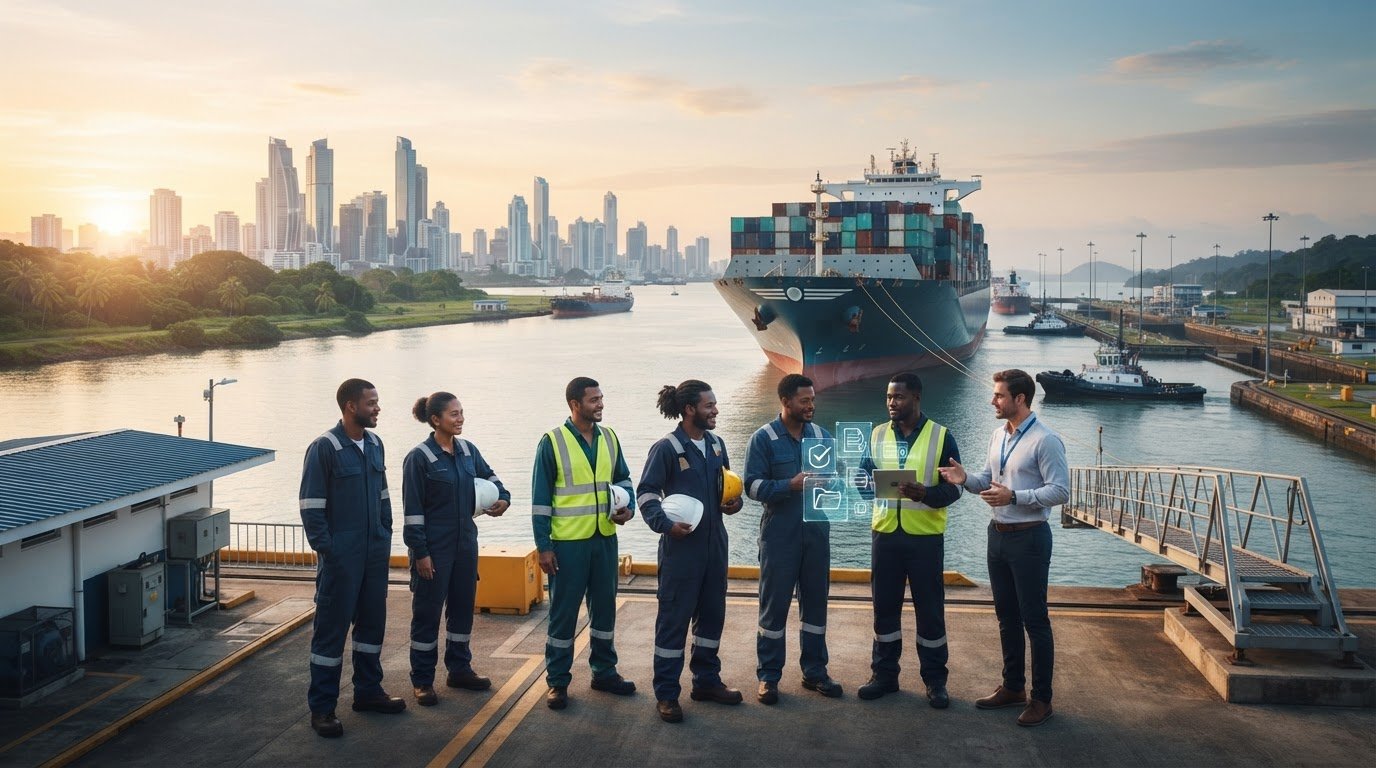

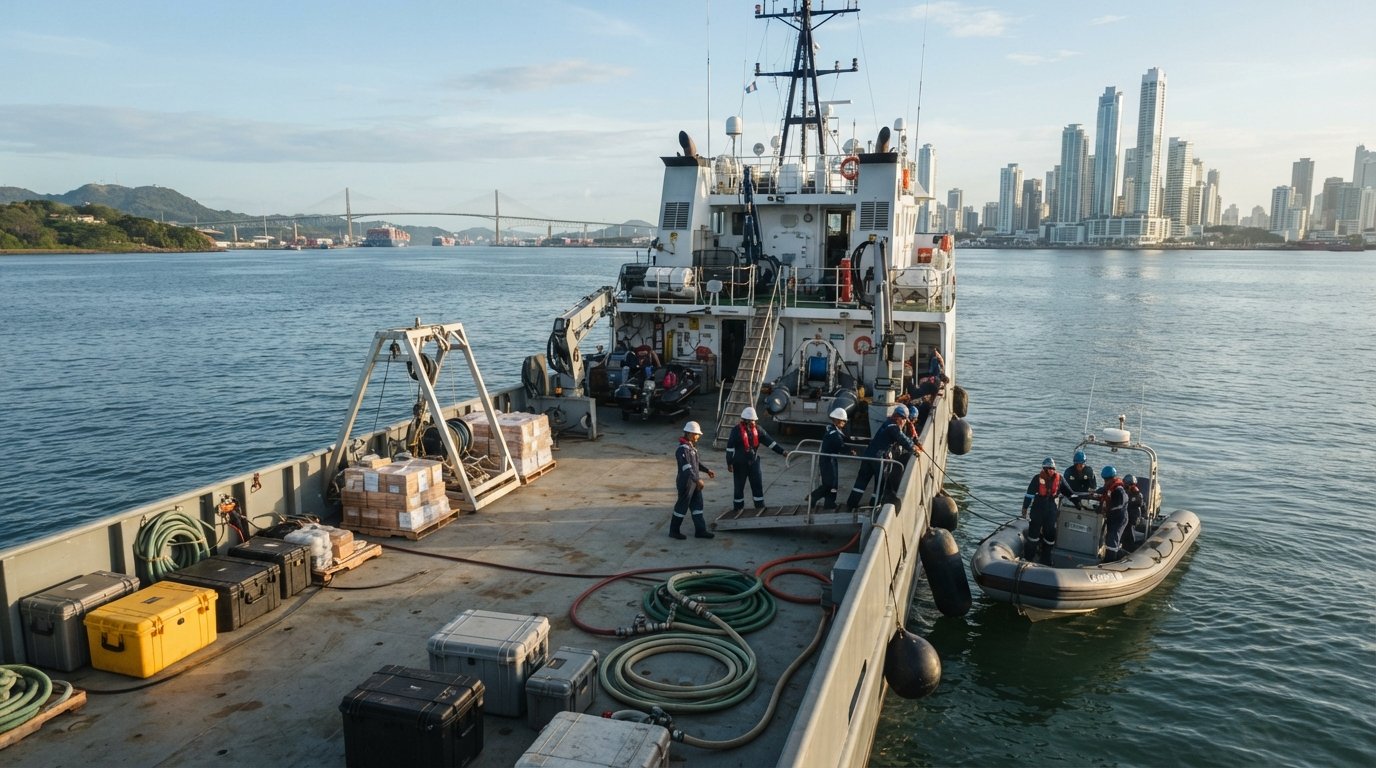
Research vessel logistics support in Panama starts with one coordinated plan for launch boat transfers, port and canal assistance, provisions, fresh water, marine fuel, and husbandry around the vessel’s schedule. For crew changes, submit the initial request 72 hours before arrival, then provide final flight itineraries and required documents 48 hours before arrival. Planning ahead helps keep people, equipment, and vessel operations aligned.
Research vessel logistics support in Panama involves more than arranging a crew transfer or routine port call. Technicians, spare parts, and project equipment may also need to reach a vessel at berth or anchorage, while transit plans must account for port and canal arrangements. Coordinating these moving parts calls for clear local communication.
This guide explains how to arrange launch boat transfers, support a Panama Canal transit or port call, and coordinate water, fuel, and other husbandry needs. It also covers the service workflow, key logistics considerations, and how a local ship agency can coordinate the work. You’ll see what to prepare and how to keep support aligned with your research vessel’s operational priorities.
Key Takeaways
- Map crew, technicians, spare parts, and research equipment to the vessel’s location and operating schedule before arranging launch boat transfers.
- Separate port-call coordination from canal-transit planning so each service request follows the right operational process.
- Specify fresh-water and marine-fuel requirements alongside delivery location and timing to keep supply planning aligned with vessel operations.
- Use a clear husbandry workflow, from service request and logistics coordination through execution monitoring and operational closeout.
- Bring vessel agency support into the plan when multiple local arrangements need a coordinated point of contact.
Launch boat transfers for crew, technicians, spares, and cargo
Plan Panama crew transfers around the vessel’s location, arrival schedule, and embarkation point. Transport, lodging, medical appointments, and shore access can be coordinated through an itinerary connecting the airport, accommodation, clinic, port, and launch boat. Give the coordinator the vessel’s position and each person’s movement requirements.
Start crew-change planning early. Submit the initial request 72 hours before arrival with the vessel ETA, crew manifest, and preliminary flight information. Provide final confirmed flight itineraries and required documents 48 hours before arrival. For smoother handling, aim to plan the change 5 to 7 days ahead, especially when several crew members or technicians are moving on different flights.
Build the manifest around each person’s role and transfer leg. Include names as they appear on travel documents, joining or leaving status, flight details, and the vessel they will board or leave. Match these details to the launch boat schedule and port location. For example, a technician carrying equipment may need a different transfer plan from a crew member travelling with personal luggage.
Prepare documentation before booking the final movements:
- Keep each joining or departing crew member’s passport details aligned with the manifest. Crew passports for a Panama crew change should be valid for at least 6 months.
- Collect final flight itineraries and required travel documents by the 48-hour-before-arrival point.
- Record technician names, equipment or spare-parts descriptions, delivery location, and the vessel contact receiving them.
- Keep payroll instructions and employment-contract handover details with the employer’s crew records, separate from travel and launch-boat arrangements.
Visa planning needs attention to nationality and travel purpose. Many nationalities can enter Panama for up to 72 hours without a visa for transit if they hold a valid Seaman’s Book and passport. Confirm that each traveller’s documents match the intended transit and joining arrangements before finalizing the itinerary.
For shore movements, list the pickup point, destination, timing, lodging details, and any clinic appointment. Tie each transfer to the crew member’s flight and vessel schedule. Shore access must also suit the port call and vessel location, so an anchorage transfer differs from a berth-side pickup.
For spares and project cargo, provide dimensions, handling requirements, delivery point, and onboard recipient. Separate urgent parts from routine stores so the launch boat plan can prioritize operationally critical items. Clear manifests and flight details help align personnel, technicians, and cargo with the vessel’s schedule.
Launch boat services in Panama coordinate crew, technician, spare-parts, and cargo transfers around vessel schedules. Panama cargo logistics can also move vessel spares, technical cargo, and project equipment through the local logistics network. Keep each movement aligned with the vessel’s schedule and delivery arrangements.
Local maritime support for vessels calling at or transiting the Panama Canal
Panamanian maritime support depends on the vessel’s location, purpose of call, and transit plan. Match port access, authority processes, and service timing to the research program’s operational needs.
Port Options and Vessel Access
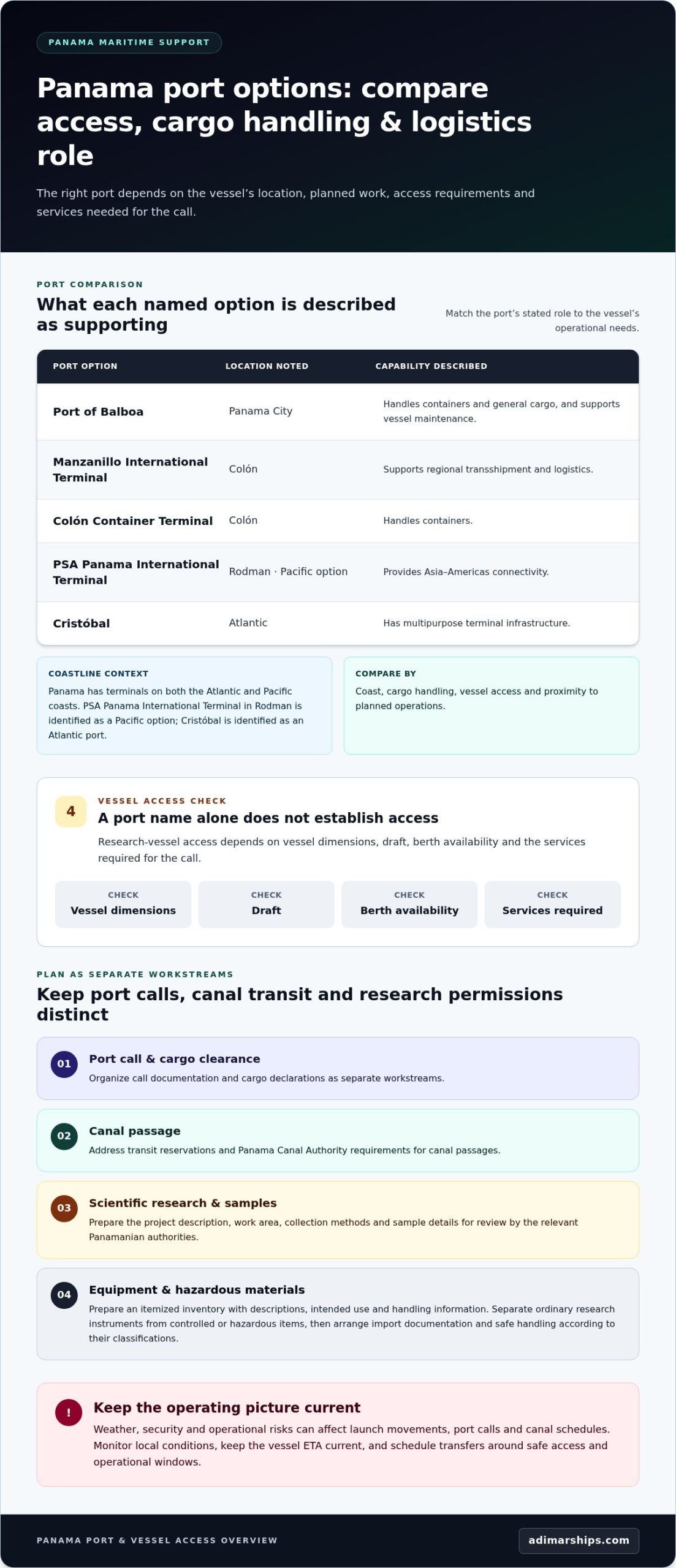
Panama has terminals on both the Atlantic and Pacific coasts. Panama City’s Port of Balboa handles containers, general cargo, and vessel maintenance. In Colón, Manzanillo International Terminal supports regional transshipment and logistics, while Colón Container Terminal handles containers. Compare locations by coast, cargo handling, vessel access, and proximity to planned operations.
Pacific options also include PSA Panama International Terminal in Rodman, which provides Asia-Americas connectivity. Cristóbal is an Atlantic port with multipurpose terminal infrastructure. Research-vessel access depends on vessel dimensions, draft, berth availability, and the services required for the call.
For port clearance and customs authorization, organize call documentation and cargo declarations as separate workstreams. Transit reservations and Panama Canal Authority requirements must also be addressed for canal passages. The vessel’s call purpose and planned movements shape the coordination sequence.
Scientific research and sample collection involve separate permission questions. Prepare the project description, work area, collection methods, and sample details for review by the relevant Panamanian authorities. These factors determine which approvals apply to the activity.
For scientific equipment and hazardous materials, prepare an itemized inventory with descriptions, intended use, and handling information. Separate ordinary research instruments from controlled or hazardous items, then arrange import documentation and safe handling according to their classifications.
Weather, security, and operational risks can affect launch movements, port calls, and canal schedules. Monitor local conditions, keep the vessel ETA current, and schedule transfers around safe access and operational windows.
Port Fees and Marine Services
Port fees, pilotage, and marine-service costs depend on the vessel, port, requested services, and timing. Build the estimate from separate service items, such as port attendance, pilotage, launch movements, and required vessel support. A breakdown helps operators identify which arrangements affect the total.
The cost of port fees, pilotage, and marine services depends on the specific requirements and is provided after a quote request. Key factors include the port, vessel particulars, transit requirements, service scope, and timing.
Panama Canal transits require advance planning, transit reservations, and compliance with Panama Canal Authority requirements. A practical sequence is to establish the intended transit, align port services with the schedule, and update operational arrangements as the vessel ETA changes.
Documentation errors, missed transfers, or disrupted service sequences can cause downtime. Port-service coordination typically moves from a service request and quotation to logistics coordination, authority processing, execution monitoring, and operational reporting. Clear handoffs help operators track each step and close the call accurately.
For coordinated local arrangements, Panama ship agency support can help align port-call and transit logistics.
Fresh water and marine fuel supply
Research vessels arrange fuel, provisions, potable water, and waste handling through a coordinated supply request for the berth or anchorage. Specify the delivery location, vessel schedule, quantities, required fuel grade, and waste streams so each movement can be planned around onboard operations.
Start with a supply list tied to the research plan. A vessel preparing for extended sampling may need drinking water, food, lubricants, spare parts, and scientific equipment. Ship provisioning in Panama can include delivery at berth or anchorage, so identify which items are essential before departure and which can follow routine operations.
For fresh water, state whether potable water is required and specify the quantity. Include the transfer point and timing, along with any vessel-specific connection or delivery instructions. A clear request helps coordinate water supply with other port services and avoid scheduling delivery during an operational window.
Fuel planning needs equally specific information. Provide the vessel’s requested product, quantity, delivery location, and preferred timing. Separate marine fuel from marine urea AUS in the supply request: marine urea AUS is available in Panama at 40% and 32.5% concentrations. State the required concentration where AUS is needed, rather than treating it as fuel.
Use one coordination schedule for fuel, water, provisions, and technical supplies. For example, if a vessel is waiting at anchorage, note which deliveries require launch transfer and which need another arrangement. Keep the vessel’s ETA current, identify an onboard contact, and group compatible deliveries when timing and handling allow.
Include waste disposal in the port-call plan. Identify the waste type, onboard storage location, handling requirements, and requested collection point. Keep waste details separate from potable-water and fuel requests so each service has clear instructions. The vessel’s operational plan and waste type determine the appropriate handling sequence.
Before confirming a supply plan, compare the request with the vessel’s actual consumption and remaining capacity. Check delivery timing against sampling schedules, equipment deployment, and crew operations. For instance, a research vessel preparing gear may need water and provisions before its team begins work, while technical supplies can follow in a separate handling window.
Send one consolidated request with the vessel name, location, ETA, service list, quantities, specifications, delivery instructions, and onboard contact. Update it if arrival timing changes. This gives port-service coordinators a practical basis for arranging supplies without disrupting research work or vessel movements.
Husbandry agent selection and 24/7 support
For a Panama port call, choose husbandry support based on the vessel’s requirements, location, and schedule. Owners need a clear service scope, a named onboard contact, and one operational plan covering each requested task. A research vessel may need provisions, spare parts, technical supplies, or crew arrangements coordinated alongside routine port-call services.
Define the agent’s role before services begin. An Owner’s Nominated Agency arrangement gives the owner a designated local representative to coordinate the vessel’s requested support. List each task, its delivery point, timing, and responsible contact. This helps distinguish owner instructions from separate requirements set by charterers or vessel operators.
Assess the working process, not just the service list. In Panama, port-service coordination typically progresses from a service request and quotation to logistics coordination, authority processing, service execution and monitoring, then an operational report and closeout. Each stage should have a clear handoff, especially when a call involves multiple suppliers or vessel locations.
- Scope: Separate provisions, technical stores, spare parts, and crew-related arrangements.
- Location: Identify whether the vessel is alongside, at anchorage, or preparing for transit.
- Timing: Tie each service to the vessel’s current ETA and operational windows.
- Communication: Name the onboard contact and define how changes reach the vessel.
- Closeout: Match completed services against the request and retain the operational report.
For time-sensitive technical supplies, planning should account for delivery coordination beyond standard business hours. Marine lubricants, filtration products, and engine-room supplies in Panama have 24/7 delivery coordination. Provide product descriptions, quantities, vessel location, and handling instructions so the movement can be organized against the vessel’s needs.
Precise instructions remain essential. If an engine-room item is needed before a research deployment, mark it as operationally critical and specify where it must be received. Keep routine stores separate from urgent spares. Clear priorities help organize delivery and reduce confusion during a busy call.
Owners should also set a reporting rhythm for changing conditions. A revised ETA, move from berth to anchorage, or change in supply priority can affect several arrangements at once. Send one updated instruction set to the operational contact, then record which tasks changed and which remain active.
Use the final report to close the call accurately. Compare requested and completed services, note outstanding items, and retain relevant delivery records. For vessels combining port attendance with Panama Canal transit, this closeout provides a useful operational record for the next call and supports consistent coordination across the vessel’s team.
Research vessel and general vessel logistics support
Research operations need logistics planned around both the vessel call and the work at sea. In Panama, build one operational plan connecting mobilization, port attendance, offshore activity, and return arrangements. This helps distinguish routine vessel requirements from the equipment and personnel needed for a specific research task.
Start by mapping each activity to a location and responsible contact. A vessel preparing for offshore sampling may need equipment delivered before mobilization, followed by technical support while working offshore. Ship-to-ship support in Panama can include equipment and logistics coordination from mobilization through offshore attendance. List the vessel, rendezvous details, receiving contact, and delivery sequence.
Separate the request into work packages so each item has a clear purpose:
- Mobilization: Identify project equipment, spare parts, lubricants, and provisions required before departure.
- Port call: Group deliveries by location, including berth or anchorage, and assign an onboard recipient.
- Offshore attendance: Specify the equipment or logistical support needed during the operation.
- Demobilization: Record equipment return movements and any supplies required for the next call.
Ship provisioning may include food, potable water, spare parts, lubricants, and equipment delivered at berth or anchorage. For a research vessel, separate consumables from mission-critical instruments. A sampling project, for example, may need equipment staged before the team begins deployment, while routine provisions can follow a separate delivery sequence.
Personnel movements must also match project timing. Crew-change coordination in Panama can include airport transfers, accommodation, immigration permits, and security. If technicians are joining the vessel for a project, align their arrival details with the vessel schedule and list any equipment they carry. Keep the receiving contact and embarkation plan in the same movement record.
Include authority processing in the overall call plan, alongside service coordination and vessel movement updates. Track each request from submission through execution, then close it with an operational report. If the vessel’s ETA or work location changes, update the affected movements and notify the responsible contacts. This creates a traceable handoff between mobilization and offshore attendance.
The key planning test is whether every item has a purpose, destination, timing, and owner. A consolidated schedule helps operators see dependencies, such as equipment delivery before technician embarkation. It also separates port-call tasks from offshore support, reducing ambiguity when several teams coordinate around the same vessel.
For a Panama research operation requiring coordinated vessel arrangements, request vessel logistics coordination with the project scope, location, schedule, and required support.
A dated record should keep the vessel schedule, delivery sequence, personnel movements, authority processing, and operational updates together. Reconcile requests against the work packages and confirm that each handoff has a receiving contact and clear status. When plans change, update affected movements while preserving the record of completed actions. This is especially important because commercial vessels can have daily operating costs of tens of thousands of dollars, according to the page’s general estimate. Keeping logistics decisions visible helps teams prioritize timing and distinguish mission-critical equipment from routine supplies.
Adimar Shipping: Ship Agency Services
Adimar Shipping, Inc. coordinates vessel calls in Panama through Ship Agency Services, bringing local port arrangements and vessel requirements into one operational plan. Turn to the team when a research vessel needs a local representative to align its call, transit-related arrangements, and husbandry requirements with its schedule.
Owners can appoint Adimar Shipping, Inc. as their Owner’s Nominated Agency, and charterers can use Charterer’s Nominated Agency. Husbandry Services support vessel needs such as provisions, technical supplies, and crew-related arrangements. Clear instructions about the vessel, location, timing, and requested tasks provide a practical basis for coordination, ensuring seamless research vessel logistics support panama.
To discuss ship agency or husbandry support for a Panama vessel call, contact Adimar Shipping, Inc. or visit adimarships.com.
Set your next Panama call up for success
A research program can change as its scope, vessel schedule, or equipment needs develop. Treat the logistics plan as a working document, with clear ownership for updates and a shared view of upcoming operational decisions. This gives the vessel team and shore contacts a practical basis for adapting arrangements while keeping the mission in view.
For research vessel logistics support in Panama, Adimar Shipping provides Ship Agency Services, Owner’s Nominated Agency, and Charterer’s Nominated Agency. The appropriate agency role depends on who appoints the local representative and which vessel arrangements need coordination. A focused inquiry outlining the vessel’s call, project requirements, and requested support gives the discussion a useful starting point.
Bring the vessel schedule and operational priorities together, then decide which local agency arrangement fits your role. Contact Adimar Shipping for support to discuss your Panama vessel call and next steps. With a clear plan and defined responsibilities, your team can move forward with greater operational focus.
Frequently Asked Questions
What logistics support services are available for research vessels in Panama?
Research vessel logistics support in Panama can include canal transit agency, port-call coordination, crew changes, provisioning, technical supplies, and PCSOPEP authorized-person services. For example, a vessel preparing for a canal passage may need transit documentation coordinated alongside crew arrangements. The right scope depends on the call and research mission, so group requests by purpose, such as transit, crew, or project equipment.
Which companies provide ship agents and logistics support for vessels in Panama?
Adimar Shipping, Inc. provides ship agency and vessel support services in Panama. Ship owners can appoint the company as their Owner’s Nominated Agency, while charterers can appoint it as their Charterer’s Nominated Agency. This distinction lets the appointing party select representation aligned with its interests. Adimar also provides Husbandry Services and acts as a PCSOPEP Authorized Person for vessels transiting the Panama Canal.
What weather, security, and operational risks affect research vessel logistics in Panama?
Weather, security, and operational risks can affect launch movements, port calls, and canal schedules. Monitor local conditions, keep the vessel ETA current, and plan transfers around safe access and operational windows.