
The right agent is more than a name on a transit form. A Panama Canal agent vetting checklist for owners should start with confirming that any PCSOPEP is authorized by the Panama Canal Authority, then assess the agent’s bond arrangements, document handling, communication, and responsiveness. Vessels arriving for transit or port calls at Balboa and Cristobal must provide required information at least 96 hours before arrival.
That deadline makes clear communication and reliable follow-through essential operational priorities. Owners also need to understand who is responsible for each filing, how security bonds and disbursements are handled, and how promptly questions receive clear answers. A careful review before appointing an agent can reveal gaps while there is still time to address them.
This guide offers a practical checklist for assessing credentials, PCSOPEP responsibilities, bond terms, paperwork coordination, accounting, and responsiveness before arranging a transit. It also explains how a local ship agent can coordinate a Panama Canal passage and keep communication clear, helping you make an informed appointment and keep the process organized.
Key Takeaways
- Confirm an agent’s Panama Canal accreditation and understand how its security bond is arranged, held, and released.
- Assess whether the agent gives clear updates, answers questions promptly, and identifies who is responsible for each transit task.
- Review how tolls, deposits, disbursements, and final accounting will be documented before authorizing payments.
- Build the required pre-arrival information and filing timeline into your vetting process to reduce avoidable paperwork delays.
- Use the checklist to decide whether local ship agency support fits your vessel’s transit and coordination needs.
Accredited agents and security bonds
For a Panama Canal transit, assess an agent’s authority and the security arrangements separately. The Panama Canal Authority must authorize the PCSOPEP, the Panama Canal Specific Oil Pollution Emergency Plan. That requirement does not, by itself, establish an agent’s credentials or explain how a security bond will be managed. Ask for evidence relevant to each responsibility, then retain the answers with the vessel’s transit records.
Use a panama canal agent vetting checklist for owners as a documented review, not just a conversation. Confirm the contracting entity’s name, identify the organization behind each credential, and record who handles each filing and bond step. This creates a clear reference if responsibilities shift between the owner, vessel team, and agent during transit preparation.
- Identify the body behind any accreditation claim. Ask which organization issued the credential and what work it covers, because a general maritime qualification may not establish authority for canal-related tasks.
- Request documentary evidence of relevant status. Match the name on the evidence to the contracting entity, because similar business names can make responsibility unclear.
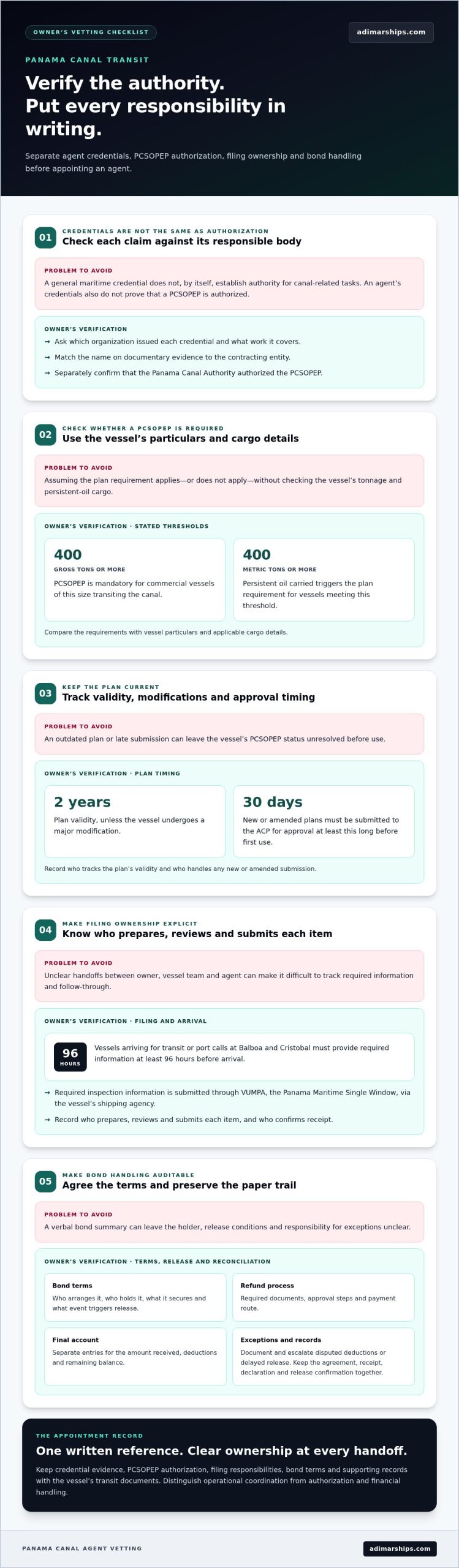
- Separate agent credentials from PCSOPEP authorization. The Panama Canal Authority must authorize the PCSOPEP, so review the plan’s authorization rather than relying on an agent’s general credentials.
- Check whether the vessel needs a PCSOPEP. The plan is mandatory for commercial vessels of 400 gross tons or more transiting the canal, so compare the requirement with the vessel’s particulars.
- Review the persistent-oil threshold. A Panama Canal Specific Oil Pollution Emergency Plan is required for vessels carrying 400 metric tons or more of persistent oil, so include applicable cargo details in the review.
- Check the plan’s validity and amendment process. PCSOPEP plans are valid for two years unless the vessel undergoes a major modification. New or amended plans must be submitted to the ACP for approval at least 30 days before first use.
- Assign responsibility for declarations. Required inspection information must be submitted through VUMPA, the Panama Maritime Single Window, via the vessel’s shipping agency. Record who prepares, reviews, and submits each item.
- Set out security bond terms in writing. Record who arranges the bond, who holds it, what it secures, and which event triggers release. A verbal summary can leave responsibilities unresolved.
- Request a written explanation of the refund process. Confirm the documents, approval steps, and payment route involved, because a defined release sequence helps owners track an outstanding return.
- Show the bond in the final account. Request separate entries for the amount received, any deductions, and the remaining balance. This makes reconciliation with disbursements easier.
- Clarify how exceptions are handled. Ask how a disputed deduction or delayed release will be documented and escalated, because a named process gives the owner a clear follow-up record.
- Keep bond evidence together. Retain the agreement, receipt, declaration, and release confirmation in one file, so the records can be compared during final accounting.
- Treat past reports as context, not proof. On 22 February 2011, a cruiser reported that an accredited Panama Canal agent helped avoid waiting 3 weeks for a security bond refund. One account cannot establish another agent’s performance.
Before appointing an agent, use the panama canal agent vetting checklist for owners to review credentials, PCSOPEP responsibilities, and bond terms. Identify who submits each document, manages each bond step, and provides the owner with records. Keep operational coordination distinct from authorization and financial handling. A written division of tasks gives the owner a practical way to track responsibilities through transit preparation and final accounting.
Agent communication and responsiveness
A canal transit depends on coordinated decisions, documents, and operational updates. During vetting, assess how an agent communicates before arrival, handles changes, and makes the next action clear. A prompt response is useful, but a complete response is more valuable: it should identify the issue, its operational effect, the responsible party, and the next step.
Set expectations before appointing the agent. Agree on the main communication channel, who receives messages, how urgent issues are flagged, and what each update should include. For an international owner, master, and operator working across time zones, a written record reduces the chance that a critical instruction remains in one person’s inbox.
- Ask for a sample status update. It should distinguish completed tasks from open items and identify the person responsible for each next step, so the owner can act without interpreting vague progress language.
- Test the response with a practical scenario. Ask how the agent would communicate a missing document, a changed arrival estimate, or an inspection concern, because each example reveals whether the answer includes actions and ownership.
- Agree on update triggers. Set milestones such as document submission, confirmation of receipt, arrival changes, and transit preparation, because milestone-based communication gives the vessel team a shared view of progress.
- Confirm who covers each communication line. Identify the primary contact and the person who handles the file if that contact is unavailable, so an open issue does not lose an owner during a handover.
- Request written summaries after calls. A short email recording decisions, document versions, and assigned actions creates a usable record for the master, owner, and other authorized parties.
- Ask how the agent flags incomplete documentation. The response should name the missing item, the correction needed, and who will submit it, allowing the vessel team to address the actual gap.
- Check how updates handle changing arrival details. Ask the agent to distinguish the vessel’s latest estimate from earlier information, because outdated arrival data can confuse planning and filing coordination.
- Clarify technical escalation. Ask who receives an engine or inspection issue and how that concern is relayed to the vessel’s responsible personnel, so operational details reach the right decision-maker.
- Make progress visible in one status record. A simple tracker with dates, submitted documents, open questions, and next actions helps international teams coordinate without relying on memory.
- Ask how transit-day changes are relayed. Confirm how updates reach the master and shore-side contacts if plans change around Gatun Lake, so everyone works from the same instruction.
Historical reports can illustrate expectations, but they aren’t performance guarantees. On 7 May 2012, a cruiser reported that an agent answered email questions almost immediately, usually within about 10 minutes. On 22 February 2011, another reported that Erick Galvez arranged line and fender equipment and had it removed from the boat within 10 minutes after transit. These dated examples show the value of prompt communication around practical tasks; they don’t establish a current response standard for every agent.
Use the vetting conversation to see whether answers are specific and consistent. If an agent describes an inspection update, for example, ask what the owner receives and how the message identifies any required action. For support coordinating vessel communications and transit arrangements in Panama, Panama ship agency coordination can be a relevant next step.
How should owners vet an agent’s handling of canal tolls, deposits, disbursements, and accounting?
Ask for a written financial workflow before authorizing a Panama Canal transit. It should explain how canal tolls, deposits, and other disbursements are requested, paid, recorded, and reconciled. The goal is a clear account trail, not an assumed total. Charges depend on the vessel and applicable items, so compare each amount with its stated basis and supporting record.
Use the published toll categories to see why itemization matters. These are separate entries, not an agent’s fee quote.
- Request an itemized estimate. Ask the agent to separate canal tolls, security charges, scheduling charges, deposits, and agency disbursements, so each amount has a clear category.
- Ask what determines each toll entry. For example, the May 2026 minimum ballast toll category used a vessel length overall under 65 feet; match the vessel’s particulars to the quoted basis.
- Clarify who receives each payment. Identify the payee and purpose for every requested amount, because a canal charge, agent disbursement, and refundable deposit serve different purposes.
- Agree how deposits are treated. Record the amount, holder, purpose, release conditions, and refund route in writing before funds move.
- Request supporting records for disbursements. Receipts, payment confirmations, and descriptions of services make it possible to match account entries against actual transit expenses.
- Separate estimates from final amounts. Ask the agent to mark estimates clearly and explain how changes will appear in the final account.
- Set a reporting format. Agree that the final statement will show opening funds, each disbursement, supporting records, remaining balance, and any refund due.
- Confirm how exceptions are recorded. Ask how disputed charges or an unavailable receipt will be identified, explained, and followed up in the account.
- Reconcile the account after transit. Compare the final statement with the original estimate, payment evidence, and deposit-release record before closing the file.
A cruiser reported that Roy Bravo did not require a security deposit for a southbound Panama Canal transit on 7 May 2012. Treat this as a dated individual account, not a general rule. The useful vetting point is to ask whether a deposit applies to your arrangement and to have the answer and terms documented. Never assume another vessel’s deposit experience establishes your own payment obligations.
Before approving disbursements, give the agent a clear authorization process: who can approve a payment, how supporting records are delivered, and how the owner receives the final reconciliation. A spreadsheet or ledger can help, but it must identify each transaction and its evidence. Owners seeking a representative for their transit can explore Owner’s Nominated Agency for local ship-agency coordination.
Operational readiness is another useful part of the agent’s workflow: ask who is responsible for each pre-arrival requirement and how any related outlay will be documented. The page states that ballast water exchange should take place 200 nautical miles offshore before Panama Canal transit. It also says a full steering gear test should be conducted within 48 hours of arrival at the Balboa or Cristobal anchorages. Ask the agent to identify the relevant deadlines, confirm what coordination is included, and show any associated disbursement separately rather than blending it into an unexplained total. A cruiser reported that Roy Bravo handled pre-arrival paperwork and sent the boat’s Panama Canal Ship Identification Number before arrival. Another cruiser reported that Roy Bravo handled immigration and customs without the cruiser needing to leave Shelter Bay Marina or visit an official. Treat these as individual reports, and ask which services the agent will provide on your transit and what evidence will appear in the account.
Clarify how transit-day arrangements are managed as well. The report describes centre-chamber rafting as the most common handling process for boats less than 125 feet long. A cruiser transiting the Panama Canal with Erick Galvez as agent reported that two line handlers assisted. Ask who arranges the line handlers and other operational support, whether related expenses are included in the estimate, and how the final statement will identify each payment. These questions connect the promised service to the eventual records: the agent should be able to explain what was arranged, what was paid, and which receipt or confirmation supports the entry. Keep the answers with the written estimate and compare them with the final account, while treating reported experiences as examples rather than assurances that every transit follows the same process. Clear advance answers can help distinguish operational charges from canal amounts, deposits, and the agent’s own fees.
Adimar Shipping: Ship Agency Services
Adimar Shipping, Inc. supports ship owners and charterers with local coordination for Panama Canal transits through its Ship Agency Services. Consider agency support when you need a local representative to coordinate transit arrangements and keep communication aligned between the vessel and shore-side teams.
Owners can appoint Adimar Shipping, Inc. through its Owner’s Nominated Agency, while charterers can use its Charterer’s Nominated Agency. Husbandry Services support vessel and crew needs, including crew changes and provisioning. The right arrangement depends on who appoints the agent and which responsibilities they need handled. Clear instructions from the outset help align the agency role with the vessel’s requirements.
To discuss agency representation for your Panama Canal transit, contact Adimar Shipping, Inc.
Turn your vetting into a clear agency appointment
Use your panama canal agent vetting checklist for owners as a working appointment brief, not simply a selection exercise. Carry its priorities into the agency relationship: identify who represents the owner, which tasks the agent coordinates, and how operational and financial updates should reach your team. Clear responsibilities help the vessel, owner, and charterer work from the same plan as transit arrangements progress.
Adimar Shipping, Inc. offers Ship Agency Services, including Owner’s Nominated Agency and Charterer’s Nominated Agency. These options provide local representation for owners or charterers coordinating a vessel in Panama. Set out the vessel’s requirements and your preferred communication and reporting arrangements when discussing the agency appointment.
Choosing an agent is a practical step toward organizing a complex passage. Keep your criteria visible, give the appointed representative clear instructions, and maintain a shared record of decisions. Contact Adimar Shipping, Inc. for support with ship agency arrangements for your Panama Canal transit. A well-structured appointment gives your team a clear starting point for the work ahead.
Frequently Asked Questions
How can owners verify a Panama Canal agent’s licenses, registration, and experience?
Verify the contracting entity’s identity, relevant credentials, and transit experience as separate checks. Match its legal name across the service agreement, invoices, and credential documents. Ask for examples of comparable vessel transits and permission to contact references about coordination and follow-through. Clarify which individual will represent the vessel and what tasks they handle. Don’t treat a business profile or general maritime experience as proof of specific canal authorization.
What Panama Canal Authority requirements apply to agents representing vessels?
Required inspection information must be submitted through the Panama Maritime Single Window, VUMPA, via the vessel’s shipping agency. Required information for vessels arriving for transit or port calls at Balboa and Cristobal must be provided at least 96 hours before arrival. PCSOPEP must be submitted by an Authorized Person residing in Panama, and the Panama Canal Authority must authorize the plan. Owners should distinguish these requirements from an agent’s general business credentials.
What documents and authorizations should owners require before appointing an agent?
Prepare an appointment file with the agent’s legal entity name, signed scope of authority, responsible contact, and clear limits on decisions or payments. Include the vessel’s identifying details and the owner’s written instructions for submissions and communications. For a vessel requiring PCSOPEP, retain the plan’s authorization and submission records, and identify the Authorized Person’s role. These records clarify who may act for the vessel and support a clean handover between owner, master, and agent.
How should owners check an agent’s references, insurance, financial stability, and compliance record?
Ask for references from owners or operators familiar with similar canal transits, then ask specific questions about accuracy, accounting, and issue escalation. Request evidence of insurance relevant to the agent’s work, including the policyholder and coverage period, and review available financial or trade references. Ask how the agent records compliance matters and resolves discrepancies. Compare names and dates across documents. A consistent record is more useful than broad claims of reliability.
What questions should owners ask about transit booking, scheduling, and canal communication?
Ask which booking period applies, what information the agent needs, and how the owner will receive confirmation of the booking status. The published periods include 365-22 days, 21-4 days, and 3-2 days before transit, followed by an auction period from 2 days at 14:00 hrs to 1 day at 13:00 hrs before transit. Ask how schedule updates reach the master and owner, and how changes are recorded.
What risks arise from using an unqualified or fraudulent Panama Canal agent, and how can owners mitigate them?
An unreliable or fraudulent representative can misdirect payments, misstate booking status, mishandle documents, or leave the vessel team without clear instructions. Reduce exposure by matching the agent’s legal identity to the contract and payee, documenting authority, and checking booking or authorization claims through appropriate official channels. Keep payment confirmations and submitted-document records under the owner’s control. Escalate inconsistencies before sending funds or relying on a transit confirmation.
Where can owners verify Panama Canal agents through official Panama Canal Authority or Panamanian sources?
Use Panama Canal Authority channels for canal requirements and to validate claims about ACP authorization, including PCSOPEP plan authorization. For an agent’s corporate identity, consult official Panamanian public records and compare the legal name with its contract and payment instructions. Ask the organization that issued a claimed credential how it can be verified. Treat an agent directory or online profile as a lead, not proof of current authority or registration.