
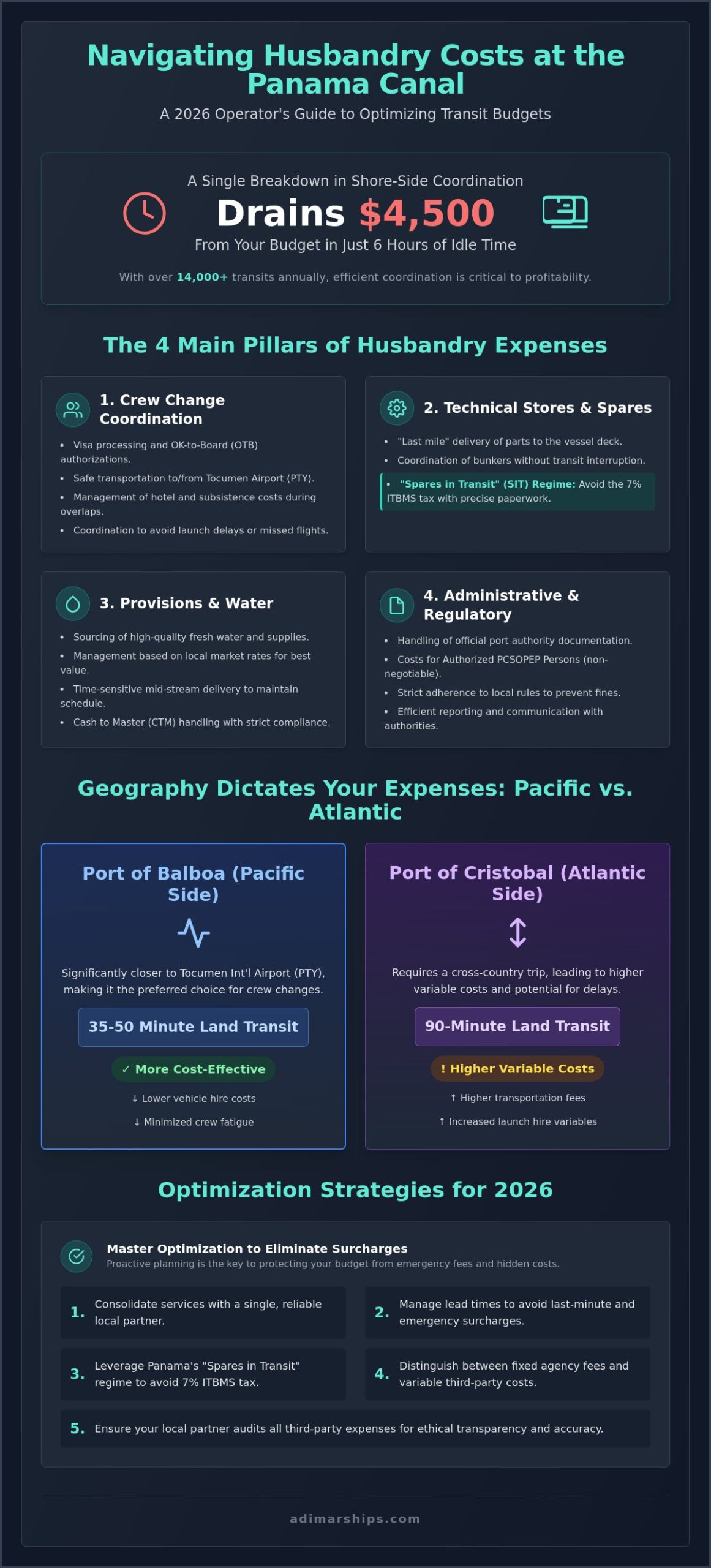
A single breakdown in shore-side coordination at the Panama Canal can drain $4,500 from your budget in just six hours of idle time. With over 14,000 transits occurring annually, the pressure to maintain a strict schedule is immense. You likely understand the frustration of seeing a voyage disrupted by unpredictable “extra” charges or logistical delays during crew changes. Managing the cost of husbandry services Panama Canal shouldn’t feel like a gamble with your operational budget.
We believe that transparency is the only way to build a reliable partnership. This 2026 guide provides the clear framework you need to budget for husbandry needs with total confidence. We’ll show you how to leverage Panama’s “Spares in Transit” regime to save on the 7% ITBMS tax and explain why the Port of Balboa remains the most efficient choice for your crew. You’ll discover a strategic approach to reduce downtime and secure the vigilant local representation your vessel deserves during every transit.
Key Takeaways
- Identify the four main pillars that drive the cost of husbandry services Panama Canal, including crew logistics and technical store deliveries.
- Learn how to leverage Panama’s “Spares in Transit” regime to avoid unnecessary tax burdens on critical technical stores.
- Distinguish between fixed agency attendance fees and variable third-party costs to create a more accurate operational budget.
- Master optimization strategies like service consolidation and lead-time management to eliminate emergency surcharges.
- Discover how a vigilant local partner protects your interests by auditing third-party expenses and ensuring ethical transparency.
What Defines the Cost of Husbandry Services in Panama?
Managing a vessel’s arrival in Panama involves two distinct operational layers. The first is the mandatory canal transit, which focuses strictly on tolls and navigation. The second, and often more complex, is husbandry. The cost of husbandry services Panama Canal encompasses everything your vessel needs that isn’t related to the movement through the locks. This includes the well-being of your crew, the delivery of critical spare parts, and the management of local administrative requirements. While transit tolls are fixed by the authorities, husbandry costs are market-driven and require careful coordination to remain economical.
Husbandry is a tactical investment. Without a dedicated partner on the ground, these costs can spiral due to poor coordination or a lack of local knowledge. Adimar Shipping, Inc. functions as your local office in Panama. We act as your vigilant eyes and ears, ensuring that every dollar spent on shore-side support directly contributes to your vessel’s operational uptime. Understanding this Panama Canal overview of services is the first step toward effective budgeting and avoiding the “hidden fee” anxiety that often plagues international fleet managers.
The Scope of Husbandry in the Panama Canal Zone
Husbandry requirements are diverse and time-sensitive. They generally fall into three specific categories that require local expertise to manage efficiently:
- Crew Welfare: This covers medical visits, shore leave, and the logistics of repatriation. Coordinating a crew change requires precision to avoid launch delays or missed flights at Tocumen International Airport.
- Vessel Support: Delivering spare parts or coordinating bunkers must happen without interrupting the transit schedule. We manage the “last mile” of these deliveries to ensure parts reach the deck exactly when needed.
- Administrative Tasks: Handling Cash to Master (CTM) and official documentation requires strict adherence to local regulations to prevent costly fines or coordination delays.
Why Husbandry Costs Vary Between Pacific and Atlantic Terminals
Geography dictates your expenses. The Port of Balboa on the Pacific side is significantly closer to Tocumen International Airport (PTY). This proximity often makes Balboa the preferred and more cost-effective location for crew changes. It reduces inland transportation time to roughly 35-50 minutes, which lowers vehicle hire costs and minimizes crew fatigue. Choosing the right terminal is a primary factor in controlling your total husbandry spend.
In contrast, reaching the Port of Cristobal on the Atlantic side requires a 90-minute cross-country trip. If your vessel is anchored at the Atlantic entrance, you’ll face higher transportation and launch hire variables. Canal congestion also plays a role. When queues are long, service provider availability tightens. This scarcity can lead to surcharges for last-minute or emergency service requests. By anticipating these geographical factors, Adimar Shipping, Inc. helps you choose the most efficient terminal for your husbandry needs.
The 4 Main Pillars of Panama Canal Husbandry Expenses
Budgeting for the cost of husbandry services Panama Canal requires a clear understanding of four primary operational pillars. Each pillar carries unique variables that can either optimize your budget or inflate it through poor timing. Given the global supply chain impact of this waterway, ensuring these pillars are managed by a local expert is essential for maintaining vessel profitability. Coordination is the key to preventing “hidden” fees that often arise from last-minute logistics.
Crew logistics represent the most variable expense. Beyond simple transportation, you must account for immigration fees and the coordination of shore-side support. Spare parts management relies heavily on the “Spares in Transit” (SIT) regime. This allows for tax-free entry of critical components, provided the paperwork is handled with precision. Provisions and fresh water sourcing depend on local market rates. High-quality supplies must be delivered mid-stream to avoid transit interruptions. Finally, regulatory compliance includes costs for Authorized PCSOPEP Persons and port authority documentation. These are non-negotiable but can be managed through efficient reporting.
Crew Change Coordination Costs
Spares and Logistics Management
Panama’s SIT regime is a major advantage for fleet managers. It exempts spare parts from the 7% ITBMS tax and other import duties. However, realizing these savings requires expert customs clearance and warehouse storage. Mid-stream delivery via launch services is often necessary to avoid delays. These launch fees vary based on distance to the anchorage and the specific location in Balboa or Cristobal. Our role is to act as a vigilant representative for your fleet, auditing these third-party costs to ensure you only pay for what is necessary. Utilizing a specialized ship agency service ensures these logistics are handled with the transparency and speed your schedule demands.
Administrative regulations also play a role in logistics. For example, Cash to Master (CTM) deliveries are governed by the OP Notice to Shipping N-1-2026. This requires a minimum of 72 hours’ notice for requests. Failure to meet these lead times can result in delivery surcharges or even missed transit windows. By managing these lead times proactively, we protect your operational budget from unnecessary strain.
Fixed vs. Variable Husbandry Fees: What to Expect
Identifying the difference between mandatory ACP tolls and private agency fees is vital for accurate budgeting. The cost of husbandry services Panama Canal is often misunderstood because it blends fixed professional fees with highly variable third-party expenses. While the Panama Canal Authority regulates the tolls for passage, your ship agent manages a private ecosystem of service providers. This distinction is where most budget overruns occur. Without a clear breakdown, owners often face “lumpsum” quotes that obscure the true cost of individual services.
Fixed professional fees provide stability, while variable costs reflect the specific logistical needs of your vessel. We believe that every disbursement account should be transparent and itemized. This approach allows fleet managers to see exactly where their budget is going, from the agent’s time to the specific fees charged by local vendors. Utilizing a structured framework for husbandry services ensures that you aren’t surprised by hidden markups at the end of a transit.
The Agency Attendance Fee
This professional fee represents the cost of your agent’s time, local expertise, and administrative support. It covers 24/7 coordination, real-time transit monitoring, and the handling of all official documentation required by port authorities. Expertise in PCSOPEP compliance is frequently bundled into this attendance fee. This ensures your vessel meets all environmental and safety standards without incurring extra administrative surcharges. The value of this fee lies in the peace of mind that comes from having a seasoned expert manage the complexities of the canal zone on your behalf.
Third-Party Vendor Markups and Transparency
Variable costs include launch hire, stevedoring, and medical services. These expenses change based on the vessel’s position, the time of day, and the urgency of the request. For example, launch hire costs are typically tiered based on the distance from the shore to the anchorage. A common industry risk is the presence of “hidden” markups on these third-party services. To protect your budget, it’s essential to receive original vendor invoices for every task performed.
Transparency is the best cure for hidden fee anxiety. A Protective Agency (OPA) can act as an independent auditor, reviewing the lead agent’s disbursements to ensure every charge is legitimate and reflects local market rates. By delegating this oversight to a vigilant partner, you gain an extra layer of financial security. This auditing process ensures that variable costs remain within reasonable limits and that your vessel’s operational budget is spent efficiently.
Optimization Strategies: Reducing Husbandry Costs in 2026
Operational efficiency is the most powerful tool for controlling your voyage budget. While some expenses are inevitable, the cost of husbandry services Panama Canal can be significantly reduced through tactical planning. The key lies in eliminating redundant logistics. Every time a launch boat leaves the pier, your costs increase. Launch services at the Balboa anchorage range from $550 to $1,400 depending on the distance. By consolidating crew changes, spare parts deliveries, and provision supplies into a single window, you minimize these expensive “trips” to the vessel.
Lead time is another critical factor. Panama’s regulatory environment rewards proactive managers. For instance, the OP Notice to Shipping N-1-2026 requires at least 72 hours’ notice for Cash to Master deliveries. Failing to meet these deadlines often results in emergency surcharges or missed transit windows. A delayed delivery that causes a missed slot can result in rescheduling fees and surcharges exceeding $65,000. Early notification allows your agent to secure the best local rates and ensure service provider availability during peak congestion periods.
Consolidating Services for Transit Efficiency
Successful fleet managers time their husbandry tasks to coincide with mandatory anchorage periods. This strategy ensures that the vessel is already stationary when services arrive. It also allows for the integration of bunkering in Panama with other essential needs. Instead of scheduling separate operations that disrupt the crew’s rest or the vessel’s readiness, you can handle fueling, provisions, and technical stores simultaneously. This level of coordination requires a partner who understands the rhythm of the canal locks and the specific layout of the anchorages.
Choosing the Right Partner for Cost Control
The “cheapest” agency fee is often a financial trap. Some agents offer low attendance fees only to recoup their margins through high markups on third-party services like launch hire or medical visits. You should evaluate an agent based on their network of local vendors and their commitment to ethical standards. A partner with deep roots in the Panamanian market can negotiate better rates for provisions and technical stores. They act as a vigilant extension of your own team, auditing every invoice to prevent overcharging. Transparency isn’t just a buzzword; it’s a cost-saving mechanism that provides the operational freedom you need to focus on the voyage itself. To secure a transparent breakdown for your next transit, contact our specialized ship agency team today.
Adimar Shipping, Inc.: Your Partner for Transparent Husbandry in Panama
Operational freedom begins with a partner you can trust. At Adimar Shipping, Inc., we understand that the cost of husbandry services Panama Canal is a significant line item in your voyage budget. Unpredictable “extra” charges from local agents shouldn’t be the norm. We’ve built our reputation on a foundation of ethical conduct and zero-hidden-fee transparency. By acting as a vigilant extension of your own team on the ground, we ensure that every service, from crew changes to spare parts delivery, is executed with precision and financial integrity.
Managing a complex Panama Canal transit while simultaneously coordinating husbandry needs requires deep local expertise. We eliminate the coordination delays that often plague larger, less personalized agencies. Our team focuses on clear, direct communication, ensuring you’re never left wondering about the status of a delivery or the location of your crew. We don’t just process paperwork; we protect your interests by auditing third-party costs and ensuring you receive the full value of every dollar spent in Panamanian waters.
The Adimar Advantage: Coordination Without Confusion
Efficiency is our primary value proposition. We proactively manage the logistics of your crew and technical stores to prevent transit delays before they happen. As your specialized Panama Canal ships agent, Adimar Shipping, Inc. serves as your local office, providing the “eyes and ears” necessary to oversee complex operations at the anchorage. Whether it’s coordinating a medical visit or managing a high-value CTM delivery, our goal is to provide a seamless experience that reduces the total cost of husbandry services Panama Canal through expert consolidation.
Personalized service means we’re available when you need us. Unlike larger corporations where your vessel is just a number, we provide dedicated attention to every transit. This focus allows us to identify cost-saving opportunities that others might miss, such as optimizing launch schedules or leveraging our deep roots in the local market to source quality provisions at competitive rates. Much like how specialized logistics and service staffing from monpilaar.nl streamlines operations in the Netherlands, professional ship agency services should simplify your life, not add to your stress.
Next Steps for Your 2026 Transit Planning
Planning for a successful transit starts with accurate data. We invite you to request a detailed pro-forma Disbursement Account (D/A) for your upcoming voyage. This document provides a transparent breakdown of expected expenses, allowing you to budget with confidence. To nominate Adimar Shipping, Inc. as your Husbandry or Protective Agent, simply reach out to our Panama City office. We’ll provide a personalized consultation to discuss your vessel’s specific requirements and demonstrate how our vigilant local representation can safeguard your operational budget in 2026.
Secure a Predictable Operational Budget for 2026
Navigating the canal involves more than just tolls; it requires a tactical approach to shore-side support. You now have the tools to distinguish between fixed attendance fees and variable vendor costs. By implementing the consolidation and lead-time strategies discussed in this guide, you can effectively manage the cost of husbandry services Panama Canal while maintaining the strict schedules required by global trade. Efficiency on the water must be matched by precision on the shore.
Adimar Shipping, Inc. acts as your vigilant partner on the ground. We provide PCSOPEP Authorized Personnel and specialized local expertise to ensure your vessel remains on schedule. Our Ethical Standards Guarantee means you’ll never face hidden markups or coordination confusion. We’re ready to serve as your local office in Panama, providing the transparency and reliability your fleet deserves to navigate these complex logistical waters successfully.
Request a Transparent Husbandry Pro-Forma for Your Panama Transit and take control of your next voyage today. We look forward to ensuring your next transit is your most efficient one yet.
Frequently Asked Questions
What is included in a standard husbandry agency fee at the Panama Canal?
A standard husbandry agency fee covers the professional attendance and local expertise required to coordinate your vessel’s non-transit needs. This includes 24/7 monitoring, communication with local port authorities, and the administrative management of all third-party service providers. It ensures that your vessel’s requirements are met without the need for constant shore-side intervention from your home office, providing a single point of contact for all logistics.
Can I perform a crew change during the actual transit of the Canal?
Crew changes cannot be performed during the actual transit through the locks or the navigation channels. These operations must take place while the vessel is at the designated anchorages in Balboa on the Pacific side or Cristobal on the Atlantic side. Attempting to perform logistics during transit would violate safety regulations and could lead to significant fines or delays for the entire convoy.
How are launch hire costs calculated for vessels at anchor in Balboa or Cristobal?
Launch hire costs are calculated based on the distance between the pier and the specific anchorage position assigned to your vessel. These fees are tiered by zones; outer anchorages require longer travel times and higher fuel consumption, which increases the price. Surcharges may also apply for night operations or heavy weather conditions that require specialized pilotage or larger vessels to ensure the safety of the crew and cargo.
Is it cheaper to deliver spare parts in Panama or wait for a different port?
Delivering spare parts in Panama is often more cost-effective because of the “Spares in Transit” (SIT) regime. This regulation allows technical stores to enter the country tax-free, exempting them from the standard 7% ITBMS tax. When you evaluate the cost of husbandry services Panama Canal, the ability to avoid import duties makes this region a preferred global hub for technical logistics and engine room spares.
What are the visa requirements for crew changes in Panama in 2026?
Visa requirements depend on the nationality of the seafarer and the specific maritime regulations in effect for 2026. Most crew members require an OK-to-Board (OTB) authorization and a specialized maritime visa processed by your local agent before arrival. We handle these applications directly with Panamanian immigration to ensure that your crew members can transition safely and legally between Tocumen International Airport and the vessel pier.
Does the Panama Canal Authority (ACP) charge for husbandry services?
The Panama Canal Authority (ACP) does not provide or charge for husbandry services. Their jurisdiction is strictly limited to mandatory transit tolls, tug services, and navigation fees. Husbandry services are private commercial arrangements managed by local ship agencies. This is why the cost of husbandry services Panama Canal varies between providers based on their service quality, vendor networks, and commitment to transparency.
How do I request a Cash to Master (CTM) delivery through my agent?
You request a Cash to Master (CTM) delivery by submitting a formal instruction to your agent with the specific amount and denomination requirements. Under the OP Notice to Shipping N-1-2026, you must provide a minimum of 72 hours’ notice for standard requests. For amounts exceeding $50,000, at least five business days are required to ensure secure armored transport and local bank availability during your transit window.
What is the role of a Protective Agent regarding husbandry costs?
A Protective Agent acts as an independent auditor to ensure that husbandry costs remain fair and transparent for the ship owner. They review the disbursement accounts provided by the lead agent, verifying that third-party vendor invoices exactly match the services rendered. This role is essential for owners who want an extra layer of financial protection against hidden markups or coordination errors during a complex canal transit.