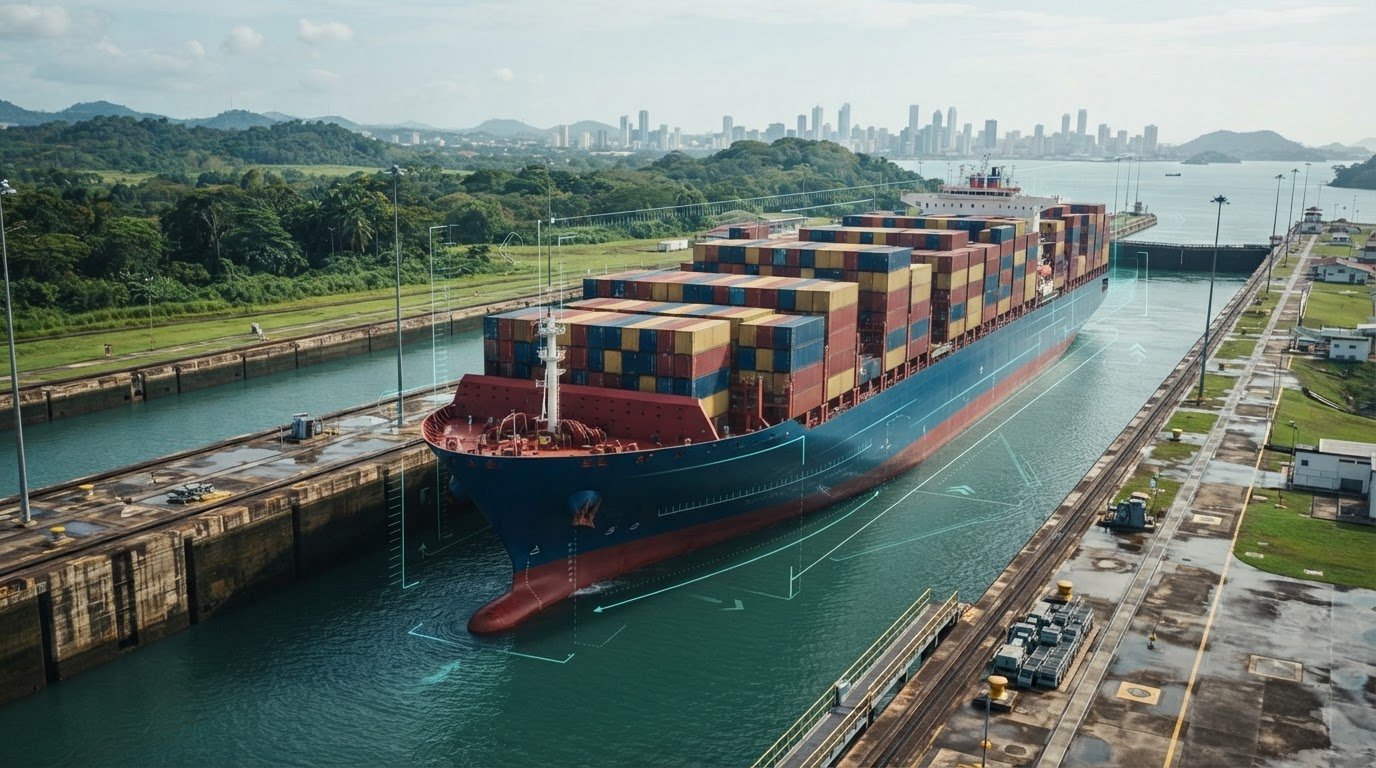

A single administrative oversight in your 2026 transit filing can now trigger a $65,000 daily surcharge. With roughly 12% of vessels facing initial delays due to technical discrepancies found during pre-transit inspections, the financial risks of the Panama Canal have never been higher. Learning how to avoid panama canal penalties is no longer just a best practice; it’s a requirement for protecting your voyage budget from unpredictable disruption charges. You’re likely dealing with the stress of the ACP’s new machine-validated clearance system, which leaves no room for error in VUMPA reporting or vessel dimension declarations.
This guide provides a clear roadmap to master the latest 2026 regulations and reporting workflows to ensure a zero-penalty transit. We’ll break down the specific differences between ‘Low’ and ‘High’ disruption charges and clarify the 96-hour VUMPA submission deadlines that often catch operators off guard. By the end of this article, you’ll have the technical knowledge and communication strategies needed to navigate the locks with confidence. We’ll show you how delegating these complexities to an experienced local partner ensures your vessel meets every new decarbonization and equipment standard without costly delays.
Key Takeaways
- Identify the specific technical deficiencies, such as mooring winch configurations and chock SWL ratings, that trigger the highest tier of ACP disruption charges.
- Learn how to avoid panama canal penalties by mastering the 96-hour VUMPA self-reporting rule to proactively mitigate fines before vessel arrival.
- Understand the financial impact of the 2026 administrative surcharges and why a single documentation error can lead to a $65,000 daily slot forfeiture cost.
- Ensure your vessel meets the latest environmental standards, including PCSOPEP requirements and the ACP’s 0.50% sulfur limit, to avoid immediate transit suspension.
- Discover how partnering with an experienced ship agency provides the local vigilance necessary to monitor real-time ACP advisories and protect your voyage budget.
The Financial Impact of Panama Canal Penalties in 2026
ACP penalties represent the financial enforcement of technical, operational, and environmental standards. These fines aren’t static; they scale based on the severity of the violation and its impact on the canal’s schedule. In 2026, the Panama Canal Authority (ACP) uses these charges to ensure that only the most prepared vessels occupy the 37 average daily transit slots. Understanding how to avoid panama canal penalties requires a clear-eyed look at the current regulatory landscape, where a single clerical error can trigger a cascade of secondary costs. While the Panama Canal history and operations show a long-standing commitment to safety, the modern era has introduced “Disruption Charges” as a primary deterrent. These are applied whenever a vessel’s deficiency causes a delay or requires additional resources to manage.
Understanding the Disruption Charge Structure
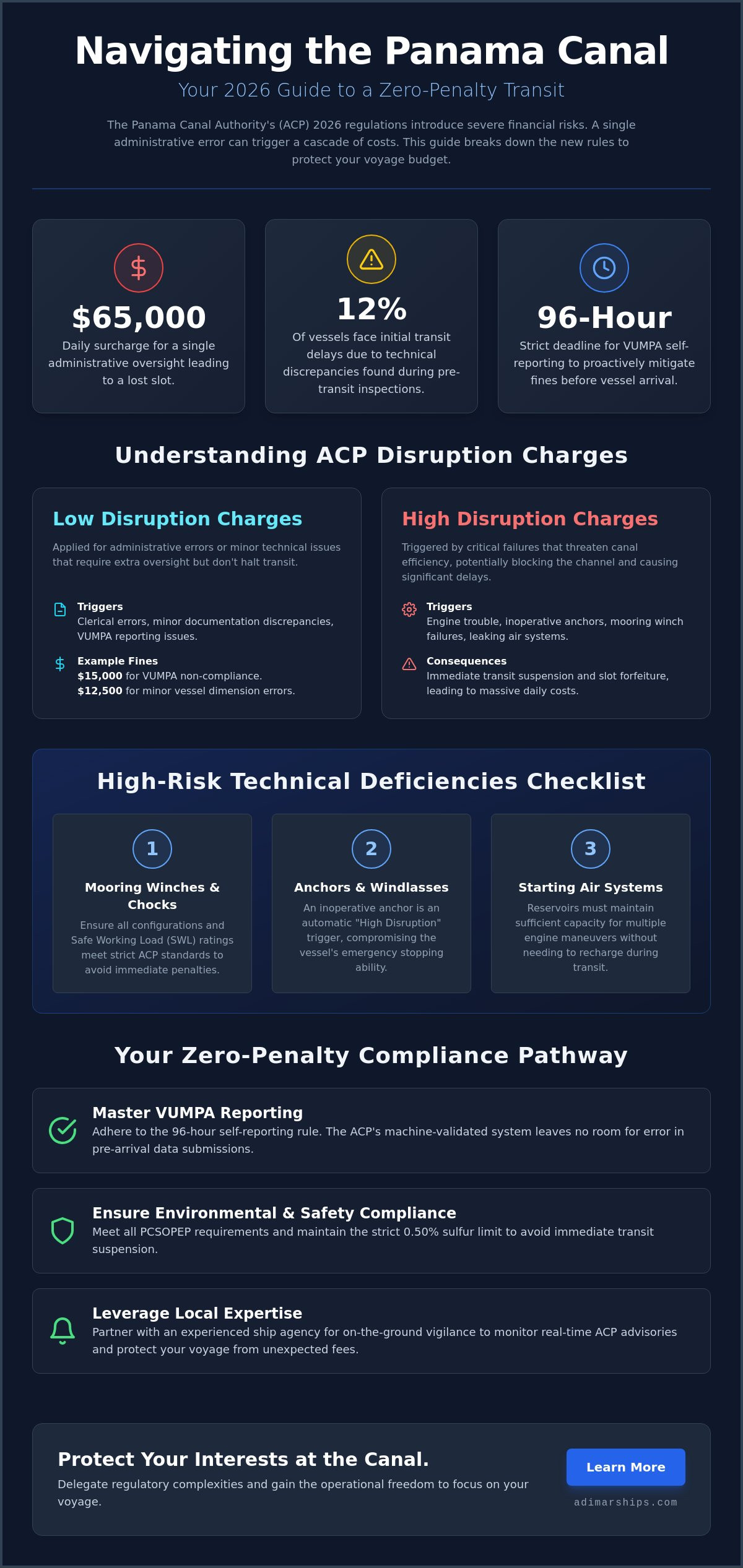
The ACP categorizes penalties into “Low” and “High” disruption charges. Low disruption charges typically apply to administrative errors or minor technical issues that don’t immediately halt transit but require extra oversight. High disruption charges are far more severe. These are triggered by critical failures, such as engine trouble or mooring winch deficiencies, that could potentially block the channel. The tier is determined by the “Non-Exhaustive” nature of the ACP’s deficiency list. This means the Authority can apply surcharges for any condition they deem a risk to canal efficiency, even if it isn’t explicitly named in a manual. Penalties apply differently to harbor movements compared to full transits, with full transit violations often resulting in much higher daily surcharges.
Direct vs. Indirect Costs of Non-Compliance
The immediate invoice impact is often the first shock for an operator. For example, non-compliance with VUMPA requirements carries an initial $15,000 fine, while a minor discrepancy in reported vessel dimensions can lead to a $12,500 penalty. However, the indirect costs are where the real budget damage occurs. Consider these secondary risks:
- Lost Transit Slots: Forfeiting a Neo-Panamax slot can cost over $65,000 per day in lost time and rescheduling fees.
- Operational Fees: Technical failures often necessitate extra tugage and pilotage fees not included in your original voyage estimate.
- Anchorage Costs: Delays lead to extended stays at anchorage, increasing husbandry expenses and crew costs.
Because the ACP uses a machine-validated system for vessel clearance, errors are caught instantly. This makes having a Panama Canal ships agent essential. A dedicated agent acts as your on-the-ground advocate, providing the vigilance needed to dispute unfair assessments and ensuring your documentation is flawless before it reaches the ACP’s digital desk. When you delegate these complex tasks, you gain the operational freedom to focus on the voyage itself.
Mastering the Disruption Charge: High-Risk Technical Deficiencies
Technical readiness is the foundation of a zero-penalty transit. In 2026, the ACP applies “High” disruption charges to any deficiency that threatens the continuous flow of traffic. This goes beyond simple mechanics. It involves a “no-fail” rule for entry. If your vessel arrives with inoperative anchors or a leaking starting air system, you risk immediate slot forfeiture and significant financial hits. Understanding how to avoid panama canal penalties starts with a rigorous pre-arrival inspection of these high-risk areas. Roughly 12% of vessels currently face initial delays due to technical discrepancies found just before transit, making proactive maintenance your most effective budget protection tool.
The ‘Big Three’ Equipment Failures
Anchors and windlasses are critical. An inoperative anchor is an automatic penalty because it compromises the vessel’s ability to moor safely in an emergency. Starting air systems must also maintain sufficient capacity for multiple engine maneuvers without recharging. If a pilot finds your air reservoirs depleted during transit, the resulting delay triggers a high-tier charge. Bridge visibility is equally vital. The ACP mandates strict sight lines and window cleanliness standards. Any obstruction to the pilot’s view or a failure in window wiping systems can lead to a transit suspension until the issue is rectified.
Neopanamax-Specific Compliance Issues
For larger vessels, the requirements are even more stringent. New 2026 standards require all ships over 294 meters to feature heavy-duty chocks with a Safe Working Load (SWL) of at least 90 tonnes. These must be properly configured to handle the stress of the Expanded Canal’s tug operations. You should also verify your specific Panamax vessel dimensions against the latest official Panama Canal Authority Notices to Shipping. Dynamic draft restrictions based on Gatun Lake levels add another layer of risk. If your reported draft exceeds the daily allowance, you may face a $12,500 penalty for dimension discrepancies or even the immediate loss of your transit slot.
Propulsion and steering systems must be flawless. Even minor air system leaks can trigger a ‘High’ disruption charge if they affect the responsiveness of the vessel. Modern navigation equipment like AIS, gyrocompasses, and ECDIS must also be fully operational. The ACP’s machine-validated system checks for active AIS signals and correct data transmission before you reach the locks. Even a minor lag in electronic chart updates can cause an inspection failure. Ensuring your crew is prepared for these technical hurdles is a complex task. Many operators find that delegating these oversight duties to professional ship agency services is the most reliable way to maintain compliance and protect their bottom line.
VUMPA Reporting and Pre-Arrival Compliance Strategies
VUMPA (Panama Maritime Single Window) is your most effective tool for operational transparency. In 2026, the ACP’s machine-validated system leaves no room for hesitation or manual corrections at the last minute. The key to how to avoid panama canal penalties lies in mastering the “Self-Reporting” rule. By declaring a technical deficiency at least 96 hours before arrival, you move into a lower penalty tier or avoid fines altogether if the issue doesn’t impact safety. If you wait for the ACP inspector to find the fault during the pre-transit boarding, you’re hit with the “Discovery Penalty.” These detected faults are always charged at the highest possible rate, as they’re viewed as a failure of vessel readiness.
The 96-Hour Reporting Window
The 96-hour deadline is a hard cutoff for digital submissions. To navigate this, you must work closely with your Panama ship agency to draft visit remarks correctly. It’s vital to distinguish between “Remarks” and “Deficiencies” in the VUMPA system. A remark might note a minor operational quirk that doesn’t affect transit, while a deficiency signals a equipment failure that requires ACP evaluation. If your crew completes a repair while en route, your agent can update the ACP in real-time. This proactive update can potentially remove a restriction before the pilot boards, preventing the automatic application of disruption charges.
Agent-Led Mitigation Strategies
Partnering with an experienced agent allows you to verify if a specific condition is truly “penalizable” before it reaches the official record. We act as a vigilant liaison, utilizing deep local knowledge to interpret maritime industry guidance on disruption charges. This expertise helps you decide whether to proceed with a declared remark or seek an immediate repair at anchorage. We focus on these core mitigation steps:
- Pre-Transit Inspections: Arranging for a local expert to board your vessel before the ACP to identify potential penalty triggers.
- Documentation Prep: Ensuring all technical certificates are uploaded and machine-verified before the 96-hour window closes.
- Liaison Advocacy: Communicating directly with ACP officials to clarify technical status and reduce the risk of slot forfeiture.
Documentation preparation is a critical hurdle that many operators underestimate. All certificates must be uploaded and verified in the digital window before the pilot boards. By delegating these specialized tasks to a regional expert, you ensure that your vessel’s paperwork is as ready as its engine room. This high level of oversight is the most reliable way to maintain your transit schedule and understand how to avoid panama canal penalties during a volatile 2026 season.
Environmental and Safety Compliance: Beyond the Engine Room
Environmental compliance is a moving target in the 2026 season. While technical readiness often takes center stage, the ACP increasingly focuses on ecological protection and crew safety as primary transit requirements. A single administrative error in your pollution plan or a faulty pilot ladder can be just as disruptive as an engine failure. Understanding how to avoid panama canal penalties requires a holistic approach that includes fuel monitoring, waste management, and strict adherence to safety protocols. The ACP doesn’t just watch your wake; they monitor your emissions and your documentation with machine-validated precision.
The PCSOPEP Factor: Authorized Person Requirements
Oil pollution prevention is non-negotiable. Every vessel over 400 gross tons must maintain PCSOPEP compliance to enter canal waters. A common pitfall is the failure to designate a valid “Authorized Person” residing in Panama. If this role isn’t correctly filled and documented, you face an immediate $2,500 fine for administrative non-compliance and potential transit delays. Adimar Shipping serves as your PCSOPEP Authorized Person, providing the local representation required to act as a liaison during an emergency. We review your Shipboard Oil Pollution Emergency Plan to catch clerical errors before they reach the ACP’s desk, ensuring your plan is active and recognized by canal authorities.
Fuel and Emission Penalties
The ACP’s focus on decarbonization has intensified. As of January 1, 2026, inspectors have increased their focus on MARPOL Annex VI, checking that all vessels maintain a sulfur limit below 0.50 percent while in canal waters. The ACP employs aggressive monitoring and sampling protocols. If your vessel is found using non-compliant fuel, or if your exhaust gas cleaning system (scrubber) fails to meet open-loop discharge standards, the penalties are severe. Visible smoke or fumes in the Culebra Cut are also monitored. These environmental infractions often lead to immediate transit suspension and high disruption charges. To stay ahead of these risks, you must ensure your fuel-switching procedures are documented and verified well before reaching the locks.
Crew safety is another high-priority area for 2026. Pilot ladder standards are strictly enforced. If a pilot deems a boarding arrangement unsafe, the vessel is hit with a “Safe Boarding” penalty and may be sent back to anchorage for rectification. Similarly, improper sludge or garbage disposal carries heavy fines. The ACP has also introduced a 15 percent surcharge increase for vessels without certified water-saving equipment as of January 2026. Managing these overlapping regulations is a heavy burden for any crew. You can secure your voyage by delegating these oversight tasks to our expert ship agency services, ensuring every environmental and safety box is checked before you arrive.
The Adimar Advantage: Protecting Your Interests at the Canal
Vigilance is our core promise. At Adimar Shipping, we monitor ACP Advisories to Shipping in real-time to ensure our clients are never blindsided by sudden regulatory shifts. Navigating the locks requires more than just technical readiness; it demands a protective approach to documentation that eliminates clerical fines before they occur. Understanding how to avoid panama canal penalties is simpler when you have a local office in Panama acting as an extension of your own team. We don’t just process paperwork. We serve as a vigilant, on-the-ground representative that protects your interests at every stage of the transit.
Proactive reporting is your strongest defense against the $65,000 daily surcharges mentioned earlier. In one recent scenario, a client identified a minor mooring winch discrepancy just before arrival. By utilizing our expertise to self-report this through the VUMPA system within the 96-hour window, we moved the vessel into a lower penalty tier. Instead of facing a high-tier disruption charge and immediate slot forfeiture, the operator proceeded with a minor administrative remark. This level of oversight is why the 12% of vessels facing delays are typically those without a proactive agency partner.
Owner’s and Charterer’s Nominated Agency Services
We provide both Owner’s and Charterer’s Nominated Agency services to ensure all parties are aligned before the pilot boards. This dual expertise allows us to resolve complex disputes regarding penalty responsibility with transparency and speed. Our meticulous husbandry services ensure your voyage budget remains intact while we manage essential logistics. Whether it’s coordinating ‘Cash to Master’ or executing crew changes, we handle these tasks without affecting your transit priority. We act as a seasoned expert with deep local knowledge, simplifying the most difficult coordination efforts for your fleet.
Final Checklist: Your Zero-Penalty Transit Roadmap
A zero-penalty transit is the result of disciplined preparation. In the volatile 2026 season, where auction prices for slots have hit $4 million, you cannot afford a single oversight. Follow this timeline to protect your interests:
- 96 Hours: Perform a final technical audit of all anchors, windlasses, and navigation equipment. Submit your VUMPA declaration through your agent to utilize the ‘Self-Reporting’ grace period.
- 48 Hours: Confirm your PCSOPEP Authorized Person is active and verify your fuel switch-over to meet the ACP’s 0.50% sulfur limit.
- 24 Hours: Execute a final inspection of pilot ladders and bridge visibility. Ensure all technical certificates are uploaded and machine-verified.
Don’t leave your transit to chance. Our team provides the security and reliability you need to master how to avoid panama canal penalties in an era of zero-tolerance enforcement. Contact Adimar Shipping today for a comprehensive pre-transit audit and secure your place in the canal’s daily transits.
Secure Your 2026 Transit Priority
Achieving a zero-penalty transit in 2026 requires more than just a well-maintained vessel. It demands a sophisticated understanding of the ACP’s digital reporting windows and a proactive approach to technical readiness. By prioritizing the 96-hour VUMPA submission and ensuring your equipment meets the latest standards for chocks and mooring winches, you protect your voyage from the high disruption charges that now exceed $65,000 per day. Mastering how to avoid panama canal penalties is an ongoing process of vigilance and precise local coordination.
Success at the locks is built on the expertise of a regional partner who acts as an extension of your own team. Adimar Shipping has provided expert Ship Agency Services since 1993, offering the on-the-ground vigilance in Panama City needed to navigate these complexities. As your Authorized PCSOPEP Representative, we ensure your environmental documentation is flawless before the pilot boards. Secure Your Panama Canal Transit with Adimar Shipping and gain the operational freedom to focus on your next port of call. Your successful transit is our primary objective.
Frequently Asked Questions
What is the most common reason for a Panama Canal disruption charge?
Technical deficiencies found during the pre-transit inspection are the leading cause of disruption charges. Approximately 12% of vessels face initial delays because equipment like anchors, windlasses, or steering systems don’t meet ACP standards. When these issues are discovered by a pilot rather than self-reported, they’re automatically classified as high-tier disruptions. This leads to immediate financial penalties and potential transit suspension while the vessel is sent to anchorage for repairs.
Can a ship agent help reduce an already issued ACP penalty?
Yes, an experienced agent acts as your local advocate to dispute or mitigate penalties through the “Transparency Workflow.” By providing immediate evidence of compliance or documenting that a deficiency was self-reported within the 96-hour window, we can often move a charge from a ‘High’ to a ‘Low’ tier. Understanding how to avoid panama canal penalties involves utilizing an agent’s local relationships to clarify technical status before the final invoice is processed.
How much does a ‘High’ disruption charge cost in 2026?
In 2026, a ‘High’ disruption charge for a Neo-Panamax vessel can exceed $65,000 per day due to slot forfeiture and administrative surcharges. Additionally, non-compliance with VUMPA requirements carries an initial $15,000 fine. These costs don’t include secondary expenses like extra tugage, pilotage fees, or the lost time associated with rescheduling a transit. Auction prices for slots have reached $4 million, making any disruption a catastrophic budget event.
Is PCSOPEP compliance mandatory for every vessel transiting the Canal?
PCSOPEP compliance is mandatory for all vessels over 400 gross tons transiting the Panama Canal. You must have a Shipboard Oil Pollution Emergency Plan that includes a designated Authorized Person residing in Panama. Failing to maintain this administrative requirement leads to an immediate $2,500 fine. Adimar Shipping serves as this authorized representative, ensuring your plan is recognized by the ACP and preventing delays at the entrance locks.
What happens if a vessel deficiency is found during the transit itself?
Deficiencies discovered mid-transit result in immediate disruption charges and the potential use of additional tugs at the owner’s expense. If the pilot determines the vessel is a risk to canal operations, transit is suspended until the issue is rectified. This often results in the loss of the transit slot and a penalty of $5,000 for unauthorized immobilization. The vessel may also be required to undergo a full re-inspection before a new slot is granted.
Do I need to report a minor equipment leak if it doesn’t affect steering?
Yes, you should report all technical deficiencies via the VUMPA 96-hour window to avoid the “Discovery Penalty.” The ACP’s machine-validated system is designed to catch even minor discrepancies in vessel performance. Reporting the leak early is a key strategy for how to avoid panama canal penalties because it demonstrates proactive compliance. This allows the ACP to evaluate the risk beforehand, often resulting in a lower penalty tier than if the pilot discovers it.
How does the ACP verify fuel compliance for transiting vessels?
The ACP verifies compliance through aggressive sampling protocols and continuous exhaust monitoring in canal waters. Inspectors focus heavily on MARPOL Annex VI standards, checking that all vessels maintain a sulfur limit below 0.50 percent. They also monitor for visible smoke or fumes, especially in sensitive areas like the Culebra Cut. Any failure to meet these environmental standards results in immediate transit suspension and significant disruption surcharges.
What are the latest pilot ladder requirements to avoid safety penalties?
Pilot ladders must be structurally sound, free of grease, and meet strict IMO and ACP height requirements to avoid “Safe Boarding” penalties. If a pilot deems the boarding arrangement unsafe, they’ll refuse to board, leading to an immediate $10,000 fine for arriving past the scheduled slot and potential slot forfeiture. Regular inspections of the ladder’s steps, side ropes, and securing points are essential for maintaining transit priority and crew safety.