


A single clerical oversight in your digital filing can halt a vessel’s transit before it even reaches the Panama Canal breakwater. Since the Panama Maritime Authority transitioned to the mandatory e-certificates platform in late 2025, the margin for error has vanished. You’ve likely felt the pressure of navigating complex SSAS exemption requirements or the stress of ensuring your CSO endorsement is perfectly aligned with the latest MMC-123 revisions. It’s a high-stakes environment where documentation isn’t just administrative; it’s the key to your operational freedom.
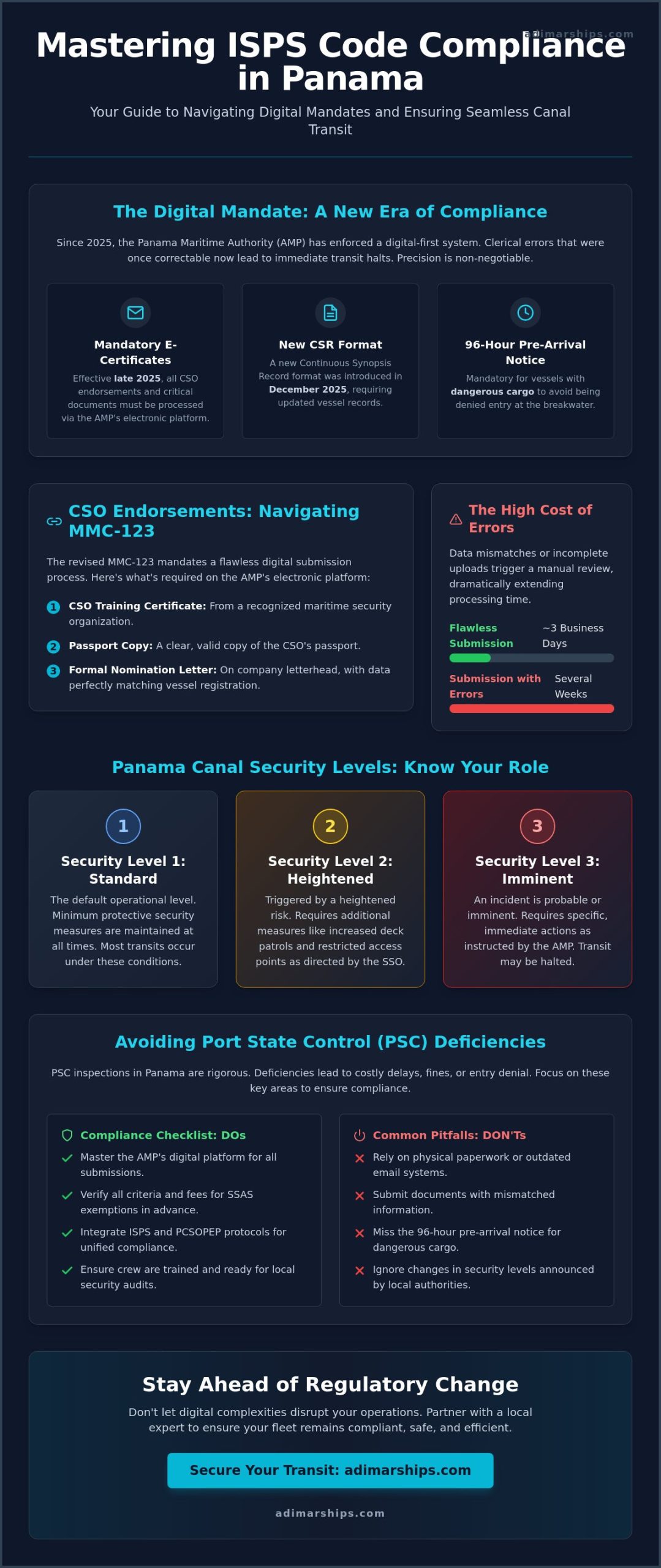
Achieving total isps code compliance panama doesn’t have to be a source of operational friction. This guide helps you master these new digital complexities and ensure a seamless, compliant journey through the Canal. You’ll learn how to navigate the 2026 security protocols, handle the new Continuous Synopsis Record format introduced in December 2025, and eliminate the risk of Port State Control deficiencies. From securing mandatory exemptions to managing the 96-hour pre-arrival notice for dangerous cargo, we provide the local clarity you need to keep your fleet moving safely and efficiently.
Key Takeaways
- Master the transition to mandatory e-certificates for CSO endorsements and the new CSR format required by the Panama Maritime Authority.
- Identify the specific criteria and fees for obtaining SSAS exemptions to maintain isps code compliance panama.
- Learn how to avoid the most common security deficiencies that trigger costly Port State Control delays in Panamanian waters.
- Discover the operational benefits of integrating your ISPS security protocols with PCSOPEP requirements for a unified and efficient Canal transit.
The Foundation of Maritime Security: ISPS Code Compliance in Panama
Panama serves as the world’s primary maritime hub, making its security protocols the benchmark for global trade. For ship owners, maintaining isps code compliance panama isn’t merely an administrative checkbox. It’s the fundamental requirement for accessing the Panama Canal and its surrounding ports. The International Ship and Port Facility Security (ISPS) Code provides the essential framework for detecting and preventing security threats. In 2026, this code has evolved into a digital-first system where local oversight is more rigorous than ever.
Vessels flying the Panamanian flag or entering Panamanian waters face specific scrutiny. The local authorities prioritize high-level security to protect the Canal’s infrastructure and the massive volume of cargo passing through daily. If your vessel’s security documentation is outdated or if your crew isn’t prepared for a local audit, the consequences are immediate. You’ll likely face costly delays, entry denials, or significant fines from Port State Control. Understanding how local security standards impact your clearance is the first step toward a successful transit. For example, vessels carrying dangerous cargo now face heightened scrutiny, requiring a mandatory 96-hour pre-arrival notice and detailed declarations to avoid being turned away at the breakwater.
The Role of the Panama Maritime Authority (AMP)
The Panama Maritime Authority (AMP) acts as the sole governing body responsible for maritime security under the Panama flag. It’s the entity that approves Ship Security Plans and issues the International Ship Security Certificate (ISSC). The AMP works in close coordination with the Panama Canal Authority (ACP) to ensure every vessel transiting the waterway meets strict safety criteria. To stay compliant, owners must monitor the Merchant Marine Circulars (MMC) constantly. These documents, such as the recently revised MMC-123, contain the latest instructions on everything from CSO endorsements to technical security requirements. We act as your vigilant eyes on the ground, ensuring you never miss a critical update from the AMP.
Key Security Levels and Their Impact on Transit
Panamanian waters operate under three distinct security levels, each requiring different operational responses from the ship owner and the Ship Security Officer (SSO):
- Security Level 1: The standard level where minimum protective measures are maintained at all times. Most transits occur at this level.
- Security Level 2: Requires additional protective measures due to a heightened risk of a security incident. The SSO must increase the frequency of deck patrols and restrict access points.
- Security Level 3: Applies when a security incident is probable or imminent. This level involves specific instructions from the AMP or local port authorities, potentially halting transit until the threat is neutralized.
Clear communication between the SSO and local authorities is vital. When security levels change, your vessel must acknowledge and implement the new requirements immediately to maintain its clearance status. Delegating the monitoring of these shifts to a local expert ensures your vessel remains ready for any change in the security landscape.
Navigating Regulatory Revisions: MMC-123 and Digital CSO Endorsements
Digitalization isn’t a future goal for the Panama Maritime Authority; it’s the current standard. Since September 1, 2025, the AMP has mandated that all applications for Company Security Officer (CSO) endorsements must be processed through their official electronic platform. This shift, outlined in the revised Merchant Marine Circular MMC-123, has fundamentally changed the workflow for isps code compliance panama. You can no longer rely on physical paperwork or legacy email systems to secure these critical endorsements. The system now demands precision and real-time data entry.
A successful nomination requires a specific set of digital credentials. You’ll need to provide the CSO’s training certificate from a recognized organization, a clear copy of their passport, and a formal nomination letter on company letterhead. In 2026, the AMP expects these submissions to be flawless. If the data on your nomination letter doesn’t perfectly match the vessel’s registered details, the system will flag it for manual review. This usually extends the processing timeline from a standard three business days to several weeks. To maintain your schedule, ensure your internal records are updated before you begin the upload process.
Step-by-Step: Using the Panama E-Certificates Portal
The gateway to compliance is the official portal at https://ecertificatespanama.amp.gob.pa. First, you must register your company profile and verify your credentials. Once active, the most critical step is uploading the Document of Compliance (DOC). This document must show all current annual or intermediate endorsements to be accepted. We often see administrative delays caused by simple clerical errors, such as uploading expired DOCs or using incorrect file formats. If these technical hurdles create friction for your team, Adimar Shipping can serve as your expert partner to manage these digital submissions on your behalf.
Managing the Company Security Officer (CSO) Endorsement
The CSO carries significant legal weight under Panamanian law. They’re the primary liaison between the ship and the company, responsible for the development and maintenance of the Ship Security Plan. These endorsements generally remain valid for five years, but you should initiate the renewal protocol at least 90 days before the expiry date to avoid a lapse in certification. A lapse doesn’t just mean a fine; it can invalidate your International Ship Security Certificate (ISSC), leading to an immediate detention by Port State Control.
For 2026, the CSO endorsement is a mandatory digital certification issued by the AMP that verifies an individual’s competence to manage a vessel’s security protocols in accordance with the latest ISPS standards.
SSAS Exemptions and Security Alert Protocols in Panama
The Ship Security Alert System (SSAS) serves as your vessel’s silent distress signal, but technical failures or specific operational profiles often necessitate an official exemption. For many owners, managing these exemptions is a critical component of isps code compliance panama. You can’t transition from an Interim International Ship Security Certificate (ISSC) to a Full Term certificate without either a fully operational SSAS or a valid exemption on file. This link between your hardware and your statutory certification makes early intervention essential. If your system is down, your vessel’s legal ability to trade is at risk.
Statutory requirements demand that if a vessel is granted an SSAS exemption, it must implement alternative security measures. These measures are not suggestions; they must be documented in the Ship Security Plan and verified by your Recognized Security Organization (RSO). The financial logic is straightforward. While the Panama Maritime Authority charges a US$300.00 fee for SSAS exemptions issued by the head office, this is a minor investment compared to the thousands of dollars lost during a Port State Control detention. Proactive compliance ensures your vessel remains an asset rather than a liability at the breakwater.
Requesting a SSAS Exemption Certificate
Securing an exemption requires a coordinated effort between your company and your RSO. You must provide a formal statement from the RSO confirming that the vessel’s alternative security arrangements meet ISPS standards. If your vessel operates in specific coastal zones, you may also need formal statements from those Coastal States acknowledging your operational area. The transition from an interim exemption to a permanent one is now managed through the digital e-certificates platform. Remember that a consular fee of US$100.00 applies for e-certificates requested through SEGUMAR offices, in addition to the standard issuance costs.
Handling False Alerts and System Testing
Accidental activations happen, but how you respond determines the severity of the fallout. Panama’s protocol requires the Ship Security Officer (SSO) to notify SEGUMAR and the local port authorities immediately upon a false alert. Failure to do so can trigger an armed response and an official investigation. Before entering the Panama Canal, you must test your SSAS to ensure it’s communicating correctly with both the company and the AMP. Always document these tests and any system failures in the ship’s logbook. This paper trail is your primary defense against PSC fines, proving that you’re maintaining vigilance even when technical issues arise.
Preparing for Port State Control (PSC): Avoiding Fines and Transit Delays
A Port State Control (PSC) inspection at the Panama Canal is a rigorous test of your vessel’s operational integrity. In 2026, inspectors have intensified their focus on how digital certifications integrate with physical security on deck. Achieving isps code compliance panama requires more than just having the right papers. It demands that your Ship Security Officer (SSO) and crew can demonstrate security protocols in real-time. Even a minor discrepancy between your electronic records and the ship’s logbook can lead to a “Code 17” deficiency, requiring rectification before your transit commences.
Top deficiencies often involve outdated Ship Security Alert System (SSAS) logs or poorly documented security drills. Inspectors look for consistency. If your drill records don’t match the entries in the deck logbook, it raises a red flag regarding the vessel’s overall security culture. Proactive local representation is your best defense against these risks. By having a vigilant partner on the ground, you can identify these gaps before the PSC officer steps on board. We act as an extension of your own team, ensuring that every detail is scrutinized through the lens of local Panamanian expectations.
The ISPS Inspection Checklist
Preparation begins with a systematic review of your vessel’s security standing. During a Panama PSC audit, expect the inspector to follow a specific sequence:
- Certificate Verification: They will verify the validity of the International Ship Security Certificate (ISSC) and ensure it matches the data on the AMP e-certificates platform.
- Access Control: Inspectors will test the gangway watch and check if restricted areas, like the bridge and engine room, are properly secured and labeled.
- Crew Knowledge: The SSO and random crew members will be interviewed to confirm they understand their specific duties under the Ship Security Plan.
Avoiding Common Compliance Fines
Administrative errors are the most frequent cause of operational transit delays in Panamanian waters. Many owners face penalties simply because they haven’t updated their documentation to reflect the latest panama canal regulations. For instance, failing to report a technical fault in the SSAS before arrival is a common violation that results in heavy fines. A local agent serves as a vital mediator in these situations. We provide the local oversight needed to ensure all notifications are filed correctly and on time. If you want to secure a deficiency-free inspection and maintain your transit schedule, contact Adimar Shipping to serve as your owner’s nominated agency.
Integrated Compliance: Why Adimar Shipping is Your Expert Partner
Maritime security is not an isolated task. In the complex environment of the Panama Canal, your security protocols must synchronize perfectly with your operational logistics. This is where the synergy between ISPS security and our role as a PCSOPEP authorized person becomes a strategic advantage. By integrating these requirements, we eliminate the friction that often occurs when managing multiple vendors for a single transit. We serve as your vigilant local office, providing a singular point of contact for all regulatory and security matters. This unified approach ensures that your isps code compliance panama supports your schedule rather than slowing it down.
Delegating these specialized tasks to a knowledgeable partner is a matter of financial and operational common sense. The burden of staying updated on every Merchant Marine Circular and digital portal revision can overwhelm an off-site team. We take that weight off your shoulders. By acting as an extension of your own team, we provide the local oversight necessary to protect your interests at the breakwater. Our deep familiarity with the Panama Maritime Authority’s digital landscape means we resolve administrative hurdles before they become transit-halting problems.
Beyond Security: Comprehensive Ship Agency Services
Coordinating your panama canal transit requires a high degree of precision. While your SSO focuses on on-board safety, we manage the external variables that can disrupt your schedule. This includes handling husbandry services and crew needs while ensuring security audits proceed without delay. Choosing an owner’s nominated agency ensures your specific interests are protected against the competing priorities of charterers or port authorities. We provide the transparency you need to manage your fleet with total confidence.
Your Local Presence in Panama
Our commitment to ethical standards and transparent communication is the foundation of our partnership. We don’t just file paperwork; we provide a protective presence on the ground. Whether you’re facing a security emergency or a complicated PSC intervention, our team is available 24/7 to provide immediate support. We understand the high stakes of the maritime industry and the financial impact of every hour spent at anchor. If you’re ready to secure a seamless, compliant journey through Panamanian waters, request a consultation for ISPS and transit coordination today. Let us show you how professional isps code compliance panama can transform your Canal experience into a smooth, predictable operation.
Securing Your Fleet’s Future in Panamanian Waters
The transition to a digital-first security environment in Panama has removed the margin for error. Success in 2026 depends on your ability to master mandatory e-certificates, the new CSR formats, and the rigorous expectations of Port State Control inspectors. You’ve seen how precise documentation and proactive SSAS management prevent the costly detentions that derail global schedules. By integrating these security requirements with your broader transit logistics, you transform a complex regulatory burden into a streamlined operational advantage. Mastery of isps code compliance panama is about more than just avoiding fines; it’s about protecting your vessel’s reputation and your company’s bottom line.
Delegating these critical tasks to a specialist provides the peace of mind you need to focus on your core business. We act as your vigilant local office, offering direct coordination with the Panama Maritime Authority (AMP) and expert PCSOPEP Authorized Person services. As a dedicated Panama Canal ship agency specialized in compliance, we ensure every detail is handled with precision. Ensure your vessel’s security compliance with Adimar Shipping and experience a transit defined by reliability. Your fleet deserves the protection and clarity that only deep local expertise can provide.
Frequently Asked Questions
What is the latest revision of Panama’s ISPS guidance?
The primary guidance for isps code compliance panama is found in the revised Merchant Marine Circulars MMC-123 and MMC-359. These documents provide the most current instructions regarding Company Security Officer endorsements and SSAS protocols. Additionally, ship owners must adhere to the Panama Canal Authority’s Notice to Shipping N-13-2026. These regulations incorporate the latest digital filing requirements and security standards for 2026.
How do I apply for a Panama CSO endorsement online?
Applications must be submitted through the official Panama Maritime Authority e-certificates platform at https://ecertificatespanama.amp.gob.pa. This system became mandatory on September 1, 2025, for all CSO endorsements and SSAS exemptions. You’ll need to upload the officer’s training credentials, a passport copy, and a formal company nomination letter. Using this portal is now the only recognized method for securing valid endorsements.
Can a vessel transit the Panama Canal without a valid ISSC?
No, a valid International Ship Security Certificate (ISSC) is a mandatory requirement for all commercial vessels of 400 gross tons or more. If your vessel lacks a valid Interim or Full Term ISSC, the Panama Canal Authority will deny your transit request. You must ensure your certificate is issued by a Recognized Security Organization and correctly registered within the Panama Maritime Authority’s digital database.
What are the costs associated with a SSAS exemption in Panama?
The Panama Maritime Authority charges a statutory fee of US$300.00 for an SSAS exemption certificate issued by the head office. If you process this request through SEGUMAR offices or Panamanian Merchant Marine Consulates, an additional consular fee of US$100.00 per e-certificate is applicable. These fees are separate from any administrative or service charges from your recognized security organization or local ship agency.
What happens if my vessel has an ISPS deficiency during a PSC inspection?
A deficiency typically results in a “Code 17” notice, which requires the vessel to rectify the issue before departure or transit. Serious security failures can lead to a full detention, resulting in significant fines and the loss of your Canal transit slot. You’ll need to coordinate with your local agent and RSO to clear the deficiency and pass a follow-up inspection by Port State Control officers.
Is a local agent required for ISPS compliance in Panama?
While the ship owner is responsible for the vessel’s security plan, a local agent is essential for navigating the administrative complexities of isps code compliance panama. Your agent manages the mandatory digital submissions and serves as your vigilant representative during PSC inspections. Delegating these tasks to a local expert ensures that technical or clerical errors don’t lead to costly operational delays at the breakwater.
How long does it take to get a permanent SSAS exemption certificate?
A permanent SSAS exemption certificate generally takes three to five business days to process once all required documents are correctly uploaded to the e-certificates platform. Delays usually occur if the required statements from the Recognized Security Organization are missing or if the coastal state declarations are incomplete. Ensuring your digital file is flawless on the first submission is the best way to maintain your schedule.
Does the Panama Canal Authority (ACP) conduct its own security audits?
The ACP focuses on operational safety and compliance with Canal-specific regulations, while the Panama Maritime Authority (AMP) manages statutory ISPS certification. However, the ACP reserves the right to inspect any vessel to ensure its security measures don’t threaten Canal infrastructure. These inspections often mirror ISPS standards, so maintaining a high level of on-board security culture is vital for a successful transit.