

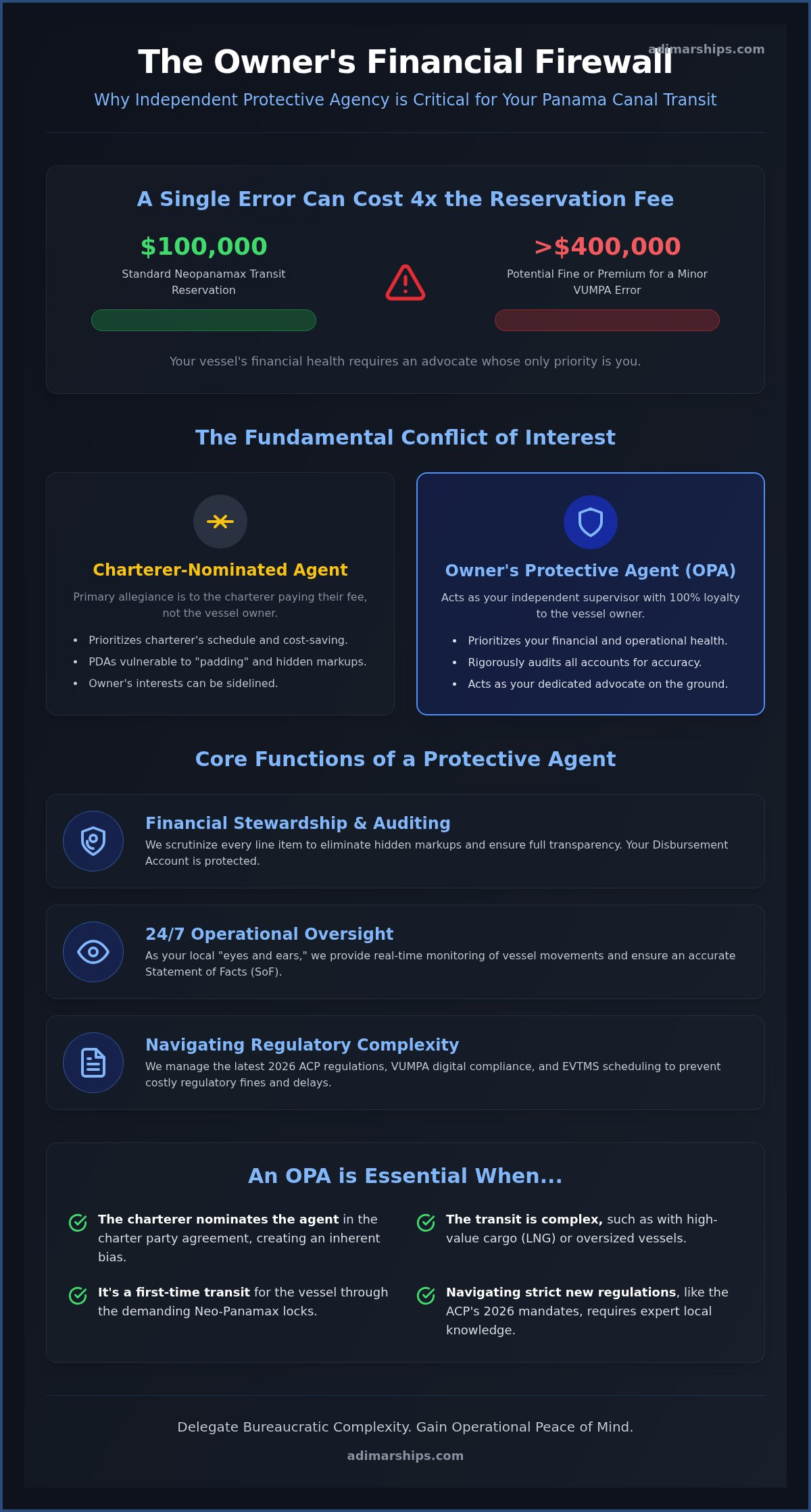
A single Neopanamax transit reservation now costs $100,000, but a minor error in your 96-hour VUMPA submission can trigger massive fines or auction premiums exceeding $400,000. When the charterer selects the primary agent, your vessel’s financial health often takes a backseat to their specific scheduling priorities. Utilizing independent protective agency services panama isn’t a redundant expense; it’s a necessary financial firewall. You need a partner who acts as your local eyes and ears, ensuring every dollar in your Disbursement Account is verified and every regulatory requirement is met without delay.
We understand the stress of navigating the 2026 Panama Canal Authority (ACP) regulations, from the new risk-based inspection models to fluctuating Fresh Water Surcharges. This guide will show you how to safeguard your interests through expert oversight and local vigilance. You’ll discover how specialized representation provides full financial transparency, guarantees an accurate Statement of Facts, and prevents the costly compliance risks that can derail a successful transit. We’ll explore how delegating these complex tasks to a seasoned specialist provides the peace of mind your global operations require.
Key Takeaways
- Identify the inherent bias in charterer-nominated agencies and learn how to protect your vessel from hidden markups in Proforma Disbursement Accounts.
- Discover how protective agency services panama act as a financial firewall by providing rigorous auditing and transparency for every dollar spent during transit.
- Understand the role of 24/7 operational monitoring in ensuring an accurate Statement of Facts and maintaining real-time visibility of your vessel’s status.
- Navigate the latest 2026 Panama Canal regulations, including mandatory VUMPA digital compliance and EVTMS scheduling, without the risk of regulatory fines.
- Learn why delegating complex bureaucratic tasks to a seasoned local partner with PCSOPEP authorization provides the operational freedom you need.
What are Protective Agency Services in Panama?
Confusion often surrounds the term “protective services” in the Panamanian maritime hub. While some might search for executive protection or physical security, protective agency services panama refer to a specialized maritime function designed to safeguard a vessel owner’s interests. Specifically, an Owner’s Protective Agency (OPA) acts as an independent supervisor. They oversee the activities of the primary ship agent who has been nominated by the charterer. This distinction is vital; while the primary agent handles the vessel’s arrival and cargo, the OPA ensures the owner isn’t overcharged or underserved during the process.
To understand the necessity of this role, one must first understand what is a protective agent in a legal and operational context. In Panama, the charter party agreement often grants the charterer the right to appoint the vessel’s agent for a Canal transit. Since the charterer’s agent is primarily accountable to the party paying their fee, the vessel owner can find themselves without a direct advocate on the ground. A protective agent fills this gap, operating with the full legal standing recognized by the Panama Canal Authority (ACP) to represent the owner’s specific needs and provide a necessary layer of accountability.
The Role of an OPA vs. a Full Agent
An OPA does not replace the full agent; instead, they audit them. Think of the protective agent as your own local office established during the critical transit window. While the primary agent handles the logistics for the cargo and the charterer, the OPA maintains a vigilant watch over the vessel’s financial and operational health. We act as your eyes and ears on the ground, ensuring that the primary agent’s performance meets your global standards.
Key responsibilities include:
- Financial Stewardship: Scrutinizing Proforma Disbursement Accounts to eliminate hidden markups or unnecessary fees.
- Operational Oversight: Monitoring lockage status and vessel movements in real-time to prevent scheduling conflicts.
- Documentation Audit: Ensuring the Statement of Facts accurately reflects every minute spent at anchor or in transit.
When Should You Appoint a Protective Agent?
You don’t always need an OPA, but certain high-stakes scenarios make them essential. If your charter party agreement allows the charterer to nominate the agent, you face an inherent risk of partiality. Appointing protective agency services panama ensures your interests aren’t sidelined by the charterer’s cost-saving measures.
Complex transits also demand higher levels of oversight. This includes vessels carrying high-value energy products like LNG or those making their first-time transits through the Neo-Panamax locks. As the ACP implements stricter 2026 regulations regarding draught and digital compliance, having a dedicated partner to verify every step of the process prevents costly delays. By delegating these complexities to a local expert, you gain the operational freedom to focus on your broader fleet management while we handle the Panamanian bureaucracy. This focus on professional oversight is a universal priority for vessel owners; for those managing luxury assets, exploring yacht syndication australia offers a comparable way to manage costs and operational burdens through expert vessel management.
The Conflict of Interest: Why Charterer-Nominated Agents Aren’t Enough
When a charterer nominates the agent, that agent’s primary allegiance follows the party paying their fee. It’s a fundamental conflict of interest that often leaves the vessel owner without a true advocate on the ground. While the nominated agent appears to serve the ship, their decisions frequently prioritize the charterer’s bottom line over your operational safety or financial health. This bias isn’t always overt; it manifests in subtle delays, overlooked husbandry needs, or financial discrepancies that only surface long after the transit is complete.
Proforma Disbursement Accounts (PDA) are particularly vulnerable to “padding.” Without independent protective agency services panama, you may find yourself paying inflated launch hire rates or unverified port fees that were never properly scrutinized. These hidden markups are difficult to spot from a distant head office, but they significantly impact your voyage expenses. You need a local partner to verify that every quoted cost aligns with the official Panama Canal Authority Notices to Shipping.
The Statement of Facts (SoF) serves as the bedrock for laytime and demurrage calculations. A nominated agent might record arrival or lockage times in a way that favors the charterer’s schedule, potentially costing you thousands in avoidable disputes. Operational neglect is another frequent risk. When an agent focuses solely on cargo speed to satisfy the charterer, essential owner requirements like crew changes or spare part deliveries often take a backseat. By utilizing protective agency services panama, you ensure that every line item and operational milestone is verified by a partner who only answers to you.
The Legal and Financial Divide
Charterer-nominated agents must manage competing priorities during a high-stakes Canal transit. They often prioritize the charterer’s timeline to secure future nominations, leaving the owner to manage the fallout of incorrect reporting or missed maintenance windows. This divide complicates future insurance claims and creates friction in charter party settlements. Ghost agency refers to a lack of transparency in vessel status updates that leaves owners in the dark during critical transit windows.
Protecting the Owner’s Bottom Line
Independent auditing is the only reliable way to verify ACP toll accuracy in 2026. With the complexity of the $10,000 fixed Fresh Water Surcharge and the $100,000 Neopanamax reservation fees, administrative errors can be incredibly expensive. A protective agent strips away the unnecessary “ancillary charges” that frequently clutter final Disbursement Accounts. It’s essential to work within a proven owner’s nominated agency framework to ensure your financial interests remain the priority. If you’re concerned about hidden costs in your upcoming transit, securing a dedicated protective agent can provide the financial firewall your fleet deserves.
Core Functions of Panama Protective Agency Services
Precision is paramount. When a vessel enters the Canal, every minute and every dollar counts toward your bottom line. The return on investment for protective agency services panama is measured in thousands of dollars recovered from billing errors and operational delays. We act as your dedicated financial and operational firewall, ensuring that the charterer’s agent remains accountable to your specific interests. Our role is to provide the local oversight necessary to turn complex Panamanian bureaucracy into a transparent, manageable process.
Financial stewardship remains our primary focus. We conduct a comprehensive audit of the Disbursement Account (D/A) to verify that every charge aligns with the 2026 Panama Canal Authority (ACP) tariffs. This includes scrutinizing the $30,000 tugboat fee for Neopanamax vessels and the $1,250 vessel security charge. Beyond the tolls, we independently manage husbandry coordination. From arranging crew changes and Cash to Master (CTM) to overseeing spare parts delivery and mechanical maintenance—similar to the expert services provided by Compass Marine in Southern Africa—we handle these tasks directly to prevent them from being sidelined by cargo priorities.
Disbursement Account (D/A) Auditing
We verify every line item against the actual 2026 tariffs, which remain frozen until September 30, 2026. Our team scrutinizes third-party invoices for port services, ensuring you aren’t overcharged for launch hire, which can range from $450 to $900 per trip in the Balboa or Cristobal anchorages. We also validate the fixed $10,000 Fresh Water Surcharge (FWS) and its variable component based on Gatun Lake levels. By auditing these costs in real-time, we ensure the timely return of unspent funds to the owner rather than letting them sit in the primary agent’s accounts.
Vessel Oversight and Reporting
Direct communication is vital for fleet managers. We provide real-time updates that bypass the charterer’s filtered reporting, giving you an unfiltered view of your vessel’s status. If a transit interruption occurs, we provide a second opinion on “Force Majeure” or weather-related delays, ensuring the Statement of Facts (SoF) is accurate. Our local presence allows for physical attendance at the locks or port when required to verify operational status. This level of vigilance ensures that your vessel complies with the 96-hour VUMPA submission deadline, avoiding the risk of massive fines or lost transit slots.
Navigating 2026 Panama Canal Regulations and Digital Compliance
The 2026 digital shift at the Canal is no longer optional. With the full implementation of machine-validated VUMPA (Vessel Universal Measurement and Pre-Arrival) packages as of April 2026, the margin for error has disappeared. A complete submission must reach the authorities at least 96 hours before arrival. If the primary agent misses this window or enters conflicting data, the vessel faces immediate slot forfeiture or heavy administrative penalties. Utilizing independent protective agency services panama provides a secondary layer of validation. We cross-reference the vessel’s actual status with the data being fed into the Panama Canal Authority (ACP) systems, ensuring your transit remains on schedule.
Integrating with the Enhanced Vessel Traffic Management System (EVTMS) requires precise coordination. This system now dictates scheduling with minute-by-minute accuracy. A protective agent monitors these digital updates 24/7, providing a proactive voice when the charterer’s agent might be slow to react. We don’t just watch the screen; we interpret the data to protect your operational interests. By delegating these technical tasks to a specialist, you gain the peace of mind that your vessel’s slot is secure.
Digital Transparency in 2026
The ACP digital ecosystem now demands faster, more accurate data entry than ever before. Since January 1, 2026, the risk-based vessel inspection model has become mandatory. This model allows for digital inspections, but only if the initial data provided is flawless. Discrepancies between the primary agent’s reports and the vessel’s actual condition can trigger a physical inspection that delays your transit. We use digital logs to defend against these regulatory fines. Having a partner who understands these nuances ensures you don’t fall victim to “extraordinary” charges that clutter your final account.
Compliance and Environmental Standards
Environmental compliance has become a central pillar of Canal operations. As of July 1, 2026, the maximum authorized draught for Neopanamax locks was reduced to 15.09 meters (49.5 ft) due to ongoing water management protocols. Violating these draught limits leads to immediate transit suspension. Additionally, managing PCSOPEP requirements is critical for any vessel carrying over 400 metric tons of persistent oil. Violations carry a minimum fine of $50,000, making an PCSOPEP authorized person a mandatory asset for your protection.
We verify fuel quality and bunkering logs against the 2026 “Green Route” standards to ensure your vessel meets every requirement. By delegating these complex regulatory tasks to a local expert, you eliminate the risk of oversight. If you’re preparing for a high-stakes transit, consult with our compliance experts today to secure your operational freedom.
Choosing Adimar Shipping for Protective Agency in Panama
Trust is the most valuable currency in the maritime sector, especially when your vessel is thousands of miles from home. Choosing protective agency services panama is about more than just auditing a bill; it’s about securing a partner who understands the high stakes of every lockage. Adimar Shipping provides a specialized shield for vessel owners, combining over 20 years of local expertise with an uncompromising commitment to ethical standards. We don’t just process paperwork. We provide the financial and operational transparency you need to navigate the increasingly complex 2026 Panama Canal environment with confidence.
Navigating the specific bureaucracy of the Panama Canal Authority requires more than just a manual. It requires the deep local knowledge that only comes from decades of active service in the Panamanian maritime hub. We understand the nuances of the 2026 VUMPA interface and the latest EVTMS scheduling protocols because we work with them every day. This experience allows us to anticipate potential delays before they occur, giving you a strategic advantage in one of the world’s most crowded waterways. Our approach integrates protective oversight with comprehensive husbandry services to ensure your vessel’s needs are never sidelined.
The Adimar Advantage: Local Vigilance
Our central location in San Francisco, Panama City, allows our team to provide a rapid response at both the Balboa and Cristobal anchorages. We maintain a proactive stance on identifying “padding” in charterer-nominated agent accounts, catching inflated launch hire or unverified port fees before they hit your final Disbursement Account. Adimar Shipping acts as an extension of the owner’s own team on the ground, providing the local eyes and ears necessary for total peace of mind. By delegating these logistical burdens to our seasoned team, you gain the operational freedom to focus on your fleet’s broader performance.
In the same way that expert representation is vital for physical operations, specialized digital growth strategies from Aquatic SEO help maritime companies maintain a competitive edge in the global market.
Securing Your 2026 Transit
Securing your 2026 transit begins with a simple appointment process. We’ve streamlined our onboarding for new owners and technical managers, ensuring that Adimar is ready to act as your OPA long before your vessel reaches the Canal anchorage. We treat every vessel as a top priority rather than just another transit number in the queue. In an era of $100,000 reservation fees and mandatory digital compliance, you can’t afford to leave your interests to chance. Ensure your vessel interests are protected with Adimar Shipping and experience the difference that true local vigilance makes for your bottom line.
Secure Your Fleet’s Future in the Panama Canal
The 2026 maritime landscape in Panama is defined by high stakes and digital precision. You’ve seen how independent oversight serves as a financial firewall against the inherent biases of charterer-nominated agents. By prioritizing financial transparency and mastering the latest ACP digital reporting requirements, you protect your vessel from avoidable fines and hidden markups. Expert protective agency services panama aren’t just an operational choice; they’re a strategic necessity for any owner navigating these complex waters.
Adimar Shipping stands ready as your vigilant partner on the ground. As an authorized PCSOPEP representative with deep expertise in 2026 ACP toll structures and digital compliance, we provide the independent local oversight your fleet deserves. We act as an extension of your own team, ensuring every transit is managed with the highest ethical standards. Secure Your Vessel’s Interests—Contact Adimar Shipping Today to gain the operational freedom and financial security you need for a successful voyage. We look forward to representing your interests at the Canal.
Frequently Asked Questions
What is the difference between a full agent and a protective agent in Panama?
A full agent manages the entire transit logistics, typically for the party that nominated them, such as the charterer. In contrast, a protective agent supervises the full agent specifically to safeguard the vessel owner’s financial and operational interests. They provide a vital layer of accountability, ensuring that the primary agent’s loyalty to the charterer doesn’t result in hidden markups or operational delays for the owner.
Can I appoint a protective agent if the charterer has already chosen the primary agent?
Yes, you can and should appoint a protective agent in this situation. It’s the most frequent reason owners seek protective agency services panama. When a charterer-nominated agent is in place, the owner lacks a direct representative on the ground. Appointing an OPA ensures you have a dedicated advocate to audit the Disbursement Account and monitor vessel status without any conflict of interest.
How much does a protective agency service typically cost in the Panama Canal?
While standard agency fees for a Panama Canal transit in 2026 typically range between $3,500 and $6,000 depending on vessel size, OPA fees are separate. These fees vary based on the specific level of oversight and husbandry coordination you require. Investing in a protective agent often pays for itself by identifying billing discrepancies in the Proforma Disbursement Account or preventing costly regulatory fines during the transit process.
Does the Panama Canal Authority (ACP) recognize the role of a protective agent?
The Panama Canal Authority (ACP) fully recognizes the role and legal standing of a protective agent. Under official guidelines, an OPA has the authority to represent the vessel owner in maritime matters, including coordination with the ACP for transit scheduling. This recognition allows your protective agent to act as a legitimate extension of your team, providing the necessary local oversight to manage complex bureaucratic requirements effectively.
How does an OPA help in verifying the Statement of Facts (SoF)?
An OPA provides an independent record of all vessel activities to ensure the Statement of Facts (SoF) is entirely accurate. They monitor arrival times, pilotage, and lockage durations in real-time. This verification is crucial for defending against incorrect laytime or demurrage claims that might otherwise favor the charterer. By having a second set of eyes on the ground, you ensure that every minute of the transit is documented correctly.
What specific ACP 2026 regulations should ship owners be aware of?
Ship owners must prioritize the 96-hour VUMPA submission deadline and the mandatory risk-based vessel inspection model effective as of 2026. Additionally, the maximum authorized draught for Neopanamax locks was reduced to 15.09 meters (49.5 ft) on July 1, 2026. Staying compliant with these shifting operational notices is essential to avoid slot forfeitures or “extraordinary” charges that can significantly inflate your final voyage costs.
Can Adimar Shipping handle crew changes while acting as a protective agent?
Adimar Shipping specializes in coordinating husbandry services while acting as your protective representative. We handle crew changes, Cash to Master (CTM), and spare parts delivery independently from the charterer’s agent. This ensures that your vessel’s maintenance and personnel needs are prioritized and executed efficiently. By delegating these tasks to us, you ensure they aren’t delayed by the primary agent’s focus on cargo operations.
What is the role of an OPA in PCSOPEP compliance?
For vessels carrying 400 metric tons or more of persistent oil, a Panama Canal Shipboard Oil Pollution Emergency Plan (PCSOPEP) is mandatory. As your OPA, we act as the authorized local person required by the ACP to manage these requirements. We ensure your documentation is compliant and provide the necessary local representation to avoid the minimum $50,000 fine associated with PCSOPEP violations during your Canal transit.