
In 2026, your Panama Canal transit success isn’t decided at the locks. It’s won or lost 96 hours before your vessel even arrives at anchorage. We know the pressure of the new machine-validated VUMPA deadlines and the uncertainty surrounding the mandatory risk-based inspection model. A single documentation error or a failed pilot ladder check can trigger a physical boarding, leading to Neo-Panamax slot forfeitures that cost over $65,000 per day. Effective panama canal vessel inspection preparation is no longer just a recommendation; it’s the only way to safeguard your schedule and your bottom line.
You’ve likely felt the frustration of evolving regulations, but mastering these changes is the key to operational freedom. Our guide provides the expertise you need to navigate the 2026 criteria with confidence. We’ll show you how to achieve ‘Low Risk’ status and qualify for digital clearance by meeting the Panama Canal Authority’s strict new conditions. We’ll preview the five critical risk factors, the updated OP Notice N-10-2026 requirements, and the precise steps to ensure your Naval Inspection Checklist leads to a zero-delay transit.
Key Takeaways
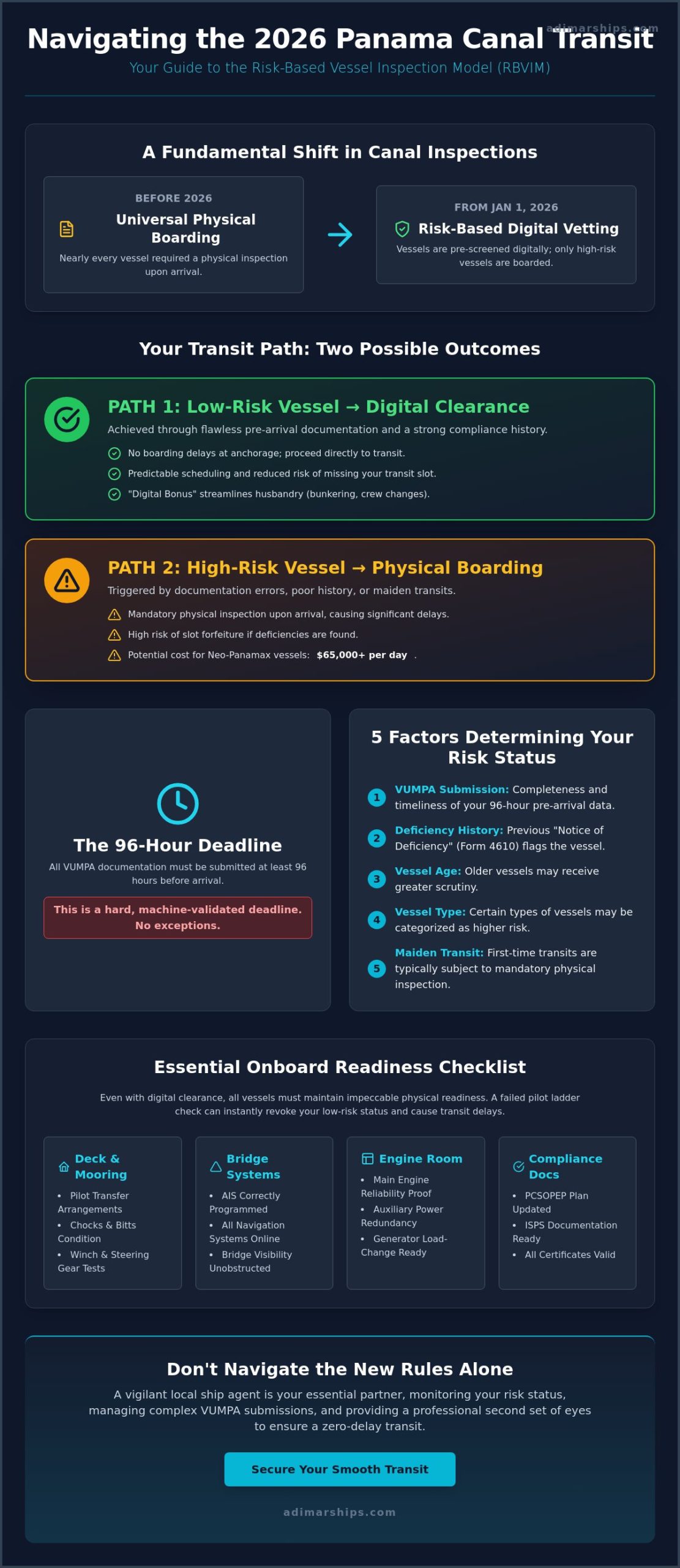
- Understand how the 2026 Risk-Based Vessel Inspection Model (RBVIM) prioritizes digital documentation over physical boarding for low-risk vessels.
- Identify the critical mooring and bridge equipment checks required to avoid immediate Notice of Deficiency flags during a physical inspection.
- Learn the five specific risk factors, including vessel age and deficiency history, that determine your vessel’s eligibility for streamlined digital clearance.
- Master the essential panama canal vessel inspection preparation steps for PCSOPEP and ISPS compliance to ensure successful 96-hour pre-arrival validation.
- Discover how a local ship agent acts as your vigilant partner to monitor risk status and manage complex VUMPA submissions before your arrival.
The 2026 Panama Canal Inspection Landscape: Digital vs. Physical
The shift to the Risk-Based Vessel Inspection Model (RBVIM) on January 1, 2026, marks a definitive end to the era of universal physical boarding. For shipowners and operators, panama canal vessel inspection preparation has transformed into a high-stakes digital exercise. The Panama Canal Authority (ACP) now uses a sophisticated data-driven framework to determine which vessels require a hands-on check and which can proceed via digital clearance. This transition isn’t just about technology; it’s about rewarding compliance and operational transparency.
Understanding the Panama Canal history and operations reveals a legacy of constant modernization. The 2026 model is the latest evolution, leveraging a $50 million investment in the Panama Maritime Single Window (VUMPA). The primary goal is to eliminate “dead time” at the locks. When a vessel qualifies for digital inspection, it avoids the traditional delay of waiting for an inspection party to board at the Atlantic or Pacific entrances. This efficiency allows for a more predictable schedule and reduces the risk of missing a reserved transit slot, which can cost Neopanamax vessels over $65,000 per day in forfeiture fees.
Understanding the RBVIM Framework
The RBVIM framework operates on a hybrid logic. Every vessel must undergo an initial physical inspection conducted by a Canal Admeasurer. This inspection remains valid for exactly one year, provided the vessel’s configuration doesn’t change. Once this baseline is established, the ACP’s system evaluates every subsequent transit through the VUMPA portal. You must submit all required documentation at least 96 hours before arrival. This is a hard, machine-validated deadline. If your data is incomplete or late, the system automatically flags the vessel as high-risk, triggering a mandatory physical boarding regardless of your previous history.
Physical Inspection vs. Digital Clearance
Digital clearance is a privilege reserved for “Low Risk” vessels. To earn this status, your panama canal vessel inspection preparation must be flawless. The ACP considers factors like vessel age, type, and your deficiency history. High-risk vessels, such as those with a history of “Notice of Deficiency” (Form 4610) or those on their maiden transit, will always face physical boarding.
Qualifying for digital clearance provides a “Digital Bonus” for husbandry services. It streamlines bunkering, crew changes, and the delivery of provisions because the vessel’s status is cleared well before it reaches the breakwater. Don’t let digital status lead to complacency. Even if you aren’t scheduled for a full inspection, the ACP requires all vessels to maintain operational pilot transfer arrangements. Safety remains the priority, and a failed ladder check upon the pilot’s arrival will immediately revoke your digital status and lead to costly transit delays.
Technical Readiness: The Physical Inspection Checklist
Physical readiness is the foundation of a successful transit. While the 2026 model prioritizes data, the hardware on your deck determines if you actually pass the initial annual inspection. Your panama canal vessel inspection preparation must prioritize the equipment that pilots and admeasurers interact with directly. Reliability is the standard. If a winch fails or a steering gear test falters during the approach, the ACP will not hesitate to suspend your transit. Reliable maritime industry guidance on Canal transit emphasizes that technical compliance is non-negotiable for maintaining a low-risk profile.
Engine room readiness is equally vital. The ACP requires documented proof of main engine reliability and auxiliary power redundancy. You must ensure that generators can handle the sudden load changes required during lockage operations. On the bridge, all navigation systems must be fully operational. This includes the AIS system, which must be programmed with the correct vessel dimensions and transit data. Partnering with an experienced ship agency ensures your crew has a professional second set of eyes on these critical systems before the admeasurer steps on board.
Deck and Mooring Equipment Standards
Chocks and bitts are not just steel fittings; they’re critical safety components for the Canal’s locomotive and tug operations. Neo-Panamax vessels face stricter requirements for heavy-duty fittings compared to the older Panamax locks. You must verify that your mooring winches meet the specific brake holding capacity required by the ACP. Another common failure point is bridge visibility. If deck cargo or equipment creates blind sectors that exceed ACP limits, you’ll face mandatory tug requirements or transit delays. Conduct a thorough visibility audit as part of your pre-arrival routine.
Pilot Transfer and Boarding Safety
Pilot ladders are the number one cause of inspection rejection. The ACP has zero tolerance for worn steps, improper side ropes, or incorrect rigging heights. You must rig your ladder to ACP specifications, which often exceed general IMO or SOLAS standards. Common deficiencies include inadequate lighting for night boardings and poor placement of man-ropes. Ensure the deck area around the boarding station is clean, dry, and completely unobstructed. A professional boarding setup sends a signal of competence to the ACP, reinforcing your vessel’s status as a low-risk, high-priority client.
Qualifying for Digital Inspection: The 5 Risk Factors
Successful panama canal vessel inspection preparation requires a deep dive into the data the ACP collects on your fleet. The Risk-Based Vessel Inspection Model (RBVIM) isn’t a secret; it’s a transparent framework that weights five primary factors to assign your vessel a risk score. Understanding these weights allows you to anticipate whether you’ll be granted digital clearance or face a mandatory boarding party. The ACP views data as a proxy for safety, and they reward vessels that demonstrate a legacy of high standards.
Vessel age and type are fundamental pillars of this assessment. Neo-Panamax ships often qualify for digital clearance more easily than older hulls, which the ACP views with heightened caution due to potential structural fatigue. Your deficiency history is even more critical. A previous “Notice of Deficiency” (Form 4610) acts as a digital flag that can trigger physical boardings for several transits. Finally, your Flag State and Classification Society standing must be pristine. Flags appearing on the “Gray” or “Black” lists of major MOUs are seen as indicators of systemic maintenance issues, making a physical boarding almost certain.
The 96-hour rule is the ultimate gatekeeper for your transit. Late VUMPA submissions don’t just incur documentation fines; they automatically override your low-risk status. If the ACP’s machine-validation system cannot process your data at least four days before arrival, the admeasurer’s boat is already being scheduled for your boarding. Consistency between your submitted data and your vessel’s actual condition is the only way to maintain the privilege of digital transit.
Managing Your Vessel’s Risk Profile
Maintaining a “Low Risk” profile is an ongoing process that starts long before you reach Panama. You must monitor your Classification Society’s standing with the ACP and track recent Port State Control (PSC) detentions globally. A detention in a foreign port can negatively impact your Canal risk score. We recommend a policy of proactive reporting. If you have a minor, non-critical technical issue, self-declaring it through the VUMPA portal demonstrates transparency. This honesty often prevents a “High Risk” tag that a surprise discovery during a spot check would certainly trigger.
VUMPA Documentation Accuracy
Accuracy in your VUMPA submission is paramount for avoiding delays. The Naval Inspection Checklist you submit must be 100% consistent with the actual conditions on deck. Any discrepancy found during a spot check leads to severe penalties and a permanent mark on your history. You must ensure all uploaded certificates are valid and current. Expired paperwork is an instant trigger for physical inspection. This is where professional husbandry services become vital. They act as a final filter, verifying every document against the latest ACP standards before the 96-hour deadline hits.
Critical Compliance: PCSOPEP and Security Requirements
Beyond the mechanical readiness of your vessel, the ACP enforces strict environmental and security mandates. These regulations protect the Canal’s ecosystem and ensure regional stability. As part of your panama canal vessel inspection preparation, you must verify that all pollution prevention and security protocols are fully integrated into your digital VUMPA submission. Neglecting these details often leads to the $5,000 “Failure to Declare” penalty. The ACP applies this fine with zero tolerance for administrative oversight or late reporting.
Sanitation and quarantine requirements also remain a high priority. While many inspections are now digital, health inspectors still perform random boardings to verify crew health records and galley hygiene. You should ensure that all medical certificates and sanitation logs are organized and ready for immediate review. If your vessel arrives from a high-risk zone for infectious diseases, your reporting must be exhaustive. Any ambiguity in your health declaration can trigger a quarantine delay that derails your entire transit schedule.
PCSOPEP Readiness for 2026
The Panama Canal Shipboard Oil Pollution Emergency Plan (PCSOPEP) is mandatory for any vessel carrying 400 metric tons or more of persistent oil. Your plan must be ACP-approved, current, and bilingual. A critical step in your digital filing is identifying your PCSOPEP authorized person within the VUMPA system. This individual acts as the legal liaison between your vessel and the ACP in the event of an incident. You must also update your SOPEP manual with current crew lists and local contact details. The Oil Record Book must be up to date; the ACP frequently uses digital audits to cross-reference your declared fuel levels with your physical logs.
ISPS and Port Facility Security
Security compliance under the ISPS Code is a non-negotiable part of the 96-hour pre-arrival window. You must synchronize your vessel’s security level with the ACP’s current requirements and prepare a Declaration of Security (DoS) when requested. This process includes providing a complete crew list with valid identification data for every person on board. Reviewing the ACP Panama Annual Report helps you stay informed about recent security updates and emerging regulatory trends. If you need assistance managing these complex filings, our team at Adimar Shipping, Inc. provides expert ship agency services to ensure your documentation is flawless before the 96-hour deadline hits.
The Strategic Advantage: Why a Local Ship Agent is Essential
The complexity of the 2026 regulations means that panama canal vessel inspection preparation is no longer a task for the crew alone. A local ship agent serves as your vigilant eyes and ears on the ground. We act as the essential bridge between your vessel’s bridge and the ACP’s digital infrastructure. By delegating these specialized tasks to a partner with deep local knowledge, you gain the operational freedom to focus on the voyage itself. We monitor your vessel’s risk status in real-time, identifying potential flags before they become transit-stopping obstacles. This oversight is vital because a vessel’s risk profile can shift based on global port state control data that the ACP tracks continuously.
Our role extends beyond data entry. We coordinate essential husbandry services to rectify technical deficiencies before the admeasurer ever steps on board. If a dispute arises regarding an inspection finding or a documentation fine, we advocate for your interests with the ACP authorities. This proactive representation provides a layer of security that standard business communication cannot achieve. Having a representative who understands the nuances of local maritime law is the most effective way to protect your bottom line. We work to prevent the automatic rejection of digital clearance by ensuring every technical detail aligns with the self-declarations made in your pre-arrival filings.
VUMPA Management and Coordination
Manual VUMPA entry by ship crews is a leading cause of digital rejection. The system’s machine-validation is unforgiving; a single misplaced character or an incorrectly formatted date can trigger a high-risk flag. Adimar Shipping, Inc. ensures that all 96-hour and 24-hour notifications are perfectly synchronized. We handle the intricate financial side of the transit, managing tolls, reservation fees, and inspection charges with absolute transparency. This precision ensures your vessel remains in the ‘Low Risk’ category, qualifying for the digital clearance we discussed in previous sections. We also manage the archival of all digital submissions to provide a clear audit trail for future transits.
Your Partner for a Seamless Passage
Navigating the Panama Canal transit requires more than just following a checklist. It requires an experienced partner who understands the nuances of local maritime law and ACP operational habits. We mitigate the risk of costly delays through proactive technical audits and constant communication with canal authorities. Our goal is a zero-delay transit that respects your schedule and your budget. We act as an extension of your own team, providing the peace of mind that comes from having seasoned experts oversee every logistical detail. Contact Adimar Shipping, Inc. to secure your 2026 transit slot and ensure your panama canal vessel inspection preparation is handled by the experts today.
Secure Your Operational Freedom in 2026
The transition to a digital-first inspection model marks a significant shift in how global fleets interact with the Canal. Success now depends on your ability to transform data into a strategic asset. By prioritizing panama canal vessel inspection preparation and maintaining a transparent risk profile, you ensure that your vessel remains a high priority for the ACP’s automated scheduling systems. We’ve seen how the combination of technical readiness, environmental compliance, and precise documentation creates a path to zero-delay transits.
Adimar Shipping, Inc. stands ready to navigate these complexities on your behalf. As an authorized PCSOPEP representative with decades of local expertise in Panama City, we specialize in the rigorous demands of 2026 risk-based compliance. We provide the vigilance and protection your operations require to avoid the high stakes of physical boarding delays and documentation fines. Secure Your Seamless Panama Canal Transit with Adimar Shipping, Inc. and let our experts handle the details while you maintain focus on your global logistics. Your future transits are secured through the actions you take today.
Frequently Asked Questions
What is the new risk-based vessel inspection model at the Panama Canal?
The Risk-Based Vessel Inspection Model (RBVIM) is a data-driven framework implemented by the ACP on January 1, 2026. It replaces universal boarding with a system that evaluates your vessel’s profile, including its age, flag state, and deficiency history. By analyzing these factors through the VUMPA portal, the Canal Authority determines if your vessel qualifies for digital clearance or requires a physical boarding party. This model rewards compliant operators with faster, more efficient transits.
How often does a vessel need a physical inspection in the Panama Canal?
Every vessel transiting the Canal requires a physical inspection at least once every 12 months. This initial annual inspection is conducted by a Canal Admeasurer and establishes your baseline for the year. After this physical check is complete and valid, your subsequent transits may qualify for digital clearance. This depends on your panama canal vessel inspection preparation and maintaining a low-risk score through consistent documentation and maintenance.
Can a vessel be rejected for transit during a digital inspection?
Yes, a vessel can be rejected or flagged during the digital inspection process. Rejection typically occurs if the machine-validation system detects inconsistencies in your VUMPA submission or expired safety certificates. If your digital filing fails to meet ACP standards, the system automatically revokes your digital status. This results in a mandatory physical boarding at the entrance, which often leads to transit delays and potential documentation fines starting at $15,000.
What are the most common reasons for failing a Panama Canal inspection?
Pilot ladder deficiencies remain the most frequent cause of inspection failure and transit delays. The ACP enforces zero tolerance for ladders that don’t meet specific rigging and safety standards. Other common issues include worn mooring winches, inadequate bridge visibility over deck cargo, and outdated contact information in the PCSOPEP manual. Thorough panama canal vessel inspection preparation must prioritize these high-risk items to ensure your vessel maintains its low-risk standing.
How many hours before arrival must I submit the Naval Inspection Checklist?
You must submit the Naval Inspection Checklist through the VUMPA portal at least 96 hours before your scheduled arrival at the Canal anchorage. This 96-hour window is a strict, machine-validated deadline with no grace period. Late or incomplete submissions automatically trigger a high-risk classification. We recommend completing this step well in advance to allow your ship agent time to verify all data against current ACP requirements.
What happens if my vessel is classified as ‘High Risk’ by the ACP?
A ‘High Risk’ classification results in a mandatory physical inspection by ACP officials before you’re cleared for transit. This status is triggered by factors like a history of deficiencies, a gray-listed flag state, or late VUMPA filings. Being flagged as high risk increases the likelihood of boarding delays and more rigorous technical scrutiny. It also removes the ‘digital bonus’ for streamlined husbandry services, making your transit more complex and time-consuming.
Do Neo-Panamax vessels have different inspection requirements?
Neo-Panamax vessels face more stringent technical requirements compared to smaller Panamax ships. The ACP mandates specific heavy-duty chocks and bitts capable of handling the increased loads of Neo-Panamax lockage. There are also stricter bridge visibility regulations to ensure pilots have an unobstructed view over massive deck loads. Because Neo-Panamax slot forfeiture costs exceed $65,000 per day, technical compliance for these vessels is a high-stakes priority for every operator.
How can a ship agent help if my vessel fails its initial inspection?
An experienced ship agent acts as your primary advocate and problem-solver if an inspection goes wrong. We coordinate immediate husbandry services to repair technical failures, such as faulty winches or pilot ladder issues, before they cause a total transit cancellation. Our team also manages communication with the ACP to mitigate fines or negotiate rescheduled transit slots. Having local experts on the ground provides the vigilance needed to protect your operational interests.