

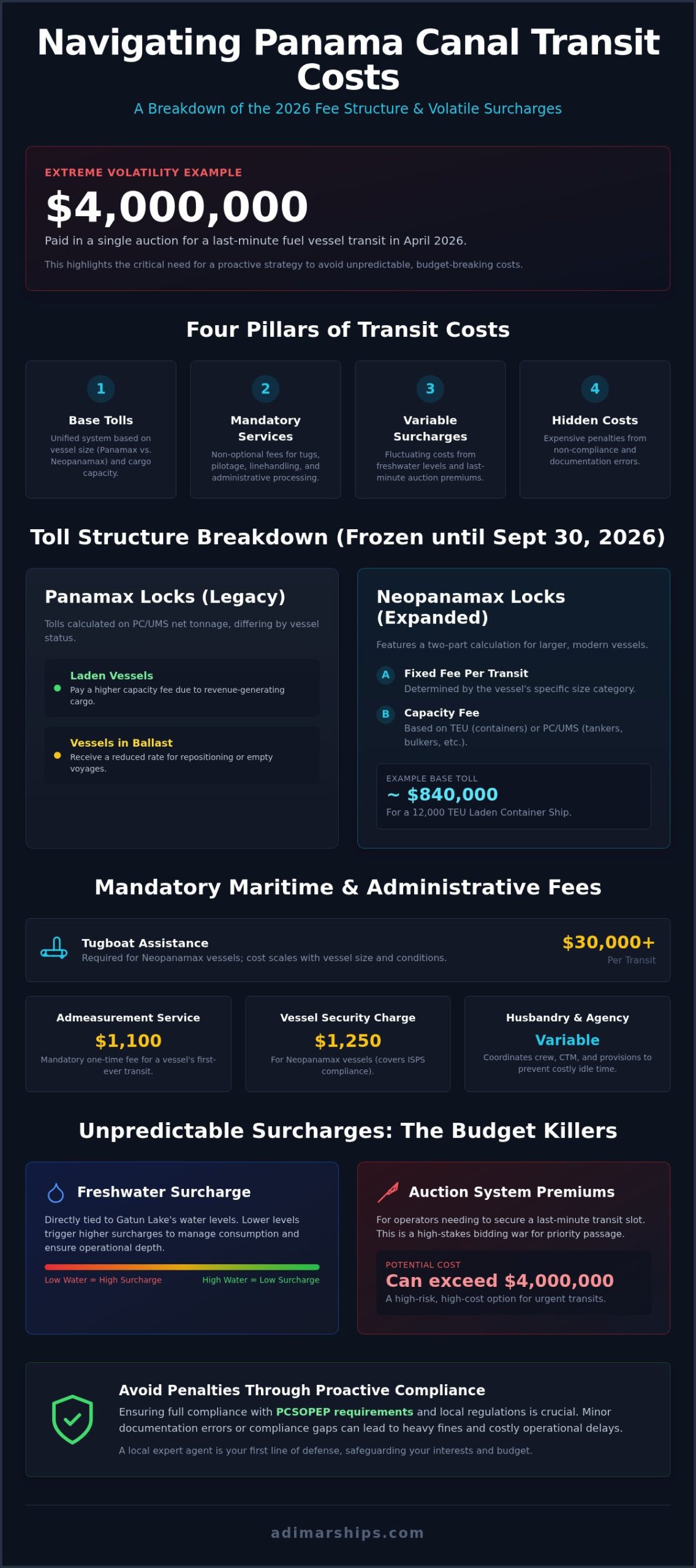
In April 2026, one operator paid a staggering $4 million in a single auction just to secure a last-minute transit for a fuel vessel. While that’s an extreme case, it highlights how volatile Panama Canal transit costs have become for those caught without a proactive strategy. You’re likely dealing with the daily frustration of unpredictable freshwater surcharges and the constant risk of heavy fines for minor compliance gaps. It’s a high-stakes environment where a few inches of Gatun Lake water level can shift your entire operational budget overnight.
We understand that you need reliability and transparency to keep your fleet moving efficiently through these complex waters. This guide will help you master the intricacies of the 2026 fee structure and show you how to optimize every dollar spent on transit. We’ll explore the current toll freezes, the latest LoTSA 2.0 slot allocation rules, and specific coordination strategies to avoid costly idle time. By the end, you’ll have a clear roadmap to navigate these logistical hurdles with the confidence of a local expert on the ground.
Key Takeaways
- Learn how the ACP unified tolling system differentiates between Panamax and Neopanamax vessels to help you predict base expenses.
- Understand how Gatun Lake levels directly influence Panama Canal transit costs through fluctuating freshwater surcharges and auction premiums.
- Identify the mandatory service fees for tugs, pilotage, and linehandling that scale based on your vessel’s specific dimensions.
- Discover how to avoid expensive penalties and documentation errors by ensuring full compliance with PCSOPEP requirements and local regulations.
- Leverage the expertise of a local ship agent to coordinate husbandry services and minimize costly idle time at the locks.
Understanding the 2026 Panama Canal Toll Structure
The Panama Canal Authority (ACP) continues to refine its unified tolling system to provide more predictability for global trade. For 2026, the structure remains divided between the legacy Panamax locks and the larger Neopanamax locks. While the ACP has frozen the main toll structure through September 30, 2026, calculating your total Panama Canal transit costs requires a deep understanding of how fixed and variable components interact. It’s not just a single fee; it’s a multi-layered calculation based on vessel dimensions, cargo type, and transit condition.
Whether a vessel is laden or in ballast significantly alters the final invoice. Laden vessels pay a higher capacity fee because they’re generating revenue from cargo. Conversely, vessels in ballast receive a reduced rate, though they still face the same fixed fees for the transit itself. This distinction is vital for operators managing return voyages or repositioning fleets across the Pacific and Atlantic oceans.
Fixed and Capacity Components for Commercial Vessels
The 2026 tolling model relies on a two-part calculation. First, every vessel pays a fixed fee per transit, which is determined by the size category of the ship. Second, a capacity fee is applied. For container ships, this is typically calculated based on Total TEU allowed, while other vessels use the PC/UMS (Panama Canal Universal Measurement System) net tonnage. We’ve seen a clear shift toward these simplified capacity units to streamline the billing process. Neopanamax vessels often face base tolls around $840,000 for a 12,000 TEU ship, making precision in your initial declarations essential to avoid overpayment; for help with detailed shipping cost breakdowns, you can learn more about FretesMaritimos.com.br.
Tolls for Non-Containerized Cargo and Tankers
For bulkers, tankers, and gas carriers, the 2026 pricing model looks slightly different. These vessels often rely on Deadweight Tonnage (DWT) or cubic meters as the primary capacity metric. LNG and LPG carriers have specific tariff structures that account for their unique handling requirements and the specialized nature of the Neopanamax locks. Because these markets are highly volatile, we recommend using our Panama Canal Transit: The Complete Guide for Ship Operators to verify the latest admeasurement rules. This proactive approach helps you anticipate the total Panama Canal transit costs before your vessel even arrives at the breakwater, protecting your voyage margins from unexpected spikes.
Maritime Service Fees and Husbandry Costs
Tolls often dominate the conversation, but they only represent a portion of the total Proforma Disbursement Account (PDA). To accurately calculate Panama Canal transit costs, you must account for mandatory maritime services. These aren’t optional; they’re essential requirements for the safe and efficient movement of your vessel through the waterway. According to the Official Panama Canal Tolls & Tariffs, these fees cover everything from pilotage to the physical handling of lines during lockage.
Tugboat assistance is one of the most significant line items for Neopanamax vessels, with standard fees reaching $30,000 per transit. The number of tugs required depends entirely on your vessel’s dimensions, engine power, and current weather conditions. Larger ships with restricted maneuverability naturally require more support, which can quickly inflate the final bill. Additionally, first-time transits incur a mandatory admeasurement service fee of $1,100 to verify the vessel’s PC/UMS tonnage for future billing.
Essential Husbandry and Protective Agency Fees
While the ship moves through the canal, the clock is always ticking on your operational expenses. Efficient husbandry services ensure that crew changes, medical assistance, and the delivery of spare parts happen without causing delays. Coordinating Cash to Master (CTM) and provisioning requires a local partner who understands the logistics of Panama’s ports. Appointing a protective agent can safeguard your interests, especially when you need to verify that third-party vendors are providing fair market rates for launch hire and inspections. It’s often more cost-effective to delegate these specialized tasks to an expert who can prevent expensive idle time.
Security and Administrative Charges
Security is a top priority for the ACP, resulting in several administrative surcharges that apply to every transit. For 2026, Neopanamax vessels are subject to a $1,250 vessel security charge to cover ISPS compliance and canal-wide monitoring. You’ll also encounter administrative fees for data processing and transit clearance. The Arrival Data Collection System (ADCS) fee is a mandatory charge for the processing of electronic vessel data required to authorize your entry into canal waters. To ensure your budget accounts for every variable, you can request a detailed Proforma Disbursement Account from our local team before your vessel arrives.
Variable Surcharges: Freshwater and the Auction System
Base tolls provide a starting point, but variable surcharges often represent the most volatile portion of Panama Canal transit costs. The Freshwater Surcharge (FWS) is a prime example. For vessels with a length overall (LOA) exceeding 300 feet, the charge includes a fixed $10,000 payment plus a variable percentage based on Gatun Lake levels. Since the Gatun Lake curve center was adjusted to 79 feet, these costs fluctuate daily based on environmental conditions. It’s a dynamic system where weather patterns directly dictate your final invoice.
Budgeting for Water Level Fluctuations
Managing these costs requires constant vigilance. The ACP Panama Annual Report provides critical climate trends that help operators anticipate these shifts. Currently, Neopanamax draft restrictions have tightened to 14.78 meters (48.5 feet) Tropical Fresh Water. This reduction directly impacts your capacity fee. If you’re forced to carry less cargo to meet draft limits, your cost per TEU or ton increases. Planning transits outside the peak dry season, typically January through May, or optimizing load factors is essential for maintaining your margins.
The Booking Auction: A Cost-Benefit Analysis
The Transit Reservation System is your first line of defense against uncertainty. A standard reservation for a Neopanamax vessel costs $100,000, while a Super vessel reservation is $50,000. If you miss these slots, you’re forced into the auction system where market demand can be brutal. In May 2026, auction premiums for Neopanamax slots reached $425,000. We’ve even seen exceptional cases where urgent transits cost as much as $4 million. This extreme volatility is why the Panama Canal Pricing Strategy emphasizes the importance of the Long-Term Slot Allocation (LoTSA) 2.0 system.
Choosing between a fixed reservation fee and the daily auction requires a clear cost-benefit analysis based on your vessel’s schedule. A dedicated ship agency Panama acts as your eyes and ears on the ground, monitoring slot availability in real-time. They help you decide when to bid and when to wait, ensuring you don’t overpay during peak demand periods. This level of local oversight is what separates profitable voyages from those plagued by unexpected surcharges and delays.
Avoiding Hidden Costs: Compliance and Penalties
While tolls and surcharges are expected, compliance-related fines often catch even seasoned operators off guard. These penalties aren’t just administrative hurdles; they’re direct hits to your Panama Canal transit costs. Minor documentation errors or equipment deficiencies can lead to delays that trigger additional port charges and pilotage fees. Being proactive is the only way to safeguard your disbursement account from these preventable expenses.
Environmental compliance has become increasingly complex. The ACP strictly enforces fuel regulations, requiring vessels to switch to compliant low-sulfur fuel before entering canal waters unless they’re equipped with approved scrubbers. Improper waste disposal or failing to provide accurate ballast water declarations can also result in immediate sanctions. These hidden costs can quickly spiral if your crew isn’t fully briefed on the latest local requirements.
PCSOPEP and Authorized Person Services
Every vessel over 400 gross tons must have a Panama Canal Shipboard Oil Pollution Emergency Plan (PCSOPEP) in place. A critical part of this regulation is appointing a PCSOPEP authorized person who resides in Panama. If you arrive without a designated representative on file, the ACP can levy a fine exceeding $2,500 immediately. Adimar Shipping, Inc. acts as your vigilant liaison, ensuring your plan is approved and your representation is active long before you reach the breakwater, providing the security you need for a smooth transit.
Common Fines and How to Pre-empt Them
“Vessel not ready” penalties are among the most frustrating expenses for owners. If a pilot boards and discovers your mooring equipment is faulty or your bridge visibility is obstructed by cargo, the transit is aborted. You’ll face fines for pilotage delays and potentially lose your reserved slot. To avoid these setbacks, we recommend a rigorous pre-transit inspection. Use this checklist to identify deficiencies before arriving at the Canal:
- Mooring Equipment: Verify that all winches, bitts, and chocks meet ACP specifications and are in good working order.
- Navigation Bridge: Confirm that visibility meets the required standards and all electronic charts are updated for the zone.
- Mechanical Systems: Test steering gear and main engines to ensure they’re capable of the rapid responses required during lockage.
- Documentation: Review MARPOL logs, fuel switchover records, and crew lists for any discrepancies.
- PCSOPEP Status: Confirm your authorized representative is correctly registered in the ACP’s system.
Protecting your voyage from these risks requires specialized local expertise. You can appoint Adimar Shipping, Inc. as your agency partner to conduct a thorough compliance review and ensure your vessel meets every ACP standard before arrival.
Optimizing Your Transit Budget with Adimar Shipping, Inc.
Managing Panama Canal transit costs in 2026 requires more than a spreadsheet; it demands a vigilant partner on the ground. A specialized Panama Canal ships agent acts as a financial safeguard by identifying potential delays before they become line items on your final invoice. We focus on reducing idle time and minimizing port charges through precise coordination with the ACP and local service providers. Our commitment to transparency ensures that your Disbursement Account (DA) reflects actual costs without hidden markups or ethical compromises.
Efficiency in Panama is built on local relationships and real-time data. By delegating complex logistical tasks to Adimar Shipping, Inc., you gain the security of knowing that every husbandry requirement, from crew changes to provisioning, is handled with speed and reliability. This proactive approach prevents the cascading costs associated with missed slots or administrative errors. We view our role as an extension of your own team, protecting your margins at every stage of the transit.
The Value of a Nominated Agent at Adimar Shipping, Inc.
Conflicting interests often arise between owners and charterers regarding voyage expenses. Our Owner’s Nominated Agency services prioritize your specific interests, ensuring that husbandry and maintenance tasks don’t get overshadowed by the charterer’s schedule. We act as your eyes and ears at the locks, providing real-time updates that allow you to make informed decisions about your fleet. This level of delegation gives you the operational freedom to focus on your global logistics while we handle the technical complexities of the transit zone.
Contact Adimar Shipping, Inc. for a Precise Quote
Online calculators provide broad estimates, but they often fail to account for the nuances of 2026 environmental surcharges or specific vessel deficiencies discussed in previous chapters. For a precise budget, you need a Pro-forma Disbursement Account (PDA) tailored to your vessel’s unique profile and transit date. We invite you to contact our local office to request a detailed PDA. Securing your 2026 Panama Canal transit with a dependable partner is the most effective way to optimize your expenditure and ensure a seamless voyage through this critical waterway.
Securing Your Voyage Margins in 2026
Success in the coming year depends on your ability to anticipate the shifting variables of the waterway. You’ve seen how environmental fluctuations and reservation demand can quickly inflate a budget, but these risks are manageable with the right local oversight. By focusing on slot allocation strategies and rigorous pre-transit compliance, you can protect your fleet from the most volatile Panama Canal transit costs. Precision in your planning is the difference between a profitable transit and one burdened by unexpected penalties.
Adimar Shipping, Inc. stands as your vigilant representative on the ground. We provide the localized Panama City expertise and transparent Disbursement Accounts you need to maintain full control over your expenditure. As a PCSOPEP Authorized Person, we ensure your vessel remains compliant with every local regulation before you reach the locks. Our team is ready to simplify the complexities of the 2026 fee structure for you.
Contact Adimar Shipping, Inc. for a detailed 2026 Transit Quote and take the first step toward a more predictable and efficient voyage. We’re here to ensure your transit is as smooth as possible.
Frequently Asked Questions
How much does it cost for a cargo ship to go through the Panama Canal in 2026?
Total expenses for a transit depend on your vessel’s category and cargo volume. A standard Panamax vessel usually pays between $250,000 and $400,000. In contrast, a 12,000 TEU Neopanamax ship can face base tolls near $840,000. You must also budget for maritime services and variable surcharges that aren’t included in the base toll. These additional fees can significantly impact your final disbursement account.
Is the freshwater surcharge a fixed or variable cost?
The Freshwater Surcharge (FWS) is a hybrid fee. Vessels with an LOA greater than 300 feet pay a fixed $10,000 component. They also pay a variable percentage, typically between 1% and 10%, which fluctuates based on the daily Gatun Lake level. This structure makes Panama Canal transit costs unpredictable during the dry season when water levels drop significantly, requiring careful seasonal budgeting.
Can I transit the Panama Canal without a local ship agent?
Commercial vessels cannot transit without a licensed local ship agent. The Panama Canal Authority requires a local representative to manage the guarantee of payment and all administrative formalities. Your agent handles the complex logistics of pilotage coordination and husbandry services. Appointing a specialist protects your interests and ensures that all local regulations are met before your ship reaches the transit zone.
What happens if my vessel is found to have a deficiency during inspection?
If an inspector identifies a deficiency, the ACP can delay or cancel your transit. You’ll likely face heavy fines and additional pilotage charges while the issue is corrected. Deficiencies in mooring equipment or bridge visibility are common causes for these penalties. To avoid these setbacks, it’s vital to conduct a pre-transit inspection and ensure your vessel meets all ACP requirements before arriving at the breakwater.
How does the Panama Canal booking auction system work?
The auction system allows vessels without a reservation to bid for available slots. It functions as a market-driven mechanism where the highest bidder wins the right to transit. During periods of high congestion in 2026, auction premiums for Neopanamax slots have climbed as high as $425,000. It’s an expensive alternative to the standard reservation system and should only be used for urgent or unscheduled voyages.
What are the PCSOPEP requirements for 2026 transits?
For 2026, all vessels over 400 gross tons must maintain an updated Panama Canal Shipboard Oil Pollution Emergency Plan. You’re also required to appoint a PCSOPEP authorized person who is a resident of Panama. Failing to comply results in immediate fines starting at $2,500. We act as your authorized representative to ensure your plan is active and your vessel avoids these unnecessary and costly penalties.
How much are the pilotage and tug fees for a Neopanamax vessel?
Neopanamax vessels generally face tugboat fees of $30,000 per transit. Pilotage fees and other mandatory service charges are calculated based on the vessel’s length, beam, and draft. These costs are essential for navigating the larger locks safely. Your total Panama Canal transit costs will include these maritime service fees, which are added to the base tolls and any applicable variable surcharges.
Does the Panama Canal accept credit cards or cash for transit fees?
Commercial transit fees cannot be paid with credit cards or cash. The ACP requires all payments to be made via wire transfer through a registered local agent. These funds must be cleared in the ACP’s account before the vessel is authorized to transit. Your agent manages this process through a Pro-forma Disbursement Account, ensuring all financial obligations are settled well in advance of your arrival.