


In Panama, the person who benefits from assets need not be the person who manages them. A private interest foundation has no shareholders, and its structure can separate the Foundation Council’s governance role from beneficiaries’ interests. Effective owner’s interest protection in Panama depends on how that arrangement is designed and maintained; separation alone does not guarantee protection from personal exposure.
It is reasonable to want clear control, continuity, and asset protection while understanding who can make decisions and who may benefit. This article explains how foundations, corporations, and trusts can separate ownership from management, and why that distinction matters when assessing personal exposure.
You’ll learn about the roles of a foundation’s charter, regulations, council, and beneficiaries, as well as how a foundation may hold corporate shares and a corporation may hold operating assets. We’ll also cover the limits of these structures, including how poor design or treating an entity as an extension of personal affairs can weaken its protective value.
Key Takeaways
- Separate who holds assets, who manages them, and who benefits to understand how a Panamanian structure may affect personal exposure.
- Distinguish asset-holding arrangements from construction liability insurance; they address different risks and aren’t interchangeable.
- Review how an Owner’s Interest policy responds alongside a contractor’s coverage, including its project scope and policy limits.
- Compare coverage options by considering the project’s scale, duration, liability exposures, and the administration each arrangement requires.
- Organize project and insurance details around the owner, contractor, site, and work so the proposed coverage can be assessed against the actual risks.
Separating ownership, management, and personal exposure
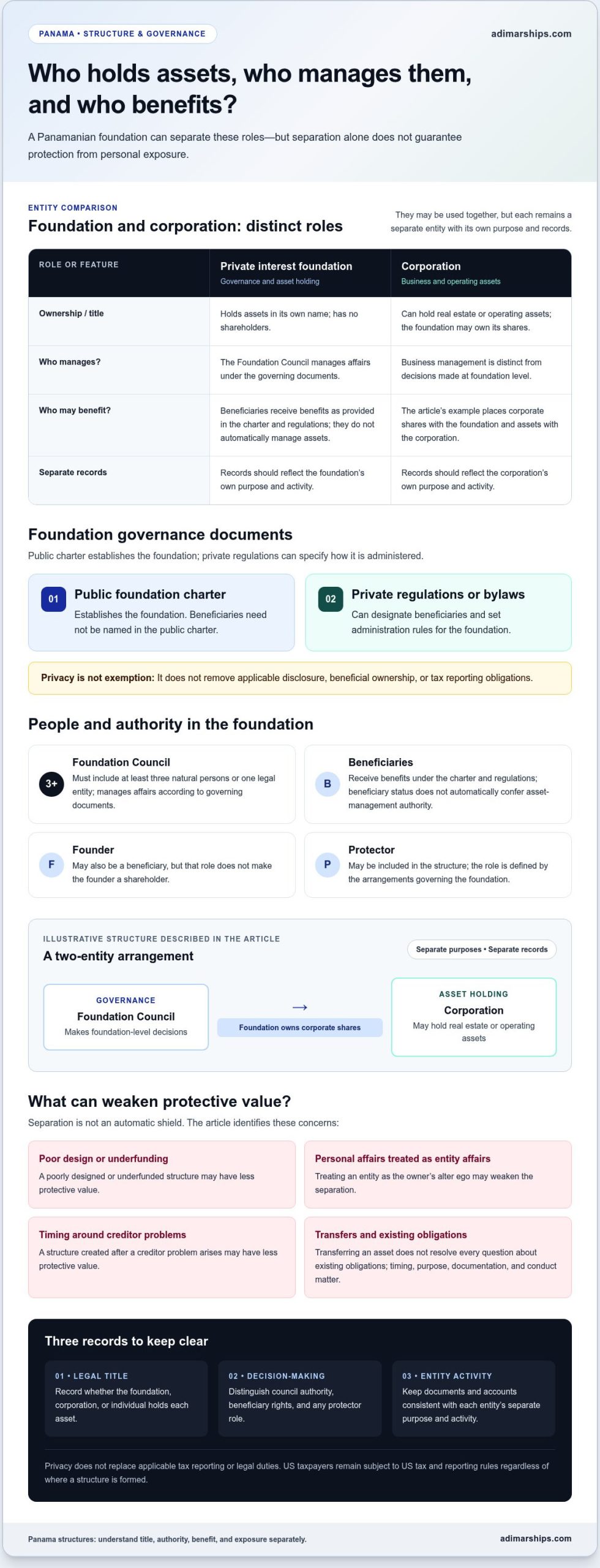
In Panama, a private interest foundation has no shareholders. It holds assets in its own name, while its charter and regulations establish how it is governed and used. The founder may also be a beneficiary, but that role does not make the founder a shareholder. Understanding this distinction clarifies who holds legal title, who makes decisions, and who may benefit.
The Foundation Council manages the foundation’s affairs according to its governing documents. The council must include at least three natural persons or one legal entity. Beneficiaries receive benefits as provided in the foundation’s charter and regulations; they do not automatically manage its assets. A protector may also be part of the structure, with a role defined by the arrangements governing the foundation.
Panama foundations use a public foundation charter and private regulations or bylaws. The charter establishes the foundation, while the private document can designate beneficiaries and set out administration rules. Beneficiaries need not be named in the public charter. This distinction can support privacy, but it does not remove applicable disclosure, beneficial ownership, or tax reporting obligations.
Consider a founder who wants a foundation to hold shares in a corporation. The foundation can own those shares, while the corporation holds real estate or operating assets. The foundation and corporation are separate entities, each with its own purpose and records. Decisions made at the foundation level by the council are distinct from the corporation’s business management, even when the same person participates in both.
This separation can support succession planning and asset segregation, but it does not automatically protect personal assets. A structure created after a creditor problem arises, poorly designed, underfunded, or treated as the owner’s alter ego may have less protective value. Transferring an asset also does not resolve every question about existing obligations. The timing, purpose, documentation, and conduct surrounding a transfer all matter.
- Identify legal title: Record whether the foundation, corporation, or individual holds each asset.
- Define decision-making: Use the charter and regulations to distinguish council authority, beneficiary rights, and any protector role.
- Keep records consistent: Maintain documents and accounts that reflect each entity’s separate purpose and activity.
Panama also recognizes trusts, which provide another way to separate asset holding from management and benefits. The right structure depends on the assets it holds, who makes decisions, and how beneficiaries receive value. Panama generally taxes income sourced within Panama, while foreign-sourced income may receive different treatment. Privacy does not replace applicable tax reporting or legal duties, and US taxpayers remain subject to US tax and reporting rules regardless of where a structure is formed.
A foundation can support succession planning and separate assets from personal ownership. Its Foundation Council, beneficiaries, and protectors can play roles in integrated wealth management. A properly maintained Panamanian corporation can contain liability and simplify joint ownership.
What does owner’s interest protection insurance cover in Panama?
Owner’s Interest insurance addresses an owner’s liability connected to a construction project. It is a project-specific commercial general liability policy, not protection for ownership interests in a foundation or corporation. For a Panama project, distinguish this construction coverage from asset-planning structures: each addresses a different exposure. The policy declarations identify the owner, project, location, and coverage period, defining the intended scope.
A central purpose is to provide excess and contingent protection when the general contractor’s insurance cannot fully respond. For example, a covered third-party injury claim could exceed the contractor’s available limits. An Owner’s Interest policy may respond above those limits or when the contractor’s coverage cannot respond. It is intended to address the owner’s vicarious liability during construction, not replace the contractor’s primary insurance.
Coverage can also address an owner’s direct liability, depending on the policy. An Owner’s Interest Liability policy may protect against liability during or after construction. Some policies include completed-operations coverage, with its duration tied to the applicable statute of repose. The policy may be issued with or without an Extended Reporting Period endorsement, so consider whether the endorsement is included and what it covers when assessing claims reported after work ends.
An Owner Controlled Insurance Program, or OCIP, works differently. The owner purchases project insurance that can cover the owner, general contractor, and subcontractors. An OCIP can include liability coverage for participating contractors instead of requiring each to buy separate project liability or workers’ compensation insurance. The owner selects the carrier and limits and decides how claims are handled. Its scope depends on the insured parties, project location, and declared operations.
Owner and Contractor Protective coverage, known as OCP, is narrower. It applies to the named owner’s liability for a designated contractor’s acts or omissions while working for that owner at the location stated in the declarations. OCP can also cover the owner’s liability arising from its own acts or omissions in generally supervising that contractor. For bodily injury or property damage, OCP excludes incidents after operations are completed or put to their intended use, whichever happens first.
- Owner’s Interest: Excess and contingent protection for the owner’s project-related liability.
- OCIP: Project insurance covering the owner and enrolled contractors under one program.
- OCP: Coverage tied to a named owner, designated contractor, location, and defined operations.
These forms are not interchangeable. Compare who is insured, which operations and location are named, when coverage ends, and whether completed-operations coverage or an Extended Reporting Period applies. For a Panama construction project, these details clarify what the policy is designed to cover and where contractor insurance remains central.
What risks are covered by owner’s interest protection in Panama?
On a construction project in Panama, an owner can face third-party liability connected to the work. For example, a falling object could injure a visitor near the site. An Owner’s Interest Liability policy is designed for project-related commercial general liability, including the owner’s vicarious liability during construction. It focuses on liability claims, not the owner’s general asset protection or every loss affecting the project.
One exposure arises when the general contractor’s insurance cannot meet a covered claim. The contractor’s policy may have inadequate limits, may have expired, or may not respond to the particular loss. An Owner’s Interest policy can provide excess or contingent protection for the owner’s liability in these circumstances. Its role is especially relevant when a third party alleges injury or property damage arising from construction activity.
A second exposure involves the owner’s own alleged conduct. For example, a claimant might allege that the owner’s direct supervision contributed to an incident. The general contractor’s policy may not cover every allegation against the owner. Owner’s Interest Liability insurance can provide project-specific protection for an owner’s liability during or after construction. The policy’s response depends on its insured parties, covered operations, exclusions, and reporting terms.
Claims can also emerge after construction is complete. Completed-operations coverage may address covered liability linked to completed work, with the applicable statute of repose shaping the available period. For a Panama project, relevant legal time limits depend on the jurisdiction governing the project. An Owner’s Interest Liability policy may cover incidents years after completion, subject to those statutory limits and the policy terms.
Coverage duration matters as much as the alleged event. Owner’s Interest Liability policies are typically written for the construction term and may be issued with or without an Extended Reporting Period endorsement. That endorsement affects reporting after the policy term; it does not automatically extend every coverage term. Before work begins, compare the project schedule, policy dates, reporting provisions, and completed-operations language.
Owner’s Interest coverage differs from an Owner Controlled Insurance Program. An OCIP can cover the owner, general contractor, and subcontractors through a project insurance program. An Owner’s Interest policy instead targets the owner’s liability, including excess and contingent exposure. Neither arrangement removes the need to understand the general contractor’s insurance and the owner’s project responsibilities.
- Contractor coverage gap: Consider excess or contingent protection if contractor limits are inadequate or coverage cannot respond.
- Owner allegations: Examine whether the policy addresses the owner’s direct or vicarious liability.
- Post-completion claims: Compare completed-operations terms, reporting provisions, and the project’s applicable legal time limits.
For owner’s interest protection in Panama, the practical question is which liability scenario the policy addresses and when. Match the owner, contractor, project location, construction period, and completed-work provisions to the contract and actual site operations. This comparison helps show where the owner’s policy complements contractor coverage and where a separate project-wide insurance arrangement may address a different need.
What policy limits, deductibles, and exclusions are typical for owner’s interest protection in Panama?
No single limit or deductible fits every construction project in Panama. The appropriate structure depends on the owner’s liability exposure, the contractor’s insurance, the work, and the project location. Start by comparing the owner’s policy with the general contractor’s coverage. An excess policy limit matters only in relation to the underlying insurance it may sit above, while contingent coverage addresses situations where contractor insurance cannot respond.
Owner’s Interest policies are intended to protect the owner’s liability, so the selected limit should reflect potential third-party claims and coverage already available. A project involving several contractors, complex operations, or extensive public access presents different exposures from a contained site with limited activity. These factors help inform the limit decision but do not establish a universal amount. The policy declarations and wording show the actual limit and how it applies.
Deductibles and self-insured retentions affect how much of a covered loss the owner retains before insurance responds. Review whether the amount applies per claim, per occurrence, or on another stated basis. Then compare it with the owner’s ability to fund a retained loss and the contractor’s insurance arrangements. The declarations and policy terms control; a deductible should not be treated as an additional limit or protection against excluded claims.
Exclusions also define the boundaries of coverage. Read the policy wording against the project contract, site, and operations rather than assuming every construction-related claim is covered. For example, OCP coverage for bodily injury or property damage excludes incidents occurring after the designated contractor’s operation has been completed or put to its intended use, whichever happens first. OCP coverage is typically not supplemented by excess coverage, so protection is limited to the policy’s own limits.
An Owner Controlled Insurance Program, or OCIP, has a different approach to limits. It can include significant excess insurance limits and cover the owner, general contractor, and subcontractors under a project program. OCIPs are more expensive than Owner’s Interest policies, though insurance credits from subcontractors can offset the difference. An OCIP may make more sense as a project grows, but it also requires substantial administration and proactive efforts to recoup costs from subcontractors.
- Compare layers: Identify the contractor’s underlying insurance and the owner’s excess or contingent protection.
- Read retention terms: Check how deductibles or self-insured retentions apply to each covered claim.
- Map exclusions: Match policy wording to the project’s location, operations, and completion status.
- Assess program scale: Weigh an OCIP’s excess limits and broader project participation against its added cost and administration.
For owner’s interest protection in Panama, do not focus on the headline limit alone. Review the declarations, underlying coverage, retention terms, and exclusions together. A high stated limit cannot address a claim outside the policy’s scope, and an OCIP’s excess limits do not eliminate its administrative demands.
What documents and project details are required to apply for owner’s interest protection in Panama
An Owner’s Interest insurance application needs to describe the project and the owner’s exposure clearly. There is no single document checklist for every construction risk. Prepare a project file identifying the owner, general contractor, location, work, and proposed construction period. For example, distinguish a new building from renovation at an occupied site, since the operations and surrounding risks differ.
Start with the contract documents that define responsibilities. The owner-contractor agreement can show who controls the work, which party carries insurance, and how subcontractors fit into the project. Include relevant insurance requirements and provisions addressing liability or risk transfer. If the contract refers to a schedule or scope attachment, include that document as well. Consistent descriptions help align the application with the planned work.
Describe the site and construction scope in practical terms. A site plan, project description, and schedule can show where work will take place, what activities are planned, and when construction is expected to begin and end. Note whether the site will remain occupied or accessible to the public. For example, renovation beside an active business raises different questions from construction on a closed site.
Include the general contractor’s insurance information so the proposed owner’s coverage can be considered alongside it. The contractor’s policy documents can show insured parties, coverage types, limits, policy dates, and relevant endorsements. A certificate may summarize selected details, but the policy wording provides fuller context. Identify subcontractors and their roles where available, especially if their work creates distinct site exposures.
Project controls also help explain how the work will be managed. Gather written procedures covering site access, visitor safety, equipment use, and coordination between contractors. If the project has phased work, describe the sequence and note when an area will be completed or opened for use. These details clarify which operations and locations the requested coverage should address.
Organize the application file around these categories:
- Parties: Owner, general contractor, and participating subcontractors.
- Project: Location, scope, site plan, schedule, and construction contract.
- Insurance: Contractor policy documents, coverage limits, dates, and relevant endorsements.
- Operations: Site access, work phases, safety procedures, and occupancy details.
Before submission, compare names, addresses, project descriptions, and dates across the contract, schedule, and insurance documents. For example, a policy listing a different site location can create confusion about the intended coverage. Document changes to the scope or schedule, since they can affect how the project is described and assessed. A complete, consistent file clearly explains the owner’s role, contractor arrangements, and construction exposure.
Before work begins, property owners should set out construction insurance requirements and risk-transfer terms in a written contract with the general contractor. A construction lender may require builders risk insurance as a funding condition. The owner may consider an Owner’s Interest Liability policy to protect against liability if the general contractor’s insurance expires or has inadequate limits, and against direct liability that the contractor’s insurance may not cover.
As a construction project grows, an Owner Controlled Insurance Program may make more sense. In Panama-related asset planning, privacy does not replace disclosure obligations, beneficial ownership requirements, or tax reporting obligations.
Adimar Shipping, Inc.: Ship Agency Services
Adimar Shipping, Inc. supports ship owners and charterers coordinating vessel transits through the Panama Canal. Its Ship Agency Services provide local coordination and communication during a vessel’s passage, helping keep operational details aligned. This is a practical next step for owners focused on vessel operations, rather than construction liability insurance or asset-holding structures.
Owners can appoint Adimar Shipping, Inc. through Owner’s Nominated Agency, while charterers can use Charterer’s Nominated Agency. Husbandry Services support vessel needs alongside transit coordination. These services are relevant when ship owners or charterers need a local partner to coordinate passage details and communicate with the parties involved.
For support with a vessel’s Panama Canal transit, contact Adimar Shipping, Inc.
Make your next decision with the right support
Use your ownership and insurance review to clarify which decisions relate to the asset structure and which concern active project risks. Keep these workstreams distinct. A foundation’s governance documents do not replace construction liability coverage, and a project policy does not define beneficiary rights. For owner’s interest protection in Panama, the next step is to align each decision with the people responsible for it and the records that support it.
If your immediate concern is a vessel’s Panama Canal transit, you need operational coordination rather than construction insurance or ownership planning. Adimar Shipping, Inc. provides Ship Agency Services, including Owner’s Nominated Agency and Charterer’s Nominated Agency, for ship owners and charterers coordinating a passage. Contact the team to discuss your vessel’s agency needs and the coordination involved.
Contact Adimar Shipping, Inc. to discuss your needs. With the right support for the task at hand, you can move forward with greater clarity.