
Most ship operators accept that the six-week gap between a vessel’s transit and the final account reconciliation is an unavoidable cost of doing business. It isn’t. You’ve likely felt the frustration of seeing a Proforma Disbursement Account that bears little resemblance to the final invoice. With the Panama Canal Authority implementing tighter draft restrictions of 14.78 meters this August, the financial stakes for every transit have never been higher. Effective panama canal disbursement account management is no longer just a back-office task; it’s a tactical strategy to protect your bottom line from unexplained variances and hidden surcharges.
We understand the pressure of the 48-hour advance payment rule and the stress of waiting for delayed reconciliations. This 2026 strategic guide provides the roadmap to master vessel fund management for total financial transparency. You’ll learn how to navigate the latest freshwater surcharges, demand better reporting from your local agent, and ensure zero-delay financial clearance with the ACP. We’ll explore how shifting from a standard agency model to a local fiduciary approach eliminates billing surprises and brings predictability back to your maritime operations.
Key Takeaways
- Define the systematic oversight of transit funds and the critical role of the ship agent as a temporary custodian of your capital.
- Master panama canal disbursement account management to navigate the ACP’s strict payment windows and eliminate the risk of transit delays.
- Learn to manage the “5% Rule” for billing variances to ensure your Final Disbursement Account aligns closely with your initial financial baseline.
- Understand how a local fiduciary agent protects your interests through proactive auditing and strict compliance with ethical maritime accounting standards.
What is Panama Canal Disbursement Account Management?
Panama Canal disbursement account management is the systematic oversight of all capital advanced for a vessel’s transit. It isn’t merely a clerical function; it’s a specialized financial process where the ship agent acts as a temporary custodian of the owner’s funds. This role requires a deep understanding of the History and Operations of the Panama Canal to ensure every dollar is accounted for. When you delegate this task, you’re trusting a partner to manage the financial pulse of your voyage.
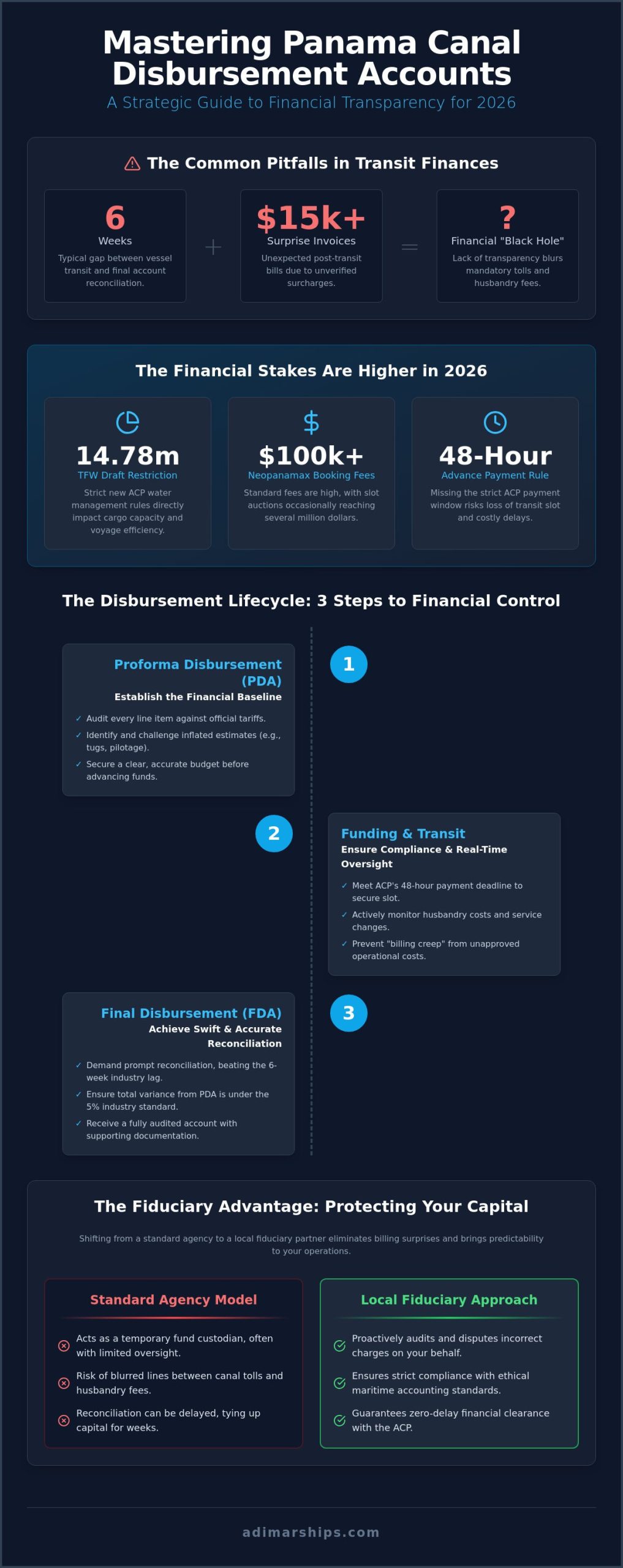
Many operators have experienced the sting of a $15,000 post-transit invoice appearing weeks after the vessel has cleared. This usually happens when the distinction between mandatory Panama Canal Authority (ACP) tolls and local husbandry fees gets blurred. Effective management ensures these two categories remain distinct and audited. It prevents the “black hole” of maritime billing where funds seem to disappear into unverified surcharges or administrative errors.
The Core Objectives of Financial Oversight
The primary goal is 100% compliance with ACP advance payment rules. Current regulations require all transit costs to be paid in full at least 48 hours before a vessel’s arrival to secure a transit slot. Missing this window doesn’t just cause a headache; it can lead to the loss of a slot or expensive delays. Vigilant management also prevents “billing creep.” This occurs when small, unverified husbandry costs inflate the final account without prior approval. By providing real-time visibility, a professional agent ensures you know exactly how your capital is allocated during the transit.
Why 2026 Requires More Vigilant Management
The fiscal year 2026 presents unique financial hurdles that demand precise panama canal disbursement account management. The ACP has implemented strict draft restrictions due to water management strategies, with a limit of 14.78 meters (48.5 feet) TFW effective August 15, 2026. These restrictions directly impact cargo capacity and the financial efficiency of the voyage.
Beyond draft limits, the costs of transiting have scaled. Neopanamax booking fees are currently $100,000, and auction prices for slots have occasionally reached several million dollars. You need a local partner who can navigate these surcharges and dispute “defective” invoices immediately. Without on-the-ground oversight, a simple billing error can become a permanent loss. Having a local fiduciary ensures that your interests are protected against the complexities of the 2026 toll structure and freshwater surcharges.
The Disbursement Lifecycle: From Funds Advanced to Final Settlement
Success in panama canal disbursement account management depends on a disciplined lifecycle that begins long before the vessel arrives at the breakwater. This process isn’t just about paying bills; it’s about controlling the financial narrative of the transit from the initial estimate to the final cent. By following a structured flow, operators can avoid the common “black hole” where costs spiral due to lack of oversight or delayed reporting.
The PDA: More Than Just an Estimate
The Proforma Disbursement Account (PDA) serves as your financial baseline. It’s the first line of defense against overpayment. A meticulous Panama Canal ships agent will audit every line item against the Official Panama Canal Tolls and Tariffs to ensure accuracy. You should watch for red flags such as inflated tugboat requirements or pilotage estimates that don’t align with your vessel’s actual dimensions. For those utilizing a charterer’s nominated agency, an independent review of the PDA is essential to protect the owner’s interests from biased cost allocations.
Funding the transit requires navigating the ACP’s strict 48-hour payment window. All transit costs must be paid in full before arrival to secure your slot. During the transit itself, operational tracking becomes the priority. A vigilant agent monitors husbandry costs and ACP service changes in real-time. This prevents small operational shifts, like an extra launch service or a change in garbage disposal needs, from becoming large financial surprises on the final bill.
Closing the Loop: The FDA Reconciliation Process
The Final Disbursement Account (FDA) is the definitive reconciliation of all expenses. While industry averages often see these accounts lingering for months, a professional management strategy aims for finalization within 30 to 45 days of transit. This phase involves reconciling actual freshwater levels, which affect the 2026 surcharges, and verifying the exact vessel dimensions recorded during admeasurement. Accuracy here is vital, as even a small discrepancy in the Panama Canal Universal Measurement System (PC/UMS) can lead to significant toll variances.
- Verification: Every ACP invoice is matched against the actual services rendered during the transit.
- Settlement: Unspent funds are promptly identified for return to the owner or applied to future transits.
- Documentation: All supporting vouchers and receipts are compiled to ensure a transparent audit trail for your accounting team.
If you’re tired of seeing your capital tied up in delayed reconciliations, it’s time to demand higher standards from your local partners. You can optimize your financial clearance by working with a team that prioritizes speed and accuracy in every FDA.
PDA vs. FDA: Managing the Billing Variance
Billing variance is the delta between estimated and actual costs. While some fluctuation is expected in complex maritime logistics, excessive gaps signal a failure in professional oversight. In the specialized field of panama canal disbursement account management, a dependable agent aims for the “5% Rule.” This industry benchmark suggests that the final settlement shouldn’t deviate from the initial estimate by more than five percent unless significant operational changes occur. Achieving this level of precision requires a ship agency in Panama that proactively manages financial shifts in real-time rather than simply recording them after the vessel has departed.
The financial integrity of your transit is grounded in a complex regulatory framework. Documents like the Panama Canal Commission Financial Regulations outline the standards for handling capital and administrative fees. When your agent understands these nuances, they can better protect your funds from unnecessary erosion. It’s about ensuring that every dollar advanced is used exactly as intended without being lost to administrative “leakage” or unverified surcharges.
Common Causes of Financial Discrepancies
Discrepancies often stem from three primary areas that can catch an unprepared operator off guard. First, unexpected husbandry services, such as emergency technical repairs or urgent crew medical transfers, can quickly inflate the final bill. Second, sudden shifts in the Panama Canal transit schedule can trigger steep booking penalties or even the forfeiture of auction fees. Finally, the ACP may levy fines for vessel dimension discrepancies if the actual measurements recorded during admeasurement don’t match the documentation provided. These “hidden” costs are the most common drivers of budget overruns.
Tactics to Minimize Variance
Minimizing variance starts with rigorous pre-arrival vigilance. We verify all vessel dimensions and certificates against current ACP requirements before the Proforma Disbursement Account is even generated. During the transit, daily reporting of any operational change is mandatory. This ensures that if a cost increases, you’re notified immediately, not weeks later when the final account arrives. We also maintain direct, constant communication with the Panama Canal Authority to clarify any ambiguous charges before they’re finalized. This proactive stance transforms panama canal disbursement account management from a reactive accounting task into a strategic financial advantage for your fleet.
Fiduciary Duty and Compliance in Canal Accounting
The relationship between a vessel owner and their agent is built on a foundation of trust. In the context of panama canal disbursement account management, this isn’t just a business arrangement; it’s a fiduciary partnership. As a local fiduciary, the agent is legally and ethically bound to protect the owner’s capital above all other interests. This means every dollar advanced for tolls, booking fees, or husbandry must be handled with absolute transparency and rigorous oversight. You aren’t just hiring a service provider; you’re appointing a vigilant guardian for your financial interests in a complex foreign market.
Compliance begins with meeting the strict regulatory requirements of the Panama Canal Authority. For instance, every vessel transiting must have a designated PCSOPEP authorized person to ensure environmental compliance and avoid heavy penalties. This role is a critical part of the financial lifecycle. If your agent fails to manage these appointments or the associated documentation correctly, the resulting fines can dwarf the original service fees. We ensure that these specialized compliance tasks are integrated directly into the accounting workflow to prevent any financial exposure.
In cases where a charterer nominates the lead agent, owners often appoint an Owner’s Protective Agent (OPA). The OPA’s primary role is to audit the lead agent’s accounts in real-time. This secondary layer of panama canal disbursement account management ensures that the lead agent isn’t prioritizing the charterer’s budget at the owner’s expense. It provides a necessary check and balance that keeps the financial narrative honest and accurate.
Anti-Corruption and Financial Integrity
Maintaining financial integrity requires a zero-tolerance approach to “Panama-specific” surcharges that often creep into vendor invoices. We vet every third-party vendor to ensure that payments are supported by original receipts and align with local market rates. This local knowledge is vital. Without it, an operator in London or Singapore has no way of knowing if a launch service or a technical repair bill has been artificially inflated. The team at Adimar Shipping, Inc. maintains global fiduciary standards by acting as your eyes and ears on the ground, ensuring that ethical conduct isn’t just a buzzword but a core brand promise.
Regulatory Compliance and the ACP
Navigating the ACP’s financial ecosystem involves more than just paying tolls. Agents must manage tax clearance certificates from the Ministry of Economy and Finance (MEF) and navigate the “Guarantor Bank” system to ensure secure fund transfers. By staying ahead of the insights found in the acp panama annual report, we anticipate regulatory shifts before they impact your balance sheet. This proactive stance allows us to clear your vessel through the ACP system without the delays often caused by paperwork errors or tax compliance issues.
Protect your capital from the complexities of local billing by partnering with a team that prioritizes your bottom line. Contact Adimar Shipping, Inc. today to secure specialized ship agency services that put fiduciary duty at the forefront of every transit.
Adimar Shipping, Inc.: Precision in Disbursement Account Management
Adimar Shipping, Inc. provides the personalized financial coordination required to eliminate the “black hole” of canal billing once and for all. We don’t just process invoices; we act as a vigilant, on-the-ground extension of your own office. Our approach to panama canal disbursement account management is built on proactive auditing and a deep understanding of the high stakes involved in maritime logistics. By scrutinizing every Proforma Disbursement Account against the most current tariffs, we ensure that your capital is never misallocated or lost to administrative errors.
Our team understands that protecting vessel margins requires more than just accounting; it requires oversight. Small, unverified expenses for launch services or supplies can erode the profitability of a transit if left unchecked. We vet every vendor and verify every service to ensure alignment with the initial budget. This level of detail provides the peace of mind you need to focus on fleet operations while we handle the complexities of the local financial landscape. Adimar Shipping, Inc. serves as a protective shield, ensuring that no unexpected fee reaches your final settlement without a thorough audit.
Why Local Expertise is Your Best Financial Safeguard
Our long-standing relationship with the Panama Canal Authority allows us to resolve billing disputes with a speed that remote operators can’t match. We specialize in managing complex accounts, including the intricate financial requirements for bunkering in panama and specialized husbandry services. Our proven track record of maintaining minimal variance between the PDA and the final settlement is a testament to our precision. When you delegate these tasks to Adimar Shipping, Inc., you’re gaining a partner with the local knowledge necessary to navigate the 2026 regulatory environment safely.
Secure Your 2026 Transits Today
The challenges of 2026 require a partner who prioritizes transparency. From draft restrictions to volatile auction prices, the financial landscape of the canal is shifting. Don’t leave your transit finances to chance or wait weeks for an opaque final account. Experience the difference of a ship agent that treats your capital with the same respect you do. Every transaction we handle is documented, audited, and reported with absolute clarity.
You can secure your upcoming vessel passages by requesting a preliminary PDA from our team today. We’ll provide a detailed financial baseline that reflects the most current ACP tariffs and surcharges. Contact Adimar Shipping, Inc. to discover how our specialized panama canal disbursement account management solutions can bring predictability and security to your maritime operations.
Master Your Canal Finances for 2026
Managing vessel funds at the Panama Canal is no longer just a clerical obligation; it’s a strategic necessity for maintaining fleet profitability. As we have explored, controlling the financial narrative from the initial PDA through to the final settlement is the only way to avoid the industry-standard billing “black hole.” By enforcing the 5% variance rule and ensuring strict PCSOPEP compliance, you transform transit logistics from a source of financial stress into a predictable, well-audited operation.
The 2026 regulatory landscape demands a higher standard of panama canal disbursement account management to navigate new draft limits and complex surcharges. Adimar Shipping, Inc. stands ready to serve as your local fiduciary, providing the vigilant oversight and ethical accounting required to protect your bottom line. Secure Your Vessel’s Success at the Canal—Contact Adimar Shipping, Inc. Today. With the right partner on the ground, you can approach every transit with absolute confidence and total financial transparency.
Frequently Asked Questions
What is the standard timeframe for receiving a Final Disbursement Account (FDA)?
You should expect to receive your Final Disbursement Account within 30 to 45 days after the vessel transits. While some agencies allow these accounts to linger for months, professional panama canal disbursement account management aims for this window to ensure your capital isn’t tied up indefinitely. This timeframe allows for the full reconciliation of all third-party vendor invoices and official ACP charges.
How does the Panama Canal Authority handle advance payments for tolls?
The ACP requires 100% advance payment of all estimated transit costs at least 48 hours before the vessel’s arrival. This rule is strictly enforced to secure your transit slot. If funds aren’t cleared in the ACP’s account by this deadline, the vessel may lose its booking or face significant delays and additional administrative fees.
Can I dispute an invoice from the ACP if there is a discrepancy in the charges?
Yes, you can dispute ACP charges, but the process requires immediate action from your local agent. If an invoice is found to be defective or mathematically incorrect, it must be challenged before the final account is settled. Having a partner with local expertise is vital for successfully navigating these disputes and ensuring you only pay for services actually rendered.
What is the difference between a Proforma and a Final Disbursement Account?
A Proforma Disbursement Account (PDA) is the estimated financial baseline provided before transit, while the Final Disbursement Account (FDA) is the actual reconciliation of all expenses. The PDA allows you to fund the transit, whereas the FDA accounts for every cent spent, including actual surcharges and service fees. Professional agents strive for minimal variance between these two documents.
Why do husbandry fees often cause variances in the final bill?
Husbandry fees often fluctuate because they cover dynamic services like crew medical transfers, emergency repairs, or last-minute supplies. These needs frequently change after the initial PDA has been generated. Without vigilant oversight, these small additions can lead to significant billing variances that surprise owners once the vessel has cleared.
Is a PCSOPEP authorized person required for all vessels transiting the canal?
A PCSOPEP authorized person is mandatory for all vessels with an oil-carrying capacity of 400 metric tons or more. This is a non-negotiable compliance requirement for transiting the Panama Canal. Failing to designate an authorized person can lead to heavy fines and the denial of transit, directly impacting your voyage’s financial efficiency.
How can I ensure my ship agent is acting as a true fiduciary for my funds?
A true fiduciary agent provides absolute transparency through original receipts and proactive auditing of every line item. They prioritize your financial interests over third-party vendor relationships. You can also appoint an Owner’s Protective Agent to audit the lead agent’s accounts, ensuring that panama canal disbursement account management remains honest and accurate.
What are the most common financial penalties for non-compliance at the Panama Canal?
The most frequent penalties involve booking cancellations, dimension discrepancies, and documentation errors. For example, if a vessel’s actual dimensions don’t match its admeasurement certificates, the ACP can levy significant fines. Compliance failures related to environmental regulations or late advance payments also result in steep financial setbacks that erode your vessel’s margins.